Her Haughtynesses Decree

Showing posts with label tightweave. Show all posts

Sunday, January 8, 2023

絽 | Ro | Ro silk | Fabric #17

Ro ( 絽 ) silk fabric is a thin, see through fabric used to make Hitoe ( 一重 | unlined kimono ). It is most often worn in hot weather, which in Japan is between the June to September months. Woven using Karamiori ( | Mojiri weave ), this is what makes the fabric easy to ventilate and gives it its line like gap effects known as (horizontal) eyes. Ro is made by weaving warp threads with an odd number of weft threads to create these see through eyes. Ro can be used in any part of Wafuku production, even undergarments. There exist 3, 5, 13 eye gaps known as Ohonro, Ranro which follows a gap pattern of 3-5-7, and Tatero where the gaps are made by reversing the gap process to an odd number of warp threads, creating vertical eyes.[1]  

Machine Ro Weave with Embroidery (2019, CC4.0) Ineffablebookkeeper

Ro began to made in the Edo period (circa 1600) and existed to be worn as formal summer wear for the rich and monks. Sha fabrics (a more transparent Gauze like weave) was the basis for the Ro weave, with Ro created to allow finer types of dyes and patterns to be made onto the textiles surface often using stencils, painting and sometimes embroidery.[1][2] This allowed patterns like the Mon to be added to Kimono without the blurring effect of Sha fabrics. During the industrial age, mass produced Ro fabrics began to made using the Leno weave and may have made the majority of exported and everyday Ro fabrics during the 19th century and early 20th century.[1] It seems hitoe were also popular with quite a number of the liberally minded living in Edwardian Japan.[3] In the modern day, Tomesode, Houmongi, Tsukesage, Komon, Nagajuban, and detachable Eri are made using Ro, but this is dwindling with the death of new buyers.[1]

Bibliography

[1]  https://rosha.jp/faq/02_about_ro-sha/ro_sha_chigai/ 

[2] https://bellatory.com/fashion-industry/kimono-fabrics

[3] My dodgy 1920s own research into art movements and writers circles.

Socials:

https://linktr.ee/Kaguyaschest

https://www.etsy.com/uk/shop/KaguyasChest?ref=seller-platform-mcnav or https://www.instagram.com/kaguyaschest/ or https://www.youtube.com/channel/UC5APstTPbC9IExwar3ViTZw, or https://www.pinterest.co.uk/LuckyMangaka/hrh-kit-of-the-suke/

Saturday, September 11, 2021

阿波 しじら織 | Awa Shijira-ori | Crinkled Cotton Weave | Fabrics #7

Awa Shijira-Ori is a woven fabric which resembles a crinkly cotton finish. This uneven finish is known as Shibo ( Down-up | 凹凸 ). Shijira is originally made in Tokushima, and is usually worn as a summer textile for workwear or as yukata, being able to combat the humid Japanese summers easily as it is commonly woven using cotton threads with an open weave in indigo dyes.[1][3]

Shijira weave is made by sorting, measuring and scouring your yarns. The yarns are then dyed and rinsed as the colour dictates, measured and dried. These yarns are twisted into threads, as tight uneven weft threads and immersing the yarn underwater in a vat. These are removed being left out to air-dry with 'gloiopeltis glue' added which stops the threads from 'fluffing'. The warp threads are re-submerged in hot water, (75 degrees) to remove the glue and the process repeated and are at times dyed in another colour simultaneously.  The two warp and weft threads are combined into the loom and woven together, the warp threads being more shrunken due to their greater exposure and treatment, creating the 'crepe' or crinkle finish in their bid for freedom from the tighter weft threads. The fabric is measured and resized with the rolling the cloth into a Tan ( 反 | Kimono fabric roll ) fabric bolt of around 1100cm length, 40cm wide. This creates a varied pattern of alternating bumpy threads and one separately dyed warp threads as the threads shrink and dry, creating a vivid Shijira weave stripe pattern with its definitive Shibo quality.[1][3][4]

Tokushima Prefecture (2007, Public Domain) Bobo12345

During the Edo period, the lord of Awa decreed that Heimin (commoners | 平民) were not to wear silk, part of the Sumptuary legislation in reaction to the wealth of the merchant classes (1604-1685) and regulation of export and imports of foreign trade in silk and cotton (1615-1685) in the wider Edo culture and tightening of the textile trades.[2] Instead therefore, the Heimin created and found new beauty in textiles such as Shijira weave or Tatae-Ori as it is known in Tokushima, which was worn by farmers, becuase of its light and durable nature and fun patterns. During the Meiji period, the technique was recovered in Awa's Atake village by Kaifu Hana c.1860-1869, when a striped Kimono had been left out in the rain, and dried in the sun. Hana noted that sections of the cloth had shrunk, producing the Shibo effect.[5] Inspired, she recreated the effect after much trial and error by reweaving warp threads in a cotton weave, creating the desired puckering or Shibo.[1] By the of the 1890s, production of the cloth totalled 2 million bolts a year, today only in its thousands by a handful of family owned businesses.[3] By the 1910s, the  traditional association with indigo dying was superseded by brighter chemical dyes, but was revived after 1945 and designated in 1978 under Awashouai-Shijirao as a traditional craft.[5] The textile is now protected and still made locally in Tokushima Prefecture in industrial quantity.

Next Fabric post will be on Chirimen.

Bibliography

[1] http://www.jtco.or.jp/en/japanese-crafts/?act=detail&id=252&p=36&c=33

[2] See the Bijin Series Timeline and Bijin post #3

[3] https://theardentthread.com/2010/02/03/awa-shijira-ori/

[4] https://voyapon.com/kimono-japanese-traditional-clothing/

[5] Swatch Favourite Fabric No 41 Awa Shijira-ori, Sarah Jane Downing, March 2018, Issue 81, p.98, Selvedge Magazine, London | https://issuu.com/selvedgemagazine/docs/81_japan_blue

Socials:

https://linktr.ee/Kaguyaschest

https://www.etsy.com/uk/shop/KaguyasChest?ref=seller-platform-mcnav or https://www.instagram.com/kaguyaschest/ or https://www.youtube.com/channel/UC5APstTPbC9IExwar3ViTZw, or https://www.pinterest.co.uk/LuckyMangaka/hrh-kit-of-the-suke/

Sunday, August 15, 2021

縦横絣 | Tate-Yoko-Kasuri | Tight Woven or Ikat Silk | Fabrics #6

Tate-Yoko-Kasuri is a tightly woven or Ikat derivative textile made on the Okinawa and Ryukyuu Islands. Tate is similar to the texture of Tsumugi silk. Tate-yoko refers to the warp and weft which due to their being combined, form the Double Ikat texture of which Meisen is based upon in central Japan, Tate-yoko however predates the Honshu variant of the design. The 'suri' of Kasuri is said to have originated in the phrase 'zure' meaning 'to shift'.[5]  The majority of what is handed down to us from history is from the Kyushu variant of the cotton weave in Fukuoka. Local sites of historical and traditional production sites include on Okinawa the Naha, Haebaru and Shuri sites and in Ryukyuu, around the Kurume area.[9]

Womens' Tate Kimono (c.1900-1939[2018], CC1.0) Honolulu Musuem of Art

Tate refers to the warp, which is the horizontal weave. Yoko refers to the vertical portion of the weave. To change the desired pattern, pressure is applied or taken away on the weavers pedal opening and closing the amount applied to the Yoko. The pressure on the reed then determines the space between the Tate and Yoko which determines the tightness or blurriness of the pattern. In Kurume Kasuri, the white threads are created by overlapping the Yoko and Tate together in this desired way and with repeated washing, highlights the white area of the pattern.[5]

Wikimedia Commons (1878,[2012] CC) Alfred Barlow

Kurume designed Tate-yoko often includes traditional Indigo dyes, often including Checkerboard, arabesque, animal and flower motifs.[2][3] The design is often in a dark indigo dye contrasted with bright white threads in interlocking patterns made by the weaver. Producing a bolt of cloth in the traditional manner can take up to 3 months.[4] The design is crafted in the same weave pattern as Meisen, drawn up beforehand in a premade pattern although often in more subdued colours from plant dyes found in the Fukuoka Chikugo River Basin area.[5] 

Historically the designs comes from some dry ice mist filled mysterious part of South East Asia, most likely Indonesia. Ikat originated in South East or Central Asia, sometime before 3000BC. Double Itak originated in Tenganan, East Bali, Indonesia as Geringsing Double Itak. This spread via the vast trade networks of the great Asian empires of modern day India and China along the silk road to as far as Egypt and became a widely available textile. Ikat then arrived in modern day Japan around 1100AD, eventually entering Japan proper in the 1300's when the Ryukyuan Kingdom began trading with Japan. Initially as these fabrics were scarce, they were only worn by the richest people in Okinawa at the time.[9] 

Yoko Kasuri (c.1596-1615 [2018] CC1.0) Honolulu Museum of Art

It was said that the local Kurume variant was developed by Inoue Den (1788-1869) who belonged to the local ruling Arima-Kurume Clan in Chikugo, Fukuoka, Kyushu from 1701 when she began adding the white spots 'Kurume Kasuri' is famous for after discovering them as patches in old and worn out textiles.[5] Around 1839, Otsuka Taizen (date unknown) who was based in the Mizuma area developed the Egasuri technique by creating new patterns in the fabric using a standing wooden plank to create the patterns by hand.[7] Large patterned fabrics were used by women, mostly as workwear, and smaller patterns were adopted by scholars and later became menswear. [5]  After 1609 when both the Okinawan and Japanese Kingdoms merged, the Ikat technique began to be used in Kyushuu, becoming regarded as a local textile by 1850.[1] Common uses included purposing the textile as bedding by the end of the Edo period.

Tate Kasuri Mulberry Stencil (c.1851-1949) Helen Snyder

When the Satsuma clan came, trade between Okinawa and continental Asia declined when Okinawa came into the Japanese sphere of influence. Japanese motifs such as the Katagami pattern shown above thus began to be produced. Okinawan and Ryukyuuan Ikat weaving as a trade fell sharply as the industry became heavily regulated and unprofitable as trade sanctions went into effect from 1864-1868. When sanctions lifted, Okinawa Kasuri became worn by regular people as workwear. By this time, Kurume Kasuri had begun to become more popular due to better technological advances in design and Okinawa styles became influenced instead by styles from Kurume, Fukuoka, Ryukyuu in particular.[8] By the Meiji era, production moved towards meeting demand on Honshu and became increasingly mechanised. After the Meiji period, production began to drop with the availability of Meisen textiles I presume. From 1899 though, with the inception of machinery, the style began to become popular again when Kunitake Goda Co., Ltd., established in 1899 by the industrial entrepreneur Kunitake Kijiro (active 1899-1904) developed Kurume Kasuri into a modern industry.[6] He did this by mechanising the Egasuri technique as not a plank but tube which feeds into a power loom.[7][10] In 1907, indigo dyes began to be replaced by German chemical dyes which produced brighter and other vivid colours.[5]  In 1912 major production shifted from Naha to a new Haebaru cottage industry sprang up in the local area of Okinawa.[9]
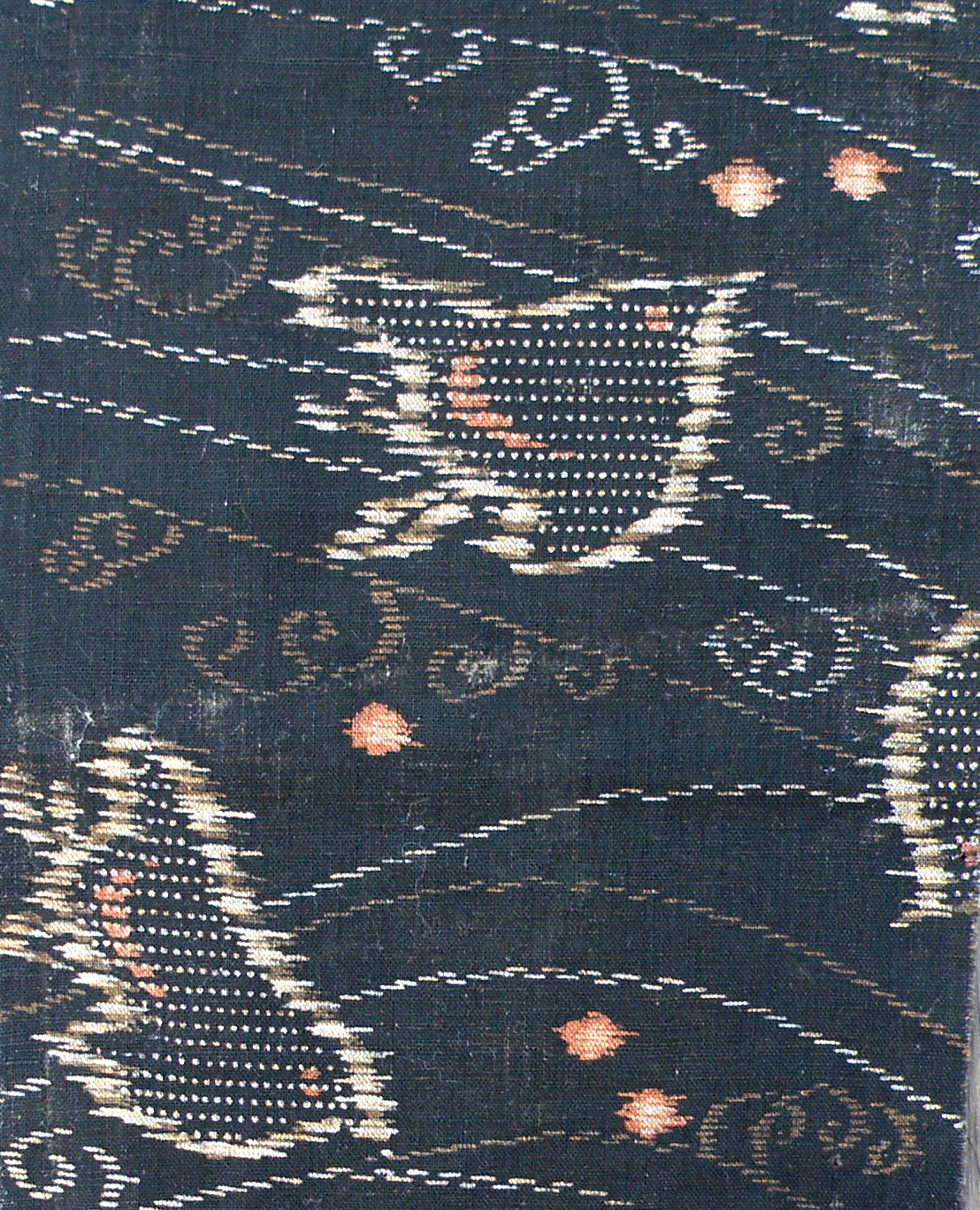
Fabric made using E-gasuri (20th century[2013], CC3.0) Chris Hazzard

With the WWII, as in general textile production, the industry saw a decline in demand and therefore was reduced in size from 1945 on.[9] From 1975 though interest in Ryukyuu Ikat was once again sparked and a local cooperative society was formed to bolster the industry as well as Ryukyu Hanaori which uses local indigo plants rather than Kurume indigo. In 1980, Kasuri Ikat hall was built to showcase traditional Ryukyu Ikat.[9] Today modern products made in 'Kurume Kasuri' are made by an Italian-Japanese company Kimonissimo which launched in March 2021.[4]

Bibliography

[1] See Fabric series #5 

[2] https://ktaylor-lotus.com/inventory/j15-5244

[3] https://www.mercari.com/jp/items/m94362956778/?_s=U2FsdGVkX18F097cGLcsvohYmGrNvnTAfsWhc4-6oKs_xkzqJ4i7MAlfniAuHdt4L4PY6p2-tA2F7ukqWB3ikzHWWdkgBtW3U-jULkO6pCWdh9XKAxtxInFbUfoTdRqp

[4] https://metropolisjapan.com/based-in-japan-kurume-kasuri/

[5] https://en.yame.travel/crafts/kurume-kasuri/

[6] https://www.google.com/maps/contrib/109015429734549306064/place/ChIJe1KuE1ekQTUROpTXrNam148/@33.3159088,130.5160818,17z/data=!3m1!4b1

[7] https://oriyasan.com/en/koe/20200901/

[8] http://ryukyukasuri.com/?page_id=257

[9] https://www.rhs-japan.org/en/tourism/ryukyukasurikaikan/

[10] Reconsidering the Japanese Industrial Revolution: Local Entrepreneurs in the Cotton Textile Industry during the Meiji Era, Naofumi Nakamura, January 2014, pp.23-44, Social Science Japan Journal 18

Sunday, June 20, 2021

秩父銘仙 | Chichibu Meisen | Chichibu Woven Silk | Fabrics #4

Chichibu Meisen is a double sided woven silk made in Chichibu, Saitama, Honshu. CM is made from raw, dupioni raw, floss, or spun silk made from waste cocoons and waste raw silk, and is a popular everyday silk for its durability and easy capacity to wish and reuse it.[1] 

Historically CM began around the time sericulture and silk weaving was introduced from Korea or China between 300-800AD.[2] Local traditions hold that this was the local Shinto deity Chichibu Hiko-no-mikoto who did this.  The local topography was heavily built up with mountains, which made rice grops difficult to grow, so sericulture eventually become the main local commodity in Chichibu. CM was at first due to its nature as a stubborn material or Futo-Ori (| Thick weave) made from waste product, worn by Chichibu farmers. In time, CM spread outside of Chichibu, and was known as Oni-chichibu, and eventually became an acceptable fabric for the Samurai class to wear due to its durability and sheen. This production was well established by the 18th century.[4]


Chichibu Saitama
A Moga (1927)

By the 1890s, the Japanese goverment sensing the encroachment of Westernisation and seeing the effect of Western colonisation in Asia, began to promote traditional Japanese arts and art or cottage industries. These led to the promulgation of traditional trades like CM production becoming joint with technology, producing new techniques like Hogushi-Ori (Virgin Thread sorting).[4] In 1908, the first Hogushi Nassen (ほぐし捺染 | Loose silk threads first dyed and then woven) technology was patented in Japan allowing for more elaborate patterns to be created.[1] Meisen then by the 1920's with an increased production capacity due to the increase of heavy textile industry began to become worn as a staple in womens fashion, most commonly worn by the Moga (モダンガール | Modern Girl).[5] The colours of Chichibu Meisen were particularly bright, and the patterns made allowed for a greater variation in Ji-monnyu than had previously being available to Kimono designers.[4] Moga often bought these kimono in Department stores, which popularised art deco Meisen and showed the modernisation of the 'New Japan' (itself arguably an adapted Western ideology deriving from contact with Western through 1853-1876), with skyscrapers, high-speed trains, and plane motifs from 1910-1930. From 1930-1940 with the changing political landscape of Japan, these patterns frequently became more charged and tied to national patriotism, such as Meisen depicting military themes, often made in rayon, mainly in regions north of Tokyo.[6] When Longingism took hold in the court of the MacArthur shogunate, Kimono become 'the old thing to wear' so to speak and 'modern Japan' once again took off from where Old 'New Japan' had taken and production of new Meisen declined rapidly, reverting back to workwear rather than being a trendy garment from the 1960s onwards, and may have seen an uptick of resurgence as a fashion item from 1990-2009 in Japanese and foreign womens Kimono from the bright designs of Taisho Meisen kimono, a large number of which survive because they are Chichibu Meisen as part of the historical revival moment in Kimono-Hime, popularized in the west at least in the fanzine Kimono Hime.

A Meisen Haori with Battleship motif (1926-1945) CC

Chichibu Meisen is made with leftover silk threads and is created by Temporal weaving, Printing, Steaming, Drying, Rollback & Weaving. Weaving is first done by sorting the white warp threads into the desired length and number and set in the loom and the weft threads wound around tubes. Temporal weaving refers to creating the desired pattern with the weft threads in the loom which prevents shrinkage during the Katazome process. The warp threads are then spread from the tubes over a printing stand and Katazome is applied to them using one stencil at a time. A frame with the pattern inside is placed atop the warp thread stand and the pattern is gradually applied by moving the frame and applying dye through the stencil with a brush. More than one colour requires the warp threads to be redyed as many times as there are colours. By dying the weft and warp threads this creates the double-sided effect or Hogushi Nassen technique of CM. The threads are then refined by immersing them in Shinsen which bonds the dye agent to the threads, then placed in a Mushibako (steam box or tube) which fixes the dye to the threads. The threads are removed and left to dry by tumble drying. The warp threads are then rolled back and check over and adjusted as needed, a process known as rollback.  

Weaving is then done by setting the warp threads in the loom and sorting and loosening (Hogushi-Ori) the weft threads to fit the end pattern using hand-thrown/flying shuttles with a treadle. The shuttles slide the weft threads in the loom, auto-weaving machines and shuttle looms which replace weft threads are also used to prevent breakage. Hogushi-ori/-nassen (Loose sorting/dying) creates the double sided sheen when the warp and weft threads join in CM silks, which was valued by Samurai for its durable and shiny qualities.[1] CM is still made today in Chichibu, being regarded a Traditional Crafts of Japan in 2013; to learn more you can visit the Meisen Kan Musuem in Chichibu.[3]

Fabrics #5 will be on the wider history of Meisen fabrics, next post will be on the Dori-Kimono style.

Bibliography

[1] https://kogeijapan.com/locale/en_US/chichibumeisen/

[2] See Fabrics #3

[3] http://www.meisenkan.com/english/

[4] https://www.ana.co.jp/en/gb/japan-travel-planner/saitama/0000013.html

[5] https://www.researchgate.net/publication/235733818_Why_was_Meisen_Japan's_traditional_working_clothe_accepted_well_in_the_market_as_everyday_clothes_and_stylish_garments_between1900_to1930

[6] https://www.thecityreview.com/kimono.html

Social Links:

Linktree (One click to all and extended Links): https://linktr.ee/Kaguyaschest

https://www.etsy.com/uk/shop/KaguyasChest?ref=seller-platform-mcnav or https://www.instagram.com/kaguyaschest/ or https://www.youtube.com/channel/UC5APstTPbC9IExwar3ViTZw https://www.pinterest.co.uk/LuckyMangaka/hrh-kit-of-the-suke/

Saturday, March 27, 2021

地機 | Jibata | Hand loom | Fabrics #2

Unfortunately a quick one today as I have a rather busy schedule this coming week. The Izaribata/Jibata loom (地機) is a traditional loom used up until the Meiji period (1868-1912). The loom weaves Yuki Tsumugi silk (結城紬) which are made in Yuki, Ibaraki, and is a labour intensive process, as with the creation of Bashofu in Okinawa. Yuki Tsumugi Kimono are generally speaking the darker/rougher fabrics you find in second hand shops and are very sturdy fabrics more suitable for damp weather in my experience. Working with this type of loom is highly personal, and allows for more the handcraft to shine through as the fabrics produced are more obviously created by hand in their finishes, which often use stencil designs, which are a dead give away because of their odd-end/fraying effects around the edge of the design against the base weave. 

It is used for tight weave fabrics which are made of fibers such as hemp or nettle. It also does a wonderful form of ragweaving as well which is useful as a winter fabric. The Tsumugi weave is a tight one, with the warp beaten with the reed (the comb structure) and weaving shuttle, in part this tightness comes from the tension placed on the warp by the weavers back! The loom itself when using support items such as a backstrap can limit therefore what pattern the fabric takes at times.[1] Today the loom is still used by some and retains it place in Japanese handicrafts.[2]

Reference List

[1] http://japanesetextileworkshops.blogspot.com/2010/08/backstrap-looms.html

[2] https://en.wikipedia.org/wiki/Y%C5%ABki-tsumugi

Social links:

https://www.etsy.com/uk/shop/KaguyasChest?ref=seller-platform-mcnav or https://www.instagram.com/kaguyaschest/ or https://www.youtube.com/channel/UC5APstTPbC9IExwar3ViTZw, or https://www.pinterest.co.uk/LuckyMangaka/hrh-kit-of-the-suke/

I had exciting topics

 and then I got sick. and then I got heatstroke. and then my home became 35 degrees. and then i was sick again. and then i got mild food poi...