Sadayakko (1871-1946 | 川上 貞奴 ) was an actress, performer, artist, globetrotter, judoka, muse, rider, teacher, theatre kid, proprietor, stage manager, project manager, business owner, patron, polygamist and traditional artisan. Sadayakko was highly regarded Beauty and upper class artisan in Japan, living in Tokyo in the beginning of her life and the palace upon her retirement, who established Kimono Textile Culture as Beautiful in countries outside Japan in the Meiji and Edwardian Period.[1] Sadayakko was an influential fashion influencer in the realm we will be discussing of how her influence was received in the Global North, unfortunately principally in her lifetime as the embodiment of the French originating Orientalist fantasy of the Lotus Blossom stereotype, with the Kimono's place in that.[10] The Kimono becoming a sign of subservience and social defilement in it's usage by French, Italian and American depictions in the early 20th century.
Sadayakko as Ophelia (1903, PD) Anonymous
Sada to Sadayakko
Sadayakko (being her stage name, real name most likely being a derivative of Sada Otaka) was born in the late Meiji period to an upper middle class family of what we may today call bureaucrats, also running a bookstore. Sadayakko's mother was a known Bijin, having worked for a feudal lords family, and thus her husband; Sadayakko's father; moved into the household overtaking husbandry duties in the process of their estate. During the heavy industrialisation process which Japan underwent in the process of modelling its industries and sciences on Western models, inflation spiked leaving many savers, such as Sadayakko's family with reduced savings. In a bid to manage this situation, Sadayakko's father turned to pawnbroking. Aged a tender 4 years old, Sada was sent to work as a maid, eventually leading her into the line of work of Art-person in 1878.It was here when Sada debuted in 1883 that Sada gained the work name of Ko-yakko after another famous Beauty and Art-person.[1]
From this perspective, we can establish that Sadayakko was the creation of a persona and work title initiated under Japanese beauty standards and desires of the Meiji period. Certainly she is a beautiful face to stare at whilst researching in the midst of grainy newspaper archive images. Her round face, long black hair, and set phenotypical features smacked of the everyday Japanese beauty standards, even up to the modern day with her wide eyes and natural beauty. This would have been a persona which was both taught to and polished by Sadayakko. This being the case particularly as the daughter of an upper class beauty, entertainer and trendsetter as expected of Art-person's as performers. During this time of being a modern if not New Woman, she took up horse-riding, and during one of her races took a lover. In 1886, she became acquainted with Ito Hirobumi who bid for her Mizuage. Given that Hirobumi was an upper crust politician, this elevated Yakko to a high class status in upper society once again.[1]
Boats and Beauties
During the early 1890s it is most likely that she will have become what we today call an influencer, dictating the tastes of those around her in the way she approached her new duties as a performer, penultimately coming into the realm of acting. Given that public acting was forbidden for women, this a particularly New Woman move, as Sadayakko preferred performing the more energized and embodied masculine roles. In 1888, she moved on from having pillow time with a future prime minister, to taking another 2 lovers. As a New Woman however, she seems to have got bored of the pillow time and became taken with her acting husband in 1891, tying the knot by 1893. Unfortunately he was a man of his time and decided to have a child with another woman in 1896. In what is a decidedly Meiji era resolution to the matter, along with the husbands financial troubles, they both ran away on a boat. In 1899, they decided to go on another boat to America to act as part of an acting troupe in New Jersey in a tea garden.[1]

How Sadayakko portrayed herself (c.1901, PD) Benichan
Kimono as International Textiles in the Global North
It was at this time, that Sada arrived in North America to be told that she been billed by their proprietor as a very famous actress, rather than simply her husband's partner. Something which she had not anticipated. Picked for her Beauty, it was at this time that Sadayakko entered the realm of introduced beauty standards for an unintentional international audience. Her equivalents were considered to be the likes of the French actress Sarah Bernhardt (1844-1923), although she rings to me more of an Ellen Terry (1947-1928). Sadayakko was presented as a high class society performer from Japan, and in the time of receptivity to the culture of Japan, all manners of her influence and cultural cache were adopted and embraced fir the consumption and usages of the West. It was in this capacity that Sadayakko became a marketing tool, and part of the toolkit of American commodification of the Kimono, an unfortunately recurrent response seen to Asian and Asian-American cultures and people of using Asian cultures as a tool to make easy money from cheap thrills.[1] Kimono thus was introduced at this juncture to many in the San Francisco area in 1899 as a performance or stage related form of dress.[1] This then spanned London, Paris, Italy and many more between 1899-1903.
Sada introduced the Kimono as part of a wider textile culture of fashion, which she deftly employed in her everyday, theatrical and performance related duties. Kimono stood both for Japan, tradition, modernity, fashion, cosmopolitanism, beauty, luxury, wealth, taste and artistic merits. In their introductions into the original setting of Kimono to North American audiences in this sense, Sadayakko introduced Kimono as beautiful, fashionable and luxurious garments with connotations of Japan. In London this may have been linked to other ideas of art, relaxation, suffrage and the middle class due to the inclination of middle class women to take up the Kimono and its derivative styles in older embroidery styles, Banyan culture, as part of Tea gown culture and as part of the wardrobes of the people involved in the artistic circles who bought their Kimono from warehousemen and luxury stores to extoll their cosmopolitan airs and graces. To the average British audience member of Sadayakko's shows however, it may have held a greater affinity to the theater, Japan and the arts.
France, the Geisha and the Lotus Blossom
The principal area where Sada would recognise to her usual profession though, was in Paris. In Paris she was perhaps the shock of the New, which granted her access to space, places and people such as the Champs de Elysees (Presidents Palace, like the White House, but more honest). Keep in mind though that this is Primitivist Decadant France, so especially colonial project-y France. Desired as a muse for the renowned misogynist Picasso (1881-1973), the bourgeois second French empire bronze cast designer Auguste Rodin (1840-1917) and Orientalist fetishist, child abuser and writer Andre Gide (1869-1951), the Kimono was a desired item to be set in print, pigment and bronze.[2][3][4][5][6][7][8] Kimono at this time were appreciated in France as an aspect of Japonisme, or the trend for Japanese flavoured culture, much like negrophilia with Josephine Baker (1906-1975) in the 1920s, Sadayakko in Kimono was a flavour of exoticism, an Other who would be fit neatly into the mold these men created for Japanese, or Asiatique femme. In the sense that Sadayakko mostly performed and was influenced by the French, Sada co-opted and promoted French practices and notions. These western inclinations included the likes of Loti's (1850-1923) Madame Chrysanthemum (1887), which flared the stage set for Sada to walk straight into, Arthur Golden (1956-present) story and all.
The Kimono therefore in the introduction of the dominant French discourse of the time, snubbed Japanese beauty standards and discussed them purely in racist terminologies of coolies, Geisha's, Butterflies, Chrysanthemums, dolls and blossoms. These subservient women narratives flew in the face of Sadayakko's own lifes work and lifestyle. During those short years of touring around Europe however (1899-1902), Sadayakko promulgated the role of the Kimono as a luxury, art-adjacent item in great demand and this is told by the rise in trademarks and fashion magazines such as Harpers Bazaar which used variants of her stage name to sell 'genuine' 'Kimono'. This may be seen as a continuation of Japonisme, however the shine had worn off by around 1895 of the Japanese flavour, and instead subjugated french 'citizens' of colour were the flavour literally in French vogue.
Another influential encounter in Milan was with another Orientalist misogynist composer Giacomo Puccini (1858-1924) who used Sada as the model for Madama Butterfly, which is probably the next essay to go over in any detail. Nonetheless of course, this means the continental European response to Sadayakko was at the very least, problematic.[9][10] Sadayakko was also seemingly known for finding these more congenial and fitting settings for her ilk, so make of that what you will.[3][7] This often included her seemingly being comfortable with the replication of her work in the manner of the image below which co-opted her role to create Madama Butterfly.
Solomiya Krushemischi as Madama Butterfly (1904, PD) Українська Вікіпедія
Cultural Cache
La Japonaise au Bain (1864, PD) James Tissot
No instead, Japonisme had lost its lustre, being a remnant of middle class 19th century collectors and artisans. Only the peasants would have bought Japanese related goods after 1900. Rather Kimono became something that people had to be convinced to buy, as they were increasingly made into a solely Japanese, or Oriental dress. Instead, Sadayakko extended the shelf life of the artistic connotations dynasties such as the Franco-American dynasties held to the Kimono due to the influence of artisans such as Whistler and the Goncourt Brothers held for Kimono in the 1860s-1880s.[11] These items however were often of lower quality and held different connotations when white French women began to wear them in the early 20th century as the decline of imperialism began with the introduction of Independence parties and educated political elites returning to today's Global South countries.
Kimono Sada Yacco advertisement (1906, PD) Au Mikado store
Kimono Sada Yacco (c.1904-1906, PD) Au Mikado
Sada in this way creates a cultural cache for European divas, tying the Kimono to another set of ideals of power, wealth and art.It is interesting to note how different nationalities (I had to classify stuff in some way to save my sanity) would portray a woman they unanimously referred to as a muse or goddess of acting as Max Beerbohm (1872-1956) put it.[12] The Sadayakko brand therefore co-opted and signed off on the establishment of Kimonopes in France by 1906, as Sadayakko trademarked these items when the option was brought up to her on her travels.[13]
Japan
Sadayakko as Portia (1903, PD) Anonymous | Sadayakko (1901, PD) Utagawa Yoshiiku
Sadayakko as Salome (1915, PD) Engei Gaho
Australia
Le Shogun (1901, PD) Rupert Bunny | Madame Sadayakko as Kesa (1907, PD) "
Britain
Sada Yacco (1901-1902, PD) William Nicholson | Sada Yacco and the Japanese Play Actors (1901, PD) Sphere
Madame Sada Yacco as Katsuragi (1902, PD) F D Walenn
Frogs
Kawakami et Sada-Yacco au Théatre de la Loie Fuller (1900, PD) Charles Lucien Léandre

.jpg)
Sada Yacco (1900, PD) Raymond Tournan | ", (c.1899, PD) Alfredo Muller
Sada Yacco Study (1902, PD) Pierre-Georges Jenniot
Sada Yacco en 'La Geisha et le Chevalier' (1903, PD) Pierre-Georges Jenniot | Sada Yakko (c.1903, PD) Leonetto_Cappiello
Sada Yacco (1908, PD) Tavik F Šimon
The Sketch work (1908, PD) Tavik F Šimon
Germany
Sada Yakko (1901, PD) Max Slevogt | Sadayakko (1901, PD) internet


Japanische Schauspielerin, Sada Yacco (1901, PD) Emil Orlik
Italy
Sada Yacco Pamphlet (c1900-1902, PD) Shakko
Portugal
Sada Yacco (1902, PD) Celso Hermínio for Parodia
Spain
Sada Yacco (c.1900-1933; 1902) Ramon Casas
Japan conveys a regular depiction of a Japanese actress for the times. This may be our baseline for expectations. Australian painters seemingly focused on the introduction of Kimono to painting styles from Sadayakko's influence in her capacity as a theatre star, with later works focusing on a Whistlerian angle which of course is mired in Orientalism. British printmakers and artists seemed to have focused on the performance and draping of the Kimono as British society was already familiar in the middle classes, especially given the report of the play was given in the upper class magazine The Sphere. Indeed the images depict Sadayakko in rather a lot of detail akin to Costume design images.
O-yuki (1750, PD) Maruyama Okyo
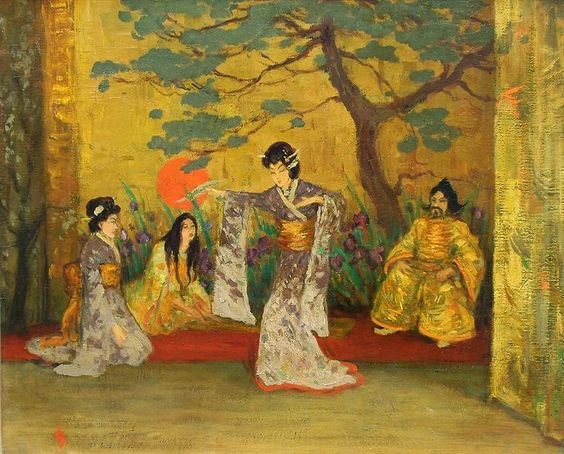
France seems to have crafted an unfortunate Oriental figure of something like a Banshee trope, of a wild crazy woman with wild outlandish hair, snakelike inhuman curvature postures, claws and ghostly pale faces in a effort to make an aesthetic image of the Ghost figure Sadayakko portrays which akin to the Yurei-zu type familiar to Japanese folklore, but not in this kind of inhuman snake-like figure. Indeed many of the racist stereotypes of WWII seem to make an appearance here, with wonky lines for eyes, claws, mixed Chinese and Japanese aesthetics, a distinct reworking of Japanese elegance into mess (the Pine Tree in Simon's 1908 work) and an inhumane caricature of Japanese culture in particular. Other elearlier posters do relay to the earlier depictions of Japonisme such as in Mullers work, but most of the post 1901 works seems to relay more to the encroaching imposition of an Asian great power in Japan to to 'civilised circle of nations' France understood along with America (this is an 1853 perry reference) hat it and not other colonial nations belonged to.
Germany and Italy get off with a better rap, depicting her stage performance and costume. However Italy seems to simply depict Sadayakko as a white woman, which seems to be a recurring theme of utilising white supremacy politics in portraying 'New Japan' as being in proximity to whiteness. Portugal and Spain follow Frances example of depicting Japan as both New and Old, somehow both modern and 'civilised', yet also feudal and 'backwards', such that depicting Sadayakko requires turning her into the Orientalist figure Casas depicts her as in her stage garb, but as a regular normal woman in his portrait sitting.
Caricatures and Cacophonous C's
In context therefore we can see that whilst an unsuspecting Beauty who was put into the spotlight by high society men, Sadayakko was a woman who utilised her connections and introduced Kimono as part of her high class brand. This was turned on it's head by mostly white Europeans who turn the Kimono into an Oriental figure more akin to a Chinoiseire wallpaper from the previous century, or at least something closer to a caricature of Japanese culture. Sadayakko perhaps due to her own autonomy in a patriarchal system of the Good Wife, Wise Mother trope, may have ignored and also being an unsuspecting victim to. Sadayakko leaves a mixed bag in her role in Kimono Textile Culture therefore, as one who both profited from the sale of Kimonopes, and spent her time in the company of unfortunates, and as someone who did not wish to have the spotlight thrust upon her originally.
Bibliography
[1] https://en.wikipedia.org/wiki/Sada_Yacco
[2] https://chumediahub.wordpress.com/2021/02/12/influential-japanese-women-sada-yacco/
[3] https://badgayspod.com/episode-archive/s6e5-andr-gide
[4] https://www.coopertoons.com/caricatures/augusterodin_bio.html
[5] https://redflag.org.au/article/crimes-french-imperialism
[6] https://en.wikipedia.org/wiki/Algerian_War#:~:text=War%20crimes%20committed%20during%20the,million%20Algerians%20to%20concentration%20camps.
[7] Please see the Glossary for the Orient Map and search the Orientalism tab to explore the French love of Orientalism and how the economy sending Mr.Rodin to school with was upheld by the French Empire, which colonised Algeria, Benin, Burkina Faso, Cameroon, Chad, Haiti, Morocco, Madagascar, Mali, Tunisia and Vietnam in his lifetime of which the profits to this day return to France.
[8] https://www.aa.com.tr/en/analysis/analysis-france-still-not-paid-for-humanitarian-crimes-committed-in-africa/2647914
[9] https://the-history-girls.blogspot.com/2017/03/sadayakko-in-london-by-lesley-downer.html
[10] https://en.wikipedia.org/wiki/Stereotypes_of_East_Asians_in_the_United_States#:~:text=In%20media%2C%20East%20Asian%20women,with%20their%20child's%20academic%20performance.
[11] See Essay #23
[12] https://easternimp.blogspot.com/2015/09/sadayakko-through-artists-eyes-part-1.html
[13] https://easternimp.blogspot.com/2015/09/sadayakko-through-artists-eyes-part-2.html
Essay Abstracts
#1 Renee Vivien (1877 - 1909) --- Born Pauline Tarn, was an English lesbian poet. She wrote in French and perhaps English. She took up the style of the Symbolists and Parnassinism and was well known during the era of the Belle Epoque (the Beautiful Age) for producing Sapphic verse and living as an open quasi butch lesbian poet; her verse derived from the ancient poet Sapphos, also famed for her love of women.
# 2 Birth of the Kimonope --- Here I shall introduce the notion of the Kimonope, that is as a garment attached to the social construct of the 'Geisha' in North America. Kimonopes being Orientalized clothing, or 'negatively affiliated or exoticized ethnic dress' which lead to the perceived notion of the Kimono and Geiko as simultaneously both high and low culture to American culture makers, such as film, television, media, writers and some academics. An example of Kimonope are the tacky Halloween costumes you may find at the Dollar store.
#3 The Legacy of the MacArthur Dynasty on KTC & The Problem with the 'Traditional Garment' Argument --- The problem with arguing that the Kimono is a 'Traditional ethnic Garment' is that that assertion is in itself, arguably Ethnocentrism, which to clarify is the imposition of, in this case, American values onto Japanese cultural values, belaying the 3 pronged pitchfork of idiocy.
#4 Divine --- Government name Harris Glenn Milstead (1945-1988) was the infamous North American Queen & Drag artist. Specifically, Divine was known for being a character actor, part of her act is well-known for its eccentricity. My personal exposure to Drag lite was Pantomine Grand Dames as a kid, and later when my friends made me watch RuPaul in art classes, so to me this is nothing new, the over the top, the glitter, the upstaging is all part and parcel.
#5 Dori-Style or 21st century Kimono Fashion --- The Dori-Kimono style. Something which I just made up because in going over notes for the first 20 years of 21st century section of Kimono history, I noticed a lack of a clear catchall term for what was happening in Japan at the time, at least in English descriptions of the time. I use the term Dori as I do not want to coin an unrelated term to the topic, but I also am reticent to claim all of Street style as 'Tori' either, whilst a large number of streets upon which the subculture originates in all use the suffix 'dori' (the bottom of Takeshita-dori for example), thence Dori-style.
#6 The Tea Gown --- This essay will cover the aspects of how 19th century Japanese import textiles to Western countries were used and repurposed, as well what their desirability tells us about how Japanese design was regarded and the image which these people held of Japan through the Western lense and consciousness. This follows the progression of how Kimono can be used in the West from the undress of the 1860s, adapting silk bolts in the 1870s to high fashion western daywear, to the 1880s aesthetic movement and 1890 wholesale adoption in the Victorian age to being used prominently by society hostesses as tea gowns by the Edwardian period, and the subsequent change in Japanese export culture which we see in extant textile collections of Japanese textile in Western dresses of the periods.
#7 Kimono and the Pre-Raphaelite Painters --- This essay will cover the aspects of Kimono in the Portraiture of the Pre-Raphaelites. The Pre-Raphaelites were a group of British artists and writers active during the late Victorian period. Unlike the Royal Academy artists, this circle of painters operated outside of the established comfortable boundaries of the expected white, cisgender middle class audience of the Victorian age. The movement is notable for its inclusion and encouragement of women, and in portraying and engaging non-conventional beauty and beauties as figures from the Classical World alongside Religious, Mythological and Folklore Heroines into Victorian 'Femme Fatales'.
#8 Jokyo/Genroku Kimono Textile Culture and the new role of the Komin --- This essay will return back to GKTC (Genroku Kimono Textile Culture ; 1688-1704) and JoKTC (Jokyo K.T.C. 1684-1688) and the new role of the Komin (Artist caste) in GKTC. JoKTC is notable for being the lead up to GKTC, JoKTC being characterised by its transitory nature in comparison to GKTC, which was far more bold in its relations to what Kosode could and should be. Komin entered the picture at this juncture, and I shall elaborate a little more here than in other posts about why that was. GKTC is notable for its elaborate, perhaps gaudy and innovative Kosode design features, whilst JoKTC more so for the enabling factors of the time, as a sort of incubatory GKTC.
#9 Tagasode Byobu - This essay will explore the art motif known in Japanese art as Tagasode Byobu ( Whose sleeves Screen) This motif is a recurring art form which was particularly popular during the Azuchi-Momoyama era ( 1568-1600 ) as a representation of the ways in which Buddhist sensibilities met with the fast changing events of the end of the Sengoku Jidai (1467-1615) and as an extension of the habit of wealthy women from military families came to own and store a large number of Kimono. Prior to this, Kin Byobu ( Golden Screens) for the most part depicted nature like Sesshuu Touyou (1420-1506) after Chinese Cha'an painter Muxi ( c.1210-1269 ) or 'flower-and-bird' scenes like those of Kano Eitoku (1543-1590), rather than humans or human paraphernalia as an extension of the Zen painting school of thought about materialism.
#10 Cultural Acculturation --- The topic of our essay is on the nature of Cultural Exchange in KTC which will be an ongoing mini-series throughout 2022. This covers the 1000CE - 1500 period in Japanese History.
#11 Cultural Appropriation --- The topic of our essay is on the nature of Cultural Appropriation which will be an ongoing mini-series throughout 2022.
#12 Cultural Acculturation --- The topic of our essay is on the nature of Cultural Acculturation which will be an ongoing mini-series throughout 2022. This covers the Asuka (Hakuho), Nara (Tempyo), and Heian periods (500CE-1000CE) in Japanese History.
#13 Asai Ryoi --- This essay will explore the legacy of Asai Ryoi on KTC. Who was Asai Ryoi you may ask? Only one of the most important writers for the Ukiyo genre. Asai Ryoi ( act. 1661-1691 ) was a prolific Ukiyo-zoshi ( Books of the floating world ) or Kana-zoshi ( Heimin Japanese Books ) writer. His leading 1661 publication, lambasted and satirized Buddhism and Samurai culture of restraint in favour of the Chonin lifestyle of worldy excess.
#14 Edith Craig --- This is a post regarding the early adoption and promulgation of the Kimono and Japanese aesthetics in the life of the wonderful Edith Craig (1869-1947), daughter of the famous actress Ellen Terry (1847-1928) and Edward William Godwin (1833-1886). Edith was also known as 'Edy'.
#15 European Banyans --- This essay will explore the European garment known as a Banyan, which originated as a European reaction to Kimono in the 17th century, popular until the end of the 18th century. The word Banyan originates from Arabic ( Banyaan), Portuguese (Banian), Tamil ( Vaaniyan ) and Gujarati ( Vaaniyo ) loanwords meaning 'Merchant'. Alternative versions saw the item fitted with buttons and ribbons to attach the two front sides together. The Banyan was worn by all genders and was particularly regarded in its first iterations as a gentlemanly or intellectual garment worn with a cap to cover the lack of a periwig, and later adopted by women and greatly influenced how British womens garments were designed with preference for comfort in removal of panniers whilst maintaining luxurious, modest 18th century fashions (see Robe a la Anglaise).
#16 Miss Universe and Kimonope --- This essay will explore how Beauty Pageants, principally Miss Universe, has engaged with KTC. While there may be real Kimono worn by Japanese and Japanese adjacent contestants in the 'National Costume' category, I will be focusing on the Kimonope worn by contestants. The idea of Kimono as a 'national costume' sparks interesting conversations on what 'national costumes' are, their target audiences, and how we form ideas about these things to begin with.
#17 Onna-E --- Womens pictures refers to the Nara, Heian and early Kamakura ( 710-1333CE ) practice of drawing women in elongated Hand scrolls, which today are regarded as feminine gender coded Art. Some of these narratives depict the lives of women, their extra diaries, or the literature they wrote. The Onna-E style derives from how mostly Heian women represented themselves and others as a performed self in these scrolls, drawing from their lives indoors at their and the imperial abodes. Whilst a limited number of women could read Kanji, they also used their knowledge of Chinese culture to create and inspire their own culture; the first truly Wamono aesthetics; and it was with these preconditions that Onna-E became established in the Japanese art scene alongside Yamato-E and Oshi-E.
#18 A Jamaican, a Monster and Portuguese bar in the Orient --- This essay looks at the Kimonope attire adopted by North American Dancehall artists Shenseea (Chinsea Linda Lee | 1996 - present ) for the video to 'ShenYeng Anthem'. Whilst the aesthetic derives mostly from East Asian, principally Chinese aesthetics, the language used is specifically Japanese, referring to Chinsea Linda Lee as 'ShenYeng Boss', a perpetuation of the Dragon Lady stereotype. The essay mostly charts how this ridiculous Kimonope derides from the North American Anti-Chinese movement and how this intersects with contemporary Orientalism.
#19 The Red Kimonope --- The Red Kimono is a terribly named racist US silent film from 1925. The Longingist film includes a key scene which the production gets its name from where the protagonist drops her Kimonope, meant to symbolize that she had turned away from sin and prostitution, or in other words equating a wearer of the Kimono as a sex worker which stemmed from another American 'tradition'. This dreadful melodrama features the previously yellowface-accepter Priscilla Bonner as the lead protagonist. Throughout her trials and tribulations, she faces many ups and downs, like becoming a white version of the Lotus Blossom stereotype, because WASPs. I will explore the origins of the Lotus concept and the 'Jade' in more detail here as to provide the contextual background of the productions symbolism.
#20 Housewife, Business Girl, Office Lady --- I explore the concept of the arrival of the Business Girl, and the Shufu ( Censored | Housewife ) of the 1930-1970's period of the 20th century.[1] This intersects with how we see Wafuku represented, in a shifting dynamic that had not shifted so many barriers since the 1870s, and even until the 1990s with the intrusion of Euro/Americentric beauty standards being foisted upon the world during these centuries, in the wardrobes of the upwardly mobile single business women of from 1955-1965. These groups came into being in the 1950s with the advent of the eclipse of settler colonialism and patriarchal standards over women's lives internationally. KTC thus developed in response to these changing, testing and trying times (between 1930-1970).
#21 Herman's 'Kimono' --- In this essay I look at another Kimonope, specifically another Miss Universe 'national costume' entry. This particular Kimonope represents the legacy of Macarthism's neo-colonial/systemic racism, and subjugation of Japanese soft-power, a follow on of Orientalist late 19th/early 20th century assumptions and stereotypes of Asian culture and peoples which saw their subjugation in American foreign and domestic policy between 1885-1952. In this entry, we see a clear leaning into the 'Cool Japan' aesthetic by the Kimonope's designer, who is not shockingly not Japanese, but Israeli and therefore represents ideas about what Kimono are to this designer than the genuine article would to other participants of KTC, foreigner or otherwise towards 'Kimono'.
#22 Uno Chiyo --- This essay explores the work of Uno Chiyo (1897-1996) as a Kimono Designer. Uno was a prolific 20th century Japanese writer and designer. As such, Uno was familiar and fluently versed in KTC throughout her life. Uno founded the influential Style which was in circulation in Japan from 1936-1959.[1] Uno was heavily influenced by Western and Genroku fashion, and focused her aesthetic on these two whilst encouraging masculine and secondhand consumer habits in her approach to Kimono as a fashionable and modern pursuit. Uno provides a fascinating glimpse into a time before Kimono were stigmatized and were instead merged with Yofuku to inform Japanese identity and femininity in new and stylish publications and normoactivities.
#23 Franco-American Singer Dynasty and their Kimonopes - Winnaretta Singer (1865-1943) and Daisy Marguerite Séverine Philippine Decazes de Glücksberg Fellowes (1890-1962) were both American-French socialites, who interacted in many ways with the white elites of the American-French fashion industries. They were heavily complicit in the racist structures and depiction of Kimono as for the 'yellow peoples', with Winnaretta implicitly using Kimono to benefit from racist tropes and imperialism in her career as a painter. This is part of a broader tradition of the French Orientalism genre which would give rise to the Madame Chrysanthemum trope a few years after Winnaretta's use of the Kimonope, in 1883. Daisy, her neice would use these tropes in her time at Harpers Bazaar from 1933-1935, displaying the same ideas about people of colour and their cultural traditions throughout the 20th century as found in her social peers.
#24 Sadayakko - Sadayakko was an actress, performer, artist, globetrotter, judoka, muse, rider, teacher, theatre kid, proprietor, stage manager, project manager, business owner, patron, polygamist and traditional artisan. Sadayakko was highly regarded Beauty and upper class artisan in Japan, living in Tokyo in the beginning of her life and the palace upon her retirement, who established Kimono Textile Culture as Beautiful in countries outside Japan in the Meiji and Edwardian Period. Sadayakko was an influential fashion influencer in the realm we will be discussing of how her influence was received in the Global North, unfortunately principally in her lifetime as the embodiment of the French originating Orientalist fantasy of the Lotus Blossom stereotype, with the Kimono's place in that. The Kimono becoming a sign of subservience and social defilement in it's usage by French, Italian and American depictions in the early 20th century.
Social Links
One stop Link shop: https://linktr.ee/Kaguyaschest
https://www.etsy.com/uk/shop/KaguyasChest?ref=seller-platform-mcnav
https://www.instagram.com/kaguyaschest/
https://www.youtube.com/channel/UC5APstTPbC9IExwar3ViTZw
https://www.pinterest.co.uk/LuckyMangaka/hrh-kit-of-the-suke/

_1903.jpg)


.jpg)

.jpg)
_(c._1901)_by_Rupert_Bunny.jpg)
.jpg)


_by_Pierre-Georges_Jenniot.JPG)



.jpg)


_(14781762251).jpg)