Her Haughtynesses Decree

Showing posts with label Sakoku. Show all posts

Sunday, August 7, 2022

紅葉 | Momiji | Maple Leaves | Patterns #14

Momiji refers to the motif of leaves from the maple tree, often most affiliated with the autumn season when they turn to a beautiful red and are shed onto the floor. The most commonly used in Wafuku is the Kaede leaf (Acer Japonicum).[1] Other popular motifs include the arabesque swirling waves of the Karakusa pattern, water ( Ryusui-ni-Momiji ) and with deer motifs.[1] 

The origins of the motif can be traced to the Nara period when they were admired for covering mountains in their yellow hues.[1] During the Heian period this changed to red when they were used as allegorical devices in Heian poetry and wafuku as a way to rejuvenate the body after a long sticky summer in preparing for the autumn, around towns like Tatsugawa.[1] This poetic change may be a moral story surrounding having the child of child Genji as opposed to the Emperors child in Momiji no Ga, the 7th chapter of the Tale of Genji's Messy Lovelife after which Fujitsubo, the Emperors lover decided to raise the child as a single mother at court. Instead Genji has to content himself with doing some Bugaku, seeing Fujitsubos child cousin playing with dolls, and watching his mates squabble in the end pining for Fujitsubo.[6]

Genroku Maple and Water Kosode fragment with Autumn Kanji (c1690, PD) LACMA
Note the Genroku propensity for writing all over everything!

By around the 16th century, plays like the Noh play Momijigari ( Maple Viewing ) foretold of the dangers of getting too drunk during Momijigari as you apparently could get attacked by demon-ladies trying to break your heart.[5] By the Genroku period this was mixed with the designs of popular designers such as Ogata Korin in a call back to the idea of Wamono in the assertion of Japaneseness by using the 'Korin-momiji-mon' motif.[2][3] In vernacular history, it is said that for an Asobi to send a Momiji to a man is to have left him, becuase she has changed colours and grown bored of him in doing so.[4] During the 1920s, a great number of popular Meisen kimono seem to have used seasonal motifs like Momiji in asserting their Wamono-ness. Other examples also show this happened again in the 1950s in polyester, with Momiji retaining its popularity. Today people go to Arashimaya or Noboribetsu to see the changing Momiji.

Bibliography

[1] https://int.kateigaho.com/articles/tradition/patterns-29/

[2] See Essay #8 under Ogata Korin

[3] For an example of Wamono beauty standards, see Bijin #10 under Komin Codifying the Genroku-Wamono Bijin and Bijin #9 under Early Ukiyo-e in Print and Technology for context.

[4] https://www.academia.edu/18981047/Momiji_the_Maple_Leaf_on_Monet_s_Kimono

[5] https://en.wikipedia.org/wiki/Momijigari_(play)

[6] https://www.japanese-wiki-corpus.org/literature/Momiji%20no%20Ga.html#:~:text=Momiji%20no%20Ga%20(%E7%B4%85%E8%91%89%E8%B3%80,next%20autumn%20at%20age%2019.

Social Links:

Linktree (One click to all and extended Links): https://linktr.ee/Kaguyaschest

https://www.etsy.com/uk/shop/KaguyasChest?ref=seller-platform-mcnav or https://www.instagram.com/kaguyaschest/ or https://www.youtube.com/channel/UC5APstTPbC9IExwar3ViTZw

Sunday, March 13, 2022

浅井 了意 | Asai Ryoi | 1612-1691 | Essay #13

This essay will explore the legacy of Asai Ryoi on KTC. Who was Asai Ryoi you may ask? Only one of the most important writers for the Ukiyo genre. Asai Ryoi ( active 1661-1691 | 浅井 了意 ) was a prolific Ukiyo-zoshi ( Books of the floating world | 浮世草子 )  or Kana-zoshi  ( Heimin Japanese Books | 仮名草子 ) writer.[1] His leading 1661 publication, lambasted and satirized Buddhism and Samurai culture of restraint in favour of the Chonin lifestyle of worldy excess.[1]

Ukiyo

Kanazoshi celebrated contemporary urban life. It was Ryoi's Ukiyo Monogatari ( Tales of the Floating World | 浮世物語 | 1661 ) which saw Buddhism infused using the Kanazoshi genre. The writing term Ukiyo, ( Transitory World | 浮世 ) describes the homophone allusion to the Buddhist Ukiyo ( The Sorrow filled World | 憂き世 ) which describes what Buddhist call Dukkha ( Suffering ) under Impernance ( Mujyou | 無常 ) due to the ongoing nature of change in human lives.[2] This was essentially a tongue-in-cheek way of pointing out how in this transitory world of suffering due to change in human lives, and therefore you should live a decadent lifestyle to cope with all of the Dukkha. Buddhists would say otherwise though, as they generally lived as Ascetics, not as Decadents.[1] 

Ukiyo Zoshi

The Ukiyo-Zoshi genre came about due to Ryois 1661 Monogatari which questioned the real value between leading an ascetic lead and decadent lifestyle and as to how best understand the meaning of the mortal and immortal realm of what Buddhism termed the ultimate goal of reaching the Pure Land or Buddha-field ( Jyoudo | 浄土 ).[3] It is important to understand the man, because it was this framework which launched this genre, Japans first major popular genre of literature.[4]

This framework was a lauded response to the major problems faced by Japanese society at the time. After the tumultuous period of civil war which Japan had just left, the Japanese found themselves in a new era of peace. As Sankin Kotai had moved the Heimin, created the Chonin, and uprooted the Samurai, Japanese society had a more stable economy and thus more leverage as a society for great numbers of people to have a greater quality of life. As such, decadence became more prevalent. It was in this newly peaceful world that values began to brought into the spotlight and new ethics and morals brought by emigrant Heimin; and more available to us, Chonin; who decided which of these where more important than others.

As such, Ukiyo-Monogatari reflects this new impetus by a form of archival liberation[5] of the Buddhist teachings. Ryoi attempts to reflect on what would later be codified as the Mono-no-aware theme which reflects on the beauty found in the passing of time and its transitory nature. His main character even through his decadent lifestyle, still finds Enlightenment by the end of the tale. It was this which gave the impetus for kindling the 'rightness' we can say, of the Chonin in their ways and wiles as being as valid as the ascetic monk and the upright retainer. It was this narrative of Enlightened Chonin pockets, that Saikaku would run with by creating the formal conventions of the genre on the back of Ryois and earlier trashier works 'critiquing' womens appearance between 1640-1650, by 1685.

Kambun Komin KTC

As part of Kambun KTC, we can also see the emergence of the material effects of the rise of the living standards for Chonin. As the Stabilisation policies brought economic prosperity to those previously living in poverty, they and their children enjoyed increasingly the fruits of this closed economy. This included an increased patronage of 'Japanese' artists such as the Machi-Eshi for those with means, and Komin or artist-craftsmen for the rest. This development came after 1639 through Sakoku, and saw a shift from dirty 'foreign' styles towards conservative styles, in painting this was the Fuzokuga-E depictions of Buddhist scenes for example rather the Kano Byobu of the Nanbanjin traders (made from 1590-1630).[6] 

The 1650s in particular saw a rise in art patronage of worldly pursuits.[6] That decade was defined by the struggle between the Komin like Iwasa Matabei (1578-1650) who existed between the brush and reality, and the samurai ruling class who sought to impose their moral codes onto the new money crowd. By the Kambun era though, the pursuit of erotic Kabuki dancers, the newly established Yuujo quarters all wrapped up in a Kimono Obi was a public affair as it seems the Chonin had become increasingly tired of hearing how salvation (Buddhahood) only came to the wealthy military elites. Over the period, the hypocritical nature of this state of a hyperfocus on the elite courts practiced since the Heian period began to shift in favour of creating a standard for the everyday person. And as the saying goes, you write about what you know first.

Their later Kambun beauty standards, as espoused in the Kambun Bijin, were in flux between this convergence of reconciling conservative Japanese Buddhist and Confucious values, with the new money lifestyle which the elites practiced themselves only to deny the Heimin. In this light, the Heimin seems to have seen fit to find Enlightenment in the arms of their Kagema or Wakashu in Yoshiwara, just as the lord found his in his Wakashu. The Heimin art of this period is truly a wonderful mess, like a teenager trying to find their way through puberty, it reflects a series of confusions of intentions, directions and solidarity of style. However by the middle of the decade, Kambun style begins to emerge in the hands of Komin-Chonin of publishers and illustrators like Hishikawa Moronobu (1618-1694), Kambun Master (act. 1661-1673) and Yoshida Hanbei (c.1664-1692).[7]

With Heimin now running the show as the merchant classes, their handiwork began to rewrite the beauty standards and it is during the Kambun period with which the rules for KTC begin to be liberally  rewritten. Their earlier incarnation, the Dress Manual, often gives away the acceptability politics game wealtheir Chonin played by, and other more artistic ventures done by the Komin-Chonin types reveals this shift towards Heimin worldview as the new standard. This standard often incurred the pursuit of those erotic Kabuki dancers and the Yuujo, particularly Tayuu as models. The fashions worn by these androgynous figures however, were made by those Komin-Chonin figures such as Hanbei, Moronobou and Asai Ryoi.

The Ryoi Enso

Enso are those non-complete Zen calligraphy circles you find labelled in pretentious Japanese art collections which simply put are an appreciation of when the hand has been allowed to wander in a circular form void of all worldly thought. The Ryoi Enso is that by the time society had come to grasp the inherent dual nature of Ukiyo Monogatari, the ineffable nature later to be called Mono-no-Aware had coem to be attached to many material things as an extension of the appreciation of transience in the human life. Objects had being given new meaning and understanding. Just as finding in watching passing Blossoms fall that this was beautiful, Objects had come to be appreciated as part of this new moral understanding of the physical world. The Japanese public had by 1670 also realised that Worldly material objects were also Mujyou, and this was celebrated.

As a material object, Kimono were also Mujyou, and thus the Kosode as an art object was born. Finding beauty in the transitory nature of textiles gave designers, craftsmen and artists overlap as was only seen before for the patronage of the Machi-Eshi. This work was now in the worldly domain of the Komin, such as Ryoi who interpreted this new Mujyou Art Object as it was now understood, through their Heimin lifestyles. Work was commissioned by Ryoi's own patrons in his own hand for his Shinsen O-Hiinagata, which captures the prototypes of what these Ukiyo or Urban lifestyles offerred. Artists saw Kimono now as an extension of their own imperment lives, a Mujyou canvas so to speak.

Shinsen Hiinagata (1667, PD) Asai Ryoi, British Library
Red Striped Shibori Zodiac Pattern

Shinsen Hiinagata (1667, PD) Asai Ryoi, British Library
Chrysanthemum Pattern

These art Kimono obviously still reflected the transient nature which had preceded them of course, and this is what I mean when I refer to the messiness of the Art Kimono. The Art Kimono, like Aesthetic dress, had to conform to the pre-existing silhouette at first, however the fabrics and aesthetics such as Ma in composition, and devlopment for Kimono of motifs as an extension of Mujyou, show us how the Art Kimono of the Kambun period came to be. As we see in Ryoi's work, the two-tone is still clearly prominent given the date, but the designs displayed are pushed to the right, a sign of good luck, and incorporate tacky motifs such as calligraphy and oversized motifs in the case of the Chrysanthemum.[9]

Examples of Pattern Books

Kosode Hiinagata (1667, PD) Anonymous, Meturo

Contemporary Kimono Patterns (1677, PD) Hishikawa Moronobu

Examples of Dress Manuals

Onna Shorei Shuu Tagasode (1660) Anonymous, NYPL
Dress and Table Manners from Rules of Etiquette for Women (1666) Yamada Ichirobei

Into the future

This lifestyle of Ukiyo or Chonin decadence had by this time moved over into money laundering schemes to combat sumptuary laws making art Kimono. Art Kimono can be pinpointed to the late Kambun era specifically as it is in this juncture when we see the greatest proliferation of Kosode sample books, Hinagata Bon and how existing Kimono design shifts to favour popular designs made popular by the masses rather than the ruling military elites who would have been the only group to have access to funds to make wide reaching purchases of lavish materials and skilled workers beforehand in any realistic amount. Fashionable Kosode for Heimin before this time, consisted of two tone patterns. By 1672, this had changed to favour styles like the Osaka Genroku Bijin, which saw drastic changes to the composition of Kimono, acceptable aesthetical influences, motifs, colours and techniques to design KTC with.

[Before] the Kambun era (1661-1673) Kosode were generally two colours and woven with metallic thread and goldleaf. During the introduction of foreign textiles and rise of the new middle classes from the import of cotton and sarasa, tastes, colour schemes and bank balances changed. B[etween 1665-]1684, the colour schemes of Kosode worn by the townspeople and [elites] became darker at the bottom, lighter at the top, to show off wealth as darker Kosode meant more dye, which required deep pockets [...] worn by Chonin wives, well paid Kabuki performers, and the Tayuu which became 'Iki' (1680s sexy). Popular dark dyes included Beni reds (amongst samurai) / Nise-kurenai (fake/ Dutch reds for the rest) and purples. [...] Regular women would simply don striped variations, or indigo Kimono [with] singular motifs, and both would go decorate their Kosode with wordly scenes, so scenes of the city. [...] Provincial districts and merchants now set the new standard, with Osaka frequently overtaking Kyoto artwares as fashionable. The Kosode of the Genroku Bijin [...] would often have use[d] new technologies to create vivid, wordly scenery on their kosode [with] Onnagata and Tayuu were often seen in these styles. Younger and poorer women [were found] sticking to older Kosode fabrics such as hemp, striped cottons, linens, ramie, plant fibres or indigos with layered recycled fabrics involving the Sashiko stitch (Stab stitch). They indeed often made their own Kosode, and by the middle of the 17th century weaving was a valuable skill for rural women. [8]

Aesthetical Enlightenment

This we can contextually see, resulted in what may be termed the Mono-no-aware Kimono. I dont say Kosode, but rather to refer to this being how we result from the pre-Kambun two tone Kosode to by the end of the era, the polychromatic and compositionally shifted Art Kosode as a reflection of a journey in the shift in though which Ryoi begins in his Ukiyo Monogatari. That is an awareness in Kambun KTC for the need to have a change in physical appearance to reflect Buddhist sensibilities in dress, in showing the transition of dress as a practicality in the Sengoku Jidai, to one of fashion for everyday people in these times of stable prosperity. 

Kosode were created in response to the dawning realisation that Buddhist aesthetics under Japanese notions, stressed the issue of Impermanence. Kimono were seen as an extension of the human existence, as they were tangible objects created around humans. They were therefore part and parcel of Dukkha, and should be experienced as such as part of this. Artists gave rise to this in their creation of Mujyou inspired designs in their Pattern Books, which inadvertently created fashion contrary to that of the stingy conservative Dress Manual. It was this shift in thinking about material life and objects, which saw the transformation of Decadent textiles into the Kosode as Art by appreciating that textiles were also Mujyou, and that each component of their construction and use was also Mujyou in creating the Kambun KTC Art Kimono, based on the Asai Ryoi Ukiyo framework to reach Englightenment.

Bibliography

[1] https://en.wikipedia.org/wiki/Asai_Ry%C5%8Di 

[2] https://en.wikipedia.org/wiki/Impermanence and also see the Glossary

[3] https://en.wikipedia.org/wiki/Pure_land 

[4] https://en.wikipedia.org/wiki/Ukiyo-z%C5%8Dshi 

[5] See the Glossary

[6] See Bijin #9

[7] See Essay #8 

[8] See Bijin #3 

[9] https://blogs.bl.uk/asian-and-african/2020/02/exquisite-patterns-japanese-textile-design-books.html 

Socials:

https://linktr.ee/Kaguyaschest

https://www.etsy.com/uk/shop/KaguyasChest?ref=seller-platform-mcnav or https://www.instagram.com/kaguyaschest/ or https://www.youtube.com/channel/UC5APstTPbC9IExwar3ViTZw, or https://www.pinterest.co.uk/LuckyMangaka/hrh-kit-of-the-suke/

Sunday, December 12, 2021

宮崎友禅 | Miyazaki Yuzen as Genroku Komin and Wamono Bijin | 1688-1736 | Bijin #10

This post will be slightly different, more of an essay than Bijin post only due to the nature of the difference in thought between Western and European Art. The post endeavours to explore the fluid relationship between Japanese mediums, across different formats and styles of Japanese Fans. Also how the Human Figure came into this crossroads in Japanese Art and Miyazaki's lasting influence on KTC.

Miyazaki (1654-1736) was a prolific fan painter and creator of the Yuzen dying technique. His painting style was immensely popular and featured on a number of Kosode from the Genroku, Hoei, Shotoku and Kyohu periods (1688-1736). Miyazaki's fan designs or Yuzen-zome designs directly onto the surface of Kosode were popular with Kyoto Chonin by 1690.[1][2] This design process is now a staple design motif found on Kimono today. 

Miyazaki's popularised Fan motifs (1717) Nakamura Senya

Fans

The concept of the fan originates in Ancient Egypt 4000 years ago. Eventually these became widespread in China which in turn influenced Japanese fans. The first known use of Japanese fans ( Sensu | Fan | 扇子) comes from 600 CE, being greatly influenced by Chinese flat hand fans at the time made of feathers or paper in a flat oval shape, inspiring Uchiwa fans. In 800 CE, Japan invented the first folding fan, the Akomeogi ( 衵扇 ), named after the courtly attire of Akome ( Cover-over Layer | 袙 ).[3] The oldest existing Hi-ogi dating from 877 CE, which at the time was used by Shinto priests and male courtiers.[7] According to Chinese lore, the Japanese monk Chōnen ( ちょう然/奝然 | 938-1016) offered Hi-ogi ( 20 Hinoki strip folding fans | 桧扇) and 2 Kawahori-ogi ( Paper fans | 蝙蝠扇) to the Song emperor Zhao Jiong (939-997) in 988. In the 10th century, Folding fans were once again taken by Korean envoys to the Chinese to use to pay tribute to the Middle Kingdom. 

By this time, Sokutai and Junihitoe had become the fashionable Wamono dress style in the Japanese court, and Heian women popularised the painted folded fan as Akomeogi by taking the name from their skirts 4th dress layer.[7] Eventually by the late Heian and Kamakura period in Japan, folding fans were regulated by sumptuary legislation much like later Tokugawa sumptuary legislation on fabric imports, until by the 15th century when they became used by the Japanese public.[4][7] During the 1400's, Japan began to export Folding fans due to their popularity on the asian mainland, and presumably further afield with the arrival of Portuguese traders during the Nanbanjin trading period from the 1560's onwards.[6] Edo period (1600-1868) fans were made by one Komin, and decorated on one-side, mass market fans included both sides.[7] By the Meiji period, folding fans were a staple global fashion accessory and the height of European fashion between the Tudor and Victorian periods in the English courts to own one, with a particular resurgence amongst the Victorian middle classes after Japan opened up from Sakoku in the 1860's. In the modern day, it can take up to 87 craftspeople to make a single fan.[7]

The earliest folding fans or Hiogi, were made by combining together 5-20 multiple thin strips of Hinoki wood at 30 cm long called Mokkan ( [orig.] Wood Recording Tablets | 木簡 ) with tightly bound silk string, afixed to a paper background.[4][7] Highly decorative fans included many layers of decoration such as fans made by Komin and adorned with tassels. The flat design was often made by artist for a specific purpose or to reference a literary text for example onto paper and layered onto the wooden sticks. Some fans in the Heian era though were made to convey Waka poetry, as seen in the Tale of Genji, and was regarded as something of a feminine artform. According to legend, the shape was inspired by a Heimin who saw a bat unfurl its wings.[5]

Fans held many uses, including to show taste, send messages to other courtiers, signal warfare in battle, as weapons, toys, decorative art and to engage in court ritual. Shinto priests still use folding fans today in their ceremonies, and many performing arts such as Geisha and Kabuki still use folding fans as part of traditional ritual dances, using ivory, bone, mica, mother of pearl, sandalwood, or tortoise shell.[4] Folding fans are today considered a traditional Japanese handicraft by the goverment, such as the Hyakudate ( 100 Bamboo stick Fan ) made by Aiba of Kyoto, who have made their Uchiwa fans for 300 years.[6]

Figures in Fans

Human figures appeared on Fans in Japan in the same way as they appeared on Screens, Lacquerware and other decorative items, due to the backdrop gargantuan shifting financial geo-social politics of the Edo period, and the Japanese understanding of Art in contrast to its Western Counterpart.

"[A]rt and crafts are one in the same process, unlike in the West when during the Renaissance [Art & Craft] split under secularisation during the Enlightenment period through the rationalism (in the art world, nature) vs empiricism (mechanised) debates into Art (divine works of nature) and the lesser crafts (mechanical and hand labour work) in the Occident."[8]

In the century before Miyazaki, the human figure underwent vast changes in Japanese Art, including being included in public Japanese art full stop. This was mostly down to the fact that Japan went from being a Rice-Economy, to a Currency Economy from 1590-1660. As such, most art in the late Sengoku period was made for wealthy Kyoto Kuge who had different tastes, desires and needs than the Heimin who consumed Bijin-ga in the 1670s would have, the Kuge wanted devout Tosa depictions of good Buddhist figures, the Heimin of the 1590s to feed their children, so very little Azuchi-Momoyami art even carried human figures in them. This came from Classical Buddhist notions of beauty imported from the Asian mainland, which held that portraiture was a vain venture, such as idolatry in some Christian and Muslim traditions.[12] However Bijin-ga can be held to a be a classical Chinese genre begun in the 6th century by Chinese painters depicting women who wrote love poetry.[13]

Back to Japan, between 1598-1615, Tokugawa Ieyasu craftily devises his Stabilisation Policies to bring an end to the Sengoku Jidai, using stability to consolidate control over the patchwork fiefs and warlords of Japan and ensuring its continuation by creating a stable Japanese society and economy. This changed the nature of power structures in Japan. Suddenly, Kyoto was no longer the aspiring culture everybody looked up, but instead, Edo culture was the new rising popular culture. One such policy being Sankin Kotai (1635) which saw warlords uproot to Edo, Ieyasu's new defacto capital for 6 months annually, bringing all their money and retinue with them, which turned Edo from a fishing port into a wealthy city.[11]

Setting the stage for Bijin-ga (1624-1673)

Tagasode Byobu (c.1573-1615) Anonymous

Southern Barbarians Screen (c1600) Kano Naisen
By the 1620's, the warlords had become bored without any Hanazuka ( Nose Mounds | 鼻塚 ) to pile up. So instead, the bored Ronin took to handicrafts, becoming Machi-Eshi, who patronised the new artform Kabuki, and fraternised with the new religion, Christianity. With this, came a shift in the use of the human figure in Japanese art by the Kanei era (1624-1644) from dukkha-vessel to sentient two dimensional being.[14] This came at first in Byobu, with first the Tagasode and then Hikone Byobu, inspired in part by the Kano school's depictions drawn from the wealthy Nanbanjin trades.[9][10] Figures of the 1630s reflected the changing times with the growing middle Chonin classes buying art in which they appeared. Figures then shifted after Sakoku in 1639; as Japan reverted to its pre-contact identity and 'unique' national psyche when it closed its borders; with the Bakufu more keen to promote Wamono than Nanbanjin affairs both to prevent further Kirishitan conversions and to reenergize the domestic Japanese economy. 'Japanese' Beauty in the arts became more valuable than Korean or Portuguese forms, and instead the rise of the conservative Buddhist Tosa figure which used the figure as was found in Yamato-E Fuzokuga became more socially acceptable, in lieu of the flashy Kano school depictions which drew on the Nanbanjin trade for their inspiration.[14]
[14]
Image taken from the Hikone Byobu (c1624-1639) Anonymous
 ta

The Four Earthly Pleasures (c1624-1644) Iwasa Matabei

During the Shoho era (1644-1648), the human figure underwent an appraisal under the guiding hand of Iwasa Matabei, who drawing on the Beauties Genre of Tang Chinese figure painting and the Kano school, but using the Tosa Yamato-E figure as a vehicle, created early Japanese high art using human figures.[14] Matabei's portraiture marked a shift in this appreciation of worldly forms from Buddhist Genre Painting into the figure as High or courtly art, and was depicted on Byobu as such.[13] By the late 1650s, Kakemono depicted early Bijin, prominently in Shikomi-e or images of young half-dressed androgynous figures.[14] It was the push for Japanese Bijin which saw the growth of the pleasure quarters and patronage of these by Chonin and Heimin. In 1666 with the publishing of Asai Ryoi's Ukiyo Monogatari, the Ukiyo genre or worldly pleasures genre mostly enacted by the new Chonin middle classes came into vogue. Ukiyo-e being the brainchild of the Komin-Chonin relationship, producing newly publicly available hedonistic and androgynous Shikomi-e Bijin-ga and later Yakusha-E prints. 

Matsuura Byobu (c.1630-1650) Unknown
Kambun Bijin (1661-1673) Anonymous
BeautyLooking Back (c1672-1686) Hishikawa Moronobu


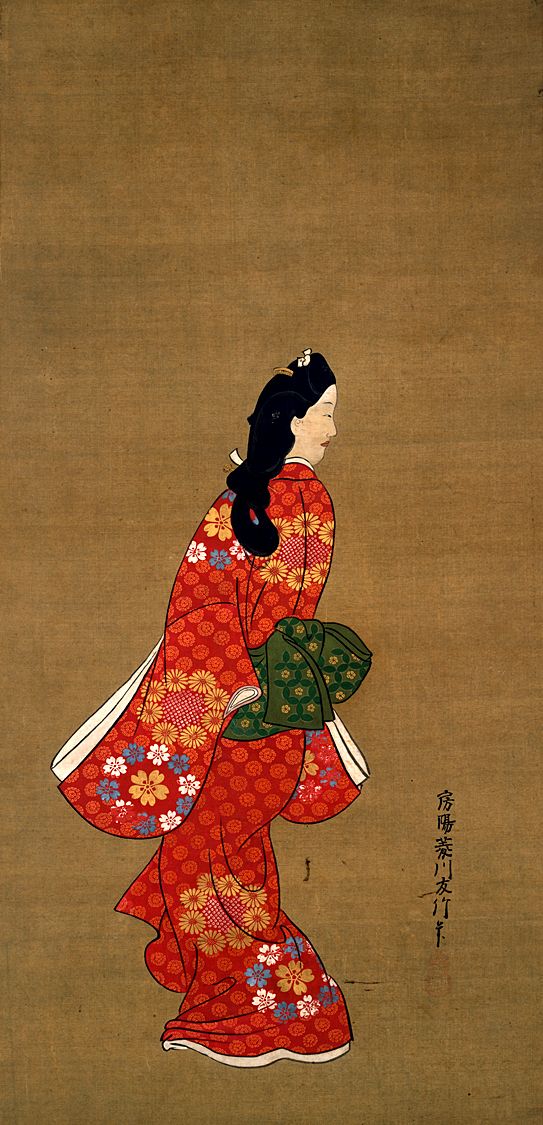
By the Kambun period, early Bijin-ga as it is known had become an acceptable format to paint the human figure in, as Shikomi-E were deemed Ga ( Refined ) icons of Dancing Artisans (Geisha). Most production done for and by Chonin who increasingly merged High Brow Art (The Iwasa family, Tang China, Tosa, Kano) with Low Brow Content (Vanity Pictures), under the permissive nature of the times ; Shunga had begun to become explicit and was widely read for example.[14] These were simple Kosode which carried usually 2-3 colours max, and were displayed in the S-Shape Silhouette, often holding Mai-Ogi ( Dancers Fans ). The 1670's saw the widespread acceptance of Bijin-ga, extolled by Komin like Hishikawa Moronobu and Sugimura Jihei and their wealthy Chonin patrons who bought and commissioned these prints, paintings and Ogi designs commerating these beauties.

Fans on figures

View of Kyoto (c.1580-1585) Kano Motohide

TLiezi on a Cloud (1590-1599) Kano school

Fans operated themselves in these religious, aesthetical and then within Bijin-ga boundaries as well, as part of GKTC. This mostly reflects the main schools of though derived from Chinese aesthetical traditions, which in Japan were for the most part reflected in the Kano school by painters like Kano Motohide, and Kiyohara Yukinobu who painted human figures on fans in the early 17th century. Related to the huma figure which developed thus:

The religious figure had existed therefore for a longer time than pop culture iconography depicting human figures. This figure accompanied Buddhist texts as a pastime for the monks and writers who created Buddhist scriptures and texts and to allow the reader deeper connection with the subject material by placing human figures in the narrative. Over time, it became acceptable to have human figure Kakemono displayed in wealthy peoples homes as a sign of their devout faith by the early 17th century. [... T]he depiction of Heimin came in with the Tosa School and their Yamato-E Fuzokuga [... and in] Kyoto scenes depicting harmonious scenes of nature, Chinese philosophers and a whole lot of gold were more the Kano aesthetic in this pre-Sankin Kotai world. Pop culture as print media, simply did not have the demand required to profligate the idea of an established common beauty until the 1650s, as all demand was in the hands of the elite who required and expected different outcomes in their commissioned art pieces [of which the majority were E-maki]".[11]

"[After popular culture moved to Edo under] the enforcement of Sankin Kotai a brand new Japanese society with new expectations had formed as younger generations had more leisure time and greater stability than their elders."[11]

This popular culture is similar to Fans becuase fans were originally held by the Kano school to be venerable art objects. They went alongside the development of Bijin-ga as they were considered refined art objects, so from the Kanei-era they added credence to the Refined nature of the Wa Bijin ideal. For Heimin, Yamato-E allowed an 'in' for their presence and worlds to be depicted on fans as socially acceptable, as many Heimin although certainly aware of Confucius if they did well in Terakoya ( Heimin School | 寺子屋), were not themselves Chinese philosophers. The development of fans from the Kano school, who used Classical Chinese lore, may be considered due to the fact that a common motif of the Pining Chinese Beauties was to be found holding a hand fan, such as in Du Fu's (712-770) Ballad of the Beauty.[12][14]

Edo period Terakoya (1844-1848) Issunshi Hanasato

"This meant that classical, conservative and traditional appraoches to how beauty, vanity and inevitable human behaviour were codified to meet social and class structures of their day saw to it that the human figure in early 17th century western Kano depictions, whether on fans, screens or lacquer, were rare."[11]

As such, this was the world of fans which depicted Beauty and Beauties, before 1650. After 1650, fans had begun to made by the lower class Komin, again due to the shift in popular culture from Kyoto to Edo and with it the power of the Samurai-Komin relationship to the Chonin-Komin relationship to dictate popular culture on art.[11] This shift by 1661 was towards the Chonin world of worldly pleasures and we can pair this with the overall development of the Bijin from there directly to the Shikomi-E, which used fans as a way to bring the High Brow, to the Low Brow.[14]

Komin Codifying the Genroku Wamono Bijin

When in the Jokyo and Genroku era (1684-1704) Miyazaki contributed his Yuzen-zome technique, he often did this by painting on a number of fan designs as well, just the paper component though. This was done under the widespread acceptance and proliferation of wholly Komin Wamono that spread due to necessity under Sakoku which celebrated Japanese domestic art manufactures and handicrafts by the 18th century.[15] When Miyazaki began to add fan designs to his Kosode designs, including in his 1688 Yuzen Hinagata book on Kosode design, he popularised the Ogi in both ode to past aesthetical ideals and towards the tolerant and exciting new climate around him which Kosode design was undergoing. Whilst fans in particular had been used before Miyazaki, he popularized the trend for fan designs on Kosode after 1690, which after 1639 had taken on on the overtones of Sakoku necessity to redefine 'Japaneseness' or by undergoing a Wamono reappraisal.[15]

Miyazaki therefore whilst not depicting the Bijin, contributed to Bijin-ga and KTC by creating the clothes which Beauties were seen in. His High-Brow-Low-Brow Harkening was a major component of Komin practice, which realistically was more Yamato-E than the Kuge could ever hope to be in their ivory and gold castles, for they repersented trends felt and worn by the Heimin and Chonin, or commonfolk and townspeople themselves as products of the new Tokugawa Japan.[2][11][14][15] Thus Miyazaki codifies JKTC fashion in a more succinct way, as the Machi-Eshi did in the early 17th century before him, codifying what it meant to be a Wamono Bijin instead of the Chinese derived equivalent pushed by the Kano school, or the Classcial Heian depictions of the Tosa.[14][15] In context therefore, we see how as cultural markers, Komin like Miyazaki Yuzen contributed more to the 'Japaneseness' of the Wamono Bijin, than most courtiers of his time ever did among the masses.

Bibliography

[1] https://en.wikipedia.org/wiki/Miyazaki_Y%C5%ABzen

[2] See Essay #8

[3] For the Akome Layer see https://www.iz2.or.jp/english/fukusyoku/wayou/index.htm

[4] https://en.wikipedia.org/wiki/Hand_fan#Japanese_hand_fan

[5] https://japan-avenue.com/blogs/japan/japanese-folding-fans-history

[6] https://japanobjects.com/features/japanese-fans

[7] https://becos.tsunagujapan.com/en/kyo-sensu-fans/

[8] See The Artisans in Essay #8

[9] See Essay #9

[10] See 17th century in Appreciation Timeline

[11] See Bijin #8

[12] See The Changing Japanese Figure in Bijin #6

[13] See Bijin #7

[14] See Bijin #1

[15] See Phases of popularity in Essay #9 and Essay #8

Bijin Series Timeline

8th century

- Introduction of Chinese Tang Dynasty clothing (710)

- Sumizuri-e (710)

- Classical Chinese Art ; Zhou Fang (active 766-805) ; Qiyun Bijin

15th century 

- Fuzokuga Painting schools; Kano (1450-1868) and Tosa (1330-1690)

16 century 

- Nanbanjin Art (1550-1630)

- Byobu Screens (1580-1670)

 - End of Sengoku Jidai brings Stabilisation policy (1590-1615)  

17th century  

- Land to Currency based Economy Shift (1601-1655)

- Early Kabuki Culture (1603-1673) ; Yakusha-e or Actor Prints

- Sumptuary legislation in reaction to the wealth of the merchant classes (1604-1685) 

- Regulation of export and imports of foreign trade in silk and cotton (1615-1685)  

Iwasa Matabei (active 1617-1650) ; Yamato-e Bijin  

- Sankin-Kotai (1635-1642) creates mass Urbanisation  

- Popular culture and print media production moves from Kyoto to Edo (1635-1650); Kiyohara Yukinobu (1650-1682) ; Manji Classical Beauty

- Shikomi-e (1650-1670) and Kakemono-e which promote Androgynous Beauties;

 Iwasa Katsushige (active 1650-1673) ; Kojin Bijin

- Mass Urbanisation instigates the rise of Chonin Cottage Industry Printing (1660-1690) ; rise of the Kabunakama Guilds and decline of the Samurai

- Kanazoshi Books (1660-1700); Koshokubon Genre (1659?-1661)

- Shunga (1660-1722); Abuna-e

Kanbun Master/School (active during 1661-1673) ; Maiko Bijin 

- Hinagata Bon (1666 - 1850)

Yoshida Hanbei (active 1664-1689) ; Toned-Down Bijin

- Asobi/Suijin Dress Manuals (1660-1700)

- Ukiyo-e Art (1670-1900)

Hishikawa Moronobu (active 1672-1694) ; Wakashu Bijin

- The transit point from Kosode to modern Kimono (1680); Furisode, Wider Obi 

- The Genroku Osaka Bijin (1680 - 1700) ; Yuezen Hiinakata

Sugimura Jihei (active 1681-1703) ; Technicolour Bijin 

Miyazaki Yuzen (active 1688-1736) ; Genroku Komin and Wamono Bijin 

Torii Kiyonobu (active 1688 - 1729) [Coming Soon]

Nishikawa Sukenobu (active 1700-1750) [Coming Soon]

Kaigetsudo Ando (active 1700-1736) [Coming Soon]

Kaigetsudo Doshin (active 1704-1716) [Coming Soon]

Baioken Eishun (active 1710-1755) [Coming Soon]

Kaigetsudo Anchi (active 1714-1716) [Coming Soon]

Miyagawa Choshun (active 1718-1753) [Coming Soon]

Miyagawa Issho (active 1718-1780) [Coming Soon]

Nishimura Shigenaga (active 1719-1756) [Coming Soon]

Matsuno Chikanobu (active 1720-1729) [Coming Soon]

Torii Kiyonobu II (active 1725-1760) [Coming Soon]

Kawamata Tsuneyuki (active 1736-1744) [Coming Soon]

Miyagawa Shunsui (active from 1740-1769) [Coming Soon]

Ishikawa Toyonobu (active 1745-1785) [Coming Soon]

Tsukioka Settei (active 1753-1787) [Coming Soon]

Torii Kiyonaga (active 1756-1787) [Coming Soon]

Shunsho Katsukawa (active 1760-1793) [Coming Soon]

Utagawa Toyoharu (active 1763-1814) [Coming Soon]

Suzuki Harunobu (active 1764-1770) [Coming Soon]

Torii Kiyonaga (active 1765-1815) [Coming Soon]

Kitao Shigemasa (active 1765-1820) [Coming Soon]

Kitagawa Utamaro (active 1770-1806) [Coming Soon]

Kubo Shunman (active 1774-1820) [Coming Soon]

Tsutaya Juzaburo (active 1774-1797) [Coming Soon]

Utagawa Kunimasa (active from 1780-1810) [Coming Soon]

Tanehiko Takitei (active 1783-1842) [Coming Soon]

Katsukawa Shuncho (active 1783-1795) [Coming Soon]

Choubunsai Eishi (active 1784-1829) [Coming Soon]

Eishosai Choki (active 1786-1808) [Coming Soon]

Chokosai Eisho (active 1792-1799) [Coming Soon]

Kunimaru Utagawa (active 1794-1829) [Coming Soon]

Utagawa Toyokuni II (active 1794 - 1835) [Coming Soon]

Teisai Hokuba (active 1800-1844) [Coming Soon]

Totoya Hokkei (active 1800-1850) [Coming Soon]

Utagawa Kunisada Toyokuni III (active 1800-1865) [Coming Soon]

Urakusai Nagahide (active from 1804) [Coming Soon]

Kitagawa Tsukimaro (active 1804 - 1836)

Kikukawa Eizan (active 1806-1867) [Coming Soon]

Keisai Eisen (active 1808-1848) [Coming Soon]

Utagawa Kuniyoshi (active 1810-1861) [Coming Soon]

Utagawa Hiroshige (active 1811-1858) [Coming Soon]

Yanagawa Shigenobu (active 1818-1832) [Coming Soon]

Utagawa Kunisada II (active 1844-1880) [Coming Soon]

Toyohara Kunichika (active 1847-1900) [Coming Soon]

Tsukioka Yoshitoshi (active 1850-1892) [Coming Soon]

Toyohara Chikanobu (active 1875-1912) [Coming Soon]

Goyo Hashiguchi (active 1899-1921) [Coming Soon]

Yumeji Takehisa (active 1905-1934) [Coming Soon]

Torii Kotondo (active 1915-1976) [Coming Soon]

Social Links

One stop Link shop: https://linktr.ee/Kaguyaschest

https://www.etsy.com/uk/shop/KaguyasChest?ref=seller-platform-mcnav or https://www.instagram.com/kaguyaschest/ or https://www.youtube.com/channel/UC5APstTPbC9IExwar3ViTZw https://www.pinterest.co.uk/LuckyMangaka/hrh-kit-of-the-suke/ 


Sunday, November 28, 2021

誰袖屏風 | Tagasode Byobu | 1550-1750 | Essay #9

This essay will explore the art motif known in Japanese art as Tagasode Byobu ( Whose sleeves Screen |  誰袖屏風 ) This motif is a recurring art form which was particularly popular during the Azuchi-Momoyama era ( 安土桃山時代 | 1568-1600 ) as a representation of the ways in which Buddhist sensibilities met with the fast changing events of the end of the Sengoku Jidai (1467-1615) and as an extension of the habit of wealthy women from military families came to own and store a large number of Kimono.[1] Prior to this, Kin Byobu ( Golden Screens | 金屏風 ) for the most part depicted nature like Sesshuu Touyou (1420-1506) after Chinese Cha'an painter Muxi ( 牧谿 | c.1210-1269 ) or 'flower-and-bird' scenes like those of Kano Eitoku (1543-1590), rather than humans or human paraphernalia as an extension of the Zen painting school of thought about materialism.[2][3]

Bamboo / Wood Stand Tagasode Byobu (c.1625, PD) Anonymous

Tagasode as a folding screen motif specifically refers to the reoccurring appearance of Kosode who belong to a mystery owner on their Byobu. Most of these are often draped across Ikou ( Clothing Stand | 衣桁 ) used to display the entirety of a trendy and wealthy womans Kimono. A number of these stands whilst decorative can also be important in the telling of the composition of the piece, being made of Bamboo or Ebony Lacquer, and often spread out in the Byobu.[1] This spread out composition is part of Zen Buddhism aesthetic thought that we should treat ourselves as one with the natural world rather than seperate. 

The lack of human figures in Tagasode Byobu comes from the Japanese understanding of Buddhist art. The human in Japanese art at this point was heavily limited to portrayals of appropriate depictions of religious and powerful figures of mostly classical, mythical and pious affiliation.[2] Their owner is therefore not present, and instead the onus is on the viewer to assume certain things about the owner in the viewers own mind, rather than stating a definitive version of the owner. This is were the split of European and Japanese aesthetical composition comes into play, as the Occidental or European framework to these Byobu may often be egological, rather than following the Zen teaching of 'Not-Two'.[4][5] Some in the Nezu musuem though do depict human figures, but this is abnormal.[8]

Flowers and Birds of the Four Seasons Kin Byobu (c.1589) Kano Eitoku

'Tagasode' originates from the phrase:

色よりも - 香こそあはれと - おもほゆれ - 誰が袖ふれし - 宿の梅ぞも 

Iro yorimo - ka koso aware to - omohoyure - tagasode fureshi - yado no ume zomo 
More colour - Than perfume - Primarily - Whose sleeves hang - In the plum tree at the inn [6]

This phrase comes from the Kokin Wakashuu ( Ancient & Modern Waka Poetry | 古今和歌集) which was written in 905 CE. The poem refers to the hanging sleeves of an absent woman, who often holds the connotation of being especially beautiful and thus is missed. The poem evokes this idea by pointing to the presence of her lingering colourful hanging sleeves, and wafting perfume from the Ikou which evokes her absence.[6] It is these lingering elements which the viewer is supposed to piece together to remind them of the beautiful woman who owns them.[7]

Between 1100-1400, wealthy women increasingly had a larger number of Kimono. As such, rules began to made about the best way to organise, store and present these Kimono. Ikou as such then became popular and standard wardrobe accessories by the 1500s, and images of these or Ikou-Ga ( Clothing Stand Pictures | 衣桁) also became part of wealthy household decor, which would have stood alongside literal Ikou to showcase all of a wealthy womens', particularly bridal, Kimono. These stands were used to showcase Kosode in the Onna Shorei Shuu ( Womens' Etiquette Anthology | 女諸礼集 | 1660 ) which shows Bridal Kosode with the Ikou arrangement in the Fukinuki yatai ( Blown-off Roof | 吹抜屋台) Yamato-e diagonal perspective style.

Onna Shorei Shuu Tagasode (1660, PD) Anonymous, NYPL

By the Jokyo era (1684-1688), the Tagasode Byobu rarely appeared as the Ikou Byobu ( Clothing Stand Screen | 衣桁屏風 ) which was a conventional item in a womens wedding ceremony. This was illustrated in accordion Sumizuri-E Etiquette Encyclopedias for women between 1687-1750. Tayuu and some Yujo had begun to also have Tagasode painted for them as a tradition handed down from military wives of the Sengoku Jidai (c1570) who used Tagasode as way of exerting their influence, much as the Chonin now did to expand their own market appeal.[1] 

By the 18th century however, Tagasode Byobu were owned or created by art connoisseurs who wished to reflect back on Japanese art, and Byobu will often at times have Inception Byobu as there are Screens painted on Screens with Tagasode slumped over them. This reflected their owners refined taste, art knowledge and also their wealth to have owned these classical Japanese masterpieces. Tagasode continued over onto lacquerware, Kosode and Kimono into the Meiji period. About 40 examples (from c.1550-1725) were known to exist in 2009, with the term being a recognised term as a genre of Byobu since around 1911. 

Kyoto and the Machi-Eshi

A majority of the Tagasode Byobu were created by wealthy elites for other wealthy elites. Kyoto was the largeest site of production for Tagasode, and these were created or requested by the wealthy wives of Daimyou or Kuge who had the money to gold-leaf everything. Due to their cost, a large number of Kin-Byobu were made as wedding gifts and may have served to reduce the expense of buying and producing the garments depicted instead. Byobu could be used indoors to create space and dimension to a room, or to tell a story. Some screens were also used outside during parties.[1]

Their creators are mostly Anonymous Machi-Eshi ( Town Painters | 町絵師 ) who migrated away from the court to places like Sakai after their separation from established patronage from the Imperial court, Shogunate and Temples during the Sengoku Jidai.[1][10] Early painters followed the lead set by Eitoku, and their pupils like Hasegawa Touhaku ( 長谷川 等伯 | 1539-1610 ) the founder of the Rinpa School created the atmosphere at court and at large to recieve Kin Byobu as Wamono. These then became presumably sought after items by women who used literature to connect their worldly belongings to Buddhist aesthetical philosophy, requesting Town Painters like Tawaraya Sōtatsu (c.1570-1640) or their apprentices to paint the Tagasode Byobu.[10]

Phases of popularity

Milhaupt describes how there are 3 historical periods of the Tagasode Byobu, the First being the Bamboo Stand group, made presumably during the Momoyama period (1573-1615) in which a Bamboo stand will be present. The Second being the Instrument group, made presumably during the Matabei era (1625-1650) in which musical instruments are present alongside lacquer Ikou. The Third group being the Profuse group, made later on (1650-1725) in which a larger number of Kosode are present on the Ikou racks than in the other 2 groups.[1] The Profuse Group often uses more items to give a sense of depth than the Bamboo or Instrument Group, and their reason to exist was usually more so to focus on their owners 'taste' rather than just their wealth.

Bamboo Group Era Tagasode (c.1615, PD) Anonymous

Kosode were depicted on Byobu for numerous reasons. The initial use of Tagasode Byobu would have been for wealthier military wives to showcase their vast number of Kimono in wealth displays to their social peers who would've visited their homes during the Sengoku Jidai in a way to both flaunt their wealth and their ability to power project unto other visiting Daimyou that their own fiefs vast wealth could afford to provide such luxurious accommodations to the lady of the land in wartime. These are for the most part Milhaupt's Bamboo Group.

See http://burkecollection.org/catalogue/221-tagasode-whose-sleeves for Instrument Group    

See https://www.bonhams.com/auctions/24858/lot/2076/ for Profuse Group

Later Byobu would have been more likely a trend followed by Tayuu and Yujo in their copying of these wealthy women's interior decorating tips, to showcase their own value and to peacock, as the Instrument Group. This is seen to have trickled down to some wealthy Chonin patrons who also had their own Tagasode Byobu made for their wives weddings. Some Tagasode were also used as a way for Chonin to sell Kosode in their stores, to promote the work of their Kimono weavers as well in a kind of late 17th century Chonin promotional sales tactic.[1] The later Tagasode Byobu which are extant and fall into a greater appreciative Wamono phase in Japanese art under Sakoku which see a revitalisation and appreciation of 'Japanese' art, and thus revisits a lot of the first 2 groups, being the Profuse group which operates under the Iki phase the Genroku era was then undergoing.[11]

Contextually, we can see how Tagasode Byobu developed from an initial need to exhibit soft-power in the face of hard power for the wives of the military elites of the Sengoku Jidai. This later became a motif which was adopted and born from the patronage of the Machi-Eshi to wealthy ladies, primarily in Kyoto who used these to display their ongoing soft-power in the forthcoming era of Stabilisation Policy pushed by the Tokugawa authorities. This trickled down by the early Edo period, to the Chonin who adopted Tagasode due to its high art status and used it as a way to advertise their own businesses, much like the soft-power projection of Sengoku military wives. By the Kambun era, this reflected the Ikou-ga Byobu of the Muromachi period once more as the country was in peacetime, and this was continued when Inception Tagasode became the popular norm by the 18th century when Tagasode reflected the Machi-Eshi painter tradition of depicting the Tagasode motif. 

Present existing examples currently reside in the Idmitsu Museum of Arts (出光美術館蔵 ), the Nezu Museum (根津美術館蔵), Suntory Museum of Arts (サントリー美術館), Sen-Oku Hakukokan (泉屋博) Museum in Japan and the Metropolitan Museum of Art and the Burke Collection in the West. These existing works hold particular interest to those interested in the Momoyama and Early Edo period, as they tell us about the popular or at the least what the wealthy were wearing and how they wished to present themselves in their Kosode such as fans, stripes and florals. Tagasode thus in context reveal when new techniques and trends may have been created or popularised again amongst the wealthy and also show us how their owners used Kosode and Tagasode to exhibit wealth, their artistic merits, to attract clients and how to project power into the world around them and to their social circles.

For more examples, see:

http://burkecollection.org/catalogue/221-tagasode-whose-sleeves (c.1600)

https://artgallery.yale.edu/collections/objects/109899 (c.1600)

https://www.artsy.net/artwork/japanese-edo-period-whose-sleeves-tagasode-painting-with-waves-of-matsushima-screen (c.1700)

Bibliography

[1] Interiors Imagined: Folding Screens, Garments, and Clothing Stands, Terry Satsuki Milhaupt, 2009, metmuseum.org (Accessed 27/11/2021) | https://www.metmuseum.org/toah/hd/fold/hd_fold.htm

[2] See Bijin #1

[3] Japanese Kinbyobu: The Gold Leafed Folding Screens of the Muromachi Period (1333-1573) P. II-IV, Bettina Klein, Carolyn Wheelwright, 1984, Vol. 45,  pp.101-102, Artibus Asiae Publishers

[4] https://en.wiktionary.org/wiki/egology

[5] See Japanese Zen Buddhist Philosophy, '5.3 Zen’s Meaning of Not Two', Anonymous, 2006[2019], Stanford Encyclopedia of Philosophy (Accessed 27/11/2021) |  https://plato.stanford.edu/entries/japanese-zen/

[6] http://www.aisf.or.jp/~jaanus/deta/t/tagasode.htm

[7] https://patrons.org.es/kyoto-capital-of-artistic-imagination/

[8] https://www.japantimes.co.jp/culture/2014/11/06/arts/openings-in-tokyo/tagasode-screens-kimono-painting-theme/

[9] http://www.aisf.or.jp/~jaanus/deta/m/machieshi.htm

[10] https://artgallery.yale.edu/collections/objects/109899

[11] See 'Iki' in Glossary & 'Sumptuary Laws (1604-1685)' in Bijin #3

Social Links

One stop Link shop: https://linktr.ee/Kaguyaschest

https://www.etsy.com/uk/shop/KaguyasChest?ref=seller-platform-mcnav or https://www.instagram.com/kaguyaschest/ or https://www.youtube.com/channel/UC5APstTPbC9IExwar3ViTZw https://www.pinterest.co.uk/LuckyMangaka/hrh-kit-of-the-suke/

I had exciting topics

 and then I got sick. and then I got heatstroke. and then my home became 35 degrees. and then i was sick again. and then i got mild food poi...