Her Haughtynesses Decree

Showing posts with label Workwear. Show all posts

Sunday, April 28, 2024

にぶたにあっつし | Nibutani-attushi | Place where Wood Bark grows quickly Cloth | Fabrics #24

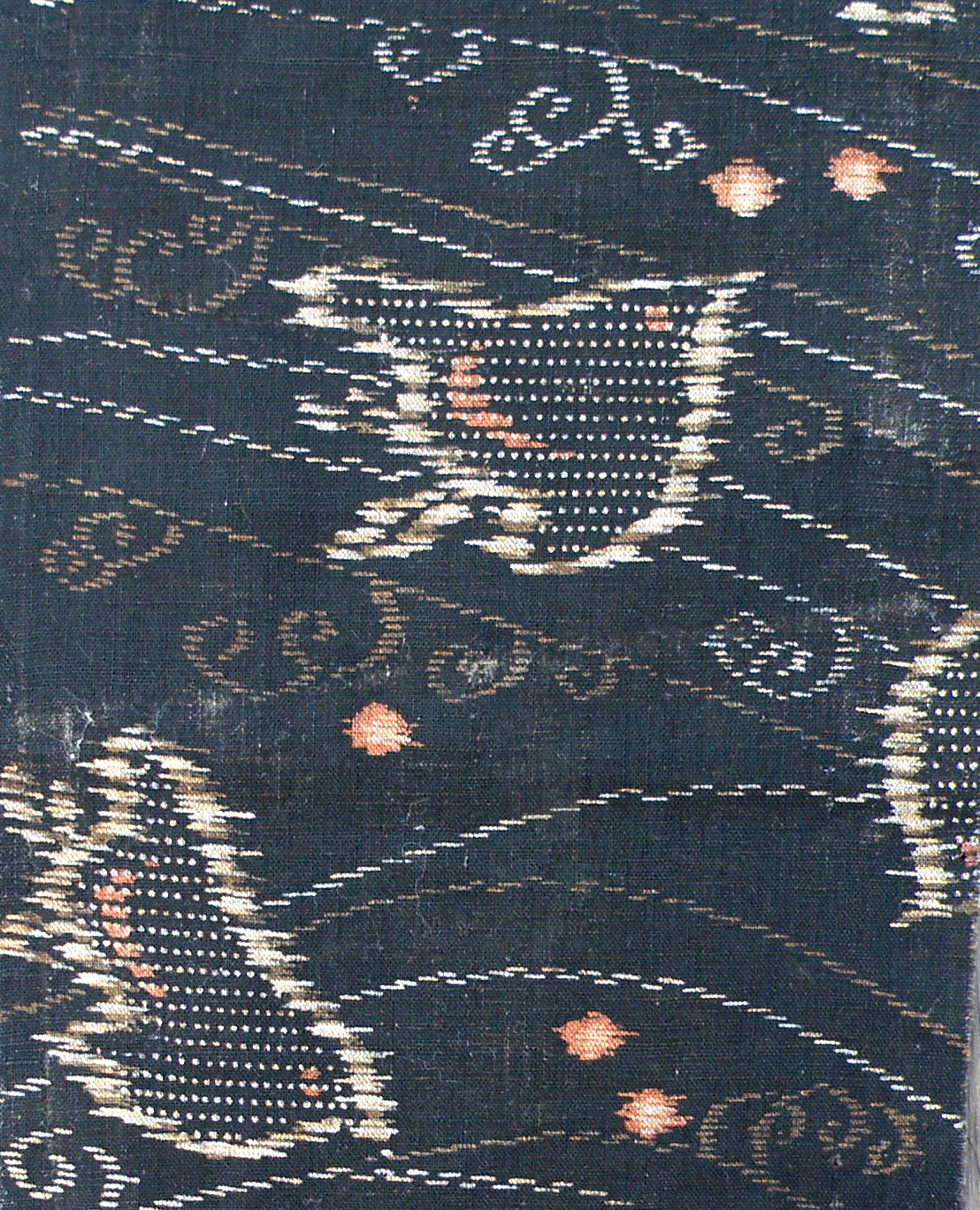
Nibutani-attushi is a fabric made from tree bark. Nibutani originates from the Ainu word (Niputai) translating to 'a land where the trees grow thickly' apparently.[1] The bark fiber is grown and harvested next to Biratori, Hokkaido by Ainu communities.[1] The bark is harvested and fiber contents scrapped from the interior layers of wild Manchurian elms in length strips. These strips then are left to dry and boiled with wood ash. The contents are removed in a sinewy like density, into thin strips of fiber content from the boiled bark and left to dry for 2 weeks.[1] These fiber contents are then left into very thin sheets and turned into 2mm threads. These tiny fiber contents are then woven into thread using a Attushi Karape which is a type of weaving loom perhaps, which uses a lot the dynamics of gravity to put weight on the warp and weft threads when weaving.[1] This is different from Honshu looms, as 2 people are required to operate the weaving process, and is a descendant of the Koshibata (back strap loom).[1] This craft has been produced as a traditional heritage craft since the early 20th century, around the first quarter of the 1900s.[1] The fabric is used for Kimono, Hanten (short coats), aprons, and accessories.[1]

Ainu craftsman in Nibutani at work (2014, CC2.0) Robert Kroos

Nibutani-attushi was originally made as a durable fabric for family members of the Ainu, this is most likely centuries before the 18th century when the first recognition of the craft was known to local literary languages. Later on down the line, Japanese merchants adopted the fabric and it became known throughout Honshu by the 18th century.[1]  Formal written records date this to around 1792.[1] By this time, the Ainu seem to have been due to a lack of access to the sea perhaps, going to the land to produce goods to sell to make their living.[1] This state of affairs would continue into the 20th century, when the craft was recognised by the Heritage Craft associations of Honshu, and then began to boom as an artisan production by the middle of the century. Nibutani crafting became a viable business in the 1950s and the craft went into mass production. These fabrics were some of the first tangible properties in Hokkaido to be designated as such in 2013.[1]

Bibliography

[1] https://kogeijapan.com/locale/en_US/nibutaniattoushi/

Socials:

One stop Link shop: https://linktr.ee/Kaguyaschest
https://www.etsy.com/uk/shop/KaguyasChest?ref=seller-platform-mcnav 
https://www.instagram.com/kaguyaschest/ 
https://www.youtube.com/channel/UC5APstTPbC9IExwar3ViTZw 
https://www.pinterest.co.uk/LuckyMangaka/hrh-kit-of-the-suke/ 

Sunday, February 18, 2024

塩沢おめし | Shiozawa Omeshi | Shiozawa Twist Dye Ikat | Fabrics #23

Shiozawa is a type of Omeshi made around Niigata prefecture. It is designated as Juji Gasuri ( じゅじがすり|crossed splash patterns ) which denotes the specific cross styles found across the tanimono.  Threads were first tye-dyed.[1] The weft is tightly wound before being spun and then placed onto a Takahata loom which leaves these distinctive cross patterns.[2] All bolts are to this day made by hand on these looms.[1] Warp threads are then dyed using tye-dye, stencils dyes or paper stencils.[3] These patterns can also be used to make different layers and levels of the work to leave a distinctive fabric gradient type effect on the final bolt. A type of silk crepe, Shiozawa uses these effects to leave a light textile crimp, much like linen.[2] Afterwards the cloth is washed in hot water and left to dry leaving the crosses exposed to the eye.[2]

Shiozawa Town (2016, CC4.0) Tariqsheikh

The murky proto history of Shiozawa Omeshi emerges from a Ramie sample known as Echigo Jofu found in the Shosoin, around 794 CE.[3] Shiozawa Hon emerged around 1750, after the Komin Masatoshi Hori created the modern hard-twist thread method used to make Shiozawa Omeshi by 1679 CE.[2][3] These were artisanal works though and are mostly thought to have been workshop specific pieces until the 20th century.[3] Modern Shiozawa Omeshi arose out of a need to create a new market for fabric in the area when industrialisation took root in the Taisho period (1912-1926). Shiozawa bolts were mostly created in masculine coded colours such as brown, blue, black and white. As time has gone on and the methods of production have turned to more fashion oriented needs rather than as everyday items, more variety has become available since the 1960s when presumably Shufu were targeted and has been made in more bold colours like reds.[1] 

Bibliography

[1] http://www.kimono.or.jp/dictionary/eng/honshiozawa.html

[2] https://kougeihin.jp/en/craft/0114/

[3] https://kogeijapan.com/locale/en_US/honshiozawa/

Socials:

One stop Link shop: https://linktr.ee/Kaguyaschest
https://www.etsy.com/uk/shop/KaguyasChest?ref=seller-platform-mcnav 
https://www.instagram.com/kaguyaschest/ 
https://www.youtube.com/channel/UC5APstTPbC9IExwar3ViTZw 
https://www.pinterest.co.uk/LuckyMangaka/hrh-kit-of-the-suke/ 

Saturday, April 1, 2023

刺し子 | Sashiko | Little Stab Stitch | Pattern #18

Sashiko ( 刺し子 | Little Stab ) is a simple continuous running stitch design atop a surface. The stitch is slightly longer atop than on the underneath.[1] Often many Sashiko designs are done in an interlocking, repetitive or overlapping manner, often using indigo cloth and white thread.[3] The nature of Boro and Sashiko traps heat, making it more likely to be found in the North of Japan where it is colder, also helping enable the cloth to last longer. Many of the motifs common to traditional Sashiko designs are from plants, animals or nature like clouds and steam.[3] Many Sashiko techniques and styles derive from local folklore and rural communities and were made for practical everyday wear.[4][5]

Fireman's Sashiko Jacket (c.1865, PD) LACMA

Sashiko began as a practical design element for the Heimin wives of farms/fisheries to show off their Embroidery skills in making kimono, like repairing Boro Kosode.[3] Due to the influence of the sumptuary laws, most Boro and Hemp Kimono were made creative by dying them in indigo, a readily available local dye for Heimin and some Chonin who travelled around for Sankin Kotai.[4][7] Japanese firemen until the 19th century used to have their uniform made from Sashiko stitch with padding, which was drenched in water to act a shield from fire during rescue attempts.[2] By the late 17th century however, these designs began to become part and parcel of a wider revolutionary aesthetic reform of Kosode surfaces which made the Chonin look more powerful than the Samurai, which was a no-no for the Fudai and Kuge Daimyo. In a bid to curb these powerful aesthetic markers of status, the Heimin were given designated fabrics and dyes which saw a rise in the popularity of Indigo Sashiko.[4]

Hokusai's New Patterns (1824, PD/CC4.0) British Musuem, Katsushika Hokusai

By the 18th century, fashionable Sashiko Kosode used local folklore to distinguish local meanings specific to their maker and communities, like the Hoshi-ami (干し網|Fish Net) design used by fishermen's wives when making Donzu/Noragi Coats, or for some Chonin the common characteristics of their daily lives from the city.[3][5] Particularly in the merchant town of Osaka, Sashiko would have a popular infusion of mother's frugal stitchwork, and being part of the new fashionable elite emerging there. By the 19th century, these designs were incredibly intricate and were no longer done in the Boro spirit, but to show off how skilled their creator artisan/embroiderer was.[5] For example the designs of  Hokusai-Moyo ( 北斎模様 | Hokusai-patterns/designs) which were particularly popular after Hokusai published his 'New Patterns' ( 新形小紋帳 | 1824).[8]

Decorative Harakata Sashiko (2019, CC4.0) 漱石の猫

Ms Endo teaches Harakata Sashiko (2018, FU; Education) Copyright Yamagata Newspaper Broadcasting 

 With the introduction of new chemical dyes and machine made textiles, Kimono were increasingly less labour intensive by the early 20th century seeing a decline in the popularity of Sashiko designs from 1950-1980.[6] As part of the 1990s Web Kimono boom however, teachers like Kiyoko Endo (dates unknown) began teaching laymen artisans and craftspeople how Sashiko is used as a folk art (Endo teaches Harakata Sashiko, a Yonezawa style) and has become popular today in the West amongst embroiderers.

Bibliography

[1] https://www.athreadedneedle.com/blogs/with-a-threaded-needle/sashiko-kogin-hitomezashi-boro-what-are-we-stitching 

[2] https://collections.vam.ac.uk/item/O18904/firemans-hood-unknown/

[3] https://indigoniche.com/2018/06/26/sashiko-origins-and-designs/#:~:text=Sashiko%20is%20a%20Japanese%20folk,in%20repeating%20or%20interlocking%20patterns.

[4] See Sumptuary Laws (1604-1685) in Bijin #3

[5] See The Genroku Osaka Bijin (1680 - 1700) in Bijin #3

[6] https://www.inspirationsstudios.com/the-history-of-sashiko/

[7] See Patterns #17

[8] https://mag.japaaan.com/archives/113368

Social Links:

Linktree (One click to all and extended Links): https://linktr.ee/Kaguyaschest

https://www.etsy.com/uk/shop/KaguyasChest?ref=seller-platform-mcnav or https://www.instagram.com/kaguyaschest/ or https://www.youtube.com/channel/UC5APstTPbC9IExwar3ViTZw

Sunday, December 11, 2022

ひとめ刺し | Hitomezashi | Single Stab Stitch | Pattern #16

Hitome-sashi/zashi (One Stab Stitch) is a type of Sashiko stitching.[1] Sashiko stitching being the famous white on blue technique of almost embroidery. The stitch makes up a geometric pattern from these white running stitches, sometimes wide sometimes miniscule to decorate or repair fabrics in a grid pattern.[2] As a task, Sashiko is said to be both therapeutic and time-consuming requiring a great deal of patience and concentration. Hitomezashi derives mostly from the practical applications of Sashiko and therefore was historically used for work uniforms, today it is mostly for repairing old clothstuffs. Many older examples come from Noragi (  野良着 | Workcoats) and Sashiko no Donzu (Fishermens coats) that have survived.[4]

Hitomezashi was originally used by Heimin as a way to mend old farming and fishermens textiles like Hemp or Ramie from the North of Japan, from around the Yamagata to Hokkaido areas.[1][4] Items started out life as Kosode, then became bags, aprons and cleaning rags.[4] Between 1600 - 1850, a majority of the working classes produced their own textiles due to the expense of buying new fabrics. It is thought that decorative stitches such as Hitomezashi originated as an ergonomic way to mend, fill in and layer fabrics for winter, becoming decorative through processes such as Tsukuroi-Sashi ( 繕いー刺しDarning Sashiko) by using undyed thread and repeatedly Darning older textiles into new ones every year. These skills were taught in school and at home to the children of farmers and fishermen.[4] Hitomezashi also spread around Japan byway of major trade routes like the Tokaido.[2][3]

Hitomezashi (c1850[2017], PD) Mr Bolton

During the Meiji period with the increase of Japan Inc, Japanese culture spread globally. Thus when agricultural workers moved to Hawaii, they took Hitomezashi with them, using it to repair their work clothes there, spreading the textile.[5] It may have also spread to Continental North America and other countries in the British Empire as it was popular during the 70's and 80's to adopt Japanese adjacent techniques among the middle class as an domestic Aestheticism (1868-1899) embroidery technique. In Japan with the promulgation of the industrialization efforts of Meiji Japan, Japan Inc. began to introduce new fabrics by 1870, making cotton available for those in Northern Japan.[3] In 1884, 'Sanitary Dress' was sent by the Japanese Government to display Health in the Workplace at the Health Exhibition. In the Exhibition  (likely Hitomezashi), Sashiko was displayed to showcase how Mens uniforms (Hakama) were made in Japan.[6] 

By the beginning of the 20th century however, Hitomezashi began to fall out of usage in favour of modern textiles flashy textiles. Meisen became more popular and workwear often became Tsumugi and  other wools as Japan Inc expanded in the 1910s and 20s.[7] Whilst Hitomezashi fell out of widespread use by the 1950s due to the import of quilting, older generations still held onto and used the technique. Northern Japanese communities still practice and teach Sashiko classes, a practice around since at least the 1990s. In the modern day, Kogin (another type of Sashiko) developed from Hitomezashi stitch.[4]

Bibliography

[1] Sashiko 365: Stitch a new sashiko embroidery pattern every day of the year, Susan Briscoe, 2022, p.5 | https://books.google.co.uk/books?id=fyqdEAAAQBAJ&pg=PT6&dq=sashiko+farmers&hl=en&newbks=1&newbks_redir=0&sa=X&ved=2ahUKEwjp59Wyhe37AhWPSMAKHdO4BtQQuwV6BAgKEAc#v=onepage&q=sashiko%20farmers&f=false

[2] https://www.athreadedneedle.com/blogs/with-a-threaded-needle/sashiko-kogin-hitomezashi-boro-what-are-we-stitching 

[3] Sashiko Pattern Book for Beginners: A Japanese Embroidery Art of Stitching, Angela Kemp, 2010, pp.10-11

[4] The Ultimate Sashiko Sourcebook: Patterns, Projects and Inspirations, Susan Briscoe, 2016, pp.8-15

[5] Japanese Immigrant Clothing in Hawaii 1885-1941, Barbara F. Kawakami, 1995

[6] Health Exhibition Literature, Executive Council of the International Health Exhibition, Council for the Society of the Arts, 1884, p.605 | https://books.google.co.uk/books?id=2fYTAAAAIAAJ&pg=PA605&dq=sashiko&hl=en&newbks=1&newbks_redir=0&sa=X&ved=2ahUKEwiTptDkm-37AhUxTEEAHbStBKcQuwV6BAgEEAY#v=onepage&q=sashiko&f=false

[7] See Fabrics #5

Socials:

https://linktr.ee/Kaguyaschest

https://www.etsy.com/uk/shop/KaguyasChest?ref=seller-platform-mcnav or https://www.instagram.com/kaguyaschest/ or https://www.youtube.com/channel/UC5APstTPbC9IExwar3ViTZw, or https://www.pinterest.co.uk/LuckyMangaka/hrh-kit-of-the-suke/

Saturday, February 5, 2022

デニム | Denimu | Denim | Fabrics #11

Denim is a modern fabric popularly worn in garments such as jeans, a kind of work trouser which has crossed over into everyday wear and fashionable as a skintight garment by the 2010s. Japanese denim is characteristically known for its darker dyes and using one single white weft thread in the design.[1] This produces a distinctive deep blue bolt with a unique selvedge.[6] Japan became first acquainted with Denim as a form of American agricultural workwear when it began sending Issei ( first generation | 一世 ) labourers to Statesian territories and this may have lead to it being brought back by 1890 to Japan as part of Boro ( Patchwork recycling | ぼろ) Kimono.[10] Denim reached its height of trendiness in the late 20th century as a staple of Zoku youth subcultural fashions, becoming a Japanese made textile by the 21st century.

Boro Shikimono which uses indigo dyes (c1899[2017], PD) Fæ

The design of Japanese denim imitates the best quality North American designs which were left behind in Japan after WWII by western soldiers.[1] Modern Japanese designed denim heavily uses indigo dyes, whereas most denim today is dyed with synthetic indigo dye. As with all Denim fabric dyeing, Japanese Denim is divided into two categories: indigo dyeing and sulfur dyeing. Indigo dyeing producing the classic indigo blue and Sulfur dyeing producing specialty black, red, pink, purple, grey, rust, mustard, and green dyes and designs.[6] Japanese Denim is often not ripped or distressed as it is an expensive work of art, not mass manufactured garbage. When dyed, the yarns are repeatedly undergoing a sequence of dipping and oxidation—the more dips, the stronger the color of the indigo,  a series of rollers that feed continuous yarns in and out of dye vats.[6]

All denim is generally made by spinning cotton fiber (sometimes silk) into yarn, and the warp yarn then dyed by either rope-dyeing or sheet dyeing. In rope dyeing, continuous yarns are gathered together into long ropes or groups of yarns – after these bundles are dyed, they must be re-beamed for weaving. In sheet dyeing, parallel yarns are laid out as a sheet, in the same order in which they will be woven; because of this, uneven circulation of dye in the dye bath can lead to side-to-side color variations in the woven cloth.[6] The weft is left white and the yarns are woven on a shuttle loom or projectile loom. The woven product is then sanforized which is a process which reduces fiber shrinkage by setting it into one shape during the production stages.[6] This gives Jeans their sturdy and yet stretchy feeling. Toyoda shuttle looms of Kojima, a subsidiary textile company of the industrial giant Toyota, are used to make Japanese Denim, which allows for greater craftmanship to show through in the final product.[1] This loom is what gives Japanese denim its higher quality selvedge which is a marker of its time consuming labour and sturdiness.

Denim Selvedge is here done in White (2018, CC4.0) Coldwrld

Historically, Denim began its life in the French city of Nîmes, where it takes its namesake from. In 1690, silk was mixed by Nimes farmers with cotton, a readily available textile in the Cevennes mountains, to create a twill weave blend of indigo yarns and white silk as their workwear.[7] It is thought that this fabric then migrated with other labourers into modern Canada as workwear by the late 1700s, where it was worn as an overall.[8] In 1872, Levi Strauss a wholesale merchant launched his overalls which popularised Denim in Statesian land by spreading the appeal of Denim workwear to other American industries.[7] From 1885 with the emigration of female labourers from Japan to the United States, the Hawaiian Japanese female population became associated with Denim as a workwear fabric which they used to make their Ahina aprons.[10] By the 1920s, Denim began to be found in Japan.[8] In the 1930s to prop up manifest destiny, more Cowboys and Indian films were being made, which Denim become a fashionable item of Americana.[9]

Denim flourished in Japan after 1945, when Japan lost WWII, or the 'Pacific War'.[1] Found in the then thriving secondhand and black markets (I cant think why MacArthur Jr.), Denim would have been a discarded textile garment left behind by American soldiers returning home. By 1955, it was seen as part of the counter-culture to wear denim as a way to piss off Tokyoites conservative parents.[1] RANT: Now I often hear this is because it was 'Muricas Softpower' influence, but archival liberation shows Japanese people often had at the time so little access to these due to the fact that money was worthless that it just was seen as an 'American' import like chocolate (technically so as that comes from Mexico byway of Britain) so it was used to subtly say 'f.u.' to the morals and ethics of a previous generations stuff ups, as the term 'Yankee' coined around 1975 (when young people born in the war came of age), means troublemaker, not cool Statesian.[2] Unfortunately, a large number of young people would have gone without, as in Britain, due to shortages, UNTIL THE LATE 50s, unlike in the States where people had plenty due to their thriving economy. 

Ametra (Ame[rica] Tra[ditional] | アメツラ) as it has since become known, is a Japanese style which first adopted North American styles like the Ivy Prep style in 1964.[3][4] The wealthiest groups first begin wearing Denim this way and were dubbed Taiyōzoku ( Youths | 太陽族 ) by the Japanese press after the 1955 novel Season of the Sun ( Taiyō no Kisetsu | 太陽の季節), similar to the Ivy League look.[1][5] By the end of the 1960s though, production costs took precedence in Statesian land, and the export of good quality products to Japan became scarce. By 1972 in Kojima, Japanese designers began to create their own denim, inspired by the 1960s left behind American fashions which were popular in the previous decade. Kojima remains the Japanese denim hub today. These eventually became large businesses which specialised in Denim production on traditional looms around Osaka by the 1980s.[1] However, Denim still retained a patina of Westerner. Albeit Westerner chic. 

And with this westerner chic, came the emergence of the 1990s on revival of vintage Kimono and upcycling. This in turn, came from the pizza effect Kimono and Denim often had as part of globally adopted textile culture. From 2005 for example, 'An Yoon Jung presented a rhinestone accented denim kimono wrap jacket'.[12] By the 2010s, Denim became a fabric Japanese craftspeople had grown familiar with. Since 2008, Kyoto Denim have created Kimono inspired accessories in Denim and from 2014, created a series of 'Kimono' in Denim.[11] Jotaro Saito exhibited a full denim kimono in 2016.[13] Sheila Cliffe also notes in her 2017 book of a number of designers using Denim, showing the wider acceptance and upheaval Kimono is currently undergoing, probably a similar process to that of Velvet Kimono design in the 1590s.[14] Denim thus has been used in Kimono since the arrival of Issei in Hawaii in the 19th century and by 2008, been accepted as a domesticated imported textile, and as such suitable for domestic Kimono usage and used to draw in wider, contemporary and modern global audiences towards KTC.

Bibliography

[1] https://redcastheritage.com/pages/history-of-japanese-denim

[2] https://languagelog.ldc.upenn.edu/nll/?p=35615#:~:text=In%20any%20case%2C%20the%20association,on%20in%20the%201980s%20nationally.

[3] https://subcultz.com/ivy-league-japan-1964/#:~:text=The%20first%20Japanese%20to%20adopt,means%20subculture%20or%20social%20group)

[4] https://www.esquire.com/style/mens-fashion/a22804481/japan-tokyo-ame-tra-american-traditionalist-style-fashion/

[5] https://en.wikipedia.org/wiki/Zoku#1950s/60s

[6] https://en.wikipedia.org/wiki/Denim

[7] https://theculturetrip.com/europe/france/articles/how-the-history-of-denim-can-be-traced-back-to-nimes/

[8] Personal research.

[9] http://www.historyofjeans.com/jeans-history/history-of-denim/

[10] Japanese Immigrant Clothing in Hawaii 1885-1941, Barbara F. Kawakami, 1995, pp.104-105

[11] Kyoto and Nara: Rough Guides Snapshot Japan, Rough Guides, 2014 | https://books.google.co.uk/books?id=vLOBBAAAQBAJ&pg=PT72&dq=%22denim+kimono%22&hl=en&newbks=1&newbks_redir=0&sa=X&ved=2ahUKEwiL-_-O2eb1AhURhlwKHT0ODAgQuwV6BAgHEAc#v=onepage&q=%22denim%20kimono%22&f=false

[12] International Textiles, Stephen Higginson, 2005, Vol. 843, pp.unknown, Benjamin Dent & Co

[13] https://www.japantimes.co.jp/life/2016/03/26/style/designer-jotaro-saito-seeks-free-kimono-confines-tradition/

[14] The Social Life of Kimono: Japanese Fashion Past and Present, Sheila Cliffe, 2017, pp.134-164

Social Links

One stop Link shop: https://linktr.ee/Kaguyaschest

https://www.etsy.com/uk/shop/KaguyasChest?ref=seller-platform-mcnav or https://www.instagram.com/kaguyaschest/ or https://www.youtube.com/channel/UC5APstTPbC9IExwar3ViTZw https://www.pinterest.co.uk/LuckyMangaka/hrh-kit-of-the-suke/ 


Saturday, September 11, 2021

阿波 しじら織 | Awa Shijira-ori | Crinkled Cotton Weave | Fabrics #7

Awa Shijira-Ori is a woven fabric which resembles a crinkly cotton finish. This uneven finish is known as Shibo ( Down-up | 凹凸 ). Shijira is originally made in Tokushima, and is usually worn as a summer textile for workwear or as yukata, being able to combat the humid Japanese summers easily as it is commonly woven using cotton threads with an open weave in indigo dyes.[1][3]

Shijira weave is made by sorting, measuring and scouring your yarns. The yarns are then dyed and rinsed as the colour dictates, measured and dried. These yarns are twisted into threads, as tight uneven weft threads and immersing the yarn underwater in a vat. These are removed being left out to air-dry with 'gloiopeltis glue' added which stops the threads from 'fluffing'. The warp threads are re-submerged in hot water, (75 degrees) to remove the glue and the process repeated and are at times dyed in another colour simultaneously.  The two warp and weft threads are combined into the loom and woven together, the warp threads being more shrunken due to their greater exposure and treatment, creating the 'crepe' or crinkle finish in their bid for freedom from the tighter weft threads. The fabric is measured and resized with the rolling the cloth into a Tan ( 反 | Kimono fabric roll ) fabric bolt of around 1100cm length, 40cm wide. This creates a varied pattern of alternating bumpy threads and one separately dyed warp threads as the threads shrink and dry, creating a vivid Shijira weave stripe pattern with its definitive Shibo quality.[1][3][4]

Tokushima Prefecture (2007, Public Domain) Bobo12345

During the Edo period, the lord of Awa decreed that Heimin (commoners | 平民) were not to wear silk, part of the Sumptuary legislation in reaction to the wealth of the merchant classes (1604-1685) and regulation of export and imports of foreign trade in silk and cotton (1615-1685) in the wider Edo culture and tightening of the textile trades.[2] Instead therefore, the Heimin created and found new beauty in textiles such as Shijira weave or Tatae-Ori as it is known in Tokushima, which was worn by farmers, becuase of its light and durable nature and fun patterns. During the Meiji period, the technique was recovered in Awa's Atake village by Kaifu Hana c.1860-1869, when a striped Kimono had been left out in the rain, and dried in the sun. Hana noted that sections of the cloth had shrunk, producing the Shibo effect.[5] Inspired, she recreated the effect after much trial and error by reweaving warp threads in a cotton weave, creating the desired puckering or Shibo.[1] By the of the 1890s, production of the cloth totalled 2 million bolts a year, today only in its thousands by a handful of family owned businesses.[3] By the 1910s, the  traditional association with indigo dying was superseded by brighter chemical dyes, but was revived after 1945 and designated in 1978 under Awashouai-Shijirao as a traditional craft.[5] The textile is now protected and still made locally in Tokushima Prefecture in industrial quantity.

Next Fabric post will be on Chirimen.

Bibliography

[1] http://www.jtco.or.jp/en/japanese-crafts/?act=detail&id=252&p=36&c=33

[2] See the Bijin Series Timeline and Bijin post #3

[3] https://theardentthread.com/2010/02/03/awa-shijira-ori/

[4] https://voyapon.com/kimono-japanese-traditional-clothing/

[5] Swatch Favourite Fabric No 41 Awa Shijira-ori, Sarah Jane Downing, March 2018, Issue 81, p.98, Selvedge Magazine, London | https://issuu.com/selvedgemagazine/docs/81_japan_blue

Socials:

https://linktr.ee/Kaguyaschest

https://www.etsy.com/uk/shop/KaguyasChest?ref=seller-platform-mcnav or https://www.instagram.com/kaguyaschest/ or https://www.youtube.com/channel/UC5APstTPbC9IExwar3ViTZw, or https://www.pinterest.co.uk/LuckyMangaka/hrh-kit-of-the-suke/

Sunday, August 15, 2021

縦横絣 | Tate-Yoko-Kasuri | Tight Woven or Ikat Silk | Fabrics #6

Tate-Yoko-Kasuri is a tightly woven or Ikat derivative textile made on the Okinawa and Ryukyuu Islands. Tate is similar to the texture of Tsumugi silk. Tate-yoko refers to the warp and weft which due to their being combined, form the Double Ikat texture of which Meisen is based upon in central Japan, Tate-yoko however predates the Honshu variant of the design. The 'suri' of Kasuri is said to have originated in the phrase 'zure' meaning 'to shift'.[5]  The majority of what is handed down to us from history is from the Kyushu variant of the cotton weave in Fukuoka. Local sites of historical and traditional production sites include on Okinawa the Naha, Haebaru and Shuri sites and in Ryukyuu, around the Kurume area.[9]

Womens' Tate Kimono (c.1900-1939[2018], CC1.0) Honolulu Musuem of Art

Tate refers to the warp, which is the horizontal weave. Yoko refers to the vertical portion of the weave. To change the desired pattern, pressure is applied or taken away on the weavers pedal opening and closing the amount applied to the Yoko. The pressure on the reed then determines the space between the Tate and Yoko which determines the tightness or blurriness of the pattern. In Kurume Kasuri, the white threads are created by overlapping the Yoko and Tate together in this desired way and with repeated washing, highlights the white area of the pattern.[5]

Wikimedia Commons (1878,[2012] CC) Alfred Barlow

Kurume designed Tate-yoko often includes traditional Indigo dyes, often including Checkerboard, arabesque, animal and flower motifs.[2][3] The design is often in a dark indigo dye contrasted with bright white threads in interlocking patterns made by the weaver. Producing a bolt of cloth in the traditional manner can take up to 3 months.[4] The design is crafted in the same weave pattern as Meisen, drawn up beforehand in a premade pattern although often in more subdued colours from plant dyes found in the Fukuoka Chikugo River Basin area.[5] 

Historically the designs comes from some dry ice mist filled mysterious part of South East Asia, most likely Indonesia. Ikat originated in South East or Central Asia, sometime before 3000BC. Double Itak originated in Tenganan, East Bali, Indonesia as Geringsing Double Itak. This spread via the vast trade networks of the great Asian empires of modern day India and China along the silk road to as far as Egypt and became a widely available textile. Ikat then arrived in modern day Japan around 1100AD, eventually entering Japan proper in the 1300's when the Ryukyuan Kingdom began trading with Japan. Initially as these fabrics were scarce, they were only worn by the richest people in Okinawa at the time.[9] 

Yoko Kasuri (c.1596-1615 [2018] CC1.0) Honolulu Museum of Art

It was said that the local Kurume variant was developed by Inoue Den (1788-1869) who belonged to the local ruling Arima-Kurume Clan in Chikugo, Fukuoka, Kyushu from 1701 when she began adding the white spots 'Kurume Kasuri' is famous for after discovering them as patches in old and worn out textiles.[5] Around 1839, Otsuka Taizen (date unknown) who was based in the Mizuma area developed the Egasuri technique by creating new patterns in the fabric using a standing wooden plank to create the patterns by hand.[7] Large patterned fabrics were used by women, mostly as workwear, and smaller patterns were adopted by scholars and later became menswear. [5]  After 1609 when both the Okinawan and Japanese Kingdoms merged, the Ikat technique began to be used in Kyushuu, becoming regarded as a local textile by 1850.[1] Common uses included purposing the textile as bedding by the end of the Edo period.

Tate Kasuri Mulberry Stencil (c.1851-1949) Helen Snyder

When the Satsuma clan came, trade between Okinawa and continental Asia declined when Okinawa came into the Japanese sphere of influence. Japanese motifs such as the Katagami pattern shown above thus began to be produced. Okinawan and Ryukyuuan Ikat weaving as a trade fell sharply as the industry became heavily regulated and unprofitable as trade sanctions went into effect from 1864-1868. When sanctions lifted, Okinawa Kasuri became worn by regular people as workwear. By this time, Kurume Kasuri had begun to become more popular due to better technological advances in design and Okinawa styles became influenced instead by styles from Kurume, Fukuoka, Ryukyuu in particular.[8] By the Meiji era, production moved towards meeting demand on Honshu and became increasingly mechanised. After the Meiji period, production began to drop with the availability of Meisen textiles I presume. From 1899 though, with the inception of machinery, the style began to become popular again when Kunitake Goda Co., Ltd., established in 1899 by the industrial entrepreneur Kunitake Kijiro (active 1899-1904) developed Kurume Kasuri into a modern industry.[6] He did this by mechanising the Egasuri technique as not a plank but tube which feeds into a power loom.[7][10] In 1907, indigo dyes began to be replaced by German chemical dyes which produced brighter and other vivid colours.[5]  In 1912 major production shifted from Naha to a new Haebaru cottage industry sprang up in the local area of Okinawa.[9]

Fabric made using E-gasuri (20th century[2013], CC3.0) Chris Hazzard

With the WWII, as in general textile production, the industry saw a decline in demand and therefore was reduced in size from 1945 on.[9] From 1975 though interest in Ryukyuu Ikat was once again sparked and a local cooperative society was formed to bolster the industry as well as Ryukyu Hanaori which uses local indigo plants rather than Kurume indigo. In 1980, Kasuri Ikat hall was built to showcase traditional Ryukyu Ikat.[9] Today modern products made in 'Kurume Kasuri' are made by an Italian-Japanese company Kimonissimo which launched in March 2021.[4]

Bibliography

[1] See Fabric series #5 

[2] https://ktaylor-lotus.com/inventory/j15-5244

[3] https://www.mercari.com/jp/items/m94362956778/?_s=U2FsdGVkX18F097cGLcsvohYmGrNvnTAfsWhc4-6oKs_xkzqJ4i7MAlfniAuHdt4L4PY6p2-tA2F7ukqWB3ikzHWWdkgBtW3U-jULkO6pCWdh9XKAxtxInFbUfoTdRqp

[4] https://metropolisjapan.com/based-in-japan-kurume-kasuri/

[5] https://en.yame.travel/crafts/kurume-kasuri/

[6] https://www.google.com/maps/contrib/109015429734549306064/place/ChIJe1KuE1ekQTUROpTXrNam148/@33.3159088,130.5160818,17z/data=!3m1!4b1

[7] https://oriyasan.com/en/koe/20200901/

[8] http://ryukyukasuri.com/?page_id=257

[9] https://www.rhs-japan.org/en/tourism/ryukyukasurikaikan/

[10] Reconsidering the Japanese Industrial Revolution: Local Entrepreneurs in the Cotton Textile Industry during the Meiji Era, Naofumi Nakamura, January 2014, pp.23-44, Social Science Japan Journal 18

Friday, July 23, 2021

銘仙 | Meisen | Woven or Pongee Silk | Fabrics #5

As promised for once (seeing as I doubled up on Essays and then instead did a Pride Kimono Essay, I still have so much E&AKTC media I want to analyse so badly!) I will be reintroducing you to the wider history of Meisen (woven or Pongee) Silk. To the touch, it is immediately recognisable as it the rougher, heavier silks which are recommended for work and winter.

Meisen is a woven or spun silk, produced from waste cocoons/raw of pre-dyed silk threads, and is a popular everyday silk for its durability and its ability to be reused as a fabric even when worn frequently as workwear. This technique is also known as Ikat, but Japanese Ikat or Meisen is known as the thickest or heaviest Ikat weave, also known as double Ikat weave.[1][2] Now I will admit, in softness to DEAR GOD THAT SCRATCHY- the order goes Omeshi, Meisen, Tsumugi, Omeshi being cotton smooth, Meisen the itchy stuff and Tsumugi the dark brown material only scratchlords love, but Meisen often falls into the scratchier rougher silks in my handling experiences as a textile collector myself.

When the threads are woven, they commonly apply loose waste silks to the weave, or by stretching the threads to the desired length and tightly binding the design before the dying process known as Nassen. The dye method of production in creating a design is known in Japan as Kasuri (resist dye) which gives Meisen its signature patchy, rough edged or blurred design look when the design stencilling (the stencils made from mulberry paper reinforced with Toxicodendron vernicifluum or since the 1960s plastics) is applied atop; using a spatula or wide hand brush called a Hake (刷毛).[7][8][14] Stencils are also cut with a knife or precision instrument.[9] The dyed yarn is then rolled up and placed into a Mushibako (a steam tube).[9] The final design is adjusted by applying hand painting or embroidery.[1] In Ikat, this process can be repeated multiple times to produce elaborate, multicolored patterns by dye, whereas Meisen also applies dye after the fabric has been woven as well. The tighter the weave, the greater the skill of the craftspeople involved due to the loose threads involved often being shorter than desirable for silk production. Meisen patterns show up on both side of the finished product due to the double printed design formed through Hogushi Nassen.[2] Meiji Meisen peices used chemical dyes to create the design, mixing rice paste or Konjac paste atop the stencilling process to warp threads after being woven with the weft. The weft threads were then undone, taken out and replaced for reuse on old boards, this being a new Meiji technique which replaced traditional Ikat production of kasuri in which chunks of threads were tye-dyed on their own in a slow and repetitive process by hand to avoid unwanted dye being spread during skein contact.[7] 

Historically, Ikat originated in South East or Central Asia, sometime before 3000BC.[2]  Double Itak originated in Tenganan, East Bali, Indonesia as Geringsing Double Itak. This spread via the vast trade networks of the great Asian empires of modern day India and China to as far as Egypt and became a widely available textile.[4] Ikat then arrived in modern day Japan around 1100AD, eventually entering Japan proper in the 1300's when the Ryukyuan Kingdom began trading with Japan. After 1609 when both Kingdoms merged, the Ikat technique began to be used in Kyushuu. By 1750 with continuing growth of the Honshu population and demand for greater cotton production, the technique had moved into Nara.[6] With the increasing growth of Ikat production in Japan, Ikat weaving became a Honshu cottage industry produced in specific villages which gave rise the creation of Ikat as a local Japanese textile, or textiles which became Meisen. By 1850, Bingo or modern day Hiroshima had its own local variant for example.[5] In Japan from 1868, Meisen grew in popularity due to Ikats popularity as textile abroad. In 1873, Japan first participated in the International Exhibitions where it is thought Japanese artisans first began bringing new European chemical dyes back to Japan to work with.[16] In 1882, it was said that expats such as Kondo Tokutaro and Inabata Katsutaro (1862-1949) began to return from Lyons France and reinvigorated the trade of Ikat weaving in Japan.[12] This became Chichibu Meisen when Sotaro Sakamoto (坂本宗太郎) patented another Meisen technique in Chichibu in 1908.[9] Between WWI (1914-1918) and the devastating 1923 earthquake silk production costs fell as Japan reaped the rewards of being a major power who had bolstered heavy industry in the Taisho era.[13] Cheaper silks thence began to be easier to produce due to advances in weaving technologies and new chemical dyes on production lines made Meisen Kimono incredibly cheap, incredibly decorative and incredibly bright Kimono.[9][15] From 1910 - 1935 therefore was the Meisen Renaissance.

Meisen machine made Kimono (Taishou) Khalili Collection

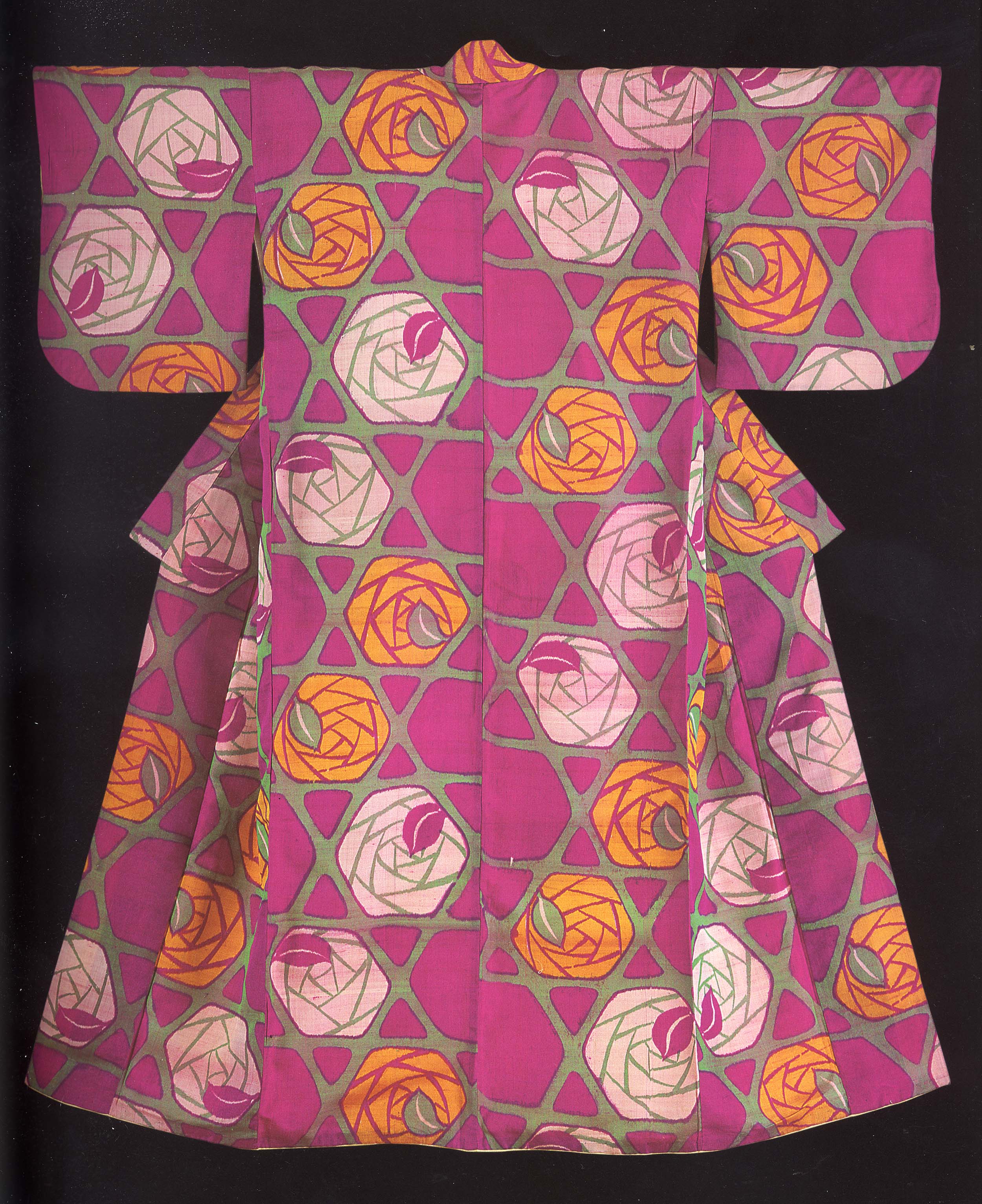
From 1920 - 1939 Meisen therefore became fashionable everyday wear and it was during this period that Meisen became most popular, with work being outsourced to the Greater Co Prosperity Circle as it was known for the cheaper labour of Korean and Chinese workers.[5]  It was said that 50% of the women in Ginza at this time wore a Meisen Kimono and became what can be regarded as Taisho 'fast fashion' by 1920 and would set you back today by 20-30,000¥/£2-300/$250-350 in todays money.[8][14] This Meisen renaissance saw the proliferation of these garments in large Department stores with popular actresses of the Taishou and early Showa eras.[7] This in keeping with the times allowed for the proliferation and greater production of Meisen silk with production reaching its peak by the 1930s. With the increasing global role Japan played on the world stage, the textile industry incorporated foreign cultures and motifs such as European Art Deco, Fauvism and later Cubism and Modernism for example into their own designs.[12][16] This is seen in the pizza effect of Meisen Kimono's flowing water motif and ribbons said to guard against evil spirits, motifs regurgitated through the Glasgow modern style, being used by the Finnish/Swedish company Marimekko who were inspired by Meisen Taishou design of 'stripes, cross[es &] arrow feathers' in the 1960's and 1970s.[11][12][16]

After WWII production began to slope downwards from the loss of the labour pool and that as an everyday, common, durable reusable fabric, secondhand long lasting Meisen silk had a larger supply in the market which made new production particularly unprofitable. By 1960 with the consumption and promotion of western styles, Meisen production declined drastically and as a readily available fabric with no demand, production almost ceased. Today the majority of Meisen is made in Honshu, focused in Gunma and the Kanto region using Tama-ito (Dense raw summer silk yarns) and Noshi-itou (Silk thrums), also other smaller sites include Kyoto, Isezaki, Chichibu, Ashikaga, Kiryuu, Hiroshima and Hachiouji and in Okinawa as Tate-Yoko in Kurume and Ryukyuu.[1][2][3][10] Modern artists like Michiko Sugihara of Isesaki who stages a Meisen fashion show each year, and Tamayo Kanai the curator of the Isesaki Meiji Musuem, today keep the tradition and history of Meisen alive in modern Japan, partially as Upholstery fabric for interior design and small personal items such as handbags.[7][10] Other artisans like Yasuo Kikuchi, who are increasingly retiring as with many heritage trades like Bashofu weavers for example, keep the tradition alive by offering classes and demonstration workshops in the Chichibu Meisen Museum.[9] Other Meisen musuems are available. 

Scholars such as Anna Jackson and Karun Thakar have also published work on Meisen Kimono in 2015 (Kimono Meisen: The Karun Thakar Collection, which holds 250 Meisen Kimono from 1300 on), and were held on display at the V&A in the Kyoto to Catwalk 2020 Exhibition. For further photos and details on Meiji era machinery, see SalzTokyo's excellent blog on Meisen in Chichibu: https://www.salz-tokyo.com/chichibu-meisen-hogushi-weaving/.

Patterns #6 will be on Tate-Yoko-Kasuri, another Ikat derivative.

Bibliography

[1] https://www.faburiq.com/blog/2014/10/21/0wtatbkndhaesj8ccxt6a9wq8878nm

[2] https://en.wikipedia.org/wiki/Ikat

[3] http://www.johnmarshall.to/H-TradTech-Tategasuri.htm

[4] https://www.wowshack.com/the-amazing-story-of-ikat-how-a-textile-wove-itself-into-indonesian-history/

[5] https://en.wikipedia.org/wiki/Kasuri

[6] https://en.wikipedia.org/wiki/Demographic_history_of_Japan_before_the_Meiji_Restoration#Population_during_the_Edo_and_early_Meiji_eras_(1600_to_1873)

[7] https://www.vam.ac.uk/blog/news/japanese-meisen-dyeing

[8] https://home.ginza.kokosil.net/en/archives/72310

[9] http://www.salz-tokyo.com/chichibu-meisen-museum-nassen-dyeing/

[10] https://www.salz-tokyo.com/chichibu-meisen-hogushi-weaving/

[11] https://www.rundetaarn.dk/en/event/meisen-kimono-2/

[12] https://www.meisenkimonocollection.com/thestoryofmeisen

[13] https://wattention.com/meisen-the-funky-kimono/

[14] http://nationalclothing.org/asia/28-japan/329-meisen-kimonos-launched-a-new-trend-in-japanese-folk-fashion-in-the-early-20th-century.html

[15] https://hali.com/news/meisen-kimono/

[16] https://reader.exacteditions.com/issues/43418/page/90

Socials:

https://linktr.ee/Kaguyaschest

https://www.etsy.com/uk/shop/KaguyasChest?ref=seller-platform-mcnav or https://www.instagram.com/kaguyaschest/ or https://www.youtube.com/channel/UC5APstTPbC9IExwar3ViTZw, or https://www.pinterest.co.uk/LuckyMangaka/hrh-kit-of-the-suke/

Sunday, June 20, 2021

秩父銘仙 | Chichibu Meisen | Chichibu Woven Silk | Fabrics #4

Chichibu Meisen is a double sided woven silk made in Chichibu, Saitama, Honshu. CM is made from raw, dupioni raw, floss, or spun silk made from waste cocoons and waste raw silk, and is a popular everyday silk for its durability and easy capacity to wish and reuse it.[1] 

Historically CM began around the time sericulture and silk weaving was introduced from Korea or China between 300-800AD.[2] Local traditions hold that this was the local Shinto deity Chichibu Hiko-no-mikoto who did this.  The local topography was heavily built up with mountains, which made rice grops difficult to grow, so sericulture eventually become the main local commodity in Chichibu. CM was at first due to its nature as a stubborn material or Futo-Ori (| Thick weave) made from waste product, worn by Chichibu farmers. In time, CM spread outside of Chichibu, and was known as Oni-chichibu, and eventually became an acceptable fabric for the Samurai class to wear due to its durability and sheen. This production was well established by the 18th century.[4]


Chichibu Saitama
A Moga (1927)

By the 1890s, the Japanese goverment sensing the encroachment of Westernisation and seeing the effect of Western colonisation in Asia, began to promote traditional Japanese arts and art or cottage industries. These led to the promulgation of traditional trades like CM production becoming joint with technology, producing new techniques like Hogushi-Ori (Virgin Thread sorting).[4] In 1908, the first Hogushi Nassen (ほぐし捺染 | Loose silk threads first dyed and then woven) technology was patented in Japan allowing for more elaborate patterns to be created.[1] Meisen then by the 1920's with an increased production capacity due to the increase of heavy textile industry began to become worn as a staple in womens fashion, most commonly worn by the Moga (モダンガール | Modern Girl).[5] The colours of Chichibu Meisen were particularly bright, and the patterns made allowed for a greater variation in Ji-monnyu than had previously being available to Kimono designers.[4] Moga often bought these kimono in Department stores, which popularised art deco Meisen and showed the modernisation of the 'New Japan' (itself arguably an adapted Western ideology deriving from contact with Western through 1853-1876), with skyscrapers, high-speed trains, and plane motifs from 1910-1930. From 1930-1940 with the changing political landscape of Japan, these patterns frequently became more charged and tied to national patriotism, such as Meisen depicting military themes, often made in rayon, mainly in regions north of Tokyo.[6] When Longingism took hold in the court of the MacArthur shogunate, Kimono become 'the old thing to wear' so to speak and 'modern Japan' once again took off from where Old 'New Japan' had taken and production of new Meisen declined rapidly, reverting back to workwear rather than being a trendy garment from the 1960s onwards, and may have seen an uptick of resurgence as a fashion item from 1990-2009 in Japanese and foreign womens Kimono from the bright designs of Taisho Meisen kimono, a large number of which survive because they are Chichibu Meisen as part of the historical revival moment in Kimono-Hime, popularized in the west at least in the fanzine Kimono Hime.

A Meisen Haori with Battleship motif (1926-1945) CC

Chichibu Meisen is made with leftover silk threads and is created by Temporal weaving, Printing, Steaming, Drying, Rollback & Weaving. Weaving is first done by sorting the white warp threads into the desired length and number and set in the loom and the weft threads wound around tubes. Temporal weaving refers to creating the desired pattern with the weft threads in the loom which prevents shrinkage during the Katazome process. The warp threads are then spread from the tubes over a printing stand and Katazome is applied to them using one stencil at a time. A frame with the pattern inside is placed atop the warp thread stand and the pattern is gradually applied by moving the frame and applying dye through the stencil with a brush. More than one colour requires the warp threads to be redyed as many times as there are colours. By dying the weft and warp threads this creates the double-sided effect or Hogushi Nassen technique of CM. The threads are then refined by immersing them in Shinsen which bonds the dye agent to the threads, then placed in a Mushibako (steam box or tube) which fixes the dye to the threads. The threads are removed and left to dry by tumble drying. The warp threads are then rolled back and check over and adjusted as needed, a process known as rollback.  

Weaving is then done by setting the warp threads in the loom and sorting and loosening (Hogushi-Ori) the weft threads to fit the end pattern using hand-thrown/flying shuttles with a treadle. The shuttles slide the weft threads in the loom, auto-weaving machines and shuttle looms which replace weft threads are also used to prevent breakage. Hogushi-ori/-nassen (Loose sorting/dying) creates the double sided sheen when the warp and weft threads join in CM silks, which was valued by Samurai for its durable and shiny qualities.[1] CM is still made today in Chichibu, being regarded a Traditional Crafts of Japan in 2013; to learn more you can visit the Meisen Kan Musuem in Chichibu.[3]

Fabrics #5 will be on the wider history of Meisen fabrics, next post will be on the Dori-Kimono style.

Bibliography

[1] https://kogeijapan.com/locale/en_US/chichibumeisen/

[2] See Fabrics #3

[3] http://www.meisenkan.com/english/

[4] https://www.ana.co.jp/en/gb/japan-travel-planner/saitama/0000013.html

[5] https://www.researchgate.net/publication/235733818_Why_was_Meisen_Japan's_traditional_working_clothe_accepted_well_in_the_market_as_everyday_clothes_and_stylish_garments_between1900_to1930

[6] https://www.thecityreview.com/kimono.html

Social Links:

Linktree (One click to all and extended Links): https://linktr.ee/Kaguyaschest

https://www.etsy.com/uk/shop/KaguyasChest?ref=seller-platform-mcnav or https://www.instagram.com/kaguyaschest/ or https://www.youtube.com/channel/UC5APstTPbC9IExwar3ViTZw https://www.pinterest.co.uk/LuckyMangaka/hrh-kit-of-the-suke/

I had exciting topics

 and then I got sick. and then I got heatstroke. and then my home became 35 degrees. and then i was sick again. and then i got mild food poi...