Her Haughtynesses Decree

Showing posts with label Occident. Show all posts

Sunday, February 4, 2024

仏米シンガー王朝とそのキモノップ | Franco-American Singer Dynasty and their Kimonopes | 1885 - 1951 | Essay #23

Winnaretta Singer (1865-1943) and Daisy Marguerite Séverine Philippine Decazes de Glücksberg Fellowes (1890-1962) were both American-French socialites, who interacted in many ways with the white elites of the American-French fashion industries. They were heavily complicit in the racist structures and depiction of Kimono as for the 'yellow peoples', with Winnaretta implicitly using Kimono to benefit from racist tropes and imperialism in her career as a painter. This is part of a broader tradition of the French Orientalism genre which would give rise to the Madame Chrysanthemum trope a few years after Winnaretta's use of the Kimonope, in 1883. Daisy, her neice would use these tropes in her time at Harpers Bazaar from 1933-1935, displaying the same ideas about people of colour and their cultural traditions throughout the 20th century.

Winnaretta

Winnaretta was a salon hostess with bisexual leanings. Winnaretta was one of the 26 children of her father Isaac Singers (1811-18something). Her mother was another French-American socialite who married Singer when he was 52 and her mother Eugenie was 19, they would later divorce due to Singers flagrantly disgusting dating history. Winaretta was the heir to the Singer fortune however and therefore was the definition of white privilege. The Singer family moved from America to Pari after the 'upstarty' black people demanded human rights American civil war happened. Hmmmm.

Winaretta lived in Paris for most of her life, with her mother's second husband being reportedly abusive to Winnaretta, who fled in 1883. Unlike other Sapphics (Renee Vivien;1877 - 1909) Winarets decided to join the straightz4life gang. Winnaretta is so classically Sapphic that during her matriomonial night of consummation in 1892, she is said to have climbed up a wardrobe and threatened to help the groom reach the next world. In 1893, she entered a lavendar marriage and began her hostess work. We are interested in Kimono however, and it is in the self portrait of Miss Winaretta Singer which are to delve upon.[1]

Self-portrait

Self Portrait (1885, PD) Winnaretta Singer

Winaretta was operating as a Queer white woman in France in the late 19th century. At this time, this meant we encounter the Kimono in these spaces as a part and parcel of the actress wardrobe as part of the aesthetic and bohemian movements. From what we can see, the Kimono is most likely a very expensive export from Japan bought in France. This would be a particularly common way for these types to attain their cultural appropriation fixes. I say this, becuase nowhere elese does it seem that Winny decided to appreciate or try to engage with Japanese culture. 

Her artwork comes from Queer escape certainly, but for some reason she has decided that as an exhibited artist at the French Academy, her memory should be done in what is a flower crown, with whatever book she has in her hand. The messages are not subtle, the flower crown in fact is a reference to the Greeks and Romans, and the Kimono an aesthetical accent. On its own, this would be fine, but this sets a slightly dangerous precedent when we consider what message this sends to both her audience and her contemporaries about the role Kimono hold for Winnaretta. 

What here Winnaretta tells her audience, is a rather sinister message that aestheticism must be beholden to Greek philosphy to be credible. Her arrangement of florals resembling these ideals of 'Old Japan', that is a Western oriental version of Japan dreamt up in the mind of somewhat ignorant elite members of the Western world, is punctuated that the Hellenic literally reigns over this (the laurel crown symbolism). There is very little need for the laurel crown, as the fashion at the time was to wear Greek Anademata ties, which was a well-known hairstyle in those circles. The laurel crown however was something which denoted war, victory and was often worn by Roman emperors to declare their rule as victorious. 
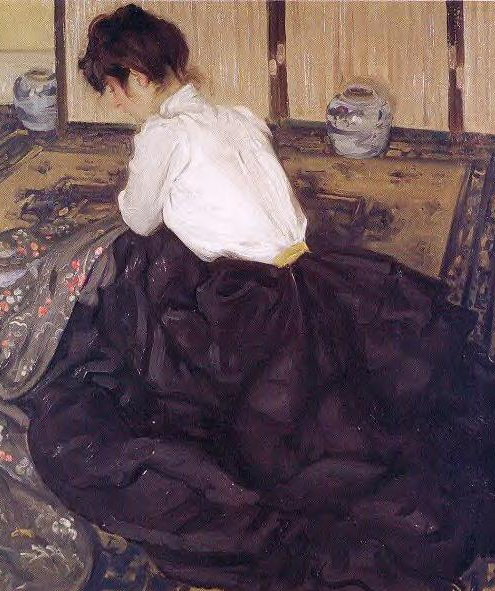
Arrangement (1901, PD) Alfred Henry Maurer
This depicts a common usage of Kimono in a rich sitters/artists models portrait, note the lack of laurels

In this way, as this was a self-portrait, Winnaretta was perhaps sending a message to her wider contemporaries who at this time had popularised Orientalism. A style of painting which by this time was used as French colonial propaganda to uphold the idea that people of colour required the 'guiding hand' of France to become 'civilized', such as was the case with Algeria whose colonisation by the French began in the 1830s only ending in 1962. In using the symbolism of the laurel crown, Singer signifies the imposition of the West over that of Japan, a country of those who her contemopary French painters such as Fernand Cormon (1845-1924) saw as on the lower rungs of scientific racism's rankings of humanity, as depicted in his white supremacist 'Human Races' which depicts Japan below French white people on this racist ranking of the 'races'.[3]

Human Races (1897, PD) Fernand Cormon

When we take this into account, we see that this is an imposition of the West over the East, a victorious triumph of American-French people, over those subjugated peoples who would help their younger sister Old Japan into the New Japan. This was an unfortunately pervasive ideal which only became stronger going into the 20th century and would likely have been passed down to Daisy.

Daisy

Daisy's mother, Isabelle died tragically. Rather like Daisy's trajectory in the shoulder department. Isabelle was Winnaretta's sibling, leading to Daisy being taken in by Winnaretta. Daisy went on to become the Pari Coreespondan for Harpers Bazaar. This was owned at the time by William Randolph Hearst, a blatant and well known racist who kept people of colour out of his magazines, which included Vogue and Harpers Bazaar.[4] These explicitly made Japanese people out to be 'undesirables'.[4] It is in this way that we come to the world in which the 'New Japan' had emerged as a result of Wilsonian foreign policy which in part lead to the depiction of the Japanese Diaspora as having a second class status to that of 'whites'.[2]
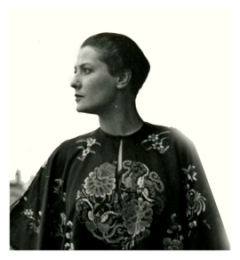
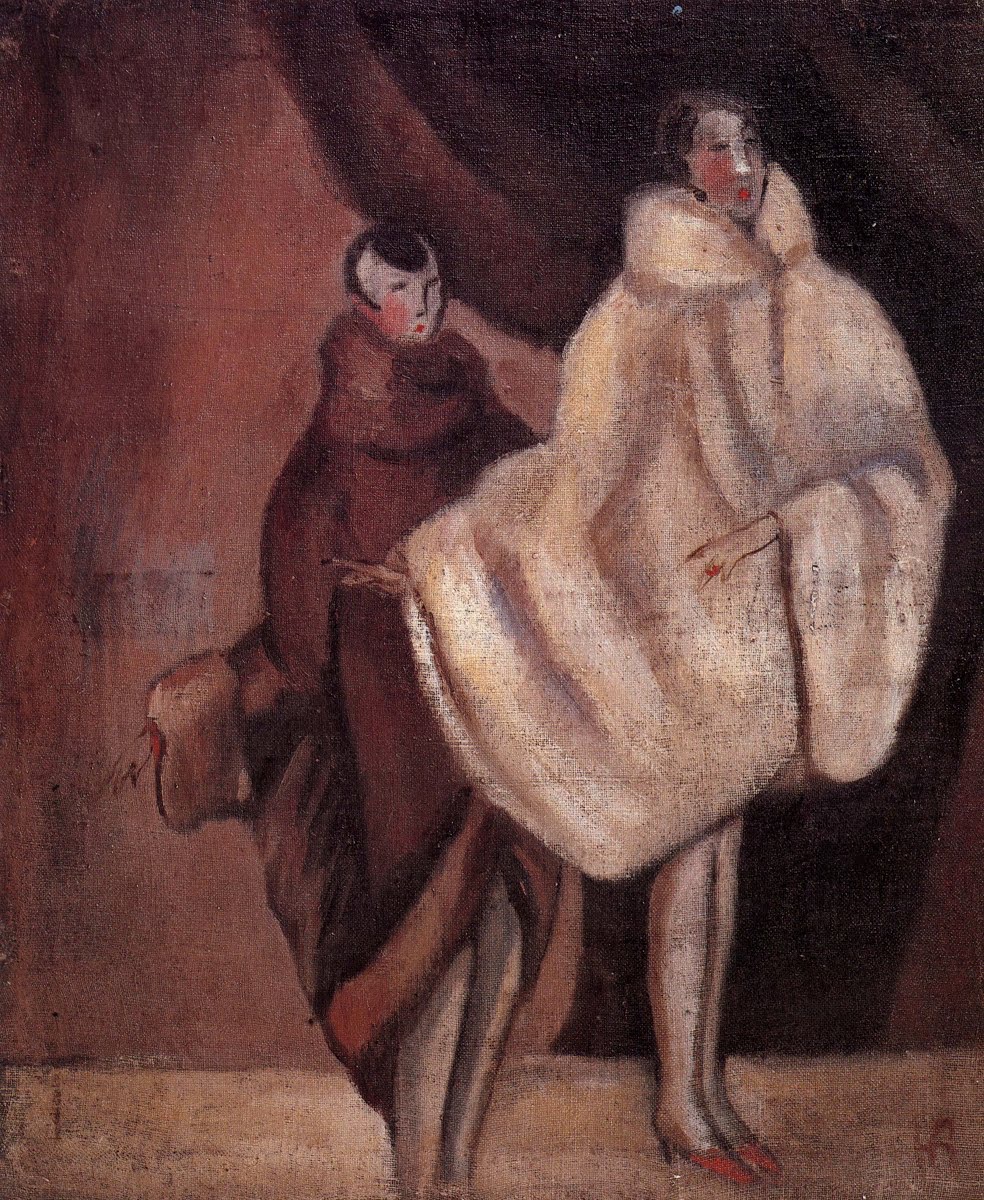
Suzanne's Kimonope (c.1930-1949, CC3.0) Olivier Baroin

Daisy as a white, no doubt encouraged these attitudes given she was rubbing shoulders with Winnaretta and Hearst. Daisy was indeed an inheritor to the Singer fortune and thus also was set for life. To reiterate this point, may we show you the influence of Kimono on her friend Suzanne Belperron (1900–1983) who wears a Kimonope. Ms Belperron's uncle was Paul Poiret the famous designer who made quite a lot of money from taking 'inspiration' from Kimono and creating a few Kimonopes and modern silhouettes. Other firends included the Chanel (a Nazi colloborator) and Schiaparelli (Chanels feted rival). A 'close friend' included Diana Vreeland (1903-1989) who is today known for stating the first known Black supermodel as 'King Kong', and that she was 'nobody's idea of what anybody wants to look like', in reference to a shoot Luna was meant to book in the 1960s.[5] King Kong came out in 1933, in a more racist friendly time and the exact year Daisy began her foray into Harpers Bazaar. A magazine which only included black models 2 years after she left, and which only encouraged the first Asian supermodel Noelie Dasouza Machado (1929-2016) to take the cover in 1959. Even this this comes with the caveat that Machado's home country was under Colonial rule by the Portuguese. This is the mindset these people wrote and followed. Around the end of her time as Pari correspondan, Daisy began a heady diet of Amphetamines, Cocaine and more friendships with Nazi Sympathisers, known as Wallis Simpson by 1936.[8][9]

Another cultural appropriation moment occurred when the colour 'Shocking Pink' was supposedly created for Diasy by Schiaparelli around 1937.[8] Diasy often continued this Oriental fantasy of Asian and 'Other' cultures as beneath her own, as costumes she could try on and profit from but never really give back to. This included ornate costume parties into the 1950s where attendants would stand around in 'exotic' dress from Asian cultures, serving and waiting hand and foot on Daisy, whilst others ran around in blackface.[7] Daisy herself would follow in a bout of cultural flagrance in her 'Hindu' necklace which was worn once to a costume party and then given away as a gift.[6] These items, which most likely included a Kimonope or two in Daisy's armoire, were known as 'Savage jewellery'.[6] Yes it is called the Oriental Ball and yes that is Ms Fellowes walking around in a cheetah print ballgown attended to by an Asian stereotype.[7] Shocking indeed.

Daisy in this way embodied the later trend of Primitivism and it is this way that the money for Singer sewing machines encouraged the adoption of Kimono as a garment for the 'Red Woman' trope, given the way the Singer Heirs spent and adopted or treated Kimono.

Conclusion

In context therefore, the impact of the Singer Dynasty on European KTC can be seen as detrimental, and heavily tied up in Orientalist tropes perpetuated by French and American elites. Winnaretta used Kimonope to embody the ideals of French imperialism and the imposition of Japanese culture as academically beneath that of White Western traditions, and Daisy in the ideals of the Primitivists and Fauvists whom she supported, as well as working amongst some of the most racist Publishers of the day. These usages of Kimono give us an entry into the world of French Orientalism and the Visual Realpolitik of how Kimono were percieved by those in power, particularly in positions of privilege and with a need to uphold whiteness. Kimono are used for the Singer Dynasty as tools of oppression and are directly a product of their racial worldviews and times.

Bibliography

[1] https://en.wikipedia.org/wiki/Winnaretta_Singer

[2] https://en.wikipedia.org/wiki/Daisy_Fellowes

[3] Allegorizing Aryanism: Fernand Cormon's The Human Races, Maria P Gindhart, 2008, Volume 9, Online Edition, The Journal of the History of Art (Aurora), WAPACC Organization

[4] On Media Moguls and Racist Tropes, Vicki Mayer, Alice Pavanello, 2022, pp.70-74, Volume 24, Online, Journalism & Communication Monographs, SAGE Publishing

[5] https://en.wikipedia.org/wiki/Suzanne_Belperron

[6] https://www.prestigeonline.com/th/jewellery/cartier-udyana-necklace/

[7] https://littleaugury.blogspot.com/2014/01/daisy-roars.html

[8] https://graindemusc.blogspot.com/2008/11/schiaparelli-shocking-hot-pink-and.html

[9] http://tweedlandthegentlemansclub.blogspot.com/2015/07/the-most-wicked-daisy-fellowes.html

Essay Abstracts 

#1 Renee Vivien (1877 - 1909) --- Born Pauline Tarn, was an English lesbian poet. She wrote in French and perhaps English. She took up the style of the Symbolists and Parnassinism and was well known during the era of the Belle Epoque (the Beautiful Age) for producing Sapphic verse and living as an open quasi butch lesbian poet; her verse derived from the ancient poet Sapphos, also famed for her love of women.

# 2 Birth of the Kimonope --- Here I shall introduce the notion of the Kimonope, that is as a garment attached to the social construct of the 'Geisha' in North America. Kimonopes being Orientalized clothing, or 'negatively affiliated or exoticized ethnic dress' which lead to the perceived notion of the Kimono and Geiko as simultaneously both high and low culture to American culture makers, such as film, television, media, writers and some academics. An example of Kimonope are the tacky Halloween costumes you may find at the Dollar store.

#3 The Legacy of the MacArthur Dynasty on KTC & The Problem with the 'Traditional Garment' Argument --- The problem with arguing that the Kimono is a 'Traditional ethnic Garment' is that that assertion is in itself, arguably  Ethnocentrism, which to clarify is the imposition of, in this case, American values onto Japanese cultural values, belaying the 3 pronged pitchfork of idiocy. 

#4 Divine --- Government name Harris Glenn Milstead (1945-1988) was the infamous North American Queen & Drag artist. Specifically, Divine was known for being a character actor, part of her act is well-known for its eccentricity. My personal exposure to Drag lite was Pantomine Grand Dames as a kid, and later when my friends made me watch RuPaul in art classes, so to me this is nothing new, the over the top, the glitter, the upstaging is all part and parcel.

#5 Dori-Style or 21st century Kimono Fashion --- The Dori-Kimono style. Something which I just made up because in going over notes for the first 20 years of 21st century section of Kimono history, I noticed a lack of a clear catchall term for what was happening in Japan at the time, at least in English descriptions of the time. I use the term Dori as I do not want to coin an unrelated term to the topic, but I also am reticent to claim all of Street style as 'Tori' either, whilst a large number of streets upon which the subculture originates in all use the suffix 'dori' (the bottom of Takeshita-dori for example), thence Dori-style.

#6  The Tea Gown --- This essay will cover the aspects of how 19th century Japanese import textiles to Western countries were used and repurposed, as well what their desirability tells us about how Japanese design was regarded and the image which these people held of Japan through the Western lense and consciousness. This follows the progression of how Kimono can be used in the West from the undress of the 1860s, adapting silk bolts in the 1870s to high fashion western daywear, to the 1880s aesthetic movement and 1890 wholesale adoption in the Victorian age to being used prominently by society hostesses as tea gowns by the Edwardian period, and the subsequent change in Japanese export culture which we see in extant textile collections of Japanese textile in Western dresses of the periods.

#7 Kimono and the Pre-Raphaelite Painters --- This essay will cover the aspects of Kimono in the Portraiture of the Pre-Raphaelites. The Pre-Raphaelites were a group of British artists and writers active during the late Victorian period. Unlike the Royal Academy artists, this circle of painters operated outside of the established comfortable boundaries of the expected white, cisgender middle class audience of the Victorian age. The movement is notable for its inclusion and encouragement of women, and in portraying and engaging non-conventional beauty and beauties as figures from the Classical World alongside Religious, Mythological and Folklore Heroines into Victorian 'Femme Fatales'.

#8 Jokyo/Genroku Kimono Textile Culture and the new role of the Komin ---  This essay will return back to GKTC (Genroku Kimono Textile Culture ; 1688-1704) and JoKTC (Jokyo K.T.C. 1684-1688) and the new role of the Komin (Artist caste) in GKTC. JoKTC is notable for being the lead up to GKTC, JoKTC being characterised by its transitory nature in comparison to GKTC, which was far more bold in its relations to what Kosode could and should be. Komin entered the picture at this juncture, and I shall elaborate a little more here than in other posts about why that was. GKTC is notable for its elaborate, perhaps gaudy and innovative Kosode design features, whilst JoKTC more so for the enabling factors of the time, as a sort of incubatory GKTC.

#9 Tagasode Byobu - This essay will explore the art motif known in Japanese art as Tagasode Byobu ( Whose sleeves Screen) This motif is a recurring art form which was particularly popular during the Azuchi-Momoyama era ( 1568-1600 ) as a representation of the ways in which Buddhist sensibilities met with the fast changing events of the end of the Sengoku Jidai (1467-1615) and as an extension of the habit of wealthy women from military families came to own and store a large number of Kimono. Prior to this, Kin Byobu ( Golden Screens) for the most part depicted nature like Sesshuu Touyou (1420-1506) after Chinese Cha'an painter Muxi ( c.1210-1269 ) or 'flower-and-bird' scenes like those of Kano Eitoku (1543-1590), rather than humans or human paraphernalia as an extension of the Zen painting school of thought about materialism.

#10 Cultural Acculturation --- The topic of our essay is on the nature of Cultural Exchange in KTC which will be an ongoing mini-series throughout 2022. This covers the 1000CE - 1500 period in Japanese History.

#11 Cultural Appropriation --- The topic of our essay is on the nature of Cultural Appropriation which will be an ongoing mini-series throughout 2022. 

#12 Cultural Acculturation --- The topic of our essay is on the nature of Cultural Acculturation which will be an ongoing mini-series throughout 2022. This covers the Asuka (Hakuho), Nara (Tempyo), and Heian periods (500CE-1000CE) in Japanese History.

#13 Asai Ryoi --- This essay will explore the legacy of Asai Ryoi on KTC. Who was Asai Ryoi you may ask? Only one of the most important writers for the Ukiyo genre. Asai Ryoi ( act. 1661-1691 ) was a prolific Ukiyo-zoshi ( Books of the floating world )  or Kana-zoshi  ( Heimin Japanese Books ) writer. His leading 1661 publication, lambasted and satirized Buddhism and Samurai culture of restraint in favour of the Chonin lifestyle of worldy excess.

#14 Edith Craig --- This is a post regarding the early adoption and promulgation of the Kimono and Japanese aesthetics in the life of the wonderful Edith Craig (1869-1947), daughter of the famous actress Ellen Terry (1847-1928) and Edward William Godwin (1833-1886). Edith was also known as 'Edy'.

#15 European Banyans --- This essay will explore the European garment known as a Banyan, which originated as a European reaction to Kimono in the 17th century, popular until the end of the 18th century. The word Banyan originates from Arabic ( Banyaan), Portuguese (Banian), Tamil ( Vaaniyan ) and Gujarati ( Vaaniyo ) loanwords meaning 'Merchant'. Alternative versions saw the item fitted with buttons and ribbons to attach the two front sides together. The Banyan was worn by all genders and was particularly regarded in its first iterations as a gentlemanly or intellectual garment worn with a cap to cover the lack of a periwig, and later adopted by women and greatly influenced how British womens garments were designed with preference for comfort in removal of panniers whilst maintaining luxurious, modest 18th century fashions (see Robe a la Anglaise).

#16 Miss Universe and Kimonope --- This essay will explore how Beauty Pageants, principally Miss Universe, has engaged with KTC. While there may be real Kimono worn by Japanese and Japanese adjacent contestants in the 'National Costume' category, I will be focusing on the Kimonope worn by contestants. The idea of Kimono as a 'national costume' sparks interesting conversations on what 'national costumes' are, their target audiences, and how we form ideas about these things to begin with.

#17 Onna-E --- Womens pictures refers to the Nara, Heian and early Kamakura ( 710-1333CE ) practice of drawing women in elongated Hand scrolls, which today are regarded as feminine gender coded Art. Some of these narratives depict the lives of women, their extra diaries, or the literature they wrote. The Onna-E style derives from how mostly Heian women represented themselves and others as a performed self in these scrolls, drawing from their lives indoors at their and the imperial abodes. Whilst a limited number of women could read Kanji, they also used their knowledge of Chinese culture to create and inspire their own culture; the first truly Wamono aesthetics; and it was with these preconditions that Onna-E became established in the Japanese art scene alongside Yamato-E and Oshi-E.

#18 A Jamaican, a Monster and Portuguese bar in the Orient --- This essay looks at the Kimonope attire adopted by North American Dancehall artists Shenseea (Chinsea Linda Lee | 1996 - present ) for the video to 'ShenYeng Anthem'. Whilst the aesthetic derives mostly from East Asian, principally Chinese aesthetics, the language used is specifically Japanese, referring to Chinsea Linda Lee as 'ShenYeng Boss', a perpetuation of the Dragon Lady stereotype. The essay mostly charts how this ridiculous Kimonope derides from the North American Anti-Chinese movement and how this intersects with contemporary Orientalism.

#19 The Red Kimonope --- The Red Kimono is a terribly named racist US silent film from 1925. The Longingist film includes a key scene which the production gets its name from where the protagonist drops her Kimonope, meant to symbolize that she had turned away from sin and prostitution, or in other words equating a wearer of the Kimono as a sex worker which stemmed from another American 'tradition'. This dreadful melodrama features the previously yellowface-accepter Priscilla Bonner as the lead protagonist. Throughout her trials and tribulations, she faces many ups and downs, like becoming a white version of the Lotus Blossom stereotype, because WASPs. I will explore the origins of the Lotus concept and the 'Jade' in more detail here as to provide the contextual background of the productions symbolism.

#20 Housewife, Business Girl, Office Lady --- I explore the concept of the arrival of the Business Girl, and the Shufu ( Censored | Housewife ) of the 1930-1970's period of the 20th century.[1] This intersects with how we see Wafuku represented, in a shifting dynamic that had not shifted so many barriers since the 1870s, and even until the 1990s with the intrusion of Euro/Americentric beauty standards being foisted upon the world during these centuries, in the wardrobes of the upwardly mobile single business women of from 1955-1965. These groups came into being in the 1950s with the advent of the eclipse of settler colonialism and patriarchal standards over women's lives internationally. KTC thus developed in response to these changing, testing and trying times (between 1930-1970).

#21 Herman's 'Kimono' --- In this essay I look at another Kimonope, specifically another Miss Universe 'national costume' entry. This particular Kimonope represents the legacy of Macarthism's neo-colonial/systemic racism, and subjugation of Japanese soft-power, a follow on of Orientalist late 19th/early 20th century assumptions and stereotypes of Asian culture and peoples which saw their subjugation in American foreign and domestic policy between 1885-1952. In this entry, we see a clear leaning into the 'Cool Japan' aesthetic by the Kimonope's designer, who is not shockingly not Japanese, but Israeli and therefore represents ideas about what Kimono are to this designer than the genuine article would to other participants of KTC, foreigner or otherwise towards 'Kimono'.

#22 Uno Chiyo --- This essay explores the work of Uno Chiyo (1897-1996) as a Kimono Designer. Uno was a prolific 20th century Japanese writer and designer. As such, Uno was familiar and fluently versed in KTC throughout her life. Uno founded the influential Style which was in circulation in Japan from 1936-1959.[1] Uno was heavily influenced by Western and Genroku fashion, and focused her aesthetic on these two whilst encouraging masculine and secondhand consumer habits in her approach to Kimono as a fashionable and modern pursuit. Uno provides a fascinating glimpse into a time before Kimono were stigmatized and were instead merged with Yofuku to inform Japanese identity and femininity in new and stylish publications and normoactivities.

#23 Franco-American Singer Dynasty and their Kimonopes - Winnaretta Singer (1865-1943) and Daisy Marguerite Séverine Philippine Decazes de Glücksberg Fellowes (1890-1962) were both American-French socialites, who interacted in many ways with the white elites of the American-French fashion industries. They were heavily complicit in the racist structures and depiction of Kimono as for the 'yellow peoples', with Winnaretta implicitly using Kimono to benefit from racist tropes and imperialism in her career as a painter. This is part of a broader tradition of the French Orientalism genre which would give rise to the Madame Chrysanthemum trope a few years after Winnaretta's use of the Kimonope, in 1883. Daisy, her neice would use these tropes in her time at Harpers Bazaar from 1933-1935, displaying the same ideas about people of colour and their cultural traditions throughout the 20th century as found in her social peers.

Social Links

One stop Link shop: https://linktr.ee/Kaguyaschest

https://www.etsy.com/uk/shop/KaguyasChest?ref=seller-platform-mcnav 

https://www.instagram.com/kaguyaschest/ 

https://www.youtube.com/channel/UC5APstTPbC9IExwar3ViTZw 

https://www.pinterest.co.uk/LuckyMangaka/hrh-kit-of-the-suke/ 

Sunday, November 12, 2023

宇野 千代 | Uno Chiyo | 1936 - 1960 | Essay #22

This essay explores the work of Uno Chiyo (1897-1996) as a Kimono Designer. Uno was a prolific 20th century Japanese writer and designer. As such, Uno was familiar and fluently versed in KTC throughout her life. Uno founded the influential Style which was in circulation in Japan from 1936-1959.[1] Uno was heavily influenced by Western and Genroku fashion, and focused her aesthetic on these two whilst encouraging masculine and secondhand consumer habits in her approach to Kimono as a fashionable and modern pursuit. Uno provides a fascinating glimpse into a time before Kimono were stigmatized and were instead merged with Yofuku to inform Japanese identity and femininity in new and stylish publications and normoactivities.

Uno Chiyo (1935, PD) 白拍子花子

Uno led a fabulous devious life in her early years, losing her first job due to the stodgy old men of the time who fired her upon discovering her affair with a male colleague in 1915. She became a writer by 1920 and it was hereafter she began to attain literary success in Japan. In 1921, she won a prize for her 1921 short story しふんのかお ( Shifun no Kao | Painted Face)、where afterwards she moved to Tokyo. This drove her into the 1920's urban cultural scenes of Art, Fashion and publishing. It was during this time that she developed her specific outlook and relationships to the major influences and artistic avenues which she pursued in her life as Japanese woman living in the 20th century.

Atarashii Onna

Uno was influenced by the times she lived in, and was repletely surrounded by the influence of Western design and fashion. In 1927 for example, she joined the fashion for Moga, and bobbed her hair and entered into the cultural era of the 'New Woman' which had become emblematic of what some called the 'Jazz Age' and the 'Liberated Woman'. The New Woman, which itself was a trope which came from the writing of British writer Sarah Grand (1854–1943) in 1894 which called for the liberation and emancipation of contemporary Victorian women in their bid for independence from patriarchal systems and oppression.[4]

This was taken up in English society and expanded upon by Maria L R Ouida (1839-1908) used the term in a response article entitled 'The New Woman'. The English writer and editor Ella Hepworth Dixon (1857–1932) also reproduced this in her is novel 'The Story of a Modern Woman'.[3] All of these writings expanded on the idea of women encouraging a human sisterhood common to all in the face of the strife faced in the Victorian and Edwardian age, be it financial, emotional, physical etcetera. They encouraged those women with enough money to uplift those without it, to live their lives independently and to foster a modern sensibility of female agency and embodiment of those ideals. This became a wave of popular modern conscious though in Britain by 1913 with issues like the Cat and Mouse Act, which called for universal suffrage to women over 25 with property soon earning the right to vote in Britain.

Women of course have always done these things, but have had to work within the limits of their day and age and thus are not always given the respect they deserved as human beings and so are not as well represented, recorded or even remembered as they could be, and thus this was their pushing against these systems and structures which denied them their creativity, their work, their social lives and their autonomy. This modern image of womanhood was taken forwards across the Empire, infamously across the Atlantic Ocean into North America. British writers such as Indian-born Annie Sophie Cory (1868–1952) The Woman Who Didn't (1895) deeply held and spread these ideals and celebrated women such as Bengali writer Toru Dutt (তরু দত্ত | 1856-1877), English Amy Judith Levy (1861-1889) South African Olive Schreiner (1855-1920), Australian Mary Chavelita Dunne Bright (1859-1945), Indian Kodagina Gowramma (1912-1939) who already lived these experiences around the British Empire. As one British child of Empire wrote:

'We must kill the force in us that says we cannot become all we desire, for that force is our evil star that turns all opportunity into grotesque failure....So let us each recognise the truth that our first business is to change ourselves, and then we shall know how to change our circumstances.' 

- Florence Beatrice Emery (1860-1917; Our Evil Stars, New Age October 1907)[2]

In Japan, the modern woman was spread both directly as a result of British Women, and via women who lived in and outside of Britains Empirical Domains. The Japanese Magazine Seito (Bluestocking) drew on this British legacy, gaining its namesake from the British society of the same name which operated in the 18th century, which first published in Japan in 1911.

Bad Wife, Dumb Mother, Usurping Student

By the 1900s, this well versed and influential feminine archetype had spread internationally. However this spread more slowly in conservative and patriarchal societies and cultures. Across East Asia, this generally meant that the New Woman genre only became popular by later decades, for example in the case of the writings of Ling Ding (丁玲 | 1904-1986) who was persecuted in China for her writings, and was imprisoned in 1933.[5] Korean chauvinists eagerly followed on with, dismissing the learned feminine as simply a caricature of Western capitalism. They urged women instead to be their Gibson girl ideal, a male caricature ideal of a woman who not career driven, but instead was busy chasing after her children in the domestic sphere and perhaps staring at an aesthetic copy of the Confucian and Chinese classics, all of which our male writers kindly informed us all placed women in the proverbial kitchen, making not sandwiches who supposedly were responsible for all of Japan Inc's all seeing grip on the Korean economy.[3] 


Ding Ling (c.1930, PD) Zanhe | 'Dancers' (1927, CC4.0) Na Hye-seok

The Korean Modern Woman writer and artist Na Hye-seok (나혜석 | 1896-1948) published Sinyoja (New Woman) was Chiyo's Korean counterpart, who wrote on Korean clothing and was writing in similar circumstances. Educated women in both countries combated male ideals of women such as Hyeonmo Yangcheo (현모양처 | wise mother and good wife) or Wise Wife, Good Mother (良妻賢母) were coined from 1875 by East Asian men towards women who operated in East Asia in the 19th and 20th centuries, in their writings and published work from the 1910s on, often risking their marriages, finances and social standing in doing so, much as Uno did on losing her job as a result of her 'lifestyle choices'. These Asian writers often promoted ideals of pursuing ones own desires as a woman, independent of what patriarchal systems told women to do so. However it was not until the 1930s that universal suffrage became a topic in Japanese politics meaning the Modern Women became the Modern Girl as a result of a lack of change in Japanese society towards the feminine, leading to the world Uno began her career in as Moga.[1][4]

Tipsy (1930, PD) Kobayakawa Kiyoshi

Sutairu

In 1936 Uno founded one of Japan's first fashion magazines, these were a rather niche market at the time of women's magazines published in Japan. As one of the first women in Tokyo to live the life of a Naomi (see Chijin no Ai, 1925), Uno lived a heady lifestyle in the circles of Tokyo poets, artists, designers, publishers and their patrons who all moved in each others social circles. The modern women who Uno wrote about, for and with all tread a grey area where dress was an important marker of the time. Stepping too far into Western clothing was considered too much, albeit that their male counterparts had been doing this for decades and were considered masculine. A whole ensemble was too much, but a glove was acceptable.[6] Only wearing purely 'Wa'fuku was considered very conservative and uptight, a strange double standard which denoted ones place in society as a second class subject and the political spectrum. 

Uno's founding her magazine then, can be seen as a rebellion against the traditional and morally acceptable standards of the frugal Shufu archetype popular in the mainstream magazine offerings of the likes of Shufu no Tomo (Housewives Friend). It focused on the needs women had, raising them to the mantle of the independent woman with purchasing power, a scary notion for those upholding systems which said women could not have their own money. Sutairu (スタイル | Style) covered a range of topics, but included both Yofuku and Wafuku and was the first to include fashion trends started or used outside Japan. This was a departure from the expected intentions of marketing to women, as previously you could deprive, degrade and dismiss women as agents with autonomy, but they could be trusted to make their way down to the department store, to be paid less for modelling in Kuchi-E than male counterparts and to be used to make revenue from and marketed towards by male owned companies and magazines but not to be thought of as smart, innovative or worthy of attention.[6]

Sutairu instead aimed itself at young female demographics, teaching them to be thrifty, modern and elegant year round. Sutairu threw off the rules of old and utilized plain and 'exotic' fabrics to bring interesting new combinations and styles to Japanese Kimono, a style Uno referred to as the 'New Kimono'.[12] Uno also encouraged her readers to utilize fabrics from Asia, like Black Velvet and natural fabrics which originated in Japan and India, particularly in fashions like Black Satin Eri which revitilised older Meiji era Kimono in 1937.[12]

Sutairu also promoted from the second issue street photography, which praised the thrift and innovation of Japanese women during rationing as modern cosmopolitan consumers.[12] Whilst at the time to promote local Japan Inc. economies, Meisen for winter was all the rage, Uno instead taught women to use fashionable attire in Summer, and to be thrifty with new materials for their Obi, such as upcycling old fabrics for the winter.[12] Sutairu's style choices harkened back to the Genroku Period (1688-1704), a time in which JKTC was at some of its most garish and vulgar.[13] Silver lame Kimono, Velveteen accessories, Leather Sandals and bold patterns all featured amongst recommended articles Uno published from 1936-1938. Other style pointers included using the lining of the Tombi style overcoat to arken back to the Sumptuary Laws of the Genroku period to include a flashy fabric such as Tartan sparingly.[12][14]

Seeing as these garments were made from Wool, it replaced the need to layer multiple garments over other Kimono as had previously been done and changed the winter silhouette for a time. Japan Wool Textile Co., Ltd was an early introducer of Wool as part of KTC when it began production in 1896.[1] It was in this time when the importation of Wool was particularly high, with most imports coming from England and Germany in 1898.[5] The suppliers of Wool of at this time came mostly from Western Mills, such as the A W Hainsworth Mill (est.1793), which in 1899 recieved an order for 'Black serge' wool to be delivered to Yokohama. This saw the introduction of new types of overcoats and capes such as the Tombi, Nijuumawashi, and Azumakouto.[14]

From 1937 on, Uno discussed how her own Kimono making processes involved the use of fabrics like wool serge to replace other winter fabrics and to recreate the feeling of deep blue Kimono for women, a transgressive act for a woman at the time given that patriarchal values were beginning to set in again with the advent of the Pacfic War with China beginning. Whilst this may be a reflection of the move towards patriotism with plain and militaristic colours like navy blue and green, floral motifs were also popular in Sutairu that year. She also encouraged her readers to begin wearing secondhand Kimono once again.[12] By 1938, Uno encouraged more women to adopt these masculine fabrics and then also to have a Meisen Kimono, but with large and bold patterns with Uno's favourite Black accent accessory with a pinstripe or Kasuri Kimono and hand painted Geta.[12]

After this time Sutairu seems to have encouraged the adoption of Western accessories, foreign origin fabrics, vintage Kimono and Genroku period fashions which may be regarded as a precursor to many of the Dori-Style Kimono worn in the 2010s, and Revival Style fashions of the 1990s which paired together bright colours and styles with the traditional and paired down Kimono often found in the markets their owners purchased their Kimono from.[12] During the 1940s, Uno successfully became a designer and writer, focusing her time on both of these and some film ventures. During this time, her Kimono become very Genroku influenced, with singular bold patterns trailing around Kimono, reflecting the Ma of Genroku Kimono. Her designs were also influenced by more Western paintings and ideas it seems, incorporating more of these fantastical exotic fabrics and masculine ideals of dressing until the end of the war, when afterwards her designs returned to a more Genroku influenced tone with some pared back yukata designs in the mix. 

Sutairu at this time was likely to have undergone censorship from SCAP regulations, and therefore may have focused more so on Japanese domestic affairs or incorporated more Yofuku than it may previously have done so willingly.

Occidentals beginnings in Fashion

Uno brought fashion for the first time to the Occidentals in the 1950s, bringing Wafuku together with Western art theory and graphical design principals in line with Japanese sensibilities towards designing Kimono. In this way, Uno introduced a great many Westerners, Europeans and Americans to how Kimono could be thought of, worn and style rather than simply being a 'traditional costume' from Japan. Rather it grounded the Kimono in a history of art theory and applied workmanship from Japan, with Western design and motifs familiar to them which allowed Kimono to become fashionable aesthetic pieces of art outside of Japan, in a far more respectful manner than the second plundering of Japanese wardrobes which occurred under American occupation in the aftermath of the Pacific and Second World War.

By 1954, Uno seems to have become a successfully regarded Kimono designer, incorporating classical motifs into modern designs which whilst not entirely stale are not totally ground breaking either, but she often used her clout in publishing to guest edit it seems so that her designs and tastes influenced trends well into the 1950s for Kimono, which was really on of the last few decades were Kimono were still produced en masse and bought by a wide audience.[10] In 1957, she flew to North America where she hosted one of the first Kimono Fashion Shows there, one of which seems to have included Piet Mondrian's Landscape paintings series.[1][9] 

Even after Sutairu folded in 1959, Uno still was regarded as a tastemaker in Wafuku related matters and continued to be sought after for her opinion on the matter well into the 1980s and 1990s until her death in 1996.[11] Modern Japanese KTC has been influenced by Uno's Hanami and Sakura designs which became popular during the early 1950s and were used in both Yukata and Furoshiki.[7][8] 

Conclusion

In context therefore, we can see how the international political and modern interpretation of Japanese and British culture lead to an emancipated and forward thinking adoption of Yofuku as a symbol of Japanese Women's struggle to become full persons. Uno introduced and used Kimono to bring herself financial and social independence and gave this to her readers and characters by embodying the trope of the New Woman in the course of her time as a Kimono designer and publisher. Uno used Sutairu to finally meld the Modern Girl with the Modern Woman trope, and she did this by using Modern design principles and Art n her designs and in carefully curating what she presented to her audiences from the 1930's into the 1950s whilst working within the constraints and limitations of her time.

Bibliography

[1] https://en.wikipedia.org/wiki/Chiyo_Uno

[2] https://en.wikipedia.org/wiki/Florence_Farr#Later_life

[3] https://en.wikipedia.org/wiki/New_Woman

[4] https://collections.reading.ac.uk/special-collections/2022/12/16/the-new-woman-five-women-writers-of-the-1890s/

[5] https://en.wikipedia.org/wiki/Ding_Ling

[6] https://www.myjapanesehanga.com/home/articles/bijin-kuchi-e-and-taisho-era-popular-magazines.html

[7] https://kyoto-asahiya.com/products/polyester-furoshiki-chiyo-uno-hanasakizakura

[8] https://www.akariya2.com/kimono2015-5-27.html

[9] https://twitter.com/tsubaki_an/status/772440228942319616

[10] https://www.kosho.or.jp/products/detail.php?product_id=330716252

[11] https://ameblo.jp/yoshiko-artlife/entry-12256427146.html

[12] A Study on “New Kimono” in the Magazine SUTAIRU edited by UNO Chiyo, Matsuo Ryoko, 2023, pp.165-175, Volume 16 Yamaguchi Prefectural University | https://ypir.lib.yamaguchi-u.ac.jp/yp/journals/yp000005/v/16/i/%E5%9B%BD%E9%9A%9B%E6%96%87%E5%8C%96%E5%AD%A6%E9%83%A8%E7%B4%80%E8%A6%81/item/1754

[13] See Essay #8

[14] See Fabric #12

Essay Abstracts 

#1 Renee Vivien (1877 - 1909) --- Born Pauline Tarn, was an English lesbian poet. She wrote in French and perhaps English. She took up the style of the Symbolists and Parnassinism and was well known during the era of the Belle Epoque (the Beautiful Age) for producing Sapphic verse and living as an open quasi butch lesbian poet; her verse derived from the ancient poet Sapphos, also famed for her love of women.

# 2 Birth of the Kimonope --- Here I shall introduce the notion of the Kimonope, that is as a garment attached to the social construct of the 'Geisha' in North America. Kimonopes being Orientalized clothing, or 'negatively affiliated or exoticized ethnic dress' which lead to the perceived notion of the Kimono and Geiko as simultaneously both high and low culture to American culture makers, such as film, television, media, writers and some academics. An example of Kimonope are the tacky Halloween costumes you may find at the Dollar store.

#3 The Legacy of the MacArthur Dynasty on KTC & The Problem with the 'Traditional Garment' Argument --- The problem with arguing that the Kimono is a 'Traditional ethnic Garment' is that that assertion is in itself, arguably  Ethnocentrism, which to clarify is the imposition of, in this case, American values onto Japanese cultural values, belaying the 3 pronged pitchfork of idiocy. 

#4 Divine --- Government name Harris Glenn Milstead (1945-1988) was the infamous North American Queen & Drag artist. Specifically, Divine was known for being a character actor, part of her act is well-known for its eccentricity. My personal exposure to Drag lite was Pantomine Grand Dames as a kid, and later when my friends made me watch RuPaul in art classes, so to me this is nothing new, the over the top, the glitter, the upstaging is all part and parcel.

#5 Dori-Style or 21st century Kimono Fashion --- The Dori-Kimono style. Something which I just made up because in going over notes for the first 20 years of 21st century section of Kimono history, I noticed a lack of a clear catchall term for what was happening in Japan at the time, at least in English descriptions of the time. I use the term Dori as I do not want to coin an unrelated term to the topic, but I also am reticent to claim all of Street style as 'Tori' either, whilst a large number of streets upon which the subculture originates in all use the suffix 'dori' (the bottom of Takeshita-dori for example), thence Dori-style.

#6  The Tea Gown --- This essay will cover the aspects of how 19th century Japanese import textiles to Western countries were used and repurposed, as well what their desirability tells us about how Japanese design was regarded and the image which these people held of Japan through the Western lense and consciousness. This follows the progression of how Kimono can be used in the West from the undress of the 1860s, adapting silk bolts in the 1870s to high fashion western daywear, to the 1880s aesthetic movement and 1890 wholesale adoption in the Victorian age to being used prominently by society hostesses as tea gowns by the Edwardian period, and the subsequent change in Japanese export culture which we see in extant textile collections of Japanese textile in Western dresses of the periods.

#7 Kimono and the Pre-Raphaelite Painters --- This essay will cover the aspects of Kimono in the Portraiture of the Pre-Raphaelites. The Pre-Raphaelites were a group of British artists and writers active during the late Victorian period. Unlike the Royal Academy artists, this circle of painters operated outside of the established comfortable boundaries of the expected white, cisgender middle class audience of the Victorian age. The movement is notable for its inclusion and encouragement of women, and in portraying and engaging non-conventional beauty and beauties as figures from the Classical World alongside Religious, Mythological and Folklore Heroines into Victorian 'Femme Fatales'.

#8 Jokyo/Genroku Kimono Textile Culture and the new role of the Komin ---  This essay will return back to GKTC (Genroku Kimono Textile Culture ; 1688-1704) and JoKTC (Jokyo K.T.C. 1684-1688) and the new role of the Komin (Artist caste) in GKTC. JoKTC is notable for being the lead up to GKTC, JoKTC being characterised by its transitory nature in comparison to GKTC, which was far more bold in its relations to what Kosode could and should be. Komin entered the picture at this juncture, and I shall elaborate a little more here than in other posts about why that was. GKTC is notable for its elaborate, perhaps gaudy and innovative Kosode design features, whilst JoKTC more so for the enabling factors of the time, as a sort of incubatory GKTC.

#9 Tagasode Byobu - This essay will explore the art motif known in Japanese art as Tagasode Byobu ( Whose sleeves Screen) This motif is a recurring art form which was particularly popular during the Azuchi-Momoyama era ( 1568-1600 ) as a representation of the ways in which Buddhist sensibilities met with the fast changing events of the end of the Sengoku Jidai (1467-1615) and as an extension of the habit of wealthy women from military families came to own and store a large number of Kimono. Prior to this, Kin Byobu ( Golden Screens) for the most part depicted nature like Sesshuu Touyou (1420-1506) after Chinese Cha'an painter Muxi ( c.1210-1269 ) or 'flower-and-bird' scenes like those of Kano Eitoku (1543-1590), rather than humans or human paraphernalia as an extension of the Zen painting school of thought about materialism.

#10 Cultural Acculturation --- The topic of our essay is on the nature of Cultural Exchange in KTC which will be an ongoing mini-series throughout 2022. This covers the 1000CE - 1500 period in Japanese History.

#11 Cultural Appropriation --- The topic of our essay is on the nature of Cultural Appropriation which will be an ongoing mini-series throughout 2022. 

#12 Cultural Acculturation --- The topic of our essay is on the nature of Cultural Acculturation which will be an ongoing mini-series throughout 2022. This covers the Asuka (Hakuho), Nara (Tempyo), and Heian periods (500CE-1000CE) in Japanese History.

#13 Asai Ryoi --- This essay will explore the legacy of Asai Ryoi on KTC. Who was Asai Ryoi you may ask? Only one of the most important writers for the Ukiyo genre. Asai Ryoi ( act. 1661-1691 ) was a prolific Ukiyo-zoshi ( Books of the floating world )  or Kana-zoshi  ( Heimin Japanese Books ) writer. His leading 1661 publication, lambasted and satirized Buddhism and Samurai culture of restraint in favour of the Chonin lifestyle of worldy excess.

#14 Edith Craig --- This is a post regarding the early adoption and promulgation of the Kimono and Japanese aesthetics in the life of the wonderful Edith Craig (1869-1947), daughter of the famous actress Ellen Terry (1847-1928) and Edward William Godwin (1833-1886). Edith was also known as 'Edy'.

#15 European Banyans --- This essay will explore the European garment known as a Banyan, which originated as a European reaction to Kimono in the 17th century, popular until the end of the 18th century. The word Banyan originates from Arabic ( Banyaan), Portuguese (Banian), Tamil ( Vaaniyan ) and Gujarati ( Vaaniyo ) loanwords meaning 'Merchant'. Alternative versions saw the item fitted with buttons and ribbons to attach the two front sides together. The Banyan was worn by all genders and was particularly regarded in its first iterations as a gentlemanly or intellectual garment worn with a cap to cover the lack of a periwig, and later adopted by women and greatly influenced how British womens garments were designed with preference for comfort in removal of panniers whilst maintaining luxurious, modest 18th century fashions (see Robe a la Anglaise).

#16 Miss Universe and Kimonope --- This essay will explore how Beauty Pageants, principally Miss Universe, has engaged with KTC. While there may be real Kimono worn by Japanese and Japanese adjacent contestants in the 'National Costume' category, I will be focusing on the Kimonope worn by contestants. The idea of Kimono as a 'national costume' sparks interesting conversations on what 'national costumes' are, their target audiences, and how we form ideas about these things to begin with.

#17 Onna-E --- Womens pictures refers to the Nara, Heian and early Kamakura ( 710-1333CE ) practice of drawing women in elongated Hand scrolls, which today are regarded as feminine gender coded Art. Some of these narratives depict the lives of women, their extra diaries, or the literature they wrote. The Onna-E style derives from how mostly Heian women represented themselves and others as a performed self in these scrolls, drawing from their lives indoors at their and the imperial abodes. Whilst a limited number of women could read Kanji, they also used their knowledge of Chinese culture to create and inspire their own culture; the first truly Wamono aesthetics; and it was with these preconditions that Onna-E became established in the Japanese art scene alongside Yamato-E and Oshi-E.

#18 A Jamaican, a Monster and Portuguese bar in the Orient --- This essay looks at the Kimonope attire adopted by North American Dancehall artists Shenseea (Chinsea Linda Lee | 1996 - present ) for the video to 'ShenYeng Anthem'. Whilst the aesthetic derives mostly from East Asian, principally Chinese aesthetics, the language used is specifically Japanese, referring to Chinsea Linda Lee as 'ShenYeng Boss', a perpetuation of the Dragon Lady stereotype. The essay mostly charts how this ridiculous Kimonope derides from the North American Anti-Chinese movement and how this intersects with contemporary Orientalism.

#19 The Red Kimonope --- The Red Kimono is a terribly named racist US silent film from 1925. The Longingist film includes a key scene which the production gets its name from where the protagonist drops her Kimonope, meant to symbolize that she had turned away from sin and prostitution, or in other words equating a wearer of the Kimono as a sex worker which stemmed from another American 'tradition'. This dreadful melodrama features the previously yellowface-accepter Priscilla Bonner as the lead protagonist. Throughout her trials and tribulations, she faces many ups and downs, like becoming a white version of the Lotus Blossom stereotype, because WASPs. I will explore the origins of the Lotus concept and the 'Jade' in more detail here as to provide the contextual background of the productions symbolism.

#20 Housewife, Business Girl, Office Lady --- I explore the concept of the arrival of the Business Girl, and the Shufu ( Censored | Housewife ) of the 1930-1970's period of the 20th century.[1] This intersects with how we see Wafuku represented, in a shifting dynamic that had not shifted so many barriers since the 1870s, and even until the 1990s with the intrusion of Euro/Americentric beauty standards being foisted upon the world during these centuries, in the wardrobes of the upwardly mobile single business women of from 1955-1965. These groups came into being in the 1950s with the advent of the eclipse of settler colonialism and patriarchal standards over women's lives internationally. KTC thus developed in response to these changing, testing and trying times (between 1930-1970).

#21 Herman's 'Kimono' --- In this essay I look at another Kimonope, specifically another Miss Universe 'national costume' entry. This particular Kimonope represents the legacy of Macarthism's neo-colonial/systemic racism, and subjugation of Japanese soft-power, a follow on of Orientalist late 19th/early 20th century assumptions and stereotypes of Asian culture and peoples which saw their subjugation in American foreign and domestic policy between 1885-1952. In this entry, we see a clear leaning into the 'Cool Japan' aesthetic by the Kimonope's designer, who is not shockingly not Japanese, but Israeli and therefore represents ideas about what Kimono are to this designer than the genuine article would to other participants of KTC, foreigner or otherwise towards 'Kimono'.

#22 Uno Chiyo --- This essay explores the work of Uno Chiyo (1897-1996) as a Kimono Designer. Uno was a prolific 20th century Japanese writer and designer. As such, Uno was familiar and fluently versed in KTC throughout her life. Uno founded the influential Style which was in circulation in Japan from 1936-1959.[1] Uno was heavily influenced by Western and Genroku fashion, and focused her aesthetic on these two whilst encouraging masculine and secondhand consumer habits in her approach to Kimono as a fashionable and modern pursuit. Uno provides a fascinating glimpse into a time before Kimono were stigmatized and were instead merged with Yofuku to inform Japanese identity and femininity in new and stylish publications and normoactivities.

Social Links

One stop Link shop: https://linktr.ee/Kaguyaschest

https://www.etsy.com/uk/shop/KaguyasChest?ref=seller-platform-mcnav 

https://www.instagram.com/kaguyaschest/ 

https://www.youtube.com/channel/UC5APstTPbC9IExwar3ViTZw 

https://www.pinterest.co.uk/LuckyMangaka/hrh-kit-of-the-suke/ 
Sunday, August 6, 2023

羽二重 | Habutai | Plain weave silk | Fabric #20

Habutai ( feather-soft silk | 羽二重 ) is a basic plain weave silk. Habutai is commonly used to make the inner lining of some Kimono, most often summer Kimono. The thickness is measured in Mommes with 4 being sheer, 8 being lightweight, and 16 or more being rather heavy.[1][4] Also known by some as Pongee, this is the most common sort of silk you will see in Japanese silk types and is known for defining the silky feeling of Kimono. Habutai is made using unweighted raw silk yarn, leaving a handmade feel to the fabric.[3]

Vantines double page advertisement selling Habutai (1914, PD) archive.org
Yes the 1560 fashion comment made me laugh too

Historically, Habutai was woven in Japan on handlooms to be used in Kimono and was included as part of the Sumptuary laws banned fabrics for lower classes during the time of Tokugawa Ienari (1773-1841 | 徳川 家斉 ), an edict enforced by the likes of Mizuno Tadakuni ( 1794-1851 | 水野忠邦 ) onto Kabuki actors for example.[1][2][9] Habutai was originally woven on handlooms in smaller operations and workshops and was first exported from Japan in 1877 by Naohiro Koriki (active 1877-1887).[6][7] Habutai is a very taken for granted silk, serving as a functional, if luxurious place in the history of KTC, as the Meiji Emperor (1852-1912) for example gifted two rolls of Habutai on an 'imperial' tour around Yamanishi Prefecture to his accomadation hosts in 1880 as thanks.[5] The industrial scale at which products like Meisen were produced at by the 1890s when Habutai began to be widely exported to Europe and the US, beget an industrial enterprise by 1905 with output declining in production and export after 1920.[6][7] Exports increased again in 1937 and 1940 due to regulations and rationing in the Pacific War period for Japan, increasing after 1955.[8] Due to costs, today Habutai is mostly woven in other Asian economies as a blend of rayon and silk warp threads for things like scarves, parachutes and summer clothing.[1]

Bibliography

[1] https://en.wikipedia.org/wiki/Habutai

[2] https://www.arket.com/en_gbp/about/knowledge/habotai.html#:~:text=Knowledge%20Habotai%20(or%20habutai)%20means,in%20Japan%2C%20Korea%20and%20China.
[3] https://cameo.mfa.org/wiki/Habutai

[4] https://blog.patra.com/2017/06/28/the-different-types-of-silk/

[5] https://sake-shichiken.com/300_years_of_history

[6] The Rise and Fall of Industrialization and Changing Labor Intensity: The Case of Export-Oriented Silk Weaving District in Modern Japan, Tomoko Hashino, Keijiro Otsuka, 2015, pp.1-6 | Available online at https://www.econ.kobe-u.ac.jp/wp/wp-content/uploads/2023/06/1501.pdf 

[7] History of the Fukui Silk Textile Association of Japan, Buntaro Matsui, 1921, pp.7-21

[8] The Economic History of Japan 1600-1990; Economic history of Japan 1914-1955, Takafusa Nakamura, Akira Hayami, Kōnosuke Odaka, 1999, p.42, Volume 3

[9] The Economic Aspects of the History of the Civilization of Japan, Yosaburō Takekoshi, 1930, p.230, Volume 3

Socials:

One stop Link shop: https://linktr.ee/Kaguyaschest
https://www.etsy.com/uk/shop/KaguyasChest?ref=seller-platform-mcnav 
https://www.instagram.com/kaguyaschest/ 
https://www.youtube.com/channel/UC5APstTPbC9IExwar3ViTZw 
https://www.pinterest.co.uk/LuckyMangaka/hrh-kit-of-the-suke/ 

Sunday, July 10, 2022

ヨーロッパのバンヤン | European Banyans | 1639 - 1750 | Essay #15

This essay will explore the European garment known as a Banyan, which originated as a European reaction to Kimono in the 17th century and was popular until the end of the 18th century. The word Banyan originates from Arabic (بنيان | Banyaan), Portuguese (Banian), Tamil (வாணியன் | Vaaniyan ) and Gujarati (વાણિયો | Vaaniyo) loanwords meaning 'Merchant'. Alternative versions saw the item fitted with buttons and ribbons to attach the two front sides together.[1] The Banyan was worn by all genders and was particularly regarded in its first iterations as a gentlemanly or intellectual garment worn with a cap to cover the lack of a periwig, and later adopted by women and greatly influenced how British womens garments were designed with preference for comfort in removal of panniers whilst maintaining luxurious, modest 18th century fashions (see Robe a la Anglaise).

Japanse Rock

Wafuku were first imported into Europe by 1649 into the Dutch Republic, and their scarcity made them a highly sought after commodity among the wealthy who could afford them, like a Birkin bag today.[2] 17th century Banyan can be recognised by their characteristic cut which resembles those of contemporary articles of Wafuku* which reached Amsterdam in the early trading period with Japan as gifts from contemporary Daimyo and Tokugawa Ietsuna (1641–1680), then Shogun. Taking their cut from Kosode of the time, some were sold and worn in the Dutch Republic (1581-1795) after being assembled in Japan and brought over by the VOC ( Dutch East India Company | Vereenigde Oostindische Compagnie). European Banyan were most commonly made from Silk, Cotton or Linen.[1] This style of dress was known by the Dutch as a Japanese dress coat (Japanse Jurk Jas) by 1688.[2]

Indian Gownes

Banyan were imported into England by around 1665 and are likely to have been used in the courts of Charles II, brought from Amsterdam by the EIC ( East India Company ). During this time, the fashionable wore their Banyans with the sleeves and collars folded back to expose the luxurious silks used underneath. Earlier Dutch examples seem to more closely follow the imported Kosode styles which due to their padding required a tight closed hem and thus not as easily folded. Samuel Pepys wrote in 1665 of doing his accounting in his nightgown, and was quite happily portrayed in 1666 in the same 'Indian Gowne' which connoted his vast wealth and status in even having one at this early time, demarcating him as a glamourous society figure and fashionable figure at court.[2]

Samuel Pepys in his 'Indian Gowne' (1666, PD) John Hayls
Indian Gowne and Morning Dress was another name for a Banyan[2]

Dutch Man in Banyan (1671, PD) Michiel van Musscher

Merry Vests

The Banyan often was companion to the 3 piece suit which was invented at the court of Charles II in 1666. To promote English trade over French fashions worn by the aristocratic classes of England, Charles began a new fashion of wearing vests at his English court.[3]
[Charles II] hath yesterday in Council declared his resolution of setting a fashion for clothes, which he will never alter. It will be a vest, I know not well how, but it is to teach the nobility thrift, and will do good. - Samuel Pepys 8/10/1666 [3]
The Banyan as a T-shaped garment made from silk for gentlemens loungewear was made in Britain certainly by the 1670s.[2] It was with the advent of the newly fashionable three piece suit that aristocratic men began styling their wardrobes with lavish accents such as gold trim, silk buttons, satire worthy hats and overcoats to match. One of these fashions by 1675 was the Banyan style House coat or even Kimono in rarer instances in which the fashionable late 17th century man of means lounged around in.
'Lord Cockerell' Display Doll in latest London Fashions (c1690, Copyright the V&A**) V&A

The upper proto-middle classes (if we can say that) of the working professionals in the time period had also begun to wear their nightgownes out in the street, unlike the gentry who simply swanned around their estates in them.[2] Both of these two social groups however would have worn these long androgynous gowns over linen shirts and their breeches or stays and chemises for women of the time. At the end of the day, Men would dress as this elegant doll in their Banyan which took the place of their waistcoats by evening. All a byproduct of the complex Restoration periods realpolitik at the English court as a 'mother country'.

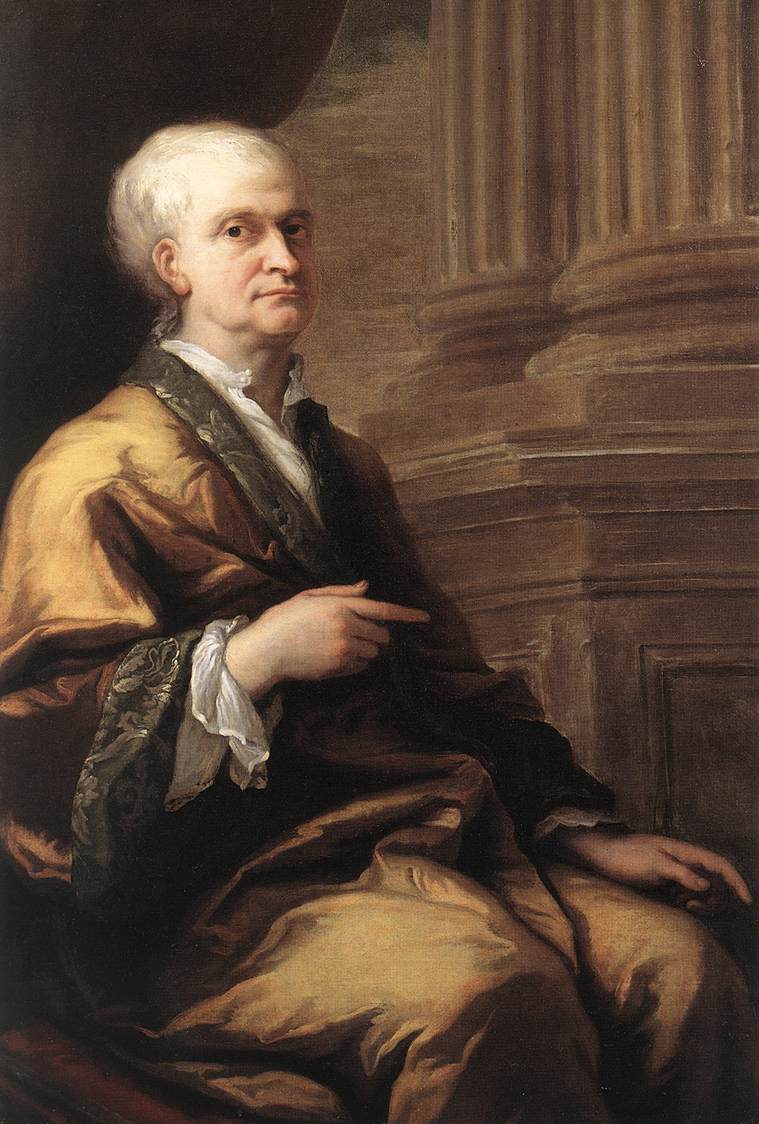
Isaac Newton in a Banyan (c1709, PD) James Newton Thornhill

As this style progressed, buttons became a must and frogging was also a key feature of 18th century first quarter British Banyans to prevent the garment trailing along the floor, a workaround for the lack of Obi it seems. By the 1730s, in London alone there were five general tailor stores or Warehouses which specialised in selling ready-to-wear Banyans made using European and Chinese silks. Other Banyans also had attached waistcoat inserts sewn into Banyans to give the illusion of a waistcoat as well for recieving visitors in the Banyan.[2] 

Thomas Weston (1723, PD) M Dahl
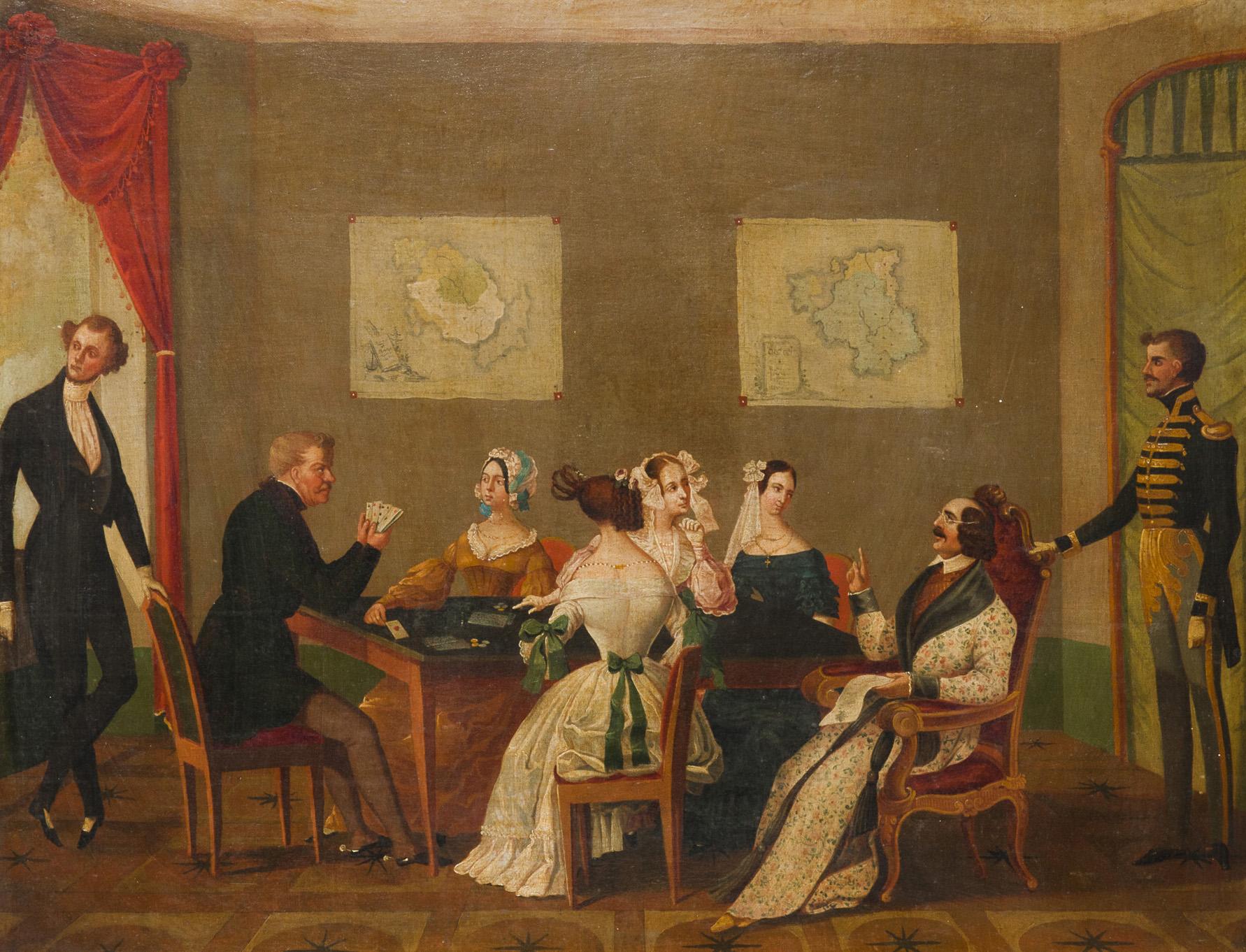
A Rake's Progress (1735, PD) William Hogarth
Figure third from right here wears a Banyan style

Banyan should be regarded as European garment made for European usage, but are distinctly part of European KTC in the sense that they were made, worn and used by Westerners. Banyan were regarded as a sort of unisex loungewear for the well to do about the house, which often co-orded with the furniture.[2] By the 1730's, they were given an intellectual veneer as men of letters often wore them to have their portraits painted in their well endowed libraries. Gentlemen would recieve visitors in them, and as is seen in the Rakes Progress, became the equivalent of a woman in rollers and sweats going to the shop for milk at 11:00PM. Add a fitted collar, and the Rake could be deemed as almost acceptably dressed to go out in public.[2] 

Robe a la Anglaise (English nightgown) Dress (c1785, PD) LACMA

Banyan were also adopted as a form of nightwear by women to worn before dressing in daywear by this time adopting a ribbon or buttons to fasten them.[1] Womens Banyan otherwise were the same shape, a sort of cloak. Womens Banyan often had pleated and broader backs than Mens, and are certainly far scarcer in todays collections. By 1740, the Banyan peaked in popularity and the grammar nazi Samuel Johnson himself noted it in 1755 as a 'Bannian'. Extant examples of the 1760s show the development of a 'Banyan pleat', which consists of 3 inverted box pleats along the spine and sides of the garment to reign in the fabric. These were also made into dresses and were the forerunner of the Robe d'Anglaise fashion which took the pleats from the waist rather than in a backless gown. The 1790 Close bodied (Anglaise) style also revealed the front petticoats, much like the overturned Banyan hems of menswear a century before.

Coromandel Banyan (c1750, PD) Sharon Sadako Takeda

Other countries also assisted in the production and thererby acculturation of these garments, principally China and India.[2] The above garment was a Coromandel (India) Banyan made for the gentleman at home and were popular until the late 18th century when the vogue became more fitted garments once more. This may be due to the popularity of the Banyan as loungewear expanding to wider portions of the Continentals who wanted the look, but didnt want the excess fabric. No, excess fabric ist zur exotisch fur die Kontinentals. Non, they wanted smoking jackets. In this stead, Indian tailoring techniques were also adopted into Banyans and became more fitted and adopted high necklines and tighter sleeves from similar Mughal court dress.

British fitted Banyan (c1780, PD) Andrew Bolton

A merry party (c1850, PD) Dorotheum

Instead by around 1780, the Banyan silhouette became more slimmed down and the back of the garment was still incredibly loose, acting as more of a coat than a robe, though retaining the social function as home loungewear. Due to the power of the Ottoman Empire though, new styles began to come into vogue.  Based on Middle Eastern styles, the smoking jacket became more popular by the 1840s. Banyan were still worn however until 1860 as a robe albeit without the excess trailing fabric in the sleeves or length of the 17th century edition. Rather than radical luxury, the Banyan or dressing gown was now the form we use today.

Conclusion

In context the overall picture we can gather of the Banyan is that as a European component of KTC, the Banyan was actively influenced by Kosode design and tailoring from 1665-1720 as an accompaniment to English fashions. 1720-1780 saw this continue with an emphasis on comfort which in France was the Robe Volante style. 1780-1860 saw the inclination towards East and Central Asians styles dominated the designs of Banyans, particularly those in Silks and Brocades.[2] After 1835 in particular, we clearly see the Banyan vogue fading in favour of the smoking jacket style in menswear, and with a similar pleated consensus in womenswear albeit by 1760, evolving into the Close bodied gown style by 1780.

Banyans began as a European alternative to the ludicrously rare Kosode of the mid 17th century and became known by 1700 as the grandfather of the modern dressing gown. Banyan acted as signifiers of taste, wealth and fashionable attire in England and the Dutch Republic at the height of their popularity, amid a time where the landed gentry sought and bought for the Japanese effect, rather than from primary sources such as Japanese artists, unless we are discussing the items were brought by the VOC at the time. The influence thus of Japanese KTC on  European textiles was in allowing greater freedom of movement, comfort and in providing an early form of androgynous or unisex tailoring in Western European tailoring and silhouettes, altering Western aesthetical conceptions of how the body interacted with cloth and space in acceptably modest forms.[2][4]

Additional Examples:

 - https://collections.vam.ac.uk/item/O1244844/night-gown-unknown/ (1720-1750 Banyan)

Bibliography

[1] https://en.wikipedia.org/wiki/Banyan_(clothing)

[2] http://www.fashioningtheearlymodern.ac.uk/wp-content/uploads/2012/02/Banyans-21.pdf | Object in focus: Man’s banyan, Moira Thunder, 2012, Victoria and Albert Musuem for the Europeana Project

[3] https://vogue.sg/history-of-the-three-piece-suit/

[4] https://fashionhistory.fitnyc.edu/robe-a-langlaise/ 

*I use 'Wafuku' instead of Kimono, as always, becuase the term 'Kimono' originated among Japanese people in reaction to the need for a word to distinguish Wafuku and Yofuku becuase foreigners asked for one; without which otherwise there would be difference prior to the 1860s, the Kimono as a social construct only entering global culture after 1918. 

**I presume the object is under the public domain down to age, the file itself is purely used to illustrate on educational content of contemporary fashions and is used here specifically in a non-commercial function. I do not intend to represent the views of the V&A, nor claim any affiliation, nor speak nor write on their behalf but am operating under the fair use clause of the 1988 UK copyright legislation, intentionally in an educational, non-commercial function under good faith. Having read the T&C's, I cannot find a specific license for these images, and thus presume the file is copyrighted and do not condone any third party actions usage of this file. All copyright again belongs to the Museum, not myself and if you wish to use the file, please see the Musuems T&C for use.

Socials:

https://www.pinterest.co.uk/LuckyMangaka/timono/

I had exciting topics

 and then I got sick. and then I got heatstroke. and then my home became 35 degrees. and then i was sick again. and then i got mild food poi...