Her Haughtynesses Decree

Showing posts with label Hakama. Show all posts

Saturday, March 18, 2023

紗 | Sha | Plainweave Hitoe Gauze | Fabric #18

Sha (紗) is the older hand woven predecessor to Ro fabric. Sha fabrics often made up the summer kimono, kosode and yukata of the Heian period down to today, and which are normally adopted globally most popularly in the Haori which employ their innovative fabric potentials for summerwear. Woven using the staple Karamiori weave, the weave allows the wearer to reveal the underneath fabric with subtle hinting and shading from the transparency of the weave and width of the eyes that Sha has over Ro. Twists in the warp threads allow larger eyes than Ro eyes, creating emerging patterns in Sha designs.[1]

Heian Sha Example (1922, PD) Tsutomu Ema

Momiji Monsha (2023, CC4.0) TykeLass

Sha began to be made in the Heian period by hand, for the elites of Japanese society to wear as formalwear in the sweltering heatwaves of July and August which Sei Shonagan believed to be unbecoming of feminine propriety.[1] Unfortunately, it was difficult to dye the natural fibers used to make handmade Sha, so Ro was created in the Edo period to do so.[1] By the Meiji period, this was made redundant as Sha fibers could be made using machines and the nature of these light designs made it easy to make fashionable pictures of ladies in revealing hitoe. In the modern day, Sha is made by machine, creating Monsha ( 紋紗 | Pattern Sha) which is made using a mix of Leno and Plain weaves, but most often regular Sha is worn daily by monks.[1]

Bibliography

[1] https://rosha.jp/faq/02_about_ro-sha/ro_sha_chigai/

Socials:

https://linktr.ee/Kaguyaschest

https://www.etsy.com/uk/shop/KaguyasChest?ref=seller-platform-mcnav or https://www.instagram.com/kaguyaschest/ or https://www.youtube.com/channel/UC5APstTPbC9IExwar3ViTZw, or https://www.pinterest.co.uk/LuckyMangaka/hrh-kit-of-the-suke/

Sunday, December 11, 2022

ひとめ刺し | Hitomezashi | Single Stab Stitch | Pattern #16

Hitome-sashi/zashi (One Stab Stitch) is a type of Sashiko stitching.[1] Sashiko stitching being the famous white on blue technique of almost embroidery. The stitch makes up a geometric pattern from these white running stitches, sometimes wide sometimes miniscule to decorate or repair fabrics in a grid pattern.[2] As a task, Sashiko is said to be both therapeutic and time-consuming requiring a great deal of patience and concentration. Hitomezashi derives mostly from the practical applications of Sashiko and therefore was historically used for work uniforms, today it is mostly for repairing old clothstuffs. Many older examples come from Noragi (  野良着 | Workcoats) and Sashiko no Donzu (Fishermens coats) that have survived.[4]

Hitomezashi was originally used by Heimin as a way to mend old farming and fishermens textiles like Hemp or Ramie from the North of Japan, from around the Yamagata to Hokkaido areas.[1][4] Items started out life as Kosode, then became bags, aprons and cleaning rags.[4] Between 1600 - 1850, a majority of the working classes produced their own textiles due to the expense of buying new fabrics. It is thought that decorative stitches such as Hitomezashi originated as an ergonomic way to mend, fill in and layer fabrics for winter, becoming decorative through processes such as Tsukuroi-Sashi ( 繕いー刺しDarning Sashiko) by using undyed thread and repeatedly Darning older textiles into new ones every year. These skills were taught in school and at home to the children of farmers and fishermen.[4] Hitomezashi also spread around Japan byway of major trade routes like the Tokaido.[2][3]

Hitomezashi (c1850[2017], PD) Mr Bolton

During the Meiji period with the increase of Japan Inc, Japanese culture spread globally. Thus when agricultural workers moved to Hawaii, they took Hitomezashi with them, using it to repair their work clothes there, spreading the textile.[5] It may have also spread to Continental North America and other countries in the British Empire as it was popular during the 70's and 80's to adopt Japanese adjacent techniques among the middle class as an domestic Aestheticism (1868-1899) embroidery technique. In Japan with the promulgation of the industrialization efforts of Meiji Japan, Japan Inc. began to introduce new fabrics by 1870, making cotton available for those in Northern Japan.[3] In 1884, 'Sanitary Dress' was sent by the Japanese Government to display Health in the Workplace at the Health Exhibition. In the Exhibition  (likely Hitomezashi), Sashiko was displayed to showcase how Mens uniforms (Hakama) were made in Japan.[6] 

By the beginning of the 20th century however, Hitomezashi began to fall out of usage in favour of modern textiles flashy textiles. Meisen became more popular and workwear often became Tsumugi and  other wools as Japan Inc expanded in the 1910s and 20s.[7] Whilst Hitomezashi fell out of widespread use by the 1950s due to the import of quilting, older generations still held onto and used the technique. Northern Japanese communities still practice and teach Sashiko classes, a practice around since at least the 1990s. In the modern day, Kogin (another type of Sashiko) developed from Hitomezashi stitch.[4]

Bibliography

[1] Sashiko 365: Stitch a new sashiko embroidery pattern every day of the year, Susan Briscoe, 2022, p.5 | https://books.google.co.uk/books?id=fyqdEAAAQBAJ&pg=PT6&dq=sashiko+farmers&hl=en&newbks=1&newbks_redir=0&sa=X&ved=2ahUKEwjp59Wyhe37AhWPSMAKHdO4BtQQuwV6BAgKEAc#v=onepage&q=sashiko%20farmers&f=false

[2] https://www.athreadedneedle.com/blogs/with-a-threaded-needle/sashiko-kogin-hitomezashi-boro-what-are-we-stitching 

[3] Sashiko Pattern Book for Beginners: A Japanese Embroidery Art of Stitching, Angela Kemp, 2010, pp.10-11

[4] The Ultimate Sashiko Sourcebook: Patterns, Projects and Inspirations, Susan Briscoe, 2016, pp.8-15

[5] Japanese Immigrant Clothing in Hawaii 1885-1941, Barbara F. Kawakami, 1995

[6] Health Exhibition Literature, Executive Council of the International Health Exhibition, Council for the Society of the Arts, 1884, p.605 | https://books.google.co.uk/books?id=2fYTAAAAIAAJ&pg=PA605&dq=sashiko&hl=en&newbks=1&newbks_redir=0&sa=X&ved=2ahUKEwiTptDkm-37AhUxTEEAHbStBKcQuwV6BAgEEAY#v=onepage&q=sashiko&f=false

[7] See Fabrics #5

Socials:

https://linktr.ee/Kaguyaschest

https://www.etsy.com/uk/shop/KaguyasChest?ref=seller-platform-mcnav or https://www.instagram.com/kaguyaschest/ or https://www.youtube.com/channel/UC5APstTPbC9IExwar3ViTZw, or https://www.pinterest.co.uk/LuckyMangaka/hrh-kit-of-the-suke/

Sunday, April 10, 2022

Making a Haori and a rant about the beauty of Transitioning

Good Sunday good folk! 

I am currently taking a break as quite a lot has happened recently which I am still waiting to pass for the time being. So I decided to finish a project that has sat in my project box for a while and make a haori from deadstock fabric. Have you seen how nice this deadstock fabric is though!?

 
Taken by myself (2022) Kaguyas Chest

The sleeves are 75 finished, I'm still trying to get the configuration right with the rest of my torso, which is proving a bit of a pain given that all I have leftover is around 30cm of the right fabric. For anyone interested this took 2 old dresses to make  and looks almost more of a Dochugi length than a Haori, but the fabric is really adorable so it's fine.

Im planning to embroider the back, but Im still looking for the right motifs. They'll be drawn from the history of British and Japanese inter-cultural history. I think theyll include:

  • Chalkboard with Poole Gakuin written in English
  • Frank Morley Fletcher Painting
  • Hiking stick
  • Yokohama Bluff
  • A Donation Pot
  • Anglo-Japanese Treaty of Commerce and Navigation (1894)
  • Kimono Cabinet (1901)
  • Sadayakkos Hamlet flower crown (1903)
  • Noh mask
  • Invitation to Lady Arnolds Afternoon Tea
  • A cat
  • Japan in Pictures (1904)
  • Kwaidan Cover Art (1904)
  • Cover of the  Daehan Maeil Sinbo (1904)
  • A Wedding Ring
  • Citron fruit
  • Ama and Jewel Tsuba from Japanese Treasure Tales (1906)
  • A collection of books in a series
  • A brown Mingei pot
  • A crane
  • A letter addressed to Ozaki
  • An illustrators pen
  • Sculptors carving tools
  • A newspaper
  • Budokwai Logo
  • Jujitsu uniform
  • An Umbrella
  • A paper parasol
  • A watercolour by Kokki Miyake
  • Prints by Kamisaka Sekka
  • Beginning of Lady Reading (1906) by Ishibashi Kazunori
  • A love letter to Hart-Synnot (1906)
  • Yoshio Markino print (1907)
  • Renee Viviens hat
  • 2cnd place ribbon for the Surrey Brooklands motor race (1907)
  • Drooping Wisteria
  • Sansoms rounded glasses
  • Aesthetic Hand fan
  • Ticker tape machine
  • Japan British Exhibition Postcard (1910)
  • Edith Margaret Garruds Hat from the Sketch (1910)
  • Red Bridges
  • Most Honourable Order of the Bath medallion
  • Stone lantern
  • Kakemono
  • Bamboo garden feature
  • Haikara-san
  • Taihaku blossom
  • Fossils
  • Tomimoto Kenkichi pottery
  • Bernard Leach pottery
  • Clotted cream knife
  • Ryuson Chuzo Matsuyama print
  • Pottery shard from the Jomon period with label 'to Scotland'
  • Butterflies from China, Japan Corea (1912)
  • Wilson Kabu and Kamidana
  • Titanic Letterhead (1914)
  • A spoiled Buddha (1919)
  • Blue Hakama
  • Kawai Kanjiro pottery
  • Thomas Baty's wig
  • Charles William Bartlett print
  • Male ballet uniform
  • Moga
  • 73 Harcourt Terraces Conservatory
  • Sempills Plane
  • A bottle of Nikka Whisky 
  • Sen Yans Devotion (1924)
  • Scotch JMT-3100
  • An Omelette on a book
  • Design plans for the Yamato (1937)
  • Upturned hat and a sign reading 'Prime Minister’s son – penniless'
Cerasus Lannesiana 'Taihaku' Ingram (2011, CC3.0) Arashiyama

Transitory Beauty Rant 

These will follow the Heian practice (if I recall correctly) of omitting human figures due to the aesthetic sensibilities of Japanese Buddhism. The train of though runs that to live as a Buddha, we must end our relation with Dukkha. And to end dukkha, the spiritual practitioner must relinquish their desires related to Dukkha. Their fleshy meat vessels known as bodies had to be cleansed so to speak of the mortal desire for vanity and covetousness, as these were material pursuits which was taught in Buddism to bring longterm pain, or Dukkha as these things did not allow the practicer to find the non-self. Thus the reduction of coveting and vanity or consumerism would help to end Dukkha and to attain nirvana. This of course comes from Mujyou, the knowledge that all things will disintegrate eventually. It was the acceptance of this fact and how to respond aesthetically which 'cultivated' aesthetics spent and spend their time pondering over.

This need to sever Dukkha and cultivate beauty developed into part of Mono-no-aware, which led to the popularization of the omittance of the human body, as the human body was full of dukkha, and nobody wants to wear Dukkha, so Dukkha related things were a no-no. This notion of worldly and unworldly beauty, in the pursuit of the realisation of ones part in nature as a non-self, is why Kimono often have very few humans on them. Lady Ise and pals had an appreciation that the fleshy meat vessel is finite, and that cultivated beauty is to be found in the passage of time, and thus you end up with motifs of objects from stories; ie Genji-Mon[1]; rather than reminders of Dukkha. Wholesome tales of non-self and relinquishing Dukka in other words. You may also want to see the post on how it became acceptable for the development of the Bijin figure. 

These two academic theories (on mortality and the pursuit of beauty) came about from the Japanese reaction to the role the human form played in Buddhist art and through Buddhist frameworks. It works under Mono-no-aware in the understanding of the relation of the body to its place as and in nature. In the Heian era, it was said the body must strive to have control over worldly desires for nirvana attainment, and by the Edo period that the body was part of life anyway and thus its pursuit as a beautiful aesthetic was simply another work towards understanding acceptance of the human condition. 

TLDR: Essentially, it is the transformative understanding of how the body fits into the natural world and how non-self is attained. It is the use of objects to draw attention to the emotion of these tales which the Heian mono-no-aware evokes which I rather more appreciate than the later Edo justification of Ukiyo-E, which whilst I get is part of the human condition is a bit of a copout for me considering it didnt even come close to Rationalist thinking as in the Occident that the Body was simply divine or almighty anyway and lowering beauty to simply base desires of lust and gluttony. Which yes there are many kinds of romantic and erotic love, but it never really leads to an exploration of platonic vs erotic vs aromanticism or any other form which love takes, and so for me is a rather boring academic framework. Even the Greeks and Romans the stuffy old men had greater vocabularies than just 'I like to watch patriarchy unfold on LGBTQIA narratives', looking at Ihara Saikaku here as well. Rant completamented.

Bibliography

[1] See patterns #3

[2] Are some of these references exceptionally vague and only a nod to if you know you know. Yep. 445 years. 169 years. Just a small difference of 276 years Mr Long. 100 years for Mr Loti.

Social Links:

Linktree (One click to all and extended Links): https://linktr.ee/Kaguyaschest

https://www.etsy.com/uk/shop/KaguyasChest?ref=seller-platform-mcnav or https://www.instagram.com/kaguyaschest/ or https://www.youtube.com/channel/UC5APstTPbC9IExwar3ViTZw https://www.pinterest.co.uk/LuckyMangaka/hrh-kit-of-the-suke/

Saturday, August 28, 2021

矢羽 | Yabane | Arrow Fletchling | Patterns #7

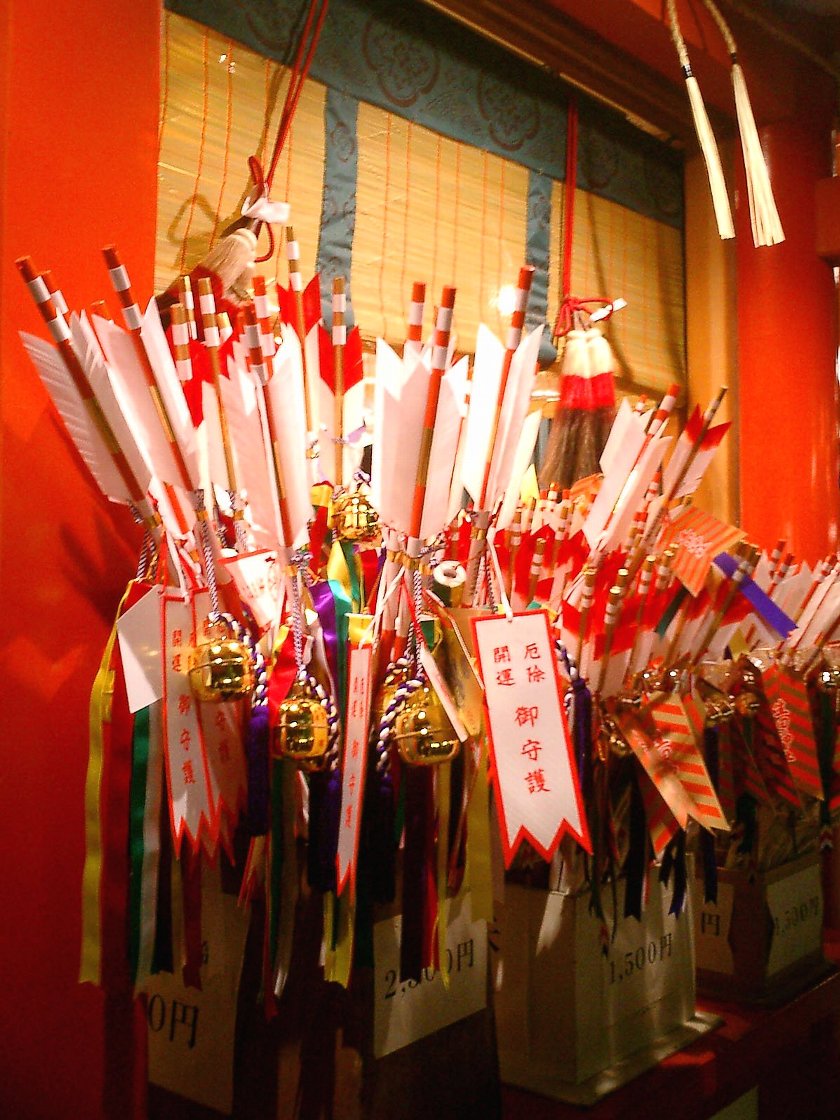
The Yabane Pattern is an interlocking and alternating series of arrow tails resembling elongated trapezoids together. The pattern is said to resemble hawk or eagle feathers which are used in Japanese arrow tails. They are said to be an auspicious pattern.[1] Yabane is also associated with Hamaya (破魔矢 | Good luck charms) which are given out at Shrines in the New Year for repelling demons.[2] Arrows thus also carry connotations of good luck for Buddhist iconography.

Hamaya Arrows (2006, CC3.0) 生田神社

Sports such as Archery, Takagari ( 鷹狩 | Falconry) and Hawking for hunting in Japan have long been popular, with Takagari being practiced since 300AD.[3] Historically Yabane is thought to have originated in the Heian era, when it was used to complement Kuge (court noble) archery in the 1200s. At the time, this held great importance as it helped mete out land jurisdiction for example. This eventually formed Ryu (Japanese falconry styles), as part of an elaborate and costly pastime like fox hunting in Britain. It was said to be a popular hobby of Tokugawa Ieyasu who eventually banned Kuge Takagari.[2][3] Yabane kimono were given to Brides in the Edo period. It was said that like an arrow which unlike a boomerang, never returns, as so would be the bride as the auspicious nature of the pattern would provide a long and happy marriage for her.[1] By the Meiji period, Yabane had become popular as womenswear and became worn at school.[2] In the 1970s Haikara : Here comes Miss Modern Anime, the main character Benio also wears Yabane. It was said pairing Yabane with Hakama (Kimono Trousers) became popular at graduation ceremonies.[1]

Pattern #8 will be the Amime Pattern.

Bibliography

[1] https://www.nippon.com/en/japan-data/h00478/traditional-japanese-patterns.html 

[2] https://mei-24.livejournal.com/10380.html

[3] https://en.wikipedia.org/wiki/Takagari

Social Links

One stop Link shop: https://linktr.ee/Kaguyaschest

https://www.etsy.com/uk/shop/KaguyasChest?ref=seller-platform-mcnav or https://www.instagram.com/kaguyaschest/ or https://www.youtube.com/channel/UC5APstTPbC9IExwar3ViTZw https://www.pinterest.co.uk/LuckyMangaka/hrh-kit-of-the-suke/

I had exciting topics

 and then I got sick. and then I got heatstroke. and then my home became 35 degrees. and then i was sick again. and then i got mild food poi...