Her Haughtynesses Decree

Showing posts with label American. Show all posts

Sunday, February 4, 2024

仏米シンガー王朝とそのキモノップ | Franco-American Singer Dynasty and their Kimonopes | 1885 - 1951 | Essay #23

Winnaretta Singer (1865-1943) and Daisy Marguerite Séverine Philippine Decazes de Glücksberg Fellowes (1890-1962) were both American-French socialites, who interacted in many ways with the white elites of the American-French fashion industries. They were heavily complicit in the racist structures and depiction of Kimono as for the 'yellow peoples', with Winnaretta implicitly using Kimono to benefit from racist tropes and imperialism in her career as a painter. This is part of a broader tradition of the French Orientalism genre which would give rise to the Madame Chrysanthemum trope a few years after Winnaretta's use of the Kimonope, in 1883. Daisy, her neice would use these tropes in her time at Harpers Bazaar from 1933-1935, displaying the same ideas about people of colour and their cultural traditions throughout the 20th century.

Winnaretta

Winnaretta was a salon hostess with bisexual leanings. Winnaretta was one of the 26 children of her father Isaac Singers (1811-18something). Her mother was another French-American socialite who married Singer when he was 52 and her mother Eugenie was 19, they would later divorce due to Singers flagrantly disgusting dating history. Winaretta was the heir to the Singer fortune however and therefore was the definition of white privilege. The Singer family moved from America to Pari after the 'upstarty' black people demanded human rights American civil war happened. Hmmmm.

Winaretta lived in Paris for most of her life, with her mother's second husband being reportedly abusive to Winnaretta, who fled in 1883. Unlike other Sapphics (Renee Vivien;1877 - 1909) Winarets decided to join the straightz4life gang. Winnaretta is so classically Sapphic that during her matriomonial night of consummation in 1892, she is said to have climbed up a wardrobe and threatened to help the groom reach the next world. In 1893, she entered a lavendar marriage and began her hostess work. We are interested in Kimono however, and it is in the self portrait of Miss Winaretta Singer which are to delve upon.[1]

Self-portrait

Self Portrait (1885, PD) Winnaretta Singer

Winaretta was operating as a Queer white woman in France in the late 19th century. At this time, this meant we encounter the Kimono in these spaces as a part and parcel of the actress wardrobe as part of the aesthetic and bohemian movements. From what we can see, the Kimono is most likely a very expensive export from Japan bought in France. This would be a particularly common way for these types to attain their cultural appropriation fixes. I say this, becuase nowhere elese does it seem that Winny decided to appreciate or try to engage with Japanese culture. 

Her artwork comes from Queer escape certainly, but for some reason she has decided that as an exhibited artist at the French Academy, her memory should be done in what is a flower crown, with whatever book she has in her hand. The messages are not subtle, the flower crown in fact is a reference to the Greeks and Romans, and the Kimono an aesthetical accent. On its own, this would be fine, but this sets a slightly dangerous precedent when we consider what message this sends to both her audience and her contemporaries about the role Kimono hold for Winnaretta. 

What here Winnaretta tells her audience, is a rather sinister message that aestheticism must be beholden to Greek philosphy to be credible. Her arrangement of florals resembling these ideals of 'Old Japan', that is a Western oriental version of Japan dreamt up in the mind of somewhat ignorant elite members of the Western world, is punctuated that the Hellenic literally reigns over this (the laurel crown symbolism). There is very little need for the laurel crown, as the fashion at the time was to wear Greek Anademata ties, which was a well-known hairstyle in those circles. The laurel crown however was something which denoted war, victory and was often worn by Roman emperors to declare their rule as victorious. 
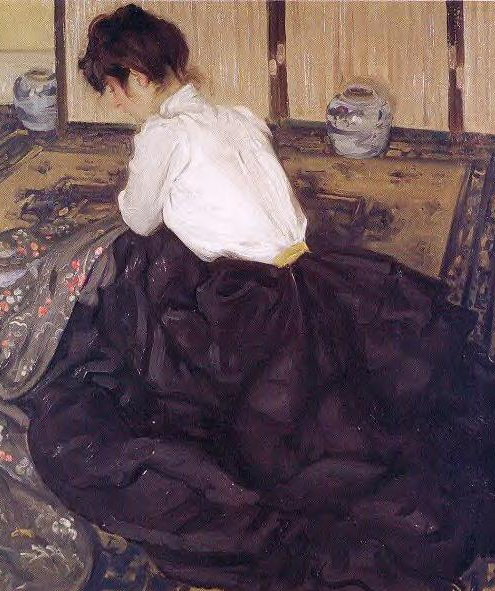
Arrangement (1901, PD) Alfred Henry Maurer
This depicts a common usage of Kimono in a rich sitters/artists models portrait, note the lack of laurels

In this way, as this was a self-portrait, Winnaretta was perhaps sending a message to her wider contemporaries who at this time had popularised Orientalism. A style of painting which by this time was used as French colonial propaganda to uphold the idea that people of colour required the 'guiding hand' of France to become 'civilized', such as was the case with Algeria whose colonisation by the French began in the 1830s only ending in 1962. In using the symbolism of the laurel crown, Singer signifies the imposition of the West over that of Japan, a country of those who her contemopary French painters such as Fernand Cormon (1845-1924) saw as on the lower rungs of scientific racism's rankings of humanity, as depicted in his white supremacist 'Human Races' which depicts Japan below French white people on this racist ranking of the 'races'.[3]

Human Races (1897, PD) Fernand Cormon

When we take this into account, we see that this is an imposition of the West over the East, a victorious triumph of American-French people, over those subjugated peoples who would help their younger sister Old Japan into the New Japan. This was an unfortunately pervasive ideal which only became stronger going into the 20th century and would likely have been passed down to Daisy.

Daisy

Daisy's mother, Isabelle died tragically. Rather like Daisy's trajectory in the shoulder department. Isabelle was Winnaretta's sibling, leading to Daisy being taken in by Winnaretta. Daisy went on to become the Pari Coreespondan for Harpers Bazaar. This was owned at the time by William Randolph Hearst, a blatant and well known racist who kept people of colour out of his magazines, which included Vogue and Harpers Bazaar.[4] These explicitly made Japanese people out to be 'undesirables'.[4] It is in this way that we come to the world in which the 'New Japan' had emerged as a result of Wilsonian foreign policy which in part lead to the depiction of the Japanese Diaspora as having a second class status to that of 'whites'.[2]
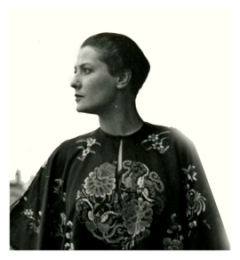
Suzanne's Kimonope (c.1930-1949, CC3.0) Olivier Baroin

Daisy as a white, no doubt encouraged these attitudes given she was rubbing shoulders with Winnaretta and Hearst. Daisy was indeed an inheritor to the Singer fortune and thus also was set for life. To reiterate this point, may we show you the influence of Kimono on her friend Suzanne Belperron (1900–1983) who wears a Kimonope. Ms Belperron's uncle was Paul Poiret the famous designer who made quite a lot of money from taking 'inspiration' from Kimono and creating a few Kimonopes and modern silhouettes. Other firends included the Chanel (a Nazi colloborator) and Schiaparelli (Chanels feted rival). A 'close friend' included Diana Vreeland (1903-1989) who is today known for stating the first known Black supermodel as 'King Kong', and that she was 'nobody's idea of what anybody wants to look like', in reference to a shoot Luna was meant to book in the 1960s.[5] King Kong came out in 1933, in a more racist friendly time and the exact year Daisy began her foray into Harpers Bazaar. A magazine which only included black models 2 years after she left, and which only encouraged the first Asian supermodel Noelie Dasouza Machado (1929-2016) to take the cover in 1959. Even this this comes with the caveat that Machado's home country was under Colonial rule by the Portuguese. This is the mindset these people wrote and followed. Around the end of her time as Pari correspondan, Daisy began a heady diet of Amphetamines, Cocaine and more friendships with Nazi Sympathisers, known as Wallis Simpson by 1936.[8][9]

Another cultural appropriation moment occurred when the colour 'Shocking Pink' was supposedly created for Diasy by Schiaparelli around 1937.[8] Diasy often continued this Oriental fantasy of Asian and 'Other' cultures as beneath her own, as costumes she could try on and profit from but never really give back to. This included ornate costume parties into the 1950s where attendants would stand around in 'exotic' dress from Asian cultures, serving and waiting hand and foot on Daisy, whilst others ran around in blackface.[7] Daisy herself would follow in a bout of cultural flagrance in her 'Hindu' necklace which was worn once to a costume party and then given away as a gift.[6] These items, which most likely included a Kimonope or two in Daisy's armoire, were known as 'Savage jewellery'.[6] Yes it is called the Oriental Ball and yes that is Ms Fellowes walking around in a cheetah print ballgown attended to by an Asian stereotype.[7] Shocking indeed.

Daisy in this way embodied the later trend of Primitivism and it is this way that the money for Singer sewing machines encouraged the adoption of Kimono as a garment for the 'Red Woman' trope, given the way the Singer Heirs spent and adopted or treated Kimono.

Conclusion

In context therefore, the impact of the Singer Dynasty on European KTC can be seen as detrimental, and heavily tied up in Orientalist tropes perpetuated by French and American elites. Winnaretta used Kimonope to embody the ideals of French imperialism and the imposition of Japanese culture as academically beneath that of White Western traditions, and Daisy in the ideals of the Primitivists and Fauvists whom she supported, as well as working amongst some of the most racist Publishers of the day. These usages of Kimono give us an entry into the world of French Orientalism and the Visual Realpolitik of how Kimono were percieved by those in power, particularly in positions of privilege and with a need to uphold whiteness. Kimono are used for the Singer Dynasty as tools of oppression and are directly a product of their racial worldviews and times.

Bibliography

[1] https://en.wikipedia.org/wiki/Winnaretta_Singer

[2] https://en.wikipedia.org/wiki/Daisy_Fellowes

[3] Allegorizing Aryanism: Fernand Cormon's The Human Races, Maria P Gindhart, 2008, Volume 9, Online Edition, The Journal of the History of Art (Aurora), WAPACC Organization

[4] On Media Moguls and Racist Tropes, Vicki Mayer, Alice Pavanello, 2022, pp.70-74, Volume 24, Online, Journalism & Communication Monographs, SAGE Publishing

[5] https://en.wikipedia.org/wiki/Suzanne_Belperron

[6] https://www.prestigeonline.com/th/jewellery/cartier-udyana-necklace/

[7] https://littleaugury.blogspot.com/2014/01/daisy-roars.html

[8] https://graindemusc.blogspot.com/2008/11/schiaparelli-shocking-hot-pink-and.html

[9] http://tweedlandthegentlemansclub.blogspot.com/2015/07/the-most-wicked-daisy-fellowes.html

Essay Abstracts 

#1 Renee Vivien (1877 - 1909) --- Born Pauline Tarn, was an English lesbian poet. She wrote in French and perhaps English. She took up the style of the Symbolists and Parnassinism and was well known during the era of the Belle Epoque (the Beautiful Age) for producing Sapphic verse and living as an open quasi butch lesbian poet; her verse derived from the ancient poet Sapphos, also famed for her love of women.

# 2 Birth of the Kimonope --- Here I shall introduce the notion of the Kimonope, that is as a garment attached to the social construct of the 'Geisha' in North America. Kimonopes being Orientalized clothing, or 'negatively affiliated or exoticized ethnic dress' which lead to the perceived notion of the Kimono and Geiko as simultaneously both high and low culture to American culture makers, such as film, television, media, writers and some academics. An example of Kimonope are the tacky Halloween costumes you may find at the Dollar store.

#3 The Legacy of the MacArthur Dynasty on KTC & The Problem with the 'Traditional Garment' Argument --- The problem with arguing that the Kimono is a 'Traditional ethnic Garment' is that that assertion is in itself, arguably  Ethnocentrism, which to clarify is the imposition of, in this case, American values onto Japanese cultural values, belaying the 3 pronged pitchfork of idiocy. 

#4 Divine --- Government name Harris Glenn Milstead (1945-1988) was the infamous North American Queen & Drag artist. Specifically, Divine was known for being a character actor, part of her act is well-known for its eccentricity. My personal exposure to Drag lite was Pantomine Grand Dames as a kid, and later when my friends made me watch RuPaul in art classes, so to me this is nothing new, the over the top, the glitter, the upstaging is all part and parcel.

#5 Dori-Style or 21st century Kimono Fashion --- The Dori-Kimono style. Something which I just made up because in going over notes for the first 20 years of 21st century section of Kimono history, I noticed a lack of a clear catchall term for what was happening in Japan at the time, at least in English descriptions of the time. I use the term Dori as I do not want to coin an unrelated term to the topic, but I also am reticent to claim all of Street style as 'Tori' either, whilst a large number of streets upon which the subculture originates in all use the suffix 'dori' (the bottom of Takeshita-dori for example), thence Dori-style.

#6  The Tea Gown --- This essay will cover the aspects of how 19th century Japanese import textiles to Western countries were used and repurposed, as well what their desirability tells us about how Japanese design was regarded and the image which these people held of Japan through the Western lense and consciousness. This follows the progression of how Kimono can be used in the West from the undress of the 1860s, adapting silk bolts in the 1870s to high fashion western daywear, to the 1880s aesthetic movement and 1890 wholesale adoption in the Victorian age to being used prominently by society hostesses as tea gowns by the Edwardian period, and the subsequent change in Japanese export culture which we see in extant textile collections of Japanese textile in Western dresses of the periods.

#7 Kimono and the Pre-Raphaelite Painters --- This essay will cover the aspects of Kimono in the Portraiture of the Pre-Raphaelites. The Pre-Raphaelites were a group of British artists and writers active during the late Victorian period. Unlike the Royal Academy artists, this circle of painters operated outside of the established comfortable boundaries of the expected white, cisgender middle class audience of the Victorian age. The movement is notable for its inclusion and encouragement of women, and in portraying and engaging non-conventional beauty and beauties as figures from the Classical World alongside Religious, Mythological and Folklore Heroines into Victorian 'Femme Fatales'.

#8 Jokyo/Genroku Kimono Textile Culture and the new role of the Komin ---  This essay will return back to GKTC (Genroku Kimono Textile Culture ; 1688-1704) and JoKTC (Jokyo K.T.C. 1684-1688) and the new role of the Komin (Artist caste) in GKTC. JoKTC is notable for being the lead up to GKTC, JoKTC being characterised by its transitory nature in comparison to GKTC, which was far more bold in its relations to what Kosode could and should be. Komin entered the picture at this juncture, and I shall elaborate a little more here than in other posts about why that was. GKTC is notable for its elaborate, perhaps gaudy and innovative Kosode design features, whilst JoKTC more so for the enabling factors of the time, as a sort of incubatory GKTC.

#9 Tagasode Byobu - This essay will explore the art motif known in Japanese art as Tagasode Byobu ( Whose sleeves Screen) This motif is a recurring art form which was particularly popular during the Azuchi-Momoyama era ( 1568-1600 ) as a representation of the ways in which Buddhist sensibilities met with the fast changing events of the end of the Sengoku Jidai (1467-1615) and as an extension of the habit of wealthy women from military families came to own and store a large number of Kimono. Prior to this, Kin Byobu ( Golden Screens) for the most part depicted nature like Sesshuu Touyou (1420-1506) after Chinese Cha'an painter Muxi ( c.1210-1269 ) or 'flower-and-bird' scenes like those of Kano Eitoku (1543-1590), rather than humans or human paraphernalia as an extension of the Zen painting school of thought about materialism.

#10 Cultural Acculturation --- The topic of our essay is on the nature of Cultural Exchange in KTC which will be an ongoing mini-series throughout 2022. This covers the 1000CE - 1500 period in Japanese History.

#11 Cultural Appropriation --- The topic of our essay is on the nature of Cultural Appropriation which will be an ongoing mini-series throughout 2022. 

#12 Cultural Acculturation --- The topic of our essay is on the nature of Cultural Acculturation which will be an ongoing mini-series throughout 2022. This covers the Asuka (Hakuho), Nara (Tempyo), and Heian periods (500CE-1000CE) in Japanese History.

#13 Asai Ryoi --- This essay will explore the legacy of Asai Ryoi on KTC. Who was Asai Ryoi you may ask? Only one of the most important writers for the Ukiyo genre. Asai Ryoi ( act. 1661-1691 ) was a prolific Ukiyo-zoshi ( Books of the floating world )  or Kana-zoshi  ( Heimin Japanese Books ) writer. His leading 1661 publication, lambasted and satirized Buddhism and Samurai culture of restraint in favour of the Chonin lifestyle of worldy excess.

#14 Edith Craig --- This is a post regarding the early adoption and promulgation of the Kimono and Japanese aesthetics in the life of the wonderful Edith Craig (1869-1947), daughter of the famous actress Ellen Terry (1847-1928) and Edward William Godwin (1833-1886). Edith was also known as 'Edy'.

#15 European Banyans --- This essay will explore the European garment known as a Banyan, which originated as a European reaction to Kimono in the 17th century, popular until the end of the 18th century. The word Banyan originates from Arabic ( Banyaan), Portuguese (Banian), Tamil ( Vaaniyan ) and Gujarati ( Vaaniyo ) loanwords meaning 'Merchant'. Alternative versions saw the item fitted with buttons and ribbons to attach the two front sides together. The Banyan was worn by all genders and was particularly regarded in its first iterations as a gentlemanly or intellectual garment worn with a cap to cover the lack of a periwig, and later adopted by women and greatly influenced how British womens garments were designed with preference for comfort in removal of panniers whilst maintaining luxurious, modest 18th century fashions (see Robe a la Anglaise).

#16 Miss Universe and Kimonope --- This essay will explore how Beauty Pageants, principally Miss Universe, has engaged with KTC. While there may be real Kimono worn by Japanese and Japanese adjacent contestants in the 'National Costume' category, I will be focusing on the Kimonope worn by contestants. The idea of Kimono as a 'national costume' sparks interesting conversations on what 'national costumes' are, their target audiences, and how we form ideas about these things to begin with.

#17 Onna-E --- Womens pictures refers to the Nara, Heian and early Kamakura ( 710-1333CE ) practice of drawing women in elongated Hand scrolls, which today are regarded as feminine gender coded Art. Some of these narratives depict the lives of women, their extra diaries, or the literature they wrote. The Onna-E style derives from how mostly Heian women represented themselves and others as a performed self in these scrolls, drawing from their lives indoors at their and the imperial abodes. Whilst a limited number of women could read Kanji, they also used their knowledge of Chinese culture to create and inspire their own culture; the first truly Wamono aesthetics; and it was with these preconditions that Onna-E became established in the Japanese art scene alongside Yamato-E and Oshi-E.

#18 A Jamaican, a Monster and Portuguese bar in the Orient --- This essay looks at the Kimonope attire adopted by North American Dancehall artists Shenseea (Chinsea Linda Lee | 1996 - present ) for the video to 'ShenYeng Anthem'. Whilst the aesthetic derives mostly from East Asian, principally Chinese aesthetics, the language used is specifically Japanese, referring to Chinsea Linda Lee as 'ShenYeng Boss', a perpetuation of the Dragon Lady stereotype. The essay mostly charts how this ridiculous Kimonope derides from the North American Anti-Chinese movement and how this intersects with contemporary Orientalism.

#19 The Red Kimonope --- The Red Kimono is a terribly named racist US silent film from 1925. The Longingist film includes a key scene which the production gets its name from where the protagonist drops her Kimonope, meant to symbolize that she had turned away from sin and prostitution, or in other words equating a wearer of the Kimono as a sex worker which stemmed from another American 'tradition'. This dreadful melodrama features the previously yellowface-accepter Priscilla Bonner as the lead protagonist. Throughout her trials and tribulations, she faces many ups and downs, like becoming a white version of the Lotus Blossom stereotype, because WASPs. I will explore the origins of the Lotus concept and the 'Jade' in more detail here as to provide the contextual background of the productions symbolism.

#20 Housewife, Business Girl, Office Lady --- I explore the concept of the arrival of the Business Girl, and the Shufu ( Censored | Housewife ) of the 1930-1970's period of the 20th century.[1] This intersects with how we see Wafuku represented, in a shifting dynamic that had not shifted so many barriers since the 1870s, and even until the 1990s with the intrusion of Euro/Americentric beauty standards being foisted upon the world during these centuries, in the wardrobes of the upwardly mobile single business women of from 1955-1965. These groups came into being in the 1950s with the advent of the eclipse of settler colonialism and patriarchal standards over women's lives internationally. KTC thus developed in response to these changing, testing and trying times (between 1930-1970).

#21 Herman's 'Kimono' --- In this essay I look at another Kimonope, specifically another Miss Universe 'national costume' entry. This particular Kimonope represents the legacy of Macarthism's neo-colonial/systemic racism, and subjugation of Japanese soft-power, a follow on of Orientalist late 19th/early 20th century assumptions and stereotypes of Asian culture and peoples which saw their subjugation in American foreign and domestic policy between 1885-1952. In this entry, we see a clear leaning into the 'Cool Japan' aesthetic by the Kimonope's designer, who is not shockingly not Japanese, but Israeli and therefore represents ideas about what Kimono are to this designer than the genuine article would to other participants of KTC, foreigner or otherwise towards 'Kimono'.

#22 Uno Chiyo --- This essay explores the work of Uno Chiyo (1897-1996) as a Kimono Designer. Uno was a prolific 20th century Japanese writer and designer. As such, Uno was familiar and fluently versed in KTC throughout her life. Uno founded the influential Style which was in circulation in Japan from 1936-1959.[1] Uno was heavily influenced by Western and Genroku fashion, and focused her aesthetic on these two whilst encouraging masculine and secondhand consumer habits in her approach to Kimono as a fashionable and modern pursuit. Uno provides a fascinating glimpse into a time before Kimono were stigmatized and were instead merged with Yofuku to inform Japanese identity and femininity in new and stylish publications and normoactivities.

#23 Franco-American Singer Dynasty and their Kimonopes - Winnaretta Singer (1865-1943) and Daisy Marguerite Séverine Philippine Decazes de Glücksberg Fellowes (1890-1962) were both American-French socialites, who interacted in many ways with the white elites of the American-French fashion industries. They were heavily complicit in the racist structures and depiction of Kimono as for the 'yellow peoples', with Winnaretta implicitly using Kimono to benefit from racist tropes and imperialism in her career as a painter. This is part of a broader tradition of the French Orientalism genre which would give rise to the Madame Chrysanthemum trope a few years after Winnaretta's use of the Kimonope, in 1883. Daisy, her neice would use these tropes in her time at Harpers Bazaar from 1933-1935, displaying the same ideas about people of colour and their cultural traditions throughout the 20th century as found in her social peers.

Social Links

One stop Link shop: https://linktr.ee/Kaguyaschest

https://www.etsy.com/uk/shop/KaguyasChest?ref=seller-platform-mcnav 

https://www.instagram.com/kaguyaschest/ 

https://www.youtube.com/channel/UC5APstTPbC9IExwar3ViTZw 

https://www.pinterest.co.uk/LuckyMangaka/hrh-kit-of-the-suke/ 

Sunday, October 15, 2023

蝶 | チョウ | Butterfly | Patterns #21

Butterflies represent the motif of transformation and renewal. They are most often also representative of spirits passing from one world to the next, sometimes who have taken their lives together to elope into the other world.[1][2][5] They also symbolise the maturity of young girls becoming young women.[3] Other meanings can also include intrigue, and it is said if the butterfly is captured this will dispel this.[5] Tsukure obi ( つくれ帯 | Pre-tied Belt ) are commonly tied in a Butterfly knot (Cho Musubi | 蝶結び ).[4] Even updoes take their cues from Butterflies, in the style of the Yoko-Hyogo (Butterfly Hairstyle).[5]

Presents for a loved one (c.1810, PD/CC1.0) Ryuuryuukyo Shinsai

Historically Butterflies have long carried connotations of the otherworld, and thus appear in a number of family crests. Some of the earliest artistic depictions come from the Heian period, in turn influenced by Chinese philosophy about the fleeting, transitory nature of butterflies in the lives of human as in the story of Zhuang Zhi who dreamt of being a butterfly and then got confused about being a human or a butterfly, because he could.[3][5] Butterflies commonly appeared in many artistic mediums of the early Edo period, including Kimono, woodcuts and Origami designs.[3] This is mostly from the 1660 onwards obsession of Komin to depict Yuujo and stage performers. Even Hokusai involved himself in the depiction of this famous motif.[3] Unfortunately, the Long character/stereotype 'Cho-Cho' (1904) also means butterfly and in this way is also adopted in Occidental Literature to denote fragility, submissiveness and other surface aesthetic notions of Japanese culture. The 1900s-1950s saw a rise in the use of the motif as more families derived on the national surplus from Japan Inc. were able to buy their children fancier wafuku such as Furisode, a popular trend in the 1930's was to have these lined with gold which in the modern day has become just a white outline. 

Bibliography

[1] https://nalatanalata.com/journal/motifs-in-japanese-design/#:~:text=In%20Japanese%20culture%2C%20butterflies%20carry,number%20of%20traditional%20family%20crests.

[2] The first chapter of Bleach. Recommended for the art alone. Story is muy dissapoint.

[3] https://news.artnet.com/art-world/a-history-of-butterflies-in-art-2085638#:~:text=In%20Japan%2C%20the%20butterfly%20has,of%20female%20ritual%20and%20experience.

[4] http://www.japonic.com/obi/obi24.htm

[5] https://arteingiappone.altervista.org/en/butterflies-in-japanese-and-western-art/

Socials:

One stop Link shop: https://linktr.ee/Kaguyaschest
https://www.etsy.com/uk/shop/KaguyasChest?ref=seller-platform-mcnav 
https://www.instagram.com/kaguyaschest/ 
https://www.youtube.com/channel/UC5APstTPbC9IExwar3ViTZw 
https://www.pinterest.co.uk/LuckyMangaka/hrh-kit-of-the-suke/ 

Sunday, September 17, 2023

ヘルマンの'着物' | Herman's 'Kimono' | 2021 | Essay 21

In this essay I look at another Kimonope, specifically another Miss Universe 'national costume' entry.[1] This particular Kimonope represents the legacy of Macarthism's neo-colonial/systemic racism, and subjugation of Japanese soft-power, a follow on of Orientalist late 19th/early 20th century assumptions and stereotypes of Asian culture and peoples which saw their subjugation in American foreign and domestic policy between 1885-1952.[3][4][5][6] In this entry, we see a clear leaning into the 'Cool Japan' aesthetic by the Kimonope's designer, who is not shockingly not Japanese, but Israeli and therefore represents ideas about what Kimono are to this designer than the genuine article would to other participants of KTC, foreigner or otherwise towards 'Kimono'.[1][5]

An example of what should have been (2018, CC4.0) Nesnad

The Individuals Responsible

The great designer himself was the notable Aviad Arik Herman (b.1984), an Israeli costume and fashion designer who seems to work exclusively in pageant costumes.[1] An Israeli designer was chosen to represent the symbolic weight of the 70 year celebration of diplomatic relations between Japan and Israel.[1] Herman was supposedly inspired by 'Harajuku fashion culture' which sounds more something my highschool textiles design teacher came out with than a high level designer on a global stage, but here we are.[1]

Ms Juri Watanabe (b.1995) is arguably American-Asian having grown up in a diverse family, home and school environment, going into the pageant world in 2016.[1][2] 

The Event

The 2021 Miss Universe pageant occurred in Israel at Eilat and the Kimonope worn by the Japanese-Korean representative, Juri Watanabe for the 'National Costume' section.[1] Kimono Wednesdays could never. Yes Im still salty.

I will point you to my previous thoughts on Kimono as 'national costumes':

Kimono after the 1950s fell away from its mores from 1900-1940 of being an exotic, expensive textile, to being a garment worn by a defeated nation when Japan became occupied by the USA from 1946-1952. During this time, elements of society which pushed Longingism, which gained traction from 1885-1920s America with the rise of Asian labour movements and immigration into the USA, created the Kimonope, which associated the Kimono as an 'Oriental' garment.[3]

[For me,] Kimono is a type of clothing which can be worn by anyone, an idea which the broadcaster NHK clearly thought so as well. Japanese Americans, whilst rightfully having the historical claim to the Kimono [...], perhaps did not foresee the global issues that claiming the Kimono as a 'Traditional Garment' may bring [...]. This [Traditional Garment/National Costume] Argument being unfortunately a spearhead of the 'culture wars' inspired by Wilsonianism which declares that non-White powers may not be considered or constituted in the worlds of academic, politics and popular culture [... in] being considered global popular culture. Instead that [...] that 'developing' countries instead be left to 'develop' away from the wealth of the United States, [...] a sort of FU to the fact that Japan had entered the world stage as a great power, and thus denial of all things Japanese as bad. [Instead the benevolent USA must prevent Communism and return ...] everything [...] back to its natural [Wilsonian] order [...]. Kimono as a visible [Asian/Japanese] cultural marker, were by this point definitively recognised by the Japonisme movement at the very least, as global popular culture [in the early 20th century], and thus the birth of the Traditional Argument (ie that Kimono is simply just a Japanese garment only to prevent pan-Asian interests taking root) and breaking down of US-Japanese relations began (seFred Korematsu v United States, 1944-2018). [...This argument is] the very trap Wilsonianism lays for 'developing' nations. It isolates the object in question (here Kimono), rips it asunder from its history, values and context, and flings it to the sorting bins of history where nobody will find it. Kimono Wednesday protests meant well, but in the end, they have sent the wrong messages to the wrong people, and helped to isolate, relegate and simplify Kimono into a relic of the Yamato. That is to say deny how the Kimono played a role in and from Asian Empires, to ignore the Kimono as a global presence in Western and other Art Histories, and to penultimately again, isolate, relegate and simplify the Kimono into an exotic national costume, worn by the Japanese. A label I do not wish to ever have to repeat here or anywhere else [unless quoting]. By this, I mean [Asian-Americans like Ms.Watanabe] have done Wilsons work for him in promoting the idea of the Kimono as an exotic 'ethnic garment' only to be worn by Japanese people and their descendants, and which denies the wider history of Kimono as a cultural touchstone [instead promoting oriental-adjacent Kimonopes ...] essentially saying that Japanese fashion is less important than American fashion, by relegating Kimono to being a product only worn in the past [...] isolating Kimono as something exotic or 'Japanese' (a fraught argument supporting homogeneity and ethnocentrism) and simplifying the complex worlds which KTC operates in as somehow unworthy of note to anyone who isnt Japanese. As such, I refute that Kimono making is a dying industry on the grounds that is a blatant lie, it is in fact adapting to the age it is in, as it has always done as a social construct, and that to think that one thing can belong to only one group as rather part of the 20th century Wilsonian anti-Asian dogma. [...] Until [considering] how ['Kimono'] was created under Chinese and Korean influence during the Asuka and Kofun periods, and as part of globalisation, not simply as 'a national costume appropriated by Westerners', but rather as with the rest of KTC, and other garments, simply a social construct [as with Western garments, e.g. T-shirts]. This is seen in the paintings, Mandalas, Embroideries and texts extant from the period when corrobarated with wider Mainland Asia garment history. I relate this to Kimono [Wednesdays] because it may allow for a wider dialogue on cultural exchange in the hope not everything 'foreign' is labelled exotic, turned into a problem, lost to history or simplified as just being a 'costume' or 'cultural appropriation' [as if graphic T-shirts for example can only be worn by certain groups of Americans as it is a traditional garment or iconic national American costume].[4]

National Costumes, [...] in English [describe ...] the historically European tradition of giving 'National Costumes' to certain groups [begun] in the 18th century [...] to define what a country was and took off in the 19th in the advent of European Colonization [of] pseudo-classif[ications in ...]  series of illustrated books drawn by many European and later American and Asian artists depicting the 'National Dresses' of certain groups [in ...] 'rational' 'native' outfits which continues as National Costume Colouring books today. [...] an example being the controversial Han-fu for China, [... rather than the Qipao]. Nationality like money and gender, is a social construct; one that at times gatekeeps other ethnic identities from exerting any kind of power and suppresses more diverse national stories. In Britain for example, there is no such definitive thing as a Kimono to call a National Costume. Instead we are often represented by tacky costumes only fit for Halloween which riff on the idea of what it means to be 'British', which axiomatically is a million and one things. [... Consecutively, as a] Beefeater (Yeomans Warder) [since] 1962. [...] Other editions [include ...] the latest by Jeaneatte Akua in a bid to the Pearley Kings and Queens of working class London culture. [...] 'National Costumes' [have] carved out a space for themselves, as a need to make space in a dominant cultural identity which threatened to wipe their own out[, e.g. Tartan ...] I in particular do not refer to Kimono as a National Costume or Dress, as it a patriarchal paternalistic notion of hegemonic cultural/White supremacy that Kimono are distinctly outdated womens attire, only fit for the 'lesser race' (in the words of Leonce Benedite) [or the Dying Kimono trope of...] Macarthism. [... which pushes] the idea that traditional Japanese culture is inferior to the superior Western culture. [...] Akiko Kojima [..., another older Miss Universe, wore] Kimono as everyday or at least casual wear, not as a traditional 'Oriental costume'. [... In Kojima's time,] generally civilian Japanese had not got the message yet about Americas superiority complex. [Changing by ...] the 1960s when Japan, as [in 1860 'Westernized' ...] to reclaim its own [... soft power agency]. This internalized Macarthism is reflected in the way Ms. Akiko was represented in American society [... by] Harpers Bazaar, a magazine that refused previously to run models of 'color' in its pages [and was strikingly] presented in Western dress, not Kimono [... telling] us of the fact that Kimono was not considered fashionable enough to be considered as fashion in its own right, instead Akiko wore *acceptable* white brands such as Sarff-Zumpano Inc. [... at a time when Honshu Japanese dealt] with the caveat of internalized inferiority dealt with the idea that 'Japan lost the [Pacific] war'. This attitude in Japan commonly refers to the postwar generation of Japanese Teeners [...] who felt the burden of growing up in the shadow of Macarthism, in a world which saw the subjugation of Japanese culture as 'feudal', saw Japanese people as 'savages' for fighting on the wrong side of WWII and the unlawful incarceration of Nissei Americans (1942-1947). When 'Sukiyaki' was released to Western audiences it gave notions of Beef dinner, to a Japanese Teener, Ue o Muite Arukō (I look up as I walk) was reminiscient of the frustration of dealing with American occupation in the Anpo protests (1959-1970) and the Sunagawa Struggle (1955-1956). Its culmination being the murder of Chinese-American Vincent Chin in 1982 at the hands of Statesian men who thought he was Japanese. [Ergo ...] casual wear of the Kimono becomes a thing of your mothers generation by 1975, and your grandmothers by 1995. [...] When the next winner of Miss Universe wore Kimono, it was as a 'National Costume' in 2007 by Riyo Mori who wore an altered Kimono. Ever since[then] it has been commonly accepted that Japanese pageant goers wear Kimono to the National Costume section of the event. [... Also] 'Cool Japan', a sort of right wing Japanese politicians wet dream of global Japanese hegemony [...] has attempted to adopt the Kimono as a National Costume as well which is a strand of Japanese paternalism [...] about the 'correct way' to wear Kimono [...] mixed with a dash of inferiority complex, [...] is certainly a proponent of the issue of bringing KTC into the global world as global fashion under Macarthism's influence. [Which ...] fosters a disturbingly ethnocentric idea of Kimono, which is also another thorn in the side of KTC. [... Moves towards] national costumes like the Seifuku is particularly reassuring as it is the Death of the 'Dying Kimono' trope, in saying that Kimono is current and alive, and that culturally Japan has more to its 'national' culture than just reasserting 'Wafuku'. Wamono in this sense has shifted to a more inclusive contemporary understanding of the national, away from the stereotypical Longingism of 'coolies' and 'Geisha-girls'. [Overall, ...] many national costumes depends on how we define national culture. Kimono and other 'traditional' garments are often seen as 'national dress' due to the decline of their wear after the introduction of Western power structures, colonization and efforts to 'modernize' under globalisation. After 1955, this evolves from Macarthistic policy, which becomes internalized in Japanese culture by 1970 becoming the 'Dying Kimono' trope, which precipitates that old 'feudal' Japanese culture has been shed off becoming 'modern' Japan. After 1990 though, KTC was revived domestically and has since re-emerged as casual clothing once more both in Japan and globally with the rise of the digital age. [However ...] when we explore how we get to the notion of certain modes of dress being 'Costumes' we can see how this can be a negative reinforcement of existing power structures through lenses such as Macarthism. The Kimonopes which exist in these spaces are often attempts at cultural appreciation, but more often are regarded as objects of cultural appropriation by many. Thankfully, we can also see post 2005, a resurgence in the pageant and fashion worlds of KTC as influential global fashion (for example the 2016 Furisode for Miss Mexico at Miss Latina USA designed by Sueko Oshimoto). This sees the Kimono as a modern incarnation of fashion, part of its revival in the contemporary world we live in and allows Kimono to be seen as desirable in the current beauty standards we ourselves hold, unravelling the work of hwight supremacists. Thus seeing the reemergence of KTC as living, contemporary fashion, as seen in high fashion, beauty pageants and street fashion.[5]
Girl in Harajuku on her phone (2008, CC2.0) Charlotte Marillet

The Result

Watanabe's Highlight Reel (2021, Educational) Youtube

Ms Watanabe finished in 16th place.[2] Thus she did dig her own grave, so perhaps it was quite a spot on Kimonope of a cocktail dress.

As you can see, this resulted in the ... creation before us. This pink-yellow mockery of a cultural besmirching wad of gum underfoot was paraded around by Watanabe in all its stereotypical glory. May we observe the maneki-neko, very Harajuku of course. Or fact this particular design has the Eri folded over incorrectly, such that its wearer may be read as going to her funeral. Muy Harajuku. Perhaps it may be the giant letter scrawled across her bare chest, another set of cultural faux pas in revealing the cleavage or potentially imitating tattoos, a cultural trait seen as inherently negative in its connotations Japan. Sehr Harajuku. We may also observe the perhaps stuck on Chrysanthemum belt or the flags attached to the sleeves. Very, very Harajuku fashion culture.[1] The boots were great though, the 'cocktail dress'[5] not so much. 

Conclusion

In context we can see how two POC people did not quite equal cultural appreciation, but rather an example of cultural appropriation in the promulgation of Kimonope. Rather unnecessarily as well, as members of the definitely not weirdly assimilating free thinking POC block of free-thinkers. Indeed they fell prey to Orientalist, internalized racist tropes which since the 1880s has dictated the terms Kimono's are received to international audiences, that is as objects consumed by white people, for white people. Ignoring the vibrant role of KTC in global history, popular culture and Japanese soft power on the international stage with the advent of Macarthism in the 1940s and the decline of Japanese hard-power during the occupation of Japan by SCAP forces.[3][4][5] This reinforcement of Longingism and Macarthism follows a tradition of seeing Asian-American and Asian workers as 'coolies' and 'Johnny Chinamen' whose labour and culture (the Kimono) was subservient and disposable to that of white North Americans, as seen during the time of Wilsonian and Roosevelt's policy-making, both foreign and domestic.[3][6] 

This inadvertant support of ethnocentrism neo-colonialism makes as much sense as gatekeeping African children from wearing graphic T-shirts Statesian dump on them; (as they are 'products of American culture'/'traditional American dress' and is to only be worn by the 'Statesian race'/that the Pedi Tribe cannot wear Tartan) thrown in the face of Asian-American grandparents who fought to normalize Kimono and other adjacent garments like Qipao, Sari and Việt phục as normal attire against the backdrop of 20th century race relations in neo-colonial systemic structures, which turn the Kimono into an Orientalist costume rather than as contemporary fashion, particularly evident in how people living in Japan reacted to this Kimonope.[1] Kaguyas Verdict: Clear-cut Cultural Appropriation.

Bibliography

[1] https://japantoday.com/category/national/miss-universe-2021-japan-entry-slammed-for-wearing-%27dead-person%E2%80%99s-kimono%27-1

[2] https://conandaily.com/2023/06/01/juri-watanabe-biography-13-things-about-miss-universe-japan-2021/

[3] See Essay #4

[4] See Essay #11

[5] See Essay #16

[6] See Essay #19

Essay Abstracts 

#1 Renee Vivien (1877 - 1909) --- Born Pauline Tarn, was an English lesbian poet. She wrote in French and perhaps English. She took up the style of the Symbolists and Parnassinism and was well known during the era of the Belle Epoque (the Beautiful Age) for producing Sapphic verse and living as an open quasi butch lesbian poet; her verse derived from the ancient poet Sapphos, also famed for her love of women.

# 2 Birth of the Kimonope --- Here I shall introduce the notion of the Kimonope, that is as a garment attached to the social construct of the 'Geisha' in North America. Kimonopes being Orientalized clothing, or 'negatively affiliated or exoticized ethnic dress' which lead to the perceived notion of the Kimono and Geiko as simultaneously both high and low culture to American culture makers, such as film, television, media, writers and some academics. An example of Kimonope are the tacky Halloween costumes you may find at the Dollar store.

#3 The Legacy of the MacArthur Dynasty on KTC & The Problem with the 'Traditional Garment' Argument --- The problem with arguing that the Kimono is a 'Traditional ethnic Garment' is that that assertion is in itself, arguably  Ethnocentrism, which to clarify is the imposition of, in this case, American values onto Japanese cultural values, belaying the 3 pronged pitchfork of idiocy. 

#4 Divine --- Government name Harris Glenn Milstead (1945-1988) was the infamous North American Queen & Drag artist. Specifically, Divine was known for being a character actor, part of her act is well-known for its eccentricity. My personal exposure to Drag lite was Pantomine Grand Dames as a kid, and later when my friends made me watch RuPaul in art classes, so to me this is nothing new, the over the top, the glitter, the upstaging is all part and parcel.

#5 Dori-Style or 21st century Kimono Fashion --- The Dori-Kimono style. Something which I just made up because in going over notes for the first 20 years of 21st century section of Kimono history, I noticed a lack of a clear catchall term for what was happening in Japan at the time, at least in English descriptions of the time. I use the term Dori as I do not want to coin an unrelated term to the topic, but I also am reticent to claim all of Street style as 'Tori' either, whilst a large number of streets upon which the subculture originates in all use the suffix 'dori' (the bottom of Takeshita-dori for example), thence Dori-style.

#6  The Tea Gown --- This essay will cover the aspects of how 19th century Japanese import textiles to Western countries were used and repurposed, as well what their desirability tells us about how Japanese design was regarded and the image which these people held of Japan through the Western lense and consciousness. This follows the progression of how Kimono can be used in the West from the undress of the 1860s, adapting silk bolts in the 1870s to high fashion western daywear, to the 1880s aesthetic movement and 1890 wholesale adoption in the Victorian age to being used prominently by society hostesses as tea gowns by the Edwardian period, and the subsequent change in Japanese export culture which we see in extant textile collections of Japanese textile in Western dresses of the periods.

#7 Kimono and the Pre-Raphaelite Painters --- This essay will cover the aspects of Kimono in the Portraiture of the Pre-Raphaelites. The Pre-Raphaelites were a group of British artists and writers active during the late Victorian period. Unlike the Royal Academy artists, this circle of painters operated outside of the established comfortable boundaries of the expected white, cisgender middle class audience of the Victorian age. The movement is notable for its inclusion and encouragement of women, and in portraying and engaging non-conventional beauty and beauties as figures from the Classical World alongside Religious, Mythological and Folklore Heroines into Victorian 'Femme Fatales'.

#8 Jokyo/Genroku Kimono Textile Culture and the new role of the Komin ---  This essay will return back to GKTC (Genroku Kimono Textile Culture ; 1688-1704) and JoKTC (Jokyo K.T.C. 1684-1688) and the new role of the Komin (Artist caste) in GKTC. JoKTC is notable for being the lead up to GKTC, JoKTC being characterised by its transitory nature in comparison to GKTC, which was far more bold in its relations to what Kosode could and should be. Komin entered the picture at this juncture, and I shall elaborate a little more here than in other posts about why that was. GKTC is notable for its elaborate, perhaps gaudy and innovative Kosode design features, whilst JoKTC more so for the enabling factors of the time, as a sort of incubatory GKTC.

#9 Tagasode Byobu - This essay will explore the art motif known in Japanese art as Tagasode Byobu ( Whose sleeves Screen) This motif is a recurring art form which was particularly popular during the Azuchi-Momoyama era ( 1568-1600 ) as a representation of the ways in which Buddhist sensibilities met with the fast changing events of the end of the Sengoku Jidai (1467-1615) and as an extension of the habit of wealthy women from military families came to own and store a large number of Kimono. Prior to this, Kin Byobu ( Golden Screens) for the most part depicted nature like Sesshuu Touyou (1420-1506) after Chinese Cha'an painter Muxi ( c.1210-1269 ) or 'flower-and-bird' scenes like those of Kano Eitoku (1543-1590), rather than humans or human paraphernalia as an extension of the Zen painting school of thought about materialism.

#10 Cultural Acculturation --- The topic of our essay is on the nature of Cultural Exchange in KTC which will be an ongoing mini-series throughout 2022. This covers the 1000CE - 1500 period in Japanese History.

#11 Cultural Appropriation --- The topic of our essay is on the nature of Cultural Appropriation which will be an ongoing mini-series throughout 2022. 

#12 Cultural Acculturation --- The topic of our essay is on the nature of Cultural Acculturation which will be an ongoing mini-series throughout 2022. This covers the Asuka (Hakuho), Nara (Tempyo), and Heian periods (500CE-1000CE) in Japanese History.

#13 Asai Ryoi --- This essay will explore the legacy of Asai Ryoi on KTC. Who was Asai Ryoi you may ask? Only one of the most important writers for the Ukiyo genre. Asai Ryoi ( act. 1661-1691 ) was a prolific Ukiyo-zoshi ( Books of the floating world )  or Kana-zoshi  ( Heimin Japanese Books ) writer. His leading 1661 publication, lambasted and satirized Buddhism and Samurai culture of restraint in favour of the Chonin lifestyle of worldy excess.

#14 Edith Craig --- This is a post regarding the early adoption and promulgation of the Kimono and Japanese aesthetics in the life of the wonderful Edith Craig (1869-1947), daughter of the famous actress Ellen Terry (1847-1928) and Edward William Godwin (1833-1886). Edith was also known as 'Edy'.

#15 European Banyans --- This essay will explore the European garment known as a Banyan, which originated as a European reaction to Kimono in the 17th century, popular until the end of the 18th century. The word Banyan originates from Arabic ( Banyaan), Portuguese (Banian), Tamil ( Vaaniyan ) and Gujarati ( Vaaniyo ) loanwords meaning 'Merchant'. Alternative versions saw the item fitted with buttons and ribbons to attach the two front sides together. The Banyan was worn by all genders and was particularly regarded in its first iterations as a gentlemanly or intellectual garment worn with a cap to cover the lack of a periwig, and later adopted by women and greatly influenced how British womens garments were designed with preference for comfort in removal of panniers whilst maintaining luxurious, modest 18th century fashions (see Robe a la Anglaise).

#16 Miss Universe and Kimonope --- This essay will explore how Beauty Pageants, principally Miss Universe, has engaged with KTC. While there may be real Kimono worn by Japanese and Japanese adjacent contestants in the 'National Costume' category, I will be focusing on the Kimonope worn by contestants. The idea of Kimono as a 'national costume' sparks interesting conversations on what 'national costumes' are, their target audiences, and how we form ideas about these things to begin with.

#17 Onna-E --- Womens pictures refers to the Nara, Heian and early Kamakura ( 710-1333CE ) practice of drawing women in elongated Hand scrolls, which today are regarded as feminine gender coded Art. Some of these narratives depict the lives of women, their extra diaries, or the literature they wrote. The Onna-E style derives from how mostly Heian women represented themselves and others as a performed self in these scrolls, drawing from their lives indoors at their and the imperial abodes. Whilst a limited number of women could read Kanji, they also used their knowledge of Chinese culture to create and inspire their own culture; the first truly Wamono aesthetics; and it was with these preconditions that Onna-E became established in the Japanese art scene alongside Yamato-E and Oshi-E.

#18 A Jamaican, a Monster and Portuguese bar in the Orient --- This essay looks at the Kimonope attire adopted by North American Dancehall artists Shenseea (Chinsea Linda Lee | 1996 - present ) for the video to 'ShenYeng Anthem'. Whilst the aesthetic derives mostly from East Asian, principally Chinese aesthetics, the language used is specifically Japanese, referring to Chinsea Linda Lee as 'ShenYeng Boss', a perpetuation of the Dragon Lady stereotype. The essay mostly charts how this ridiculous Kimonope derides from the North American Anti-Chinese movement and how this intersects with contemporary Orientalism.

#19 The Red Kimonope --- The Red Kimono is a terribly named racist US silent film from 1925. The Longingist film includes a key scene which the production gets its name from where the protagonist drops her Kimonope, meant to symbolize that she had turned away from sin and prostitution, or in other words equating a wearer of the Kimono as a sex worker which stemmed from another American 'tradition'. This dreadful melodrama features the previously yellowface-accepter Priscilla Bonner as the lead protagonist. Throughout her trials and tribulations, she faces many ups and downs, like becoming a white version of the Lotus Blossom stereotype, because WASPs. I will explore the origins of the Lotus concept and the 'Jade' in more detail here as to provide the contextual background of the productions symbolism.

#20 Housewife, Business Girl, Office Lady --- I explore the concept of the arrival of the Business Girl, and the Shufu ( Censored | Housewife ) of the 1930-1970's period of the 20th century.[1] This intersects with how we see Wafuku represented, in a shifting dynamic that had not shifted so many barriers since the 1870s, and even until the 1990s with the intrusion of Euro/Americentric beauty standards being foisted upon the world during these centuries, in the wardrobes of the upwardly mobile single business women of from 1955-1965. These groups came into being in the 1950s with the advent of the eclipse of settler colonialism and patriarchal standards over women's lives internationally. KTC thus developed in response to these changing, testing and trying times (between 1930-1970).

#21 Herman's 'Kimono' --- In this essay I look at another Kimonope, specifically another Miss Universe 'national costume' entry. This particular Kimonope represents the legacy of Macarthism's neo-colonial/systemic racism, and subjugation of Japanese soft-power, a follow on of Orientalist late 19th/early 20th century assumptions and stereotypes of Asian culture and peoples which saw their subjugation in American foreign and domestic policy between 1885-1952. In this entry, we see a clear leaning into the 'Cool Japan' aesthetic by the Kimonope's designer, who is not shockingly not Japanese, but Israeli and therefore represents ideas about what Kimono are to this designer than the genuine article would to other participants of KTC, foreigner or otherwise towards 'Kimono'.

Social Links

One stop Link shop: https://linktr.ee/Kaguyaschest

https://www.etsy.com/uk/shop/KaguyasChest?ref=seller-platform-mcnav 

https://www.instagram.com/kaguyaschest/ 

https://www.youtube.com/channel/UC5APstTPbC9IExwar3ViTZw 

https://www.pinterest.co.uk/LuckyMangaka/hrh-kit-of-the-suke/ 

Sunday, August 6, 2023

羽二重 | Habutai | Plain weave silk | Fabric #20

Habutai ( feather-soft silk | 羽二重 ) is a basic plain weave silk. Habutai is commonly used to make the inner lining of some Kimono, most often summer Kimono. The thickness is measured in Mommes with 4 being sheer, 8 being lightweight, and 16 or more being rather heavy.[1][4] Also known by some as Pongee, this is the most common sort of silk you will see in Japanese silk types and is known for defining the silky feeling of Kimono. Habutai is made using unweighted raw silk yarn, leaving a handmade feel to the fabric.[3]

Vantines double page advertisement selling Habutai (1914, PD) archive.org
Yes the 1560 fashion comment made me laugh too

Historically, Habutai was woven in Japan on handlooms to be used in Kimono and was included as part of the Sumptuary laws banned fabrics for lower classes during the time of Tokugawa Ienari (1773-1841 | 徳川 家斉 ), an edict enforced by the likes of Mizuno Tadakuni ( 1794-1851 | 水野忠邦 ) onto Kabuki actors for example.[1][2][9] Habutai was originally woven on handlooms in smaller operations and workshops and was first exported from Japan in 1877 by Naohiro Koriki (active 1877-1887).[6][7] Habutai is a very taken for granted silk, serving as a functional, if luxurious place in the history of KTC, as the Meiji Emperor (1852-1912) for example gifted two rolls of Habutai on an 'imperial' tour around Yamanishi Prefecture to his accomadation hosts in 1880 as thanks.[5] The industrial scale at which products like Meisen were produced at by the 1890s when Habutai began to be widely exported to Europe and the US, beget an industrial enterprise by 1905 with output declining in production and export after 1920.[6][7] Exports increased again in 1937 and 1940 due to regulations and rationing in the Pacific War period for Japan, increasing after 1955.[8] Due to costs, today Habutai is mostly woven in other Asian economies as a blend of rayon and silk warp threads for things like scarves, parachutes and summer clothing.[1]

Bibliography

[1] https://en.wikipedia.org/wiki/Habutai

[2] https://www.arket.com/en_gbp/about/knowledge/habotai.html#:~:text=Knowledge%20Habotai%20(or%20habutai)%20means,in%20Japan%2C%20Korea%20and%20China.
[3] https://cameo.mfa.org/wiki/Habutai

[4] https://blog.patra.com/2017/06/28/the-different-types-of-silk/

[5] https://sake-shichiken.com/300_years_of_history

[6] The Rise and Fall of Industrialization and Changing Labor Intensity: The Case of Export-Oriented Silk Weaving District in Modern Japan, Tomoko Hashino, Keijiro Otsuka, 2015, pp.1-6 | Available online at https://www.econ.kobe-u.ac.jp/wp/wp-content/uploads/2023/06/1501.pdf 

[7] History of the Fukui Silk Textile Association of Japan, Buntaro Matsui, 1921, pp.7-21

[8] The Economic History of Japan 1600-1990; Economic history of Japan 1914-1955, Takafusa Nakamura, Akira Hayami, Kōnosuke Odaka, 1999, p.42, Volume 3

[9] The Economic Aspects of the History of the Civilization of Japan, Yosaburō Takekoshi, 1930, p.230, Volume 3

Socials:

One stop Link shop: https://linktr.ee/Kaguyaschest
https://www.etsy.com/uk/shop/KaguyasChest?ref=seller-platform-mcnav 
https://www.instagram.com/kaguyaschest/ 
https://www.youtube.com/channel/UC5APstTPbC9IExwar3ViTZw 
https://www.pinterest.co.uk/LuckyMangaka/hrh-kit-of-the-suke/ 

Sunday, July 23, 2023

主婦、ビジネスガール、OL | Housewife, Business Girl, Office Lady | 1930-1970 | Essay #20

In this essay I explore the concept of the arrival of the Business Girl, and the Shufu ( Censored | Housewife ) of the 1930-1970's period of the 20th century.[1] This intersects with how we see Wafuku represented, in a shifting dynamic that had not shifted so many barriers since the 1870s, and even until the 1990s with the intrusion of Euro/Americentric beauty standards being foisted upon the world during these centuries, in the wardrobes of the upwardly mobile single business women of from 1955-1965. These groups came into being in the 1950s with the advent of the eclipse of settler colonialism and patriarchal standards over women's lives internationally. KTC thus developed in response to these changing, testing and trying times (between 1930-1970).

Woman in Kimono with men in uniform (c1940, PD) SSJF01

Interwar period 1919-1940

The interwar years for the West saw the construction in Japan of new GEACPS beauty standards of homoegnous raven haired 'Wamono' beauties stood around, being a good wife, wise mother. Like Shanghai, places like Tokyo and Yokohama were very Western influenced, and highly cosmpolitan, diverse places to be in the 1920's. With their high numbers of foreign born population, cities like these enabled faster adoption of foreign trends, styles and fashions. In a bid to acclimatize to being a great power amongst the 'Civilized circle' of white powers as one of Commodore Perry's 19th century biographers related Japan, Japan heavily lent in to white proximity identity politicking during the early 20th century. Albeit with the aftermath of the rejection of the racial equality clause at the 1919 Versailles Treaty, and as the only POC signatory with a seat at the table, this increasingly isolated Japan from its White 'Counterparts' in the next 2 decades in the throes of Statesian Wilsonian foreign policy decisions.

Albeit GEACPS wanted MORE resources. So Asian countries were also not entirely co-prospering under this system either, even having the double intersectionality identity politics of being non-white and yet being GEACPSed by a nonwhite power. Mmhmm. Following this aftermath, these beauty standards grew heavily more jingoistic by the 1940s, with fashion being not an individual or societal lead activity, but rather a patriotic endeavour where Shufu would patch up old Hakama and use unconventional materials for the good of the Mother Country. These eventually lead to some rather strange propaganda styles on posters and various other wartime rationing fashions which lead more women into the workforce against the chagrin of some people, allowing more women to enter not just the labour force, but the middle classes and business arena than was seen as appropriate before during GEACPS time.

Kimono 1940-1945

I will let the images speak for themselves here, as it deserves at least 2 essays on its own to draw a conclusion about these images.


Jingo Dogwhistle Kimono (c.1940, PD) Japan


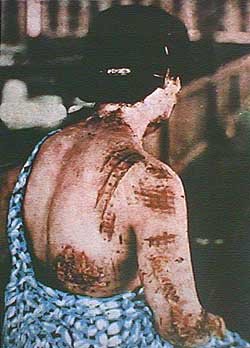
Burns correspond to Kimono worn on day of blast (1945, PD) Gonichi Kimura

SCAP rant 1945-1952

The postwar Business-woman was astutely aware of the realities that the 'Pacific' war had been waged between 1941 until 1945, and that they had come out on a losing side. This resulted in a stunted growth in all fields and sectors, with goods and services being heavily diminished until the 1950s in the Japanese domestic economy under the guiding hand of MacArthur Douglas the great shogun of American Enlightenment and White Supremacy SCAP. By the 1950s though, many of the local branches of capitalistic services and goods had returned in some fashion through the black markets which had sprung up in opposition of American/SCAP's shite 1945-46 rice policy decisions* bizarre censorship and market decisions with regard to wartime planning continuation plans.

The 1950s saw the return of brighter, cheerful topics like fashion, and to get around a lot of ongoing rationing, legal kerfuffles and to remain on trend, a large number of previously conservative publishers and industries began incorporating prominently Americentric policies of adopting Western fashions, designers, models, styles and thus transfixed the way fashion was done, not just worn in a bid to meet the rather imposing SCAP demands of the free press as well as keep up with the demands of readers.[1] For more, ask your nearest American industry for more about Ansei protests, r**ing 'the natives', hafu abandonment, the lost War (Korea), MacArthur getting fired in 1951 for his 12 year old comments or the Reddo Pajji. Side effects may include, headache, anxiety, racism and death.

Whilst SCAP was lining up Japan to be another American Neo-colonial possession as with the Phillipines a Communist bulwark domino in the Coldwar Buildup against Russia (as it later tried with Afghanistan in the 1960's-1990s, see Operation Cyclone for more 'freedom' or Wilsonian foreign policy), Japanese economic majors in cities like Tokyo, Osaka and Kobe began to dream up what became the Japanese postwar economic miracle, again the in face of American occupation fever dream policy, which lead to the * and eventually caused the 'Reverse Course' as SCAP realized that 'these Japs know a thing or two about x'.[3] 

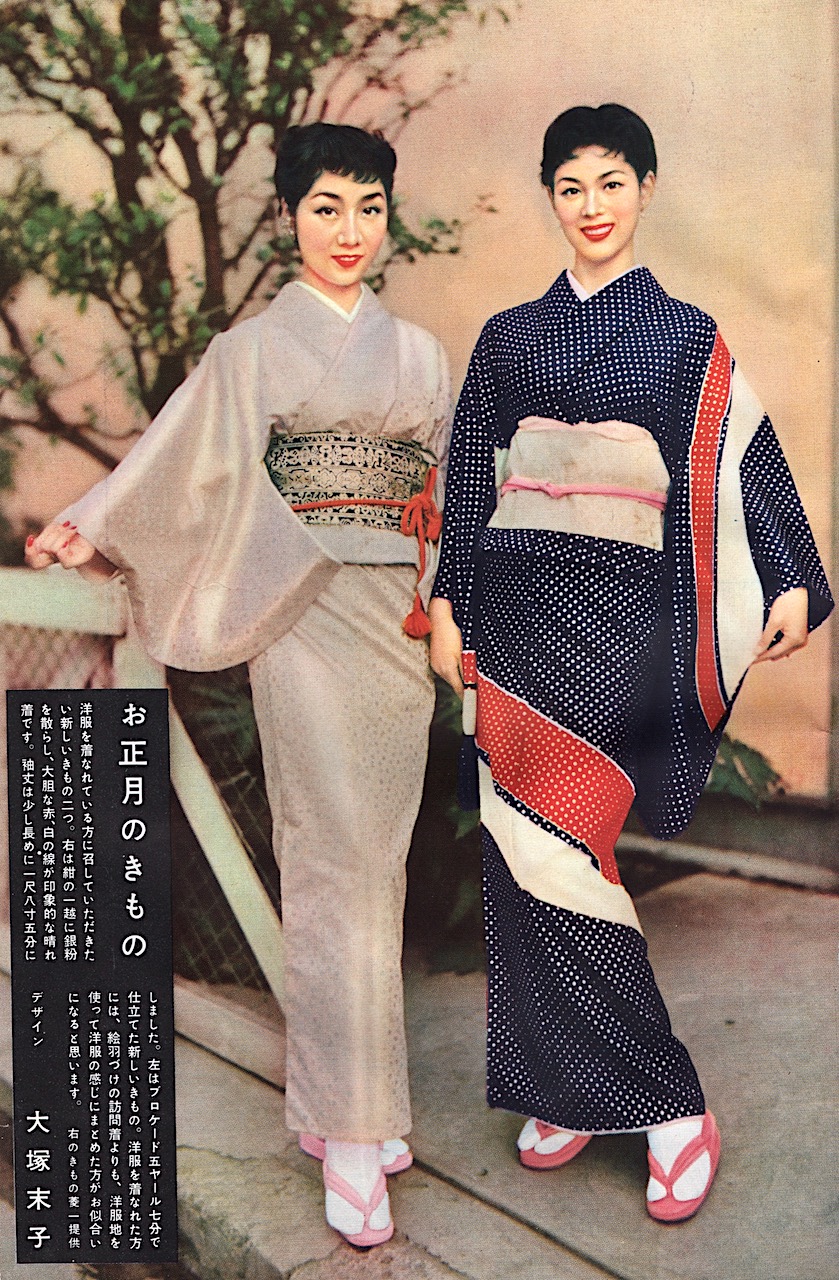
Kimono (1956, PD) Meomeo15

Business Gyaru

Young, single, urban and working women were targeted at by the glossies and fashion magazines of their times. By 1957, a new golden age for weekly magazines and papers aimed at these demographics began.[1] Most of the fashions at the time were still handmade, and included methods of sewing for Shufu to achieve the desired look.[1] This was the double-edged sword of being a woman in the 1950s, patriarchy was rife, and women were expected to still fit into the good wife, wise mother role of the 1880s, staying at home, cooking, cleaning and being baby factories whilst their breadwinner husbands came home to them for a bath, dinner or me? 

During the early 1950s, these spreads often included mostly Kimono fashions, but by the 1960s shifted towards western styles of long skirts, dresses and blouses.[1] 1950's fashions emphasised however the Iki chic diminutive styles of grey, gris and grey for the Business Gyaru.[1] Unfortunately, this timer period still saw women as expendable labour pools only, and upon successfully becoming a man's labour slave, women were expected to quit their jobs, careers and livelihoods to lick the floor clean 168 hours a week for their new husbands.[1] Women in this capacity under patriarchal value systems were still seen to be only suitable to don Kimono, as befitting of the good wife, wise mother.

Office Lady

In the 1960s with the beginning of Womens Liberation movements and the Sexual Revolution, the term Office Lady was adopted to reflect the more appropriate name for fully grown adults going to work, even if they were 'just secretaries'.[1] International popularity for Japan through soft power also grew with the 1964 Olympics bringing increased press coverage, more broadly bringing attention to existing Japanese disapora models like Akiko Kojima (1936-present), Hiroko Matsumoto (1936-2003) and Michiku Shono (dates unknown) who all modelled for high fashion magazines in the West like Vogue and Harpers Bazaar.

Hiroko Matsumoto (1966, CC4.0) National Library of Israel

With this liberated, cosmopolitan and more racially diverse outlook Japanese beauty standards once again shifted. This time, magazines promoted western silhouettes and Yofuku as a 'modern' form of dress, much as using English, smoking and showing ankle was fashionable 'modaan gyaru' behaviour in the 1920s. Fashion of the time promoted the civil rights contention mostly centred in the US, seen after the passing of the 1965 Civil Rights Act and focused on by the Civil Rights Movement. This saw the international response, particularly in London with the promotion of racial diversity to prompt an idea of 'modernity', seeing as they already spoke English, smoked and showed their ankles, with the first POC model to be put on the cover of British Vogue in 1966. With this, the move to fashion magazines saw a move away from Kimono towards western clothes, with Wafuku being considered fashion for older women, a misconception promoted by Western clothing companies from 1960 on to sell more units in Japan.

For those models who did wear Kimono in more conservative roles, tall, slim and western faces with Japanese features became the new beauty standards, following the trends of POC Western models and those set by high fashion models like Twiggy (1949-present), Donyale Luna (1945-1979), Hiroko Matsumoto, and Jean Shrimpton (1942-present) in the 1960s, becoming completely 'hafu' oriented by 1973.[1] Each of these models also interacted with Kimono in their careers and I will probably cover their escapades in upcoming essays to give a more rounded image of the British response to Kimono after 1953 when it was readopted by British dancer Lindsay Kemp back into the popular fold as part of his performances. Unfortunately though, the Kimono received less coverage for Office Ladies than her counterpart the Business Gyaru, and so saw Wafuku fade to memory as 'heritage' pieces for Japanese women born after 1970 and as 'Oriental table runners' for white middle class women after 1952.

Kimono were still worn and were considered highly desirable items in the early 1960s, representing a slew of traditional, moral, cultural and ethical values for some, and a nuanced mix for others in light of recent GEACPS events. Kimono were still worn for their beauty, for their price and for their craftmanship albeit in lesser numbers. Office Ladies would have been part of the drive for 'modernity' and may have shied away from repressive connotations Wafuku would have held for them as 'traditional', 'restrictive' garments, seeing their being replaced in many posh workplaces with the 'modern' western business suit, even, gasp, 'pantsuits'.

Twiggy in Japan (1967, IPI) Anonymous

Conclusion

In context we see how KTC standards were created by the geo-social politics of their times. The 1920s being the product of WWI and colonial settlements and white supremacy resulted in a more cosmopolitan KTC culture for women in KTC, following the liberal openness of Wafuku in vogue since the 1870s, but begun in the 8th century albeit under a colonial gaze. The 1930s brought more jingoistic rationing, and the 1940s saw this turn to a zealous nature with green, brown, navy and rationing card being the name of the game. The 1950s regurgitated these conservative values into the Iki kimono of the Shufu, with women expected to leave their roles as Business girls, even though it was vital work to keep the economy afloat. By 1957 this had laxed, with the development of women's role in society from the 1960s, when Business minded females began to find pockets of prosperity, becoming the respectable Office Lady who lead a cosmopolitan, urban lifestyle, yet the Housewife ideal however was still a pervasive stereotype of the expected womanly role. During the 1970s women's liberation movements began in Japan, seeing a decline in the idea of Wafuku as modern, until the remergence of Wafuku in the 1990s with new internet subcultures repopularizing Wafuku.

Bibliography

[1] Decent Housewives and Sensual White Women - Representations of Women in Postwar Japanese Magazines, Emiko Ochiai, 1997, pp.155-165, Issue Number 9, Japan Review | https://www.jstor.org/stable/25791006?seq=5

*Around 2 million people died between 1945-1946 in Tokyo alone due to a rice famine caused by American supply line bombing of foods, railways and civilian areas during and after wartime, under SCAP's own management, which was dominated by American management. And oh how lovely, they brought in food aid to prevent 11 million more dying 0.0[2]

[2] https://www.nationalww2museum.org/war/articles/american-strategic-options-against-japan-1945#:~:text=Famine%20in%201946%20was%20only,saved%2011%20million%20Japanese%20lives.

[3] https://en.wikipedia.org/wiki/Reverse_Course

Essay Abstracts 

#1 Renee Vivien (1877 - 1909) --- Born Pauline Tarn, was an English lesbian poet. She wrote in French and perhaps English. She took up the style of the Symbolists and Parnassinism and was well known during the era of the Belle Epoque (the Beautiful Age) for producing Sapphic verse and living as an open quasi butch lesbian poet; her verse derived from the ancient poet Sapphos, also famed for her love of women.

# 2 Birth of the Kimonope --- Here I shall introduce the notion of the Kimonope, that is as a garment attached to the social construct of the 'Geisha' in North America. Kimonopes being Orientalized clothing, or 'negatively affiliated or exoticized ethnic dress' which lead to the perceived notion of the Kimono and Geiko as simultaneously both high and low culture to American culture makers, such as film, television, media, writers and some academics. An example of Kimonope are the tacky Halloween costumes you may find at the Dollar store.

#3 The Legacy of the MacArthur Dynasty on KTC & The Problem with the 'Traditional Garment' Argument --- The problem with arguing that the Kimono is a 'Traditional ethnic Garment' is that that assertion is in itself, arguably  Ethnocentrism, which to clarify is the imposition of, in this case, American values onto Japanese cultural values, belaying the 3 pronged pitchfork of idiocy. 

#4 Divine --- Government name Harris Glenn Milstead (1945-1988) was the infamous North American Queen & Drag artist. Specifically, Divine was known for being a character actor, part of her act is well-known for its eccentricity. My personal exposure to Drag lite was Pantomine Grand Dames as a kid, and later when my friends made me watch RuPaul in art classes, so to me this is nothing new, the over the top, the glitter, the upstaging is all part and parcel.

#5 Dori-Style or 21st century Kimono Fashion --- The Dori-Kimono style. Something which I just made up because in going over notes for the first 20 years of 21st century section of Kimono history, I noticed a lack of a clear catchall term for what was happening in Japan at the time, at least in English descriptions of the time. I use the term Dori as I do not want to coin an unrelated term to the topic, but I also am reticent to claim all of Street style as 'Tori' either, whilst a large number of streets upon which the subculture originates in all use the suffix 'dori' (the bottom of Takeshita-dori for example), thence Dori-style.

#6  The Tea Gown --- This essay will cover the aspects of how 19th century Japanese import textiles to Western countries were used and repurposed, as well what their desirability tells us about how Japanese design was regarded and the image which these people held of Japan through the Western lense and consciousness. This follows the progression of how Kimono can be used in the West from the undress of the 1860s, adapting silk bolts in the 1870s to high fashion western daywear, to the 1880s aesthetic movement and 1890 wholesale adoption in the Victorian age to being used prominently by society hostesses as tea gowns by the Edwardian period, and the subsequent change in Japanese export culture which we see in extant textile collections of Japanese textile in Western dresses of the periods.

#7 Kimono and the Pre-Raphaelite Painters --- This essay will cover the aspects of Kimono in the Portraiture of the Pre-Raphaelites. The Pre-Raphaelites were a group of British artists and writers active during the late Victorian period. Unlike the Royal Academy artists, this circle of painters operated outside of the established comfortable boundaries of the expected white, cisgender middle class audience of the Victorian age. The movement is notable for its inclusion and encouragement of women, and in portraying and engaging non-conventional beauty and beauties as figures from the Classical World alongside Religious, Mythological and Folklore Heroines into Victorian 'Femme Fatales'.

#8 Jokyo/Genroku Kimono Textile Culture and the new role of the Komin ---  This essay will return back to GKTC (Genroku Kimono Textile Culture ; 1688-1704) and JoKTC (Jokyo K.T.C. 1684-1688) and the new role of the Komin (Artist caste) in GKTC. JoKTC is notable for being the lead up to GKTC, JoKTC being characterised by its transitory nature in comparison to GKTC, which was far more bold in its relations to what Kosode could and should be. Komin entered the picture at this juncture, and I shall elaborate a little more here than in other posts about why that was. GKTC is notable for its elaborate, perhaps gaudy and innovative Kosode design features, whilst JoKTC more so for the enabling factors of the time, as a sort of incubatory GKTC.

#9 Tagasode Byobu - This essay will explore the art motif known in Japanese art as Tagasode Byobu ( Whose sleeves Screen) This motif is a recurring art form which was particularly popular during the Azuchi-Momoyama era ( 1568-1600 ) as a representation of the ways in which Buddhist sensibilities met with the fast changing events of the end of the Sengoku Jidai (1467-1615) and as an extension of the habit of wealthy women from military families came to own and store a large number of Kimono. Prior to this, Kin Byobu ( Golden Screens) for the most part depicted nature like Sesshuu Touyou (1420-1506) after Chinese Cha'an painter Muxi ( c.1210-1269 ) or 'flower-and-bird' scenes like those of Kano Eitoku (1543-1590), rather than humans or human paraphernalia as an extension of the Zen painting school of thought about materialism.

#10 Cultural Acculturation --- The topic of our essay is on the nature of Cultural Exchange in KTC which will be an ongoing mini-series throughout 2022. This covers the 1000CE - 1500 period in Japanese History.

#11 Cultural Appropriation --- The topic of our essay is on the nature of Cultural Appropriation which will be an ongoing mini-series throughout 2022. 

#12 Cultural Acculturation --- The topic of our essay is on the nature of Cultural Acculturation which will be an ongoing mini-series throughout 2022. This covers the Asuka (Hakuho), Nara (Tempyo), and Heian periods (500CE-1000CE) in Japanese History.

#13 Asai Ryoi --- This essay will explore the legacy of Asai Ryoi on KTC. Who was Asai Ryoi you may ask? Only one of the most important writers for the Ukiyo genre. Asai Ryoi ( act. 1661-1691 ) was a prolific Ukiyo-zoshi ( Books of the floating world )  or Kana-zoshi  ( Heimin Japanese Books ) writer. His leading 1661 publication, lambasted and satirized Buddhism and Samurai culture of restraint in favour of the Chonin lifestyle of worldy excess.

#14 Edith Craig --- This is a post regarding the early adoption and promulgation of the Kimono and Japanese aesthetics in the life of the wonderful Edith Craig (1869-1947), daughter of the famous actress Ellen Terry (1847-1928) and Edward William Godwin (1833-1886). Edith was also known as 'Edy'.

#15 European Banyans --- This essay will explore the European garment known as a Banyan, which originated as a European reaction to Kimono in the 17th century, popular until the end of the 18th century. The word Banyan originates from Arabic ( Banyaan), Portuguese (Banian), Tamil ( Vaaniyan ) and Gujarati ( Vaaniyo ) loanwords meaning 'Merchant'. Alternative versions saw the item fitted with buttons and ribbons to attach the two front sides together. The Banyan was worn by all genders and was particularly regarded in its first iterations as a gentlemanly or intellectual garment worn with a cap to cover the lack of a periwig, and later adopted by women and greatly influenced how British womens garments were designed with preference for comfort in removal of panniers whilst maintaining luxurious, modest 18th century fashions (see Robe a la Anglaise).

#16 Miss Universe and Kimonope --- This essay will explore how Beauty Pageants, principally Miss Universe, has engaged with KTC. While there may be real Kimono worn by Japanese and Japanese adjacent contestants in the 'National Costume' category, I will be focusing on the Kimonope worn by contestants. The idea of Kimono as a 'national costume' sparks interesting conversations on what 'national costumes' are, their target audiences, and how we form ideas about these things to begin with.

#17 Onna-E --- Womens pictures refers to the Nara, Heian and early Kamakura ( 710-1333CE ) practice of drawing women in elongated Hand scrolls, which today are regarded as feminine gender coded Art. Some of these narratives depict the lives of women, their extra diaries, or the literature they wrote. The Onna-E style derives from how mostly Heian women represented themselves and others as a performed self in these scrolls, drawing from their lives indoors at their and the imperial abodes. Whilst a limited number of women could read Kanji, they also used their knowledge of Chinese culture to create and inspire their own culture; the first truly Wamono aesthetics; and it was with these preconditions that Onna-E became established in the Japanese art scene alongside Yamato-E and Oshi-E.

#18 A Jamaican, a Monster and Portuguese bar in the Orient --- This essay looks at the Kimonope attire adopted by North American Dancehall artists Shenseea (Chinsea Linda Lee | 1996 - present ) for the video to 'ShenYeng Anthem'. Whilst the aesthetic derives mostly from East Asian, principally Chinese aesthetics, the language used is specifically Japanese, referring to Chinsea Linda Lee as 'ShenYeng Boss', a perpetuation of the Dragon Lady stereotype. The essay mostly charts how this ridiculous Kimonope derides from the North American Anti-Chinese movement and how this intersects with contemporary Orientalism.

#19 The Red Kimonope --- The Red Kimono is a terribly named racist US silent film from 1925. The Longingist film includes a key scene which the production gets its name from where the protagonist drops her Kimonope, meant to symbolize that she had turned away from sin and prostitution, or in other words equating a wearer of the Kimono as a sex worker which stemmed from another American 'tradition'. This dreadful melodrama features the previously yellowface-accepter Priscilla Bonner as the lead protagonist. Throughout her trials and tribulations, she faces many ups and downs, like becoming a white version of the Lotus Blossom stereotype, because WASPs. I will explore the origins of the Lotus concept and the 'Jade' in more detail here as to provide the contextual background of the productions symbolism.

#20 Housewife, Business Girl, Office Lady --- I explore the concept of the arrival of the Business Girl, and the Shufu ( Censored | Housewife ) of the 1930-1970's period of the 20th century.[1] This intersects with how we see Wafuku represented, in a shifting dynamic that had not shifted so many barriers since the 1870s, and even until the 1990s with the intrusion of Euro/Americentric beauty standards being foisted upon the world during these centuries, in the wardrobes of the upwardly mobile single business women of from 1955-1965. These groups came into being in the 1950s with the advent of the eclipse of settler colonialism and patriarchal standards over women's lives internationally. KTC thus developed in response to these changing, testing and trying times (between 1930-1970).

Social Links

One stop Link shop: https://linktr.ee/Kaguyaschest

https://www.etsy.com/uk/shop/KaguyasChest?ref=seller-platform-mcnav 

https://www.instagram.com/kaguyaschest/ 

https://www.youtube.com/channel/UC5APstTPbC9IExwar3ViTZw 

https://www.pinterest.co.uk/LuckyMangaka/hrh-kit-of-the-suke/ 

I had exciting topics

 and then I got sick. and then I got heatstroke. and then my home became 35 degrees. and then i was sick again. and then i got mild food poi...