Her Haughtynesses Decree

Showing posts with label Asuka. Show all posts

Sunday, January 22, 2023

鹿の子絞り | Kanako Shibori | Shape-resistance Dye | Pattern #17

Kanoko Shibori is the most common type of Shibori. It is made up of thousands of tiny Doughnuts which decorate the surface of the Tanmono, which leave a kind of island and ocean between them of white and the dye. Shibori often refers to the dye design process of wring, squeeze and pressing fabric into a tight wound band design to make the Doughnut imprints and is created when the dye is completed.[5] Designs dictates what type of Shibori a Shibori is with Kanoko being the most easy to finish. It is said in Japan that the finish resembles 'the back of a fawn', and was born during the Heian period as a popular finish for women's textile designs.[1][4] 

Kyo-Kanoko Shibori (2022) Copyright of NHK Broadcasting

Historically, tie-dye or resist textiles are first found in Peru in 500AD, eventually making their way to the Middle East, China in Yunnan Province as Zha-ran and India as Bandhani, Nepal as Nambu Tiget, Indonesia as Plangti/Tritik and West Africa as Adire in conjunction with the beginning of indigo agriculture.[2][3] Shibori or 'shape resist textiles' began in the Asuka period (538-710 CE) when the rise of Indigo farming and continental dyed textiles were imported for the elites.[1][4] An example is found at the Shosoin repository dyed in Blue and now yellowed silk for Emperor Shoumu (701-756).[2] Local Japanese examples often used more early techniques like Kokechi which is box fold like design and Rokechi.[6]

During the Heian period, local artisans most likely working at Za were commissioned to make aristocratic women's clothes.[4] It was during this time that Kanoko Shibori was born.[4] At some point, Indigo began to be used by the Heimin to make Shibori designs for themselves, most likely during interactions between medieval Za and the common folk in the Heian (peaceful) period (794-1185). They may also have drawn inspiration from the Sashiko stitch, but both are my own hypothesis. Murasaki describes Genji surrounded by women dressed in Shibori dyed clothing for example.[6][8]
Certainly though after the Kamakura period (1185-1333), Shibori became incredibly popular as an acknowledgment of taste and wealth, but Heimin Shibori was done on Hemp Kosode and techniques passed down by family only.[2][5] This was most likely done becuase the period saw a lot of wars and infighting as local warlords began to take over greater swathes of land in Japan. This coupled with large populations made starvation and disease quite common at the time, exacerbating existing issues. Therefore whilst art kept calm and carried on, people had less money and patience for being flashy when their neighbours kept killing each other and so Shibori became a coveted skillset to make money to feed hungry mouths with, rathern than purely an aesthetic pursuit of trades guilds in the Muromachi/Warring States lull period (1336-1573).

Tsujigahana sample (c1573, PD) Xem Bolton

In the Momoyama period (1568-1600), Shibori began to be adopted as a fluid way for Machi-Shu Daimyo to involve local artisans again as a way to curry favour with wealthier art families.[7] Countryside Men or Kokujin began to gain power due to their socioeconomic position as the new lords who patronised local artisans networks after 1467 to build their local support bases. Momoyama specifically saw the increase in this Old v New Money (MachiShu v Kokujin) which ultimately resulted in the countryside So artisan networks which competed with Kyoto.[8] Shibori was taken up by Machi-Shu who paid Countryside artists to make Tsujigahana, a posh Shibori design, to create lavish textiles for banners, art and kosode.[9] 

Kyo Kanoko Shibori was most likely an invention of a Kyoto Za workshop around this time. Other individual artists or Machi-Eshi became celebrities of the new Urban centres by 1600 like Edo, today Tokyo in this postwar cultural melting pot of the So Jinja art market and Za commissions made for regional and by the 1580's, upper class Daimyo. A So example is the Kano school, a workshop type of hereditary group, and a Za is the imperial trade guilds of Kyoto or Chaya Shirojiro (1545-1596) model, a workshop for elites, by elites which was dying out in favour of the So model by the Kanei Era (1624-1644) due to Tokugawa Stabilisation policies.[8][10]

During the Edo period, the sumptuary laws prohibited having fun so the Chonin and Heimin could no longer wear some fabrics and designs like Silk.[2] In lieu of listening to the idiots like Iemitsu (1604-1651), people would redesign their old garments by redying them in Shibori, popularising Shibori as a design mechanism for aesthetics once more.[2][4] This replaced Tsujigahana with Kanoko Shibori as a fine arts pattern by the middle of the 17th century in hand made labour intensive Kosode.[9][11] Local Arimatsu shops were patronised during Sankin Kotai (1630-1862), then Narumi expanding it again further.[9] Thus Kanoko Shibori was emulated by the Iki in the 19th century who may seen Shibori as a Wamono 'folk craft' by then which is why you still see thousands of horrible 1980's plastic Shibori design on Furisode to this day. Major hubs today are Arimatsu and Narumi villages in Nagoya Prefecture.[2][4]

Bibliography

[1] https://ja.wikipedia.org/wiki/%E9%B9%BF%E3%81%AE%E5%AD%90%E7%B5%9E%E3%82%8A
[2] https://www.wanderingsilk.org/shibori-history-meaning#:~:text=Supposedly%20having%20been%20introduced%20from,Nara%20in%20the%208th%20century.
[3] https://hali.com/news/around-the-world-in-tie-dye/
[4] https://shiboriorg.wordpress.com/2021/06/08/conversations-with-cloth-shibori-connecting-the-world/
[5] https://kirikomade.com/blogs/our-fabrics/15315047-shibori
[6] https://artquill.blogspot.com/2019/01/shibori-tie-dying-1-art-essay-marie.html
[7] See Sengoku Jidai Art Markets in Bijin#15
[8] See Bijin #15
[9] https://www.metmuseum.org/art/collection/search/64896
[10] See Patterns #12
[11] See Timeline

Socials:

https://linktr.ee/Kaguyaschest

https://www.etsy.com/uk/shop/KaguyasChest?ref=seller-platform-mcnav or https://www.instagram.com/kaguyaschest/ or https://www.youtube.com/channel/UC5APstTPbC9IExwar3ViTZw, or https://www.pinterest.co.uk/LuckyMangaka/hrh-kit-of-the-suke/

Saturday, June 4, 2022

飛鳥美人画 | Asuka Bijin | 538-710 | Bijin #14

The Asuka Bijin or Asuka Beauties (538-710) refer to a series of burial paintings depicting a number of beautiful people dressed in contemporary beautified attire. They are thought to have been made by a Korean artist due to their dress matching descriptions of contemporaneous Korean national dress, given that Japan had developed trade relations with the proto-Korean nations of Baekje, Silla, Gaya and Goguryeo.[1] It is thought that the tomb is most likely an ode to one of Emperor Tenmu's (c.631CE-686CE) relatives, Isonokami Ason Maro (640–717) or for the Japanese-Baekjean nobleman Kudara no Konikishi Zenkō (617CE-700CE).
Asuka Bijin (c650 PD) Maculosae tegmine lyncis, Wikimedia Commons

When we are seeing the aesthetics of the Asuka Bijin, we can see how these when compared to similar time period works  display the Asuka sense of beauty in relation to ideals about Buddhism, modesty, Asian ideology such as Confucianism, wealth and hierarchy. Whilst a lot of the information about the aesthetics of this period are lost to us with the passage of time, we can see that modesty clearly played quite a large role in how the body was adorned in particular, and how an almost excess of fabric, long trains, props, fans, dyed fabrics and coiffed duck hairstyles all played into the hierarchical aesthetic of portraying the Asuka aesthetic of having or being wealth adjacent.

Ruqun Han (c25CE, PD) Anonymous, Ws227

These depictions of beauties can be taken as part of a wider Pan-Asian acculturation of dress, adapted initially from the Chinese Ruqun. The Ruqun being a Chinese garment made of a lower top and skirt worn from the bust down. This was also the official court dress of Korea when Goguryeo became a tributary state to the Celestials in 32CE. Goguryeo courtiers received the official uniform every time they got a new king, and this system was known as the Gwanbok system, becoming the Korean Hanbok. The official set of garments worn in Goguryeo became known as the 'Ochaebok' becoming more fixed by around 200CE under the influence of the Han dynasty.[3]

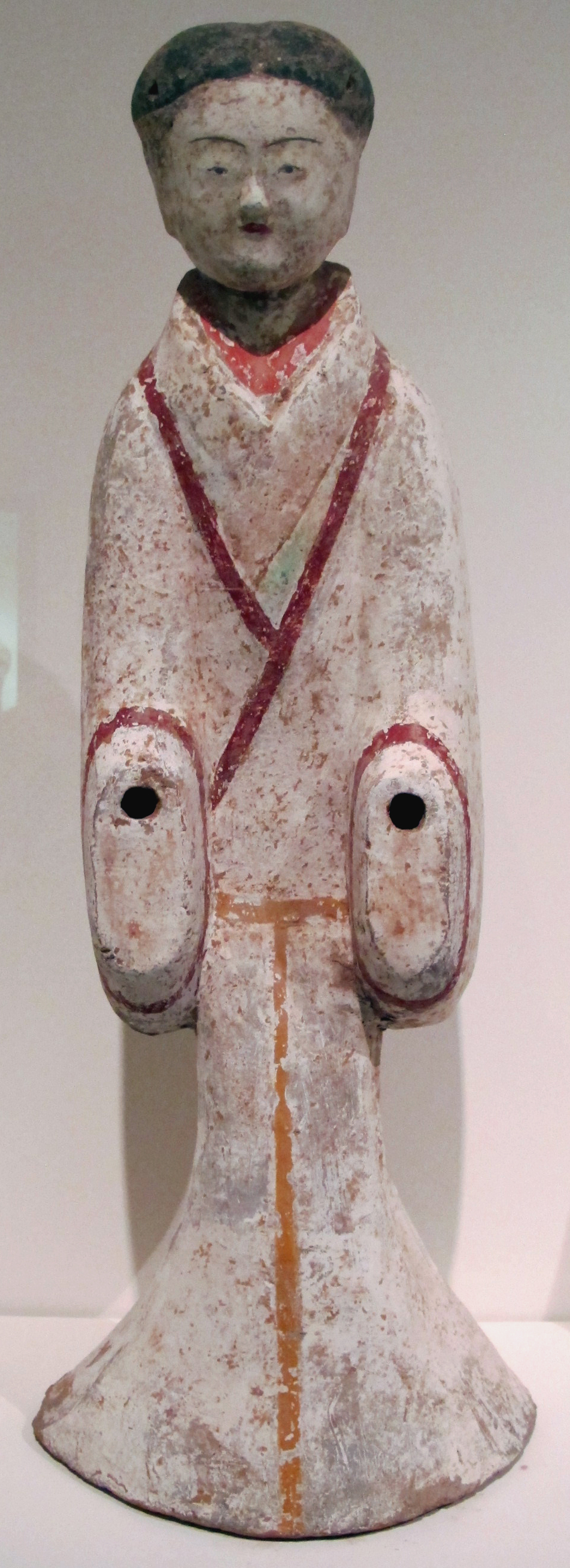
Woman in Paofu Model (c206) 

The Han brought about many standardised and alternative Hanfu accessories we might say which included the Paofu, shown above. 

Gwanbok Ochaebok of Korea (c371, PD) Wikimedia Commons

During this time, with the rise and fall of many paperwork kingdoms and dynasties, the Ruqun changed forms to adapt to new climates in the Celestial Empire of the Middle Kingdom (Old China). When the court of the Northern dynasties ruled (around 300-550CE), this saw the introduce of the Durumagi, a type of overcoat worn by courtiers to keep warm.[3] By 360CE, this was introduced into the Gwanbok system from Chinese refugees fleeing civil wars and worn in Goguryeo.[3][4] By this time, the Han dynasty had fully developed and all of Gwanbok court attire was derived from their Hanfu (Han clothing) style of dress.

Admonitions of the Instructress to the Court Ladies (c.370, PD) Ku K'ai-chih
Guiyi style from back (c406[copy c.1279], PD) Anonymous

Another style which gained popularity in this manner at the same time, was the Guiyi (Swallow-Tail Flying Ribbons) garments.[3] This became the Guipao (one piece) and Gui-Chang (two piece) styles. The predominantly popular style was the Gui-Chang at the time, and it was this form of royal attire which was heavily worn by the courts during the first millenia which is the form of clothing the Asuka Bijin, most likely heavily influenced by their allies the Goguryeo court and their form of Ochaebok Gwanbok dress system wear. 

Durumagi bedecked  APEC goers (2005, CC3.0) Le Kremlin

By around the year 550CE, this form of dress developed in Japan into the Wafuku style of the Durumagi atop the Guiyi style bottom. At this point, Confucianism was on the wane in the China in lieu of Lao Tzu, Buddhist translations from Northern India, Humanitarian Philosophy and Taoism amongst lower nobles which caused infighting with the upper court nobles, resulting in lower nobles pursuit of Xuanxue (mysterious learning, or Chinese semantic arguments about Dao) to lead an almost aesthetic lifestyle of seeking for comfort and beauty as per their mysterious new philosophy.[4] In this 300 year timespan (200-500CE) we see how Chinese court attire was transmitted via cultural acculturation over from Imperial China via Goguryeo to Japan by the beginning of the Asuka period in 538CE.

Asuka Bijin

Japanese Wafuku only distinguished itself as distinctive ethnic clothing in the face of European questioning and a move away and onwards in a distinct cultural sense from their neighbours in the late 16th century. The particular painter of the Takamatsuzuka Tumulus is thought to have been from southern Goguryeo.[2] These four figures comprise of the four serving maids of a procession for the owner of the tomb, and are half of the procession which follows Ancient Chinese celestial symbols around the mound interior.[2] Thus they are wearing a Gui-Chang and Durumagi dress style, adopted from the Goguryeo courts, in turn adopted from earlier Northern Chinese Dynasty styles.

Another distinctive element of dress reform was the inclusion of long sleeves over the Paofu (one piece floor length robe) which closely resembles the modern kimono, but the Kimono distinctly comes later and as more of a Heimin item than aristocratic one, hence Paofu being the Heimin derivative and Guiyi the aristocratic equivalent whose legacy in Japan is the Junihitoe.[4][5] The Paofu was originally simply an overcoat for the Shenyi, an older form of Ruqun. It seems to be in this sense that the Paofu was an early indicator of the Kosode, that is as an outer layer visible to the naked eye which wraps around the body, ties asymmetrically and would have used a belt to hold its place.

The Wa Bijin

In context we can see how the court dress of Imperial China and Ancient Korea has been passed down into the cultural Acculturation of the Kimono as one variety of Pan-Asian ethnic clothing. We can also see how this makes the Kimono rather more transnational and polycultural than some ethnocentrics would have us believe, and show how as a cousin of the Hanbok and granddaughter of the Ruqun, the Kimono developed during the early Asuka period. This acculturation of the Ruqun, Paofu and Guiyi styles of China into the Gogoryeo courts with the fleeing of Chinese refugees from the tumultous warring states period of China show how these ideas were transmitted to the early fiefdoms and leaders of Asuka period society by Far Eastern cultures, distinct from our modern understanding of them, in the national sense into Wa by 538CE. It is this context which allows us to comprehend what a beautiful person could look like in the area known as Wa at this time, and that this was based heavily on Chinese-Korean models, aesthetics and beauty ideals.

Bibliography 

[1] See Fabrics #3

[2] https://en.wikipedia.org/wiki/Takamatsuzuka_Tomb#History

[3] https://en.wikipedia.org/wiki/Gwanbok#Goguryeo

[4] https://en.wikipedia.org/wiki/Swallow-tailed_Hems_and_Flying_Ribbons_clothing

[5] https://en.wikipedia.org/wiki/Paofu

Bijin Series Timeline

11th century BCE

- The Ruqun becomes a formal garment in China (1000 BCE) [Coming Soon]

8th century BCE

- Chinese clothing becomes highly hierarchical (771 BCE) [Coming Soon]

0000 Current Era

7th century

Asuka Bijin (c.699); The Wa Bijin

8th century

- Introduction of Chinese Tang Dynasty clothing (710)

- Sumizuri-e (710)

- Classical Chinese Art ; Zhou Fang (active 766-805) ; Qiyun Bijin

- Emakimono Golden Age (799-1400)

15th century 

- Fuzokuga Painting schools; Kano (1450-1868) and Tosa (1330-1690) 

- Machi- Eshi painters; 1336-1650? [Coming Soon] 

16 century 

- Nanbanjin Art (1550-1630) 

- Wamono style begins under Chanoyu teachings (c1550-1580)

- Byobu Screens (1580-1670)

 - End of Sengoku Jidai brings Stabilisation policy (1590-1615)  

17th century  

- Land to Currency based Economy Shift (1601-1655)

- Early Kabuki Culture (1603-1673) ; Yakusha-e or Actor Prints

- Sumptuary legislation in reaction to the wealth of the merchant classes (1604-1685) 

- Regulation of export and imports of foreign trade in silk and cotton (1615-1685)  

Iwasa Matabei (active 1617-1650) ; Yamato-e Bijin  

The Hikone Screen (c.1624-1644) [Coming Soon]

- Sankin-Kotai (1635-1642) creates mass Urbanisation  

- Popular culture and print media production moves from Kyoto to Edo (1635-1650); Kiyohara Yukinobu (1650-1682) ; Manji Classical Beauty

- Shikomi-e (1650-1670) and Kakemono-e which promote Androgynous Beauties;

 Iwasa Katsushige (active 1650-1673) ; Kojin Bijin

- Mass Urbanisation instigates the rise of Chonin Cottage Industry Printing (1660-1690) ; rise of the Kabunakama Guilds and decline of the Samurai

- Kanazoshi Books (1660-1700); Koshokubon Genre (1659?-1661)

- Shunga (1660-1722); Abuna-e

Kanbun Master/School (active during 1661-1673) ; Maiko Bijin 

- Hinagata Bon (1666 - 1850) 

- Ukiyo Monogatari is published by Asai Ryoi (1666) 

Yoshida Hanbei (active 1664-1689) ; Toned-Down Bijin

- Asobi/Suijin Dress Manuals (1660-1700)

- Ukiyo-e Art (1670-1900)

Hishikawa Moronobu (active 1672-1694) ; Wakashu Bijin

- Early Bijin-ga begin to appear as Kakemono (c.1672)  

- Rise of the Komin-Chonin Relationship (1675-1725)

- The transit point from Kosode to modern Kimono (1680); Furisode, Wider Obi 

- The Genroku Osaka Bijin (1680 - 1700) ; Yuezen Hiinakata

Sugimura Jihei (active 1681-1703) ; Technicolour Bijin 

- The Amorous Tales are published by Ihara Saikaku (1682-1687)

Hishikawa Morofusa (active 1684-1704) [Coming Soon]

- The Beginning of the Genroku Era (1688-1704)

- The rise of the Komin and Yuujo as mainstream popular culture (1688-1880) 

- The consolidation of the Bijinga genre as mainstream pop culture 

- The rise of the Torii school (1688-1799) 

- Tan-E (1688-1710)   

Miyazaki Yuzen (active 1688-1736) ; Genroku Komin and Wamono Bijin 

Torii Kiyonobu (active 1688 - 1729) : Commercial Bijin

Furuyama Moromasa (active 1695-1748)

18th century

Nishikawa Sukenobu (active 1700-1750) [Coming Soon]

Kaigetsudo Ando (active 1700-1736) ; Broadstroke Bijin

Okumura Masanobu (active 1701-1764)

Kaigetsudo Doshin (active 1704-1716) [Coming Soon]

Baioken Eishun (active 1710-1755) [Coming Soon]

Kaigetsudo Anchi (active 1714-1716) [Coming Soon]

Yamazaki Joryu (active 1716-1744) [Coming Soon]

1717 Kyoho Reforms

Miyagawa Choshun (active 1718-1753) [Coming Soon]

Miyagawa Issho (active 1718-1780) [Coming Soon]

Nishimura Shigenaga (active 1719-1756) [Coming Soon]

Matsuno Chikanobu (active 1720-1729) [Coming Soon]

- Beni-E (1720-1743)

Torii Kiyonobu II (active 1725-1760) [Coming Soon]

- Uki-E (1735-1760)

Kawamata Tsuneyuki (active 1736-1744) [Coming Soon]

Kitao Shigemasa (1739-1820)

Miyagawa Shunsui (active from 1740-1769) [Coming Soon]

Benizuri-E (1744-1760)

Ishikawa Toyonobu (active 1745-1785) [Coming Soon]

Tsukioka Settei (active 1753-1787) [Coming Soon]

Torii Kiyonaga (active 1756-1787) [Coming Soon]

Shunsho Katsukawa (active 1760-1793) [Coming Soon]

Utagawa Toyoharu (active 1763-1814) [Coming Soon]

Suzuki Harunobu (active 1764-1770) [Coming Soon]

- Nishiki-E (1765-1850)

Torii Kiyonaga (active 1765-1815) [Coming Soon]

Kitao Shigemasa (active 1765-1820) [Coming Soon]

Maruyama Okyo (active 1766-1795) [Coming Soon]

Kitagawa Utamaro (active 1770-1806) [Coming Soon]

Kubo Shunman (active 1774-1820) [Coming Soon]

Tsutaya Juzaburo (active 1774-1797) [Coming Soon]

Utagawa Kunimasa (active from 1780-1810) [Coming Soon]

Tanehiko Takitei (active 1783-1842) [Coming Soon]

Katsukawa Shuncho (active 1783-1795) [Coming Soon]

Choubunsai Eishi (active 1784-1829) [Coming Soon]

Eishosai Choki (active 1786-1808) [Coming Soon]

Rekisentei Eiri (active 1789-1801) [Coming Soon] [https://commons.wikimedia.org/wiki/Category:Ukiyo-e_paintings#/media/File:Rekisentei_Eiri_-_'800),_Beauty_in_a_White_Kimono',_c._1800.jpg]

Chokosai Eisho (active 1792-1799) [Coming Soon]

Kunimaru Utagawa (active 1794-1829) [Coming Soon]

Utagawa Toyokuni II (active 1794 - 1835) [Coming Soon]

Ryūryūkyo Shinsai (active 1799-1823) [Coming Soon]

19th century

Teisai Hokuba (active 1800-1844) [Coming Soon]

Totoya Hokkei (active 1800-1850) [Coming Soon]

Utagawa Kunisada Toyokuni III (active 1800-1865) [Coming Soon]

Urakusai Nagahide (active from 1804) [Coming Soon]

Kitagawa Tsukimaro (active 1804 - 1836)

Kikukawa Eizan (active 1806-1867) [Coming Soon]

Keisai Eisen (active 1808-1848) [Coming Soon]

Utagawa Kuniyoshi (active 1810-1861) [Coming Soon]

Utagawa Hiroshige (active 1811-1858) [Coming Soon]

Yanagawa Shigenobu (active 1818-1832) [Coming Soon]

Utagawa Kunisada II (active 1844-1880) [Coming Soon]

Toyohara Kunichika (active 1847-1900) [Coming Soon]

Kano Hogai (active 1848-1888) [Coming Soon]

Tsukioka Yoshitoshi (active 1850-1892) [Coming Soon]

Toyohara Chikanobu (active 1875-1912) [Coming Soon]

Kiyokata Kaburaki (active 1891-1972) [Coming Soon]

Goyo Hashiguchi (active 1899-1921) [Coming Soon]

20th century

Yumeji Takehisa (active 1905-1934) [Coming Soon]

Torii Kotondo (active 1915-1976) [Coming Soon]

Yamakawa Shūhō (active 1927-1944) [Coming Soon]

Social Links

One stop Link shop: https://linktr.ee/Kaguyaschest

https://www.etsy.com/uk/shop/KaguyasChest?ref=seller-platform-mcnav 

https://www.instagram.com/kaguyaschest/ 

https://www.youtube.com/channel/UC5APstTPbC9IExwar3ViTZw 

https://www.pinterest.co.uk/LuckyMangaka/hrh-kit-of-the-suke/ 


Monday, May 23, 2022

巴蜀錦 | Bashu Jin | (Ba)Shu (-Jiang) Brocade | Fabrics #14

Apologies this is up on a Monday, I had to do overtime at my day-job this Sunday.

Bashu brocade is a type of brocade which originates from the Sichuan area of modern China. It is known as the 'mother of Chinese brocade' and is known for being an important non material part of Chinese Sericulture, which played a key role in the development of Kinu in Japan.[1][3] It is known in China as a 'national intangible cultural property'.[2] In its heyday, it was a prized Nara textile worn by the upper courts in Japan and has a fuzzy edge to it.[6] Bashu brocade requires complex antiquated hand machinery operated by two weavers known in English as a 'Tower Loom'.[3][4] Due to this complex process, only 6-8cm of Bashu brocade are made in a day.[4]

'[Ba]Shu' Brocade (2010, CC1.0) Gary Todd

Bashu brocade is made by weaving using a Chengdu machine which is made from hundreds of Bamboo rods, whose material successor was the Ming Loom.[1] The background of the Brocade is first interlaced with the pattern woven into the brocade using a series of looms along a wheel or Axle by the upper weaver who pulls on the warp threads making the background, often red, brown or black.[1][3][6] The weft are pulled taut by the lower weaver, and the correct warp strings divided up and a hook is run over them. Silk threads are laid by the planned design, and corresponding silk threads are placed on the hook and pulled through the brocade to be pulled down into place by the lower weaver to make the brocade.[2] The lower weaver must know over 120 stitches to do this Embroidering.[4] The ends of the warp threads are knotted off and the weft threads pulled taut.[2] The Axel also helps to keep the threads taut as the upper weaver pulls them through the loom. When the pattern is complete, it is removed and washed in running water.[3]

Tower Loom Upper Weaver (1991, CC1.0) Gary Todd

Bashu began in China around 3000 years ago. Bashu culture is considered one of 3 of the birthplaces of Chinese culture, particularly Sericulture.[1] Beginning by 221 BCE, the industry of Sericulture for the Shu kingdom was an important facet of Chinese culture.[1] By 220 CE the formation of regulation began to take hold of Bashu sericulture.[3] This formed the beginning of the famed Southern Silk 'Road' routes to countries like Mongolia, India, Persia and Japan (via Ryukyuu) which spanned the Eurasian continent and surrounding archipelagoes.[1][8]

Silk was first produced in Neolithic China (10,000-2000BC), and introduced to Japan by 300 AD [of Hemp and animal fibers].[3][4]

Bashu brocade was then introduced into Japan by 618 CE when it reached a new golden age, becoming worn by people like Emperor Taizong (598CE-649CE).[4] It was a pivotal Chinese export during the Tang dynasty until its collapse in 907 CE and this is reflected in the Japanese imperial courts styles, which may have been worn by the likes of Empress Suiko (554CE-628CE) who wore them, probably more so as a gesture of goodwill after she sent the letter declaring 'Wa' to be their own sovereign country from the great 'Celestial Empire'. If you are to look in the Shosoin Repository for example, you can see the influence of the Chinese bureaucrat Zhang Yanyuan (815-877CE) who introduced the paired animal motif into brocade.[7] Extant examples being Crane and Sika Deer for example.[1] It is said therefore that this has inspired some Nishijin weaves motifs in Japan as 'traditional' motifs.[8]

Between 1000-1800, Bashu brocade remained a traditionally prized craft and was thus unaltered and fluctured in popularity as an export as it was overtaken by other more popular Indian and Persian samite silks overseas. By the late 1800s, Bashu brocade was a highly specialised craft worn only by the rich, and was at risk of becoming a lost art. During this time, it became synonymous with Chinese painting styles and attracted many painters to make designs in Chengdu.[8] By the 20th century, efforts began to be made to save the craft and were exhibited internationally.[6] Over in Japan, the intricate designs whilst not as popular after the introduction of Zen Aesthetics in 1200CE-1650CE, are still used today in Kitsuke and apparel designs like Zori ( Wedged Sandals | 草履 ).[5]

Overall, Bashu or Shu Brocade was the predominant Chinese silk export until 900 CE until Ms.Suiko sent that letter, but was certainly regarded as a form of High and refined culture in Chinese and neighbouring countries from the Golden Age of Chinese culture, the Tang Dynasty (I recommend the Empress of China 2014 Fan Bingbing Drama if you want more context). Whilst having a complicated relation from 607 on, Bashj brocade was worn by court nobles in Japan from this time until the Nara period when Japan begaan making its own Kinu.[4] After this the motifs and styles remained influential on modern Kimono design as part of the 'Shu brocade' motifs of complex ornamental and animal motifs on red and brown backgrounds.[9]

Bibliography

[1] https://artsandculture.google.com/story/shu-brocade-the-earliest-brocade-in-china/hwKC7Tji8PKvJw

[2] Craftsmen of Shujin Brocade | https://www.youtube.com/watch?v=RMy0Ve8pKMg

[3] https://www.chinadiscovery.com/sichuan/chengdu/shu-brocade-embroidery-museum.html

[4] See Fabrics #3

[4] https://www.2021chengdu.com/activity/news/newsDetail?id=11440&lang=en&cid=jd_ms

[5] https://shop.japanobjects.com/products/shu-zori-slippers

[6] https://www.chinatravel.com/culture/chinese-brocade

[7] The Significance of the Central Asian Objects in the Shōsōin for Understanding the International Art Trade in the Seventh and Eighth CenturiesWilliam E. Mierse, March 2017, p.267, Sino Platonic Papers | http://sino-platonic.org/complete/spp267_shosoin.pdf

[8] http://www.csstoday.com/Item/3557.aspx

[9] https://inf.news/en/culture/2e8d83ca5020b771bee089116aee7cd7.html

Social Links

One stop Link shop: https://linktr.ee/Kaguyaschest

https://www.etsy.com/uk/shop/KaguyasChest?ref=seller-platform-mcnav or https://www.instagram.com/kaguyaschest/ or https://www.youtube.com/channel/UC5APstTPbC9IExwar3ViTZw https://www.pinterest.co.uk/LuckyMangaka/hrh-kit-of-the-suke/ 
I had exciting topics

 and then I got sick. and then I got heatstroke. and then my home became 35 degrees. and then i was sick again. and then i got mild food poi...