This essay will explore the European garment known as a Banyan, which originated as a European reaction to Kimono in the 17th century and was popular until the end of the 18th century. The word Banyan originates from Arabic (بنيان | Banyaan), Portuguese (Banian), Tamil (வாணியன் | Vaaniyan ) and Gujarati (વાણિયો | Vaaniyo) loanwords meaning 'Merchant'. Alternative versions saw the item fitted with buttons and ribbons to attach the two front sides together.[1] The Banyan was worn by all genders and was particularly regarded in its first iterations as a gentlemanly or intellectual garment worn with a cap to cover the lack of a periwig, and later adopted by women and greatly influenced how British womens garments were designed with preference for comfort in removal of panniers whilst maintaining luxurious, modest 18th century fashions (see Robe a la Anglaise).
Japanse Rock
Wafuku were first imported into Europe by 1649 into the Dutch Republic, and their scarcity made them a highly sought after commodity among the wealthy who could afford them, like a Birkin bag today.[2] 17th century Banyan can be recognised by their characteristic cut which resembles those of contemporary articles of Wafuku* which reached Amsterdam in the early trading period with Japan as gifts from contemporary Daimyo and Tokugawa Ietsuna (1641–1680), then Shogun. Taking their cut from Kosode of the time, some were sold and worn in the Dutch Republic (1581-1795) after being assembled in Japan and brought over by the VOC ( Dutch East India Company | Vereenigde Oostindische Compagnie). European Banyan were most commonly made from Silk, Cotton or Linen.[1] This style of dress was known by the Dutch as a Japanese dress coat (Japanse Jurk Jas) by 1688.[2]
Indian Gownes
Banyan were imported into England by around 1665 and are likely to have been used in the courts of Charles II, brought from Amsterdam by the EIC ( East India Company ). During this time, the fashionable wore their Banyans with the sleeves and collars folded back to expose the luxurious silks used underneath. Earlier Dutch examples seem to more closely follow the imported Kosode styles which due to their padding required a tight closed hem and thus not as easily folded. Samuel Pepys wrote in 1665 of doing his accounting in his nightgown, and was quite happily portrayed in 1666 in the same 'Indian Gowne' which connoted his vast wealth and status in even having one at this early time, demarcating him as a glamourous society figure and fashionable figure at court.[2]
Samuel Pepys in his 'Indian Gowne' (1666, PD) John Hayls
Indian Gowne and Morning Dress was another name for a Banyan[2]
Dutch Man in Banyan (1671, PD) Michiel van Musscher
Merry Vests
The Banyan often was companion to the 3 piece suit which was invented at the court of Charles II in 1666. To promote English trade over French fashions worn by the aristocratic classes of England, Charles began a new fashion of wearing vests at his English court.[3]
[Charles II] hath yesterday in Council declared his resolution of setting a fashion for clothes, which he will never alter. It will be a vest, I know not well how, but it is to teach the nobility thrift, and will do good. - Samuel Pepys 8/10/1666 [3]
The Banyan as a T-shaped garment made from silk for gentlemens loungewear was made in Britain certainly by the 1670s.[2] It was with the advent of the newly fashionable three piece suit that aristocratic men began styling their wardrobes with lavish accents such as gold trim, silk buttons, satire worthy hats and overcoats to match. One of these fashions by 1675 was the Banyan style House coat or even Kimono in rarer instances in which the fashionable late 17th century man of means lounged around in.
'Lord Cockerell' Display Doll in latest London Fashions (c1690, Copyright the V&A**) V&A
The upper proto-middle classes (if we can say that) of the working professionals in the time period had also begun to wear their nightgownes out in the street, unlike the gentry who simply swanned around their estates in them.[2] Both of these two social groups however would have worn these long androgynous gowns over linen shirts and their breeches or stays and chemises for women of the time. At the end of the day, Men would dress as this elegant doll in their Banyan which took the place of their waistcoats by evening. All a byproduct of the complex Restoration periods realpolitik at the English court as a 'mother country'.
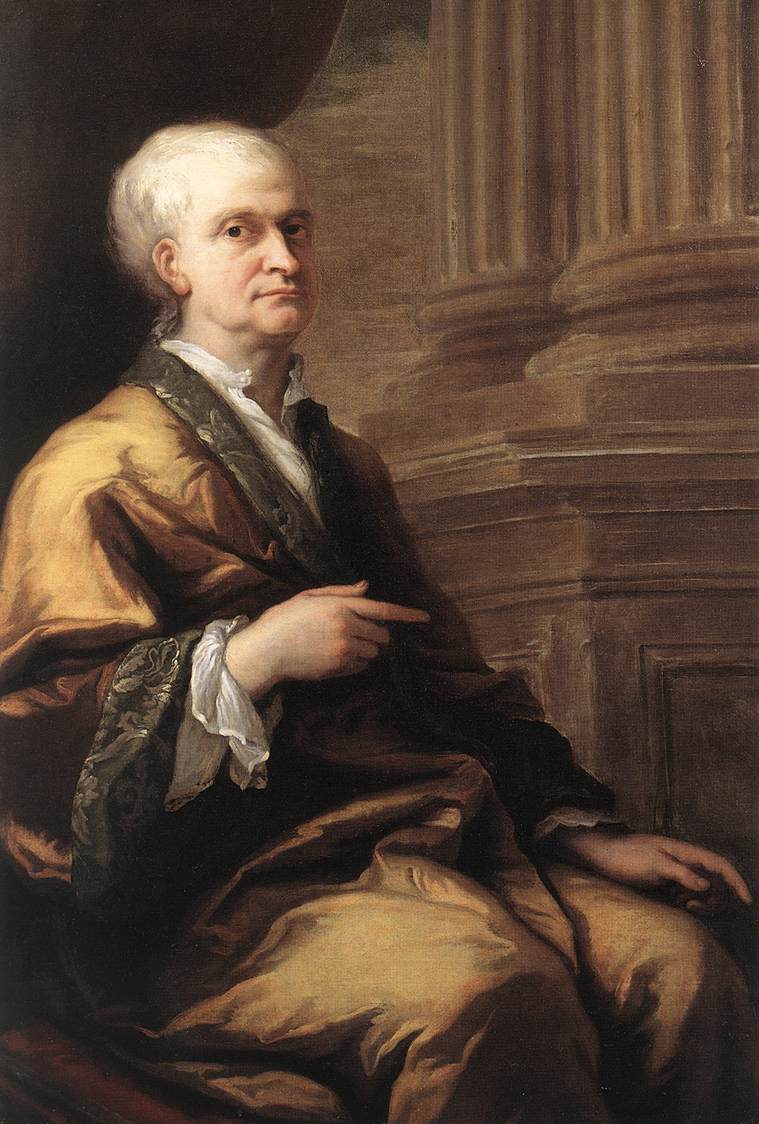
Isaac Newton in a Banyan (c1709, PD) James Newton Thornhill
As this style progressed, buttons became a must and frogging was also a key feature of 18th century first quarter British Banyans to prevent the garment trailing along the floor, a workaround for the lack of Obi it seems. By the 1730s, in London alone there were five general tailor stores or Warehouses which specialised in selling ready-to-wear Banyans made using European and Chinese silks. Other Banyans also had attached waistcoat inserts sewn into Banyans to give the illusion of a waistcoat as well for recieving visitors in the Banyan.[2]
Thomas Weston (1723, PD) M Dahl
A Rake's Progress (1735, PD) William Hogarth
Figure third from right here wears a Banyan style
Banyan should be regarded as European garment made for European usage, but are distinctly part of European KTC in the sense that they were made, worn and used by Westerners. Banyan were regarded as a sort of unisex loungewear for the well to do about the house, which often co-orded with the furniture.[2] By the 1730's, they were given an intellectual veneer as men of letters often wore them to have their portraits painted in their well endowed libraries. Gentlemen would recieve visitors in them, and as is seen in the Rakes Progress, became the equivalent of a woman in rollers and sweats going to the shop for milk at 11:00PM. Add a fitted collar, and the Rake could be deemed as almost acceptably dressed to go out in public.[2]
Robe a la Anglaise (English nightgown) Dress (c1785, PD) LACMA
Banyan were also adopted as a form of nightwear by women to worn before dressing in daywear by this time adopting a ribbon or buttons to fasten them.[1] Womens Banyan otherwise were the same shape, a sort of cloak. Womens Banyan often had pleated and broader backs than Mens, and are certainly far scarcer in todays collections. By 1740, the Banyan peaked in popularity and the grammar nazi Samuel Johnson himself noted it in 1755 as a 'Bannian'. Extant examples of the 1760s show the development of a 'Banyan pleat', which consists of 3 inverted box pleats along the spine and sides of the garment to reign in the fabric. These were also made into dresses and were the forerunner of the Robe d'Anglaise fashion which took the pleats from the waist rather than in a backless gown. The 1790 Close bodied (Anglaise) style also revealed the front petticoats, much like the overturned Banyan hems of menswear a century before.
Coromandel Banyan (c1750, PD) Sharon Sadako Takeda
Other countries also assisted in the production and thererby acculturation of these garments, principally China and India.[2] The above garment was a Coromandel (India) Banyan made for the gentleman at home and were popular until the late 18th century when the vogue became more fitted garments once more. This may be due to the popularity of the Banyan as loungewear expanding to wider portions of the Continentals who wanted the look, but didnt want the excess fabric. No, excess fabric ist zur exotisch fur die Kontinentals. Non, they wanted smoking jackets. In this stead, Indian tailoring techniques were also adopted into Banyans and became more fitted and adopted high necklines and tighter sleeves from similar Mughal court dress.
British fitted Banyan (c1780, PD) Andrew Bolton
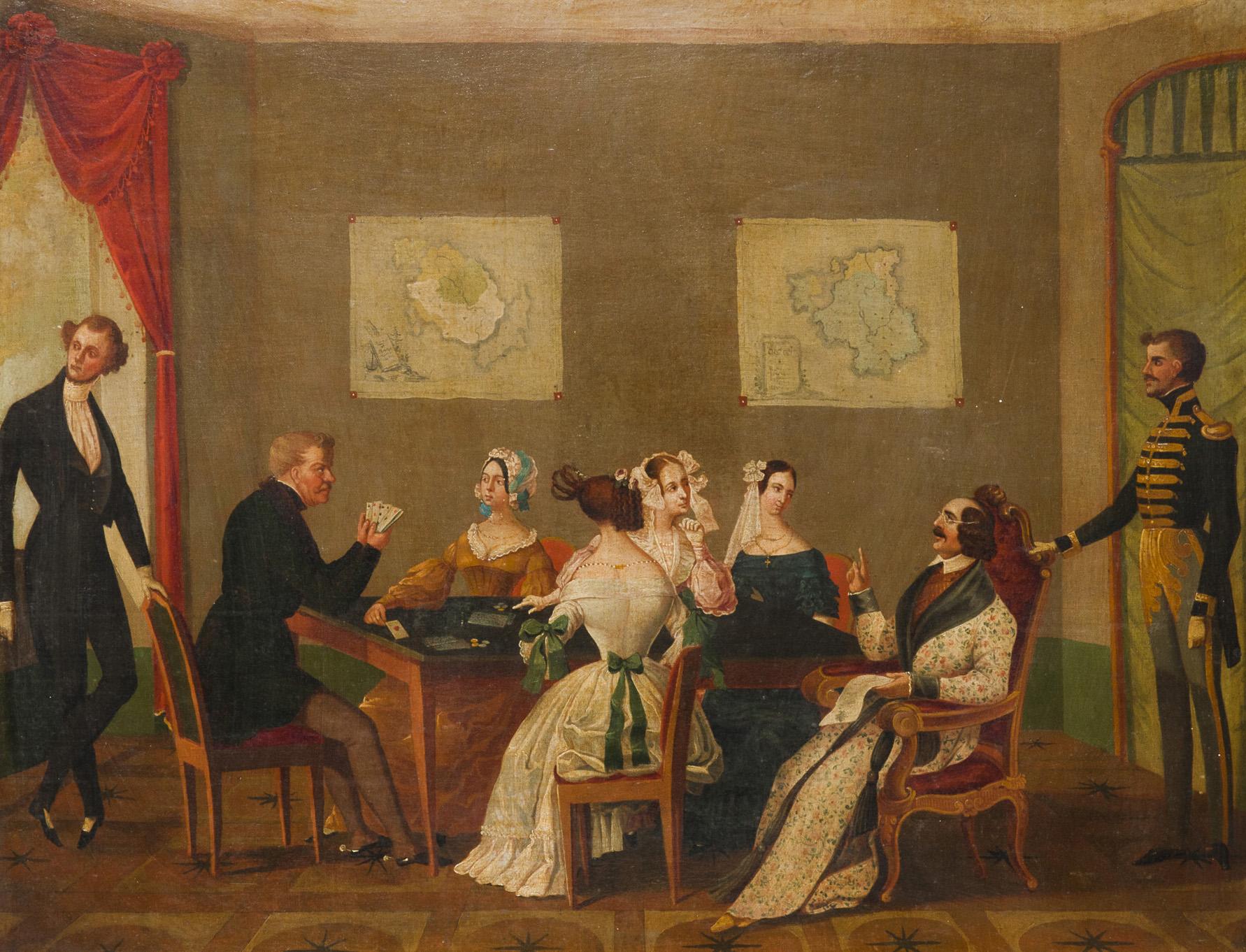
A merry party (c1850, PD) Dorotheum
Instead by around 1780, the Banyan silhouette became more slimmed down and the back of the garment was still incredibly loose, acting as more of a coat than a robe, though retaining the social function as home loungewear. Due to the power of the Ottoman Empire though, new styles began to come into vogue. Based on Middle Eastern styles, the smoking jacket became more popular by the 1840s. Banyan were still worn however until 1860 as a robe albeit without the excess trailing fabric in the sleeves or length of the 17th century edition. Rather than radical luxury, the Banyan or dressing gown was now the form we use today.
Conclusion
In context the overall picture we can gather of the Banyan is that as a European component of KTC, the Banyan was actively influenced by Kosode design and tailoring from 1665-1720 as an accompaniment to English fashions. 1720-1780 saw this continue with an emphasis on comfort which in France was the Robe Volante style. 1780-1860 saw the inclination towards East and Central Asians styles dominated the designs of Banyans, particularly those in Silks and Brocades.[2] After 1835 in particular, we clearly see the Banyan vogue fading in favour of the smoking jacket style in menswear, and with a similar pleated consensus in womenswear albeit by 1760, evolving into the Close bodied gown style by 1780.
Banyans began as a European alternative to the ludicrously rare Kosode of the mid 17th century and became known by 1700 as the grandfather of the modern dressing gown. Banyan acted as signifiers of taste, wealth and fashionable attire in England and the Dutch Republic at the height of their popularity, amid a time where the landed gentry sought and bought for the Japanese effect, rather than from primary sources such as Japanese artists, unless we are discussing the items were brought by the VOC at the time. The influence thus of Japanese KTC on European textiles was in allowing greater freedom of movement, comfort and in providing an early form of androgynous or unisex tailoring in Western European tailoring and silhouettes, altering Western aesthetical conceptions of how the body interacted with cloth and space in acceptably modest forms.[2][4]
Additional Examples:
- https://collections.vam.ac.uk/item/O1244844/night-gown-unknown/ (1720-1750 Banyan)
Bibliography
[1] https://en.wikipedia.org/wiki/Banyan_(clothing)
[2] http://www.fashioningtheearlymodern.ac.uk/wp-content/uploads/2012/02/Banyans-21.pdf | Object in focus: Man’s banyan, Moira Thunder, 2012, Victoria and Albert Musuem for the Europeana Project
[3] https://vogue.sg/history-of-the-three-piece-suit/
[4] https://fashionhistory.fitnyc.edu/robe-a-langlaise/
*I use 'Wafuku' instead of Kimono, as always, becuase the term 'Kimono' originated among Japanese people in reaction to the need for a word to distinguish Wafuku and Yofuku becuase foreigners asked for one; without which otherwise there would be difference prior to the 1860s, the Kimono as a social construct only entering global culture after 1918.
**I presume the object is under the public domain down to age, the file itself is purely used to illustrate on educational content of contemporary fashions and is used here specifically in a non-commercial function. I do not intend to represent the views of the V&A, nor claim any affiliation, nor speak nor write on their behalf but am operating under the fair use clause of the 1988 UK copyright legislation, intentionally in an educational, non-commercial function under good faith. Having read the T&C's, I cannot find a specific license for these images, and thus presume the file is copyrighted and do not condone any third party actions usage of this file. All copyright again belongs to the Museum, not myself and if you wish to use the file, please see the Musuems T&C for use.
Socials:
https://www.pinterest.co.uk/LuckyMangaka/timono/

.jpg)

.jpg)
.jpg)
.jpg)
.jpg)

_with_Design_of_Maple_Leaves%2C_Raft%2C_Flowing_water_and_a_Character_of_'Autumn'_LACMA_M.39.2.289_(1_of_2).jpg)

_met_zijn_jongere_broer_en_zijn_toekomstige_zwager.jpg)



.jpg)