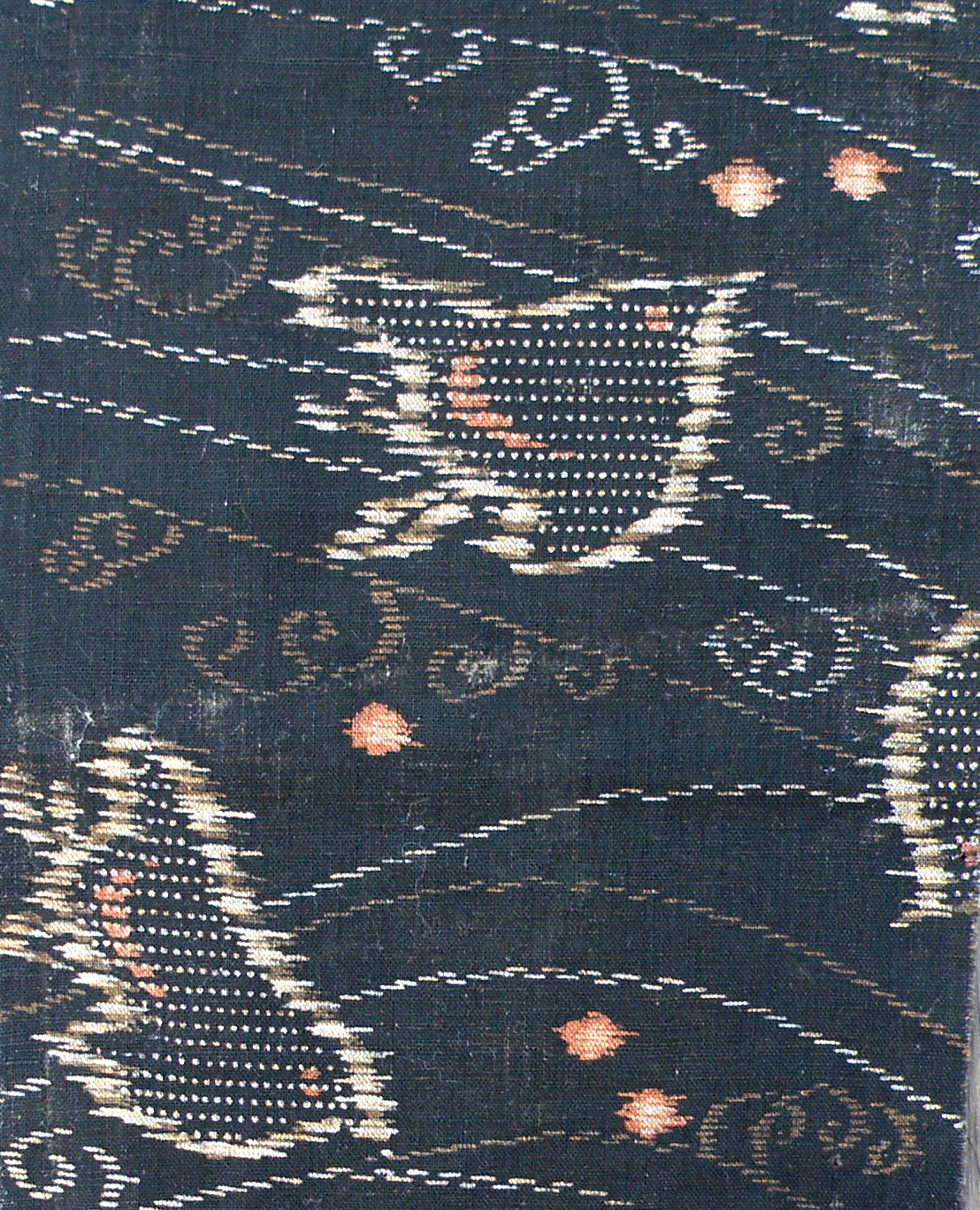
As promised for once (seeing as I doubled up on Essays and then instead did a Pride Kimono Essay, I still have so much E&AKTC media I want to analyse so badly!) I will be reintroducing you to the wider history of Meisen (woven or Pongee) Silk. To the touch, it is immediately recognisable as it the rougher, heavier silks which are recommended for work and winter.
Meisen is a woven or spun silk, produced from waste cocoons/raw of pre-dyed silk threads, and is a popular everyday silk for its durability and its ability to be reused as a fabric even when worn frequently as workwear. This technique is also known as Ikat, but Japanese Ikat or Meisen is known as the thickest or heaviest Ikat weave, also known as double Ikat weave.[1][2] Now I will admit, in softness to DEAR GOD THAT SCRATCHY- the order goes Omeshi, Meisen, Tsumugi, Omeshi being cotton smooth, Meisen the itchy stuff and Tsumugi the dark brown material only scratchlords love, but Meisen often falls into the scratchier rougher silks in my handling experiences as a textile collector myself.
When the threads are woven, they commonly apply loose waste silks to the weave, or by stretching the threads to the desired length and tightly binding the design before the dying process known as Nassen. The dye method of production in creating a design is known in Japan as Kasuri (resist dye) which gives Meisen its signature patchy, rough edged or blurred design look when the design stencilling (the stencils made from mulberry paper reinforced with Toxicodendron vernicifluum or since the 1960s plastics) is applied atop; using a spatula or wide hand brush called a Hake (刷毛).[7][8][14] Stencils are also cut with a knife or precision instrument.[9] The dyed yarn is then rolled up and placed into a Mushibako (a steam tube).[9] The final design is adjusted by applying hand painting or embroidery.[1] In Ikat, this process can be repeated multiple times to produce elaborate, multicolored patterns by dye, whereas Meisen also applies dye after the fabric has been woven as well. The tighter the weave, the greater the skill of the craftspeople involved due to the loose threads involved often being shorter than desirable for silk production. Meisen patterns show up on both side of the finished product due to the double printed design formed through Hogushi Nassen.[2] Meiji Meisen peices used chemical dyes to create the design, mixing rice paste or Konjac paste atop the stencilling process to warp threads after being woven with the weft. The weft threads were then undone, taken out and replaced for reuse on old boards, this being a new Meiji technique which replaced traditional Ikat production of kasuri in which chunks of threads were tye-dyed on their own in a slow and repetitive process by hand to avoid unwanted dye being spread during skein contact.[7]
Historically, Ikat originated in South East or Central Asia, sometime before 3000BC.[2] Double Itak originated in Tenganan, East Bali, Indonesia as Geringsing Double Itak. This spread via the vast trade networks of the great Asian empires of modern day India and China to as far as Egypt and became a widely available textile.[4] Ikat then arrived in modern day Japan around 1100AD, eventually entering Japan proper in the 1300's when the Ryukyuan Kingdom began trading with Japan. After 1609 when both Kingdoms merged, the Ikat technique began to be used in Kyushuu. By 1750 with continuing growth of the Honshu population and demand for greater cotton production, the technique had moved into Nara.[6] With the increasing growth of Ikat production in Japan, Ikat weaving became a Honshu cottage industry produced in specific villages which gave rise the creation of Ikat as a local Japanese textile, or textiles which became Meisen. By 1850, Bingo or modern day Hiroshima had its own local variant for example.[5] In Japan from 1868, Meisen grew in popularity due to Ikats popularity as textile abroad. In 1873, Japan first participated in the International Exhibitions where it is thought Japanese artisans first began bringing new European chemical dyes back to Japan to work with.[16] In 1882, it was said that expats such as Kondo Tokutaro and Inabata Katsutaro (1862-1949) began to return from Lyons France and reinvigorated the trade of Ikat weaving in Japan.[12] This became Chichibu Meisen when Sotaro Sakamoto (坂本宗太郎) patented another Meisen technique in Chichibu in 1908.[9] Between WWI (1914-1918) and the devastating 1923 earthquake silk production costs fell as Japan reaped the rewards of being a major power who had bolstered heavy industry in the Taisho era.[13] Cheaper silks thence began to be easier to produce due to advances in weaving technologies and new chemical dyes on production lines made Meisen Kimono incredibly cheap, incredibly decorative and incredibly bright Kimono.[9][15] From 1910 - 1935 therefore was the Meisen Renaissance.
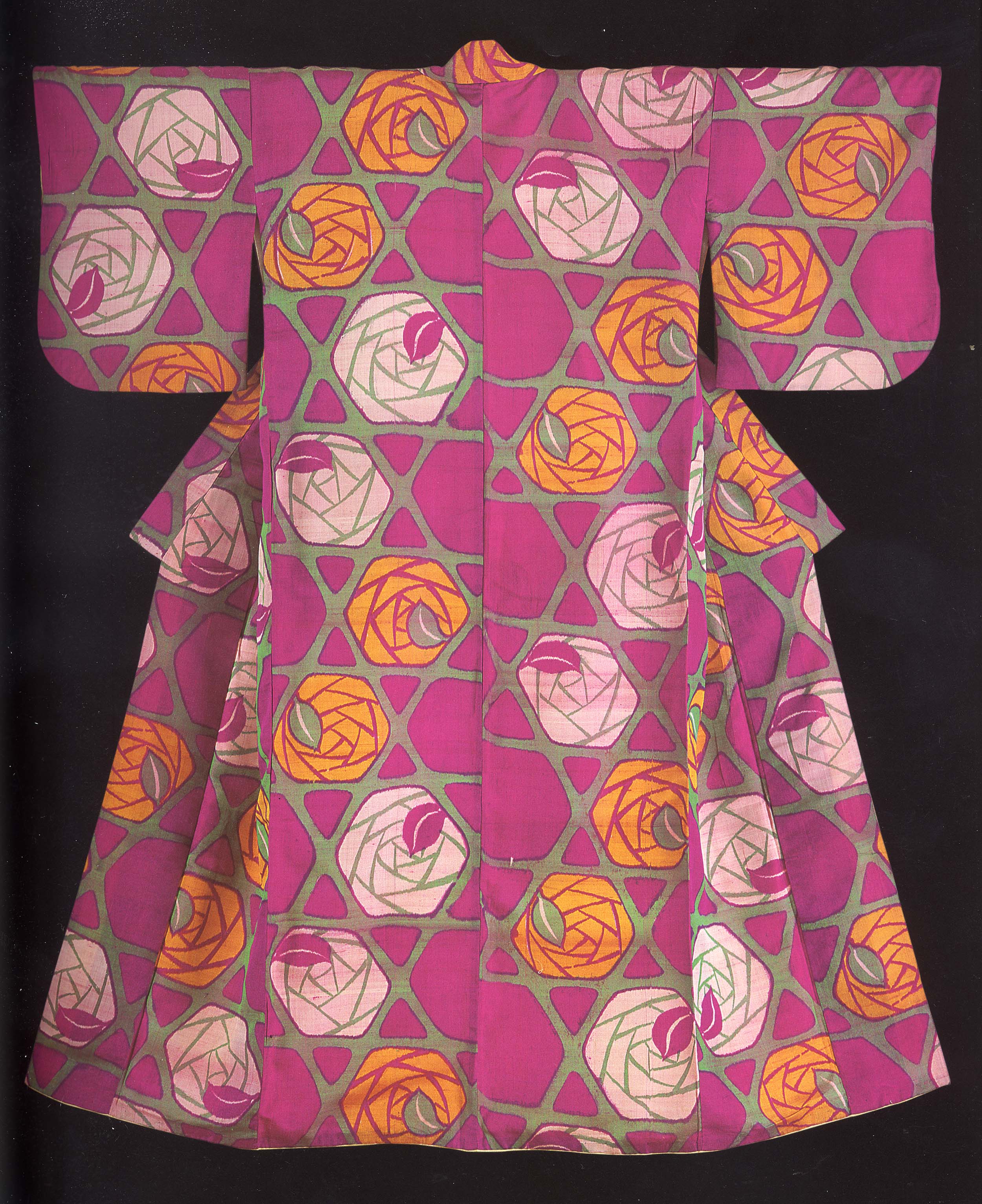
Meisen machine made Kimono (Taishou) Khalili Collection
From 1920 - 1939 Meisen therefore became fashionable everyday wear and it was during this period that Meisen became most popular, with work being outsourced to the Greater Co Prosperity Circle as it was known for the cheaper labour of Korean and Chinese workers.[5] It was said that 50% of the women in Ginza at this time wore a Meisen Kimono and became what can be regarded as Taisho 'fast fashion' by 1920 and would set you back today by 20-30,000¥/£2-300/$250-350 in todays money.[8][14] This Meisen renaissance saw the proliferation of these garments in large Department stores with popular actresses of the Taishou and early Showa eras.[7] This in keeping with the times allowed for the proliferation and greater production of Meisen silk with production reaching its peak by the 1930s. With the increasing global role Japan played on the world stage, the textile industry incorporated foreign cultures and motifs such as European Art Deco, Fauvism and later Cubism and Modernism for example into their own designs.[12][16] This is seen in the pizza effect of Meisen Kimono's flowing water motif and ribbons said to guard against evil spirits, motifs regurgitated through the Glasgow modern style, being used by the Finnish/Swedish company Marimekko who were inspired by Meisen Taishou design of 'stripes, cross[es &] arrow feathers' in the 1960's and 1970s.[11][12][16]
After WWII production began to slope downwards from the loss of the labour pool and that as an everyday, common, durable reusable fabric, secondhand long lasting Meisen silk had a larger supply in the market which made new production particularly unprofitable. By 1960 with the consumption and promotion of western styles, Meisen production declined drastically and as a readily available fabric with no demand, production almost ceased. Today the majority of Meisen is made in Honshu, focused in Gunma and the Kanto region using Tama-ito (Dense raw summer silk yarns) and Noshi-itou (Silk thrums), also other smaller sites include Kyoto, Isezaki, Chichibu, Ashikaga, Kiryuu, Hiroshima and Hachiouji and in Okinawa as Tate-Yoko in Kurume and Ryukyuu.[1][2][3][10] Modern artists like Michiko Sugihara of Isesaki who stages a Meisen fashion show each year, and Tamayo Kanai the curator of the Isesaki Meiji Musuem, today keep the tradition and history of Meisen alive in modern Japan, partially as Upholstery fabric for interior design and small personal items such as handbags.[7][10] Other artisans like Yasuo Kikuchi, who are increasingly retiring as with many heritage trades like Bashofu weavers for example, keep the tradition alive by offering classes and demonstration workshops in the Chichibu Meisen Museum.[9] Other Meisen musuems are available.
Scholars such as Anna Jackson and Karun Thakar have also published work on Meisen Kimono in 2015 (Kimono Meisen: The Karun Thakar Collection, which holds 250 Meisen Kimono from 1300 on), and were held on display at the V&A in the Kyoto to Catwalk 2020 Exhibition. For further photos and details on Meiji era machinery, see SalzTokyo's excellent blog on Meisen in Chichibu: https://www.salz-tokyo.com/chichibu-meisen-hogushi-weaving/.
Patterns #6 will be on Tate-Yoko-Kasuri, another Ikat derivative.
Bibliography
[1] https://www.faburiq.com/blog/2014/10/21/0wtatbkndhaesj8ccxt6a9wq8878nm
[2] https://en.wikipedia.org/wiki/Ikat
[3] http://www.johnmarshall.to/H-TradTech-Tategasuri.htm
[4] https://www.wowshack.com/the-amazing-story-of-ikat-how-a-textile-wove-itself-into-indonesian-history/
[5] https://en.wikipedia.org/wiki/Kasuri
[6] https://en.wikipedia.org/wiki/Demographic_history_of_Japan_before_the_Meiji_Restoration#Population_during_the_Edo_and_early_Meiji_eras_(1600_to_1873)
[7] https://www.vam.ac.uk/blog/news/japanese-meisen-dyeing
[8] https://home.ginza.kokosil.net/en/archives/72310
[9] http://www.salz-tokyo.com/chichibu-meisen-museum-nassen-dyeing/
[10] https://www.salz-tokyo.com/chichibu-meisen-hogushi-weaving/
[11] https://www.rundetaarn.dk/en/event/meisen-kimono-2/
[12] https://www.meisenkimonocollection.com/thestoryofmeisen
[13] https://wattention.com/meisen-the-funky-kimono/
[14] http://nationalclothing.org/asia/28-japan/329-meisen-kimonos-launched-a-new-trend-in-japanese-folk-fashion-in-the-early-20th-century.html
[15] https://hali.com/news/meisen-kimono/
[16] https://reader.exacteditions.com/issues/43418/page/90
Socials:
https://linktr.ee/Kaguyaschest
https://www.etsy.com/uk/shop/KaguyasChest?ref=seller-platform-mcnav or https://www.instagram.com/kaguyaschest/ or https://www.youtube.com/channel/UC5APstTPbC9IExwar3ViTZw, or https://www.pinterest.co.uk/LuckyMangaka/hrh-kit-of-the-suke/


%2C_late_19th%E2%80%93early_20th_century_(CH_18490057).jpg)