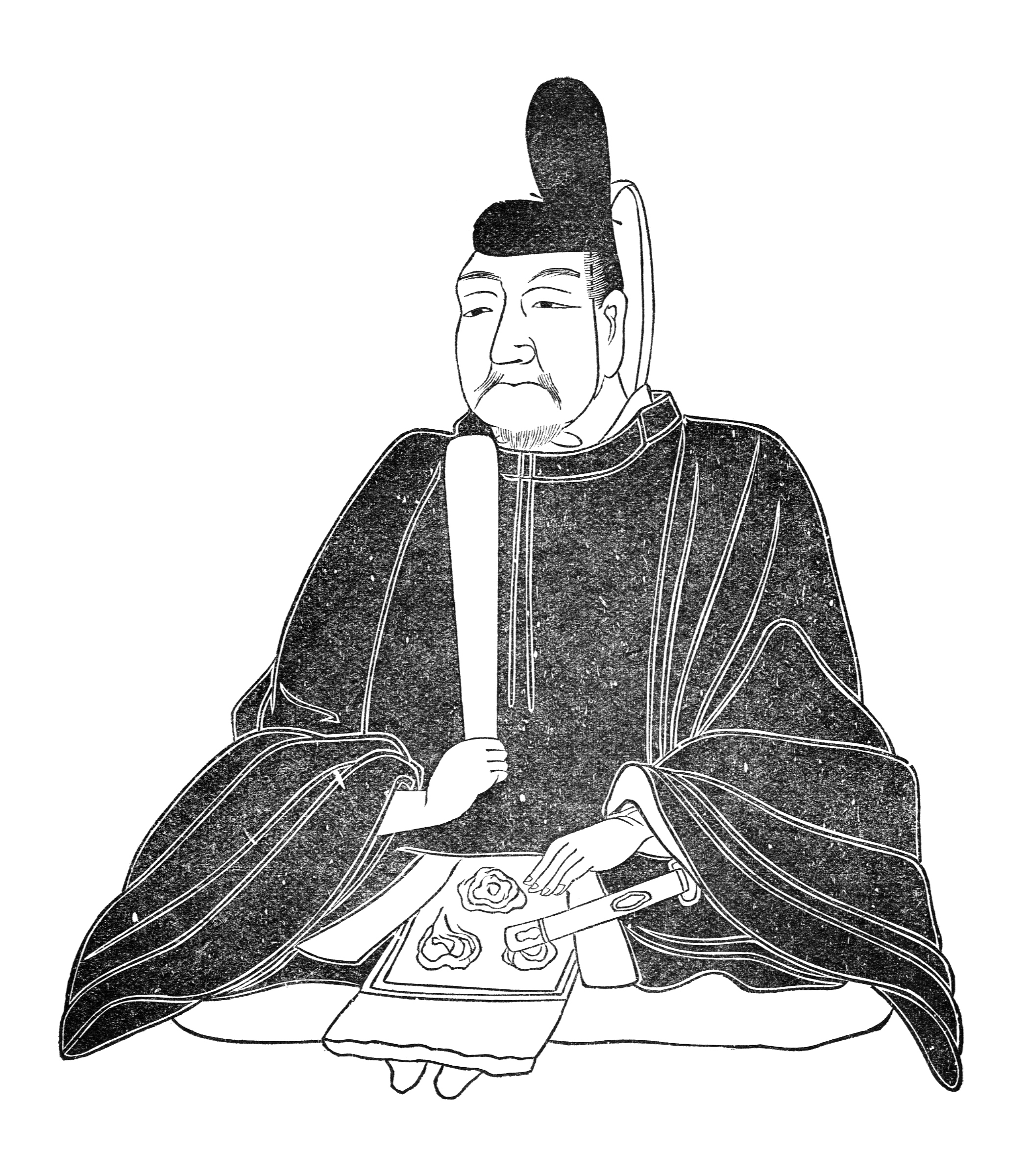
During this time, thw Fujiwara came into power, and the capital was moved mutltiple times, eventually into Heian-Kyo. With this the trade with China ended and the improvement of local industries became paramount to continue life in Japan as it had before. This systematic change however only came after 967 when the capital was rebuilt in a more 'Wamono' style, as the Nara capitals were built on Chinese models of city planning.[15] 500-1000 in KTC
In the prescribed time period, Asuka culture changed significantly and is noted for being an artistic period which flourished under Buddhist patrons.[11] Prince Shotoku was one of these eminent Buddhist patrons, whose tutors such as Gwalleuk (fl.602) were also Korean, led to him comissioning some of the earliest embroideries and Mandalas, which also show the influence of the Korean dynasty at this point in time on his death in 622 (see the Asuka Bijin).[12] Examples include The Hata Clan who are said to have brought twill silk weaving to Japan during the Asuka period.[4] During 600-659, multiple missions were sent from Japan to China and proto-Korea, primarily Baekje. It was by the end of the 7th century therefore that we can safely say that the early Korean influence on Japanese clothing subsided in favour of the Tang Dynasty silhouette style, with an adoption of Buddhist garments as well.
During the artistic Hakuhou ( 白鳳時代 | 660-690) period, major influences upon the courts where Gupta India, Baekje Korea and Sui and Tang China.[12][13] The Nara court saw an increased use of Buddhist art until Empress Kokens scandalous death in 770, which saw the height of the Tempyo Era (729-749) with clothing becoming more hierarchical with the capital consolidation, Buddhist aesthetics merging with Shinto ones, and an increased use in silks and other fabrics at court, and decoration for the Heimin not doubt as well. The dress of the time was heavily influenced by China, Korea, India, and the Islamic empires of the the Umayyad Caliphate (661–750), and the Abbasid Caliphate (750–1517) which stretched from Morocco to Iran due to the Silk Road trade route.[14]
Empress Komyo about 750 (1897, PD) Shimomura Kanzan
The early Heian period saw the collapse of the missions to Tang China due to political turmoil in China.[15] This meant that local industries and areas such as Nishijin had to ramp up production of their own textile creating and design in order to meet the new demand. This increase in local supply allowed during the early Heian period for a flowering of Wamono styles and designs. Kasane textile culture, that is the layering of Junihitoe in graduating colour gradients in the sleeves and collars, became high fashionable among court women. Commoners around this time are also thought to have begun wearing fabrics like Hemp cloth, with most being in simple colours available to them like browns and perhaps blues.
Timeline
Kimono as Culturalisms from 500CE-1000CE
Cultural Appropriation
EX: Erasure of acknowledgement of Tang aesthetics as simply Wamono by the later centuries
Cultural Appreciation: the acknowledged or appropriate adoption of the practices, customs, or aesthetics of one social or ethnic group by members of another community or society
EX: The adoption of Buddhism in Japan in 552
Cultural Assimilation: the process in which a minority group or culture comes to resemble a dominant group or assume the values, behaviors, and beliefs of another group
EX: Kimono takes on the form of the Tang Chinese court dress
Pizza Effect: the phenomenon of elements of a nation's or people's culture being transformed or at least more fully embraced elsewhere, then re-imported to their culture of origin, or the way in which a community's self-understanding is influenced by foreign sources.
EX: Hiogi culture being exported to China and returned to Japan as part of Buddhist aesthetics in turn affecting popular motifs[1]
Transculturation: the phenomenon of merging and converging cultures
EX: Kasane-no-irome (襲の色目|coloured layering) which adhered to the Chinese calendar of 72 seasons became fashionable as indoor wear for women on their Junihitoe[4]
Cultural Heterogeneity: the differences in cultural identity related to class, ethnicity, language, traditions, religion, sense of place etc, that can make it more or less difficult for people to communicate, trust and co-operate with each-other
EX: An increasing distancing away from China on Japans behalf as they went from being the 'dwarf' nation, to the 'harmony' nation of Wa, which is reflected in the increasing interest in local Japanese folklore and dress is affected by adopting Wamono literature of the Manyoshu (600-759) and Kokin Wakashu (887-920) anthologies being used to make reference to Japanese landscape scenes on textiles rather than the Chinese classics[2]
Cross-cultural competence: a persons ability to understand people from different cultures and engage with them effectively
EX: The competence of Junihitoe wearers could be seen in their ability to understand classical references to Chinese poetry and aesthetics
Cultural Diffusion: the spread of cultural items—such as ideas, styles, religions, technologies, languages—between individuals, whether within a single culture or from one culture to another e.g- the spread of Western business suits in the 20th century
EX: In this time period, technologies for creating new textile goods and decoration would emerge, one of which was embroidery which came from China into Japan by the 6th century.[5] This technique which was first used to decorate Emperors trinkets and Buddhist Mandalas, eventually becoming key to decorating Junihitoe and was spread by Korean embroiderers as well
Cultural pluralism: the practice of various ethnic groups collaborating and entering into a dialogue with one another without having to sacrifice their particular identities
EX: During this time, this became increasingly less interesting to the growing Japanese nobility who had begun to care more about their lands than shiny gifts and trinkets from abroad. An example may be the adoption of Kesa aesthetics and textiles, which became increasingly more lavish and gold as time wore on[6]
Polyculturalism: the ideological approach to the consequences of intercultural engagements within a geographical area which emphasises similarities between, and the enduring interconnectedness of, groups which self-identify as distinct, thus blurring the boundaries which may be perceived by members of those groups. Multiculturalism instead thought to emphasise difference and separateness, being divisive and harmful to social cohesion.
EX: Buddhism aesthetics in the formation of how space and desire played a role in beauty, such as embracing Mujou ( Impermenant Transition | ) qualities such as admiring falling cherry blossom and the appropriate placement of space in a composition or design, which transferred over to KTC by the Heian era[7][8][9]
Multiculturalism: the coexistence of people with many cultural identities in a common state, society, or community, also though in the prescriptive sense to refer to the political theory framework that individual cultures, groups or ethnic peoples be given their own space in the wider society which has led some to criticise policymakers use of multiculturalism as divisive (should only be considered post 1996 world due to the times tightening of immigration, the enforcing of borders and encouragement of national identity rather than encouraging individuals to think of themselves as global citizens)
EX: Korean immigrants in this era having to take on Japanese identities in the Japanese legal framework
Cultural diversity: the quality of diverse or different cultures, as opposed to monoculture, the global monoculture, or a homogenization of cultures, akin to cultural evolution. The term cultural diversity can also refer to having different cultures respect each other's differences.
EX: In contributing to KTC at this time, cultural diversity is represented by the increasing number of works including Buddhist figures from India and China who were represented in the new aesthetics influenced in turn by a mixture of Buddhist and Shinto aesthetics
Monolithic culture: a societal construct or organisation like religion which often has negative connotations in our society. For example, the percived rigidity and homogeneity of a monolithic culture that is not open to new ideas, these is their truest form are the few hunter-gatherer societies or uncontacted societies like those few found in the Amazon rainforest.
EX: Women often in this time had a better understanding of Wamono than some men in high positions, particularly in the art of writing or Onnade ( womens writing | 女手 ). The Nikki ( diary | 日記) of these nobles, for men the Tosa Nikki ( Tosa Diary | 土佐日記 | 935 ) and women authors the Kagerō Nikki ( Mayfly Diary | 蜻蛉日記 | 974) gave rise to the first uniquely Wamono genre as such Nikki Bungaku ( Diary Genre | 日記文学 )[3] This was a catalyst for KTC in the later Heian period, which through Onnade created Wamono and Wafuku points of reference originating in the Monolithic writings of 'Japanese' upper class court noblewomen
Preface to the Kokin Wakashu (c914[2017], PD) Anonymous, ReijiYamashina777
I should be clear, Cultural Acculturation is key to Polycultural societies, one whilst the official line from some Japanese institutions is that it is not, Japan is a polycultural society and has been for a long time.
Conclusion
In the time period described, we see glimpses of how large amounts of heterogeneous 'Japanese' aesthetic and textile culture was in fact rather more so Korean, Chinese and Asian. Other the time period, we see how Chinese textile culture was adopted and adapted to suit Japanese needs. Korean skills were also made use of to this same end. In KTC, this was seen is in the increased use of Embroidery skills and application, goldthread work[10], Kasane aesthetics and so on.
Due to the politics of the Chinese states and tributary system however, this saw a decline in adopting Chinese aesthetics wholesale, moving Japan in favour towards a more Wamono aesthetic and feeling of proto-nationality, as seen in the favouring of Waka poetry references rather than ones knowledge among the elites of Chinese poetry. Zen Buddhism also heavily afflicts the understanding of material culture and therefore aesthetics by introducing concepts such as Ma (negative space).[7] Whilst therefore a large amount of aesthetic design was heavily taken wholesale at first from China from the Asuka and Nara periods, by the Heian period this had become a set of design guides more uniquely Japanese than in previous centuries, even though their founders often came from places like Korea (for technological advances), India (for Buddhism and some fabrics) and China.
Asuka period clothing heavily drew from Korean styles in the first half, until Tang dynasty styles overtook them by 690. This KTC continued until well into the Nara period under Tenpyo culture. After this, Buddhism played an increasing role in shaping the aesthetic designs worn by courtiers by 750 AD. The clothing thus worn by the early Heian period was a reflection of early Junihitoe, which incorporated clothing worn by high ranking Chinese courtiers, but which often used Japanese functions. Keiko (Junihitoe trousers) were a leftover vestige of this for example. By 967 however, with a decreased trade with the outside, Cultural Acculturation began to acclimatise foreign influences into Junihitoe, in a bid to cement what Emperor Shotoku had started in the 7th century.[11][13][14][15]
Overall contextually, cultural acculturation steadily increases at the juncture when outside influence trickles down to nearly nothing by 850CE, flourishing in uniquely Wamono aesthetics between 850-1000CE. This Acculturation however would be impossible if it were not acknowledged however that Buddhism, itself an import and later acculturated by 750CE, were to have made Japanese high culture rethink its own approach to their own design philosophies. Thus in context, we see that over 500-1000CE, there is a steadily increasing level of cultural Acculturation due to an increasing closed off world to the island nation of Japan and and increased inwards looking society in Japan itself which allowed for the fostering of a Wamono aesthetic based on influences which ranged from Morocco to Korea due to multidisciplinary commercial and artistic approaches, and trade routes such as the Silk Road to have led to the creation of this times KTC.
Bibliography
[1] See Fans in Bijin #10
[2] https://www.kyohaku.go.jp/eng/theme/floor1_4/past/1F-4_20200102.html
[3] http://webcache.googleusercontent.com/search?q=cache:iJvC1r3EAZYJ:https://medium.com/pomme-de-terre/the-sexist-history-behind-the-development-of-hiragana-e9f5676ab1f9&hl=en&gl=uk&strip=1&vwsrc=0
[4] See Fabrics #3
[5] https://www.letempsdebroder.com/en/articles-en/japanese-embroidery/
[6] See Patterns #10
[7] Wabi-Sabi, Mono no Aware, and Ma:
Tracing Traditional Japanese Aesthetics
Through Japanese History, Lauren Prusinsk, March 2012, Vol 2, pp.27-29, Studies on Asia
[8] https://nomurakakejiku.com/lesson_lineup/mujou
[9] https://www.interactiongreen.com/history-japanese-aesthetics/
[10] The Techniques and Origin of Ornamental Gold Silks in Ancient China, Xiaorui Hu, Weidong Yu, 2016, p.1, Donghua University of Shanghai | https://www.researchgate.net/ publication/304340441_The_Techniques_and_Origin_of_Ornamental_Gold_Silks_in_Ancient_China
[11] https://en.wikipedia.org/wiki/Asuka_period
[12] See Essay #11
[13] https://en.wikipedia.org/wiki/Hakuhou_period
[14] https://en.wikipedia.org/wiki/Nara_period
[15] https://en.wikipedia.org/wiki/Heian_period


.jpg)

.jpg)
.jpg)
.jpg)
.jpg)
_with_Design_of_Maple_Leaves%2C_Raft%2C_Flowing_water_and_a_Character_of_'Autumn'_LACMA_M.39.2.289_(1_of_2).jpg)
.jpg)






.jpg)