Her Haughtynesses Decree

Showing posts with label Androgyny. Show all posts

Tuesday, March 19, 2024

やん りべん | Yan Liben | 600 CE - 673 CE | Bijin #24

Yan Liben (c. 600–673) was a Tang dynasty painter who we can point to as a genuine Tang artefact creative. Liben was sandwiched between the archetypal artwork figures of Gu Kaizhi (345-406 CE) and Zhou Fang (730-800 CE) during a time of greater acceptance of foreign influnces from Mahayana Buddhism and the incorporation of female divinity figures in art.[1][7] This particular Bijin or Meiren post examines the Buddhist Guan Yin connection to the ruling elite known to us as the Rouged Bijin who employed Buddhism, such as Wu Zetian to enact the creation of the Drunken Lotus Beauties of Zhou Fang. Liben is our intermediary guide throughout the Sui and early Tang Dynasty into the creation of Chinese Tang Beauty Standards into distinctively feminine lead and codified outer Mei, in a shift away from earlier Inner Mei beauty standards found in the patriarchal Metaphorical Beauty of the Lotus and Tacit Bijin. This saw a rise in feminine stories, poetry, roles and the importance of feminine aesthetic as a result, leading to the Golden Age of Classical Chinese Art which so inspired the Onna-E of Heian Japan.

Willow Guan Yin (PD) Yan Liben

I deeply apologise to myself for not meeting my own schedule, but as usual, life decided to get in the way. 

Art Theory on the Meiren

Art Scholars and Chinese Aestheticians held deeply patriarchal notions of beauty. Whilst men and non-binary figures could be considered beauties, to espouse this publicly would have have a big no-no. Instead beauty was said to only morally acceptable as Dai Mei, or Great Beauty from the Inside influenced by the Dao (Way) teachings. This being the Lotus Bijin who nonetheless was codified as a beauty, and this was translated into the poetry and Yuefu of the Han Dynasty in the Male version of reality. In actual reality, female beauty was cunningly hidden and celebrated in the Yuefu and everyday discourse (see Ye Xian for example). We known this because of evidence like Han burial tomb murals which whilst espousing these pious inner beauty mantras, rather heavily display visibly flamboyant outer beauty in sporadic feminine and male images to display their tomb owners wealth and taste.

However with exposure to outside influence and cultures (such as Buddhism) over the course of centuries beginning in the Han through to the Sui, these ideals began to change and developed into the Drunk Lotus Meiren type. The Drunken Lotus was a beauty who was enabled to exist as the power dynamics of the Tang leaned heavily into the female, drawing on the influence of Yuefu, Gongti and everyday styles of espousing beauty ideals to create the Tang beauty ideal immortalised by the later standards of Zhou Fang of plump, rounded red Chinese women and men.[2] Liben's works situates itself in the early transitory phase of the Tang and is therefore of interest to us of what proto-Meiren beauty standards would be for that time at the height of the golden age of Classical Chinese Art.

Yasodhara on right (2012, 2.0) Photo Dharma

Palace Figure painter

Liben is primarily known for his 13 emperor scroll and then the Lingyan Pavilion. In this capacity, he was known primarily in his lifetime for portrait and figure painting. Many of his figures were historical figures. Supposedly much of his work has been speculated to revolve around celestial and prophetic themes related to Chinese mysticism and Tang understanding of the cosmos. One of his works is found in the Mogao caves for example, which famously is known for its burial figures and for our purposes, Meiren.[1]

These portraits were often life size, but not life-like. Whilst women at the timer were still considered property to be bought and sold, they most certainly held sway over 'men' who were mostly only capable of 'boy stuff'.[2] Increasingly, this meant depicting figures such as gods of war attendants as female, and appropriating the tales of female figures in foreign cultures and religions such as Yasodhara to express the 'boy stuff' women were capable of, and most often just did.[2] It was in the 5th century about that the testosterone wore off long enough for stability to come about, enabling the arts to enter an age of flourishing which would become the golden age of Chinese art.[1]

Liben was a heavily involved palace official. His family grew up in Chang'an surrounded by the best the current emperor had to offer in Art. The entire Liben family had artistic bents, mostly with a focus on architecture. Liben's early years were spent in the service of the Emperor working with his elder brother on palace architectural commissions, heavily involving tombs which may have influenced his themes focusing on the afterlife and heaven and the stars in his later years. The bent of his beauties is both a conundrum of the feminine, masculine and androgynous. His work may particularly understood of his early work, as being informed by the Metaphorical Beauty standards of Kaizhi, but comes with the caveat of being made during a time most of his audience and patrons may have been female.[1]

Guan Yin

Many examples of female figures are extant by Liben, but this is the Bijin series so I have focused on his Guan Yin depiction. Guan Yin is a Bodhisattva associated with compassion. It is believed in Mahayana Buddhism, which is practised in China, Tibet, Vietnam and Cambodia, that Guan Yin is a highly influential Bodhisattva, or one who has abstained from Buddhahood to teach enlightenment throughout Samsara to widen the Sangha. Guan Yin is said to place the dying into the heart of a lotus and send them on to the Western Pure Land (Sukhāvatī). Guan Yin or Avalokitasvara (a borrowing from Sanskrit into Traditional Chinese) is depicted as female in East Asian Buddhism, in Japan as Kannon and Korea as Gwaneum. The Chinese translation roughly connotes 'The One who Perceives the Cries of Beings in need of Help' to describe the Bodhisattva role Guan Yin carries in the Lotus Sutra, Chapter 25 as bearer of humans to the Pure Land at the Tenth Bhumi (state of consciousness, closest one to Buddhahood).[4] The famous Mantra, Aum mani padme hum (Praise to the jewel in the lotus) refers to Guan Yin's work in this capacity.[3]

It is said that in certain cannon, Guan Yin attained Buddhahood before Gautama (the popular one) and stayed back just to let others also attain enlightenment, which is were the compassion element of Guan Yin's character traits come in. Other texts describe incarnations as the Great Protector of all sentient beings and Great Contemplator.[3] Indian sites of Buddhahood are said to be Mount Potalaka, in Chinese Buddhism it is said that Guan Yin reached enlightenment around Mount Putuo where Liben's Guan Yin lies in situ.[3][4] Guan Yin as understood in Liben's time certainly was what we today know as genderfluid.[4] The Lotus sutra, then a relatively new introduction to a new religion for many given the introduction of Buddhism in 150 CE to China from India/Nepal made Guan Yin a popular figure among men and women, particularly the elites of Sui Dynasty Imperial China.[4]

Genderfluid Guan Yin (c.916 CE, CC2.0) Tengu800

Liben's Guan Yin is most likely male oriented as a beauty and it is interesting in this sense that Guan Yin is depicted in such a way. Liben's depiction has the trademark characteristics of a moral enlightened figure, long earlobes, elaborate headdress and focused eyes which look upon those in suffering. The more interesting aspect of Liben's mural is that of the decorative beauty standard elements. The many flying ribbons are highly linked to the Gui Yi (flying ribbon swallow tail style) popular in dynasties gone by and the rotund silhouette and half exposed chest. This more androgynous figure belies an understanding of the compassion of both masculine and feminine wiles, beset in Chinese beauty standards. And what looks like a pot belly, but equally is probably something more than that. Indeed it points to the link that in ode to the ruling female elites of the time; Wu Zetian (624-705 CE) for example; Liben's Guan Yin may have links to female Tibetan Buddhist figures such as Pāṇḍaravāsinī (पाण्डरवासिनी) an incarnation of a Vidyārājñī (Wisdom Queen) from 500 CE.[4][5]

In this way, we may understand Guan Yin as being revered by her female Chinese Buddhist devotees as a leader in the new understanding of female participation and almost emancipation of female liberty and embodied power. In this way, Liben's Guan Yin is not just a beautiful adrogynous figure, but a moral figure who bestows compassionate forgiveness upon the feminine, a byway allegory for the forgiveness of the feminine for the fragile male ego of the time to enable a greater overtaking and space for the feminine to exist in public. In other words, Guan Yin was a stand-in figure of beauty and a precursor or proto-Meiren figure which female devotees and patrons could lavish their adorations upon to develop their pent up frustations, wordly desires and needs whilst being safely assumed to be forgiven and developing their ethical and moral endeavours. A sort of safe space mixed with a confession box for the early Drunk Lotus Beauty, bored Imperial Chinese housewife type.

Indeed Guan Yin in the hands of Liben becomes virtually feminine coded, given a sort of 'S-shape' which almost looks like a woman with a pregnant belly, hidden chest and attire worn mostly by women at the time.[7] Indeed it has been noted that from the this time, as evidenced by Liben's stele, Guan Yin was often depicted as feminine in that they often began depicting Guan Yin holding a willow branch to bolster the connotation of birth and rebirth, forgiveness and compassion with Guan Yin.[7] This combined with the flowing ribbons, jewels and fleshy face standard for women from Gongti poetry lead contemporary Chinese art critics to note Libens leaning to the feminine, a far cry from Kaizhis benevolvent women types which upheld the matron and aggressive stereotypes. The S shaped silhouette was introduced and with it came the influx of Zetian and feminine beauty standards as being in vogue.[7]

This gave rise to the popularity of offshoots of Bodhisattva Meiren figurine's and heroes affiliated with local pilgrimage sites which Guan Yin was said to have blessed, giving birth to their affiliated local heroines in the area. In this way we can clearly understand the motivations for Liben to paint a woman like figure in his stele. The Bodhisattva was uniquely made feminine coded in China to reflect the patronage of a female Emperor, who supposedly passionately watched down upon worldly beings and fostered their rebirth. Guan Yin was an androgynous beauty who surpassed the Inner Beauty and was a sort of Beauty Incarnate. A beauty who existed to spread beauty in the world.[8]

Bodhisattva Bijin

In context therefore, we can see how the evolution of Chinese Buddhist devotees understand Guan Yin to be a goddess of mercy and compassion. As an omniscient Bodhisattva, they are clearly a figure who women could certainly call upon in times of despair, fear and uncertainty to forgive their worldly material transgressions. Indeed Buddhist undertakings were often picked up by the Rouged Bijin in a bid to have a moral shield with which to battle the Metaphorical Damei of Kaizhi's Benevolent Women types. These were midway roles undertaken in the emancipation of beauty standards during the time of the push for outer beauty seen in the explicit work of Zhou Fang, in comparison to the moral work of Liben whose beauties often followed the beauty standards of the Gongti and Yuefu beauties of the day, e.g. Ye Xian, Xi Shi types who men may have ascribed to Inner beauty types, even if they worked as spies, protagonists and sex workers.[2] Instead Liben records for us the evolving acceptance of outer feminine beauty which the Tang roundly celebrated and which was given a moral gloss in the guise of Buddhism and other foreign influences to provide the basis for the creation of these mostly venerative and aesthetic images of beauty and bodily pleasures in sites and images like Liben's Guan Yin at Mount Putuo.[6][7]

Bibliography 

[1] https://en.wikipedia.org/wiki/Yan_Liben

[2] See Bijin #20.

[3] https://en.wikipedia.org/wiki/Avalokite%C5%9Bvara

[4] https://en.wikipedia.org/wiki/Guanyin

[5] https://www.wisdomlib.org/definition/pandaravasini

[6] https://en.wikipedia.org/wiki/Mount_Putuo

[7] Ambiguity of the Gender of Avalokiteśvara in the Sui-Tang period: A Comparative Study of India & China, Huang Lele, 2021, Volume 1, Number 1, Online, pp.31-42, Journal of History, Art and Archaeology, Academic Research Foundations India | See https://arfjournals.com/image/57413_4_huang.pdf

[8] Kuan yin ; The Chinese transformation of Avalokitesvara, Chün-fang Yü, 2001, pp.291-296

Bijin Series Timeline

11th century BCE

- The Ruqun becomes a formal garment in China (1045 BCE); Ruqun Mei

8th century BCE

- Chinese clothing becomes highly hierarchical (770 BCE)

3rd century BCE

Xi Shi (flourished c201-900CE); The (Drunken) Lotus Bijin

2cnd century BCE

        - The Han Dynasty

1st century BCE

Wang Zhaojun (active 38 - 31 BCE) Intermediary Bijin

0000 Current Era

1st century

        - Han Tomb portraiture begins as an extension of Confucian Ancestor Worship; first Han aesthetic                                scholars dictate how East Asian composition and art ethics begin

                       - Isometric becomes the standard for East Asian Composition (c.100); Dahuting Tomb Murals

                       - Ban Zhao introduces Imperial Court to her Lessons for Women (c106);                                                                    - Women play major roles in the powerplay of running of China consistently until 1000 CE, i                                        influencing Beauty standards

                       - Buddhism is introduced to China (150 CE)

                       - Qiyun Shengdong begins to make figures more plump and Bijin-like (c.150) but still pious

Diao Chan (192CE); The Outer Bijin

2cnd century

             - Yuefu folk ballads inspire desirable beauty standards of pining women ; Tacit Bijin

4th century

Gu Kaizhi (active 364-406); Metaphorical Beauty

        - Buddhism is introduced to Korea (c.372)

        - Chinese Artists begin to make aesthetic beauties in ethereal religious roles of heavenly Nymphs

                       - Luo River Nymph Tale Scroll (c.400)

          - Womens clothing emphasized the waist as the Guiyi (Swallow-Tail Flying Ribbons) style (c.400)

                       - Wise and Benevolent Women (c.400)

5th century

          - Chinese Art becomes decadent; Imperial Culture begins to see more expression in religious statues (c450)

                       - Longmen Grotto Boddhisattvas (471)

6th century

Xu Ling; (active 537-583); Terrace Meiren

7th century

            - Tang Dynasty Art (618-908)

           - Rouged Bijin (600-699 CE) https://commons.wikimedia.org/wiki/Category:Paintings_of_the_Tang_Dynasty

Yan Liben (active 642-673); Bodhisattva Bijin

Wu Zetian (active 665-705); The Great Tang Art Patron [Coming Soon]

Asuka Bijin (c.699); The Wa Bijin

8th century

            - Princess Yongtai's Veneration Murals (701) [Coming Soon]

- Introduction of Chinese Tang Dynasty clothing (710)

- Sumizuri-e (710)

Yang Yuhuan Guifei (719-756); [Coming Soon] East Asian Supermodel Bijin https://core.ac.uk/download/pdf/275768522.pdf https://factsanddetails.com/china/cat2/4sub9/entry-5437.html#chapter-5

            - Astana Cemetery (c.700-750) [Coming Soon]

Zhang Xuan (active 720-755); [Coming Soon]

- What is now Classical Chinese Art forms

                    - An Lushun Rebellion (757) 

 Zhou Fang (active 766-805) ; Qiyun Bijin

- Emakimono Golden Age (799-1400)

9th century

                       - Buddhist Bijin [Coming Soon] https://commons.wikimedia.org/wiki/Category:Paintings_of_the_Tang_Dynasty#/media/File:Noble_Ladies_Worshiping_Buddha.jpg + https://en.wikipedia.org/wiki/Mogao_Caves#/media/File:Anonymous-Bodhisattva_Leading_the_Way.jpg

                    - Gongti Revival https://www.jstor.org/stable/495525?seq=2#metadata_info_tab_contents

10th century

                       -End of Tang Art (907)

13th century

                     - Heimin painters; 1200-1850; Town Beauty

15th century 

- Fuzokuga Painting schools; Kano (1450-1868) and Tosa (1330-1690) 

Tang Yin (active 1490-1524); Chinese Beauties [Coming Soon] https://www.comuseum.com/painting/masters/tang-yin/ 

16 century 

- Nanbanjin Art (1550-1630) 

- Wamono style begins under Chanoyu teachings (c1550-1580)

- Byobu Screens (1580-1670)

 - End of Sengoku Jidai brings Stabilisation policy (1590-1615)  

17th century  

- Land to Currency based Economy Shift (1601-1655)

- Early Kabuki Culture (1603-1673) ; Yakusha-e or Actor Prints

- Machi-Eshi Art ( 1610 - 1710) ; The Town Beauty

- Sumptuary legislation in reaction to the wealth of the merchant classes (1604-1685) 

- Regulation of export and imports of foreign trade in silk and cotton (1615-1685)  

Iwasa Matabei (active 1617-1650) ; Yamato-e Bijin  

The Hikone Screen (c.1624-1644) [Coming Soon]

- Sankin-Kotai (1635-1642) creates mass Urbanisation  

- Popular culture and print media production moves from Kyoto to Edo (1635-1650); Kiyohara Yukinobu (1650-1682) ; Manji Classical Beauty

- Shikomi-e (1650-1670) and Kakemono-e which promote Androgynous Beauties;

 Iwasa Katsushige (active 1650-1673) ; Kojin Bijin

- Mass Urbanisation instigates the rise of Chonin Cottage Industry Printing (1660-1690) ; rise of the Kabunakama Guilds and decline of the Samurai

- Kanazoshi Books (1660-1700); Koshokubon Genre (1659?-1661)

- Shunga (1660-1722); Abuna-e

Kanbun Master/School (active during 1661-1673) ; Maiko Bijin 

- Hinagata Bon (1666 - 1850) 

- Ukiyo Monogatari is published by Asai Ryoi (1666) 

Yoshida Hanbei (active 1664-1689) ; Toned-Down Bijin

- Asobi/Suijin Dress Manuals (1660-1700)

- Ukiyo-e Art (1670-1900)

Hishikawa Moronobu (active 1672-1694) ; Wakashu Bijin

- Early Bijin-ga begin to appear as Kakemono (c.1672)  

- Rise of the Komin-Chonin Relationship (1675-1725)

- The transit point from Kosode to modern Kimono (1680); Furisode, Wider Obi 

- The Genroku Osaka Bijin (1680 - 1700) ; Yuezen Hiinakata

Fu Derong (active c.1675-1722) ; [Coming Soon] https://archive.org/details/viewsfromjadeter00weid/page/111/mode/1up?view=theater

Sugimura Jihei (active 1681-1703) ; Technicolour Bijin 

- The Amorous Tales are published by Ihara Saikaku (1682-1687)

Hishikawa Morofusa (active 1684-1704) [Coming Soon]

- The Beginning of the Genroku Era (1688-1704)

- The rise of the Komin and Yuujo as mainstream popular culture (1688-1880) 

- The consolidation of the Bijinga genre as mainstream pop culture 

- The rise of the Torii school (1688-1799) 

- Tan-E (1688-1710)   

Miyazaki Yuzen (active 1688-1736) ; Genroku Komin and Wamono Bijin 

Torii Kiyonobu (active 1688 - 1729) : Commercial Bijin

Furuyama Moromasa (active 1695-1748)

18th century

Nishikawa Sukenobu (active 1700-1750) [Coming Soon]

Kaigetsudo Ando (active 1700-1736) ; Broadstroke Bijin

Okumura Masanobu (active 1701-1764)

Kaigetsudo Doshin (active 1704-1716) [Coming Soon]

Baioken Eishun (active 1710-1755) [Coming Soon]

Kaigetsudo Anchi (active 1714-1716) [Coming Soon]

Yamazaki Joryu (active 1716-1744) [Coming Soon] | https://www.jstor.org/stable/25790976?seq=5

1717 Kyoho Reforms

Miyagawa Choshun (active 1718-1753) [Coming Soon]

Miyagawa Issho (active 1718-1780) [Coming Soon]

Nishimura Shigenaga (active 1719-1756) [Coming Soon]

Matsuno Chikanobu (active 1720-1729) [Coming Soon]

- Beni-E (1720-1743)

Torii Kiyonobu II (active 1725-1760) [Coming Soon]

- Uki-E (1735-1760)

Kawamata Tsuneyuki (active 1736-1744) [Coming Soon]

Kitao Shigemasa (1739-1820)

Miyagawa Shunsui (active from 1740-1769) [Coming Soon]

Benizuri-E (1744-1760)

Ishikawa Toyonobu (active 1745-1785) [Coming Soon]

Tsukioka Settei (active 1753-1787) [Coming Soon]

Torii Kiyonaga (active 1756-1787) [Coming Soon]

Shunsho Katsukawa (active 1760-1793) [Coming Soon]

Utagawa Toyoharu (active 1763-1814) [Coming Soon]

Suzuki Harunobu (active 1764-1770) [Coming Soon]

- Nishiki-E (1765-1850)

Torii Kiyonaga (active 1765-1815) [Coming Soon]

Kitao Shigemasa (active 1765-1820) [Coming Soon]

Maruyama Okyo (active 1766-1795) [Coming Soon]

Kitagawa Utamaro (active 1770-1806) [Coming Soon]

Kubo Shunman (active 1774-1820) [Coming Soon]

Tsutaya Juzaburo (active 1774-1797) [Coming Soon]

Utagawa Kunimasa (active from 1780-1810) [Coming Soon]

Tanehiko Takitei (active 1783-1842) [Coming Soon]

Katsukawa Shuncho (active 1783-1795) [Coming Soon]

Choubunsai Eishi (active 1784-1829) [Coming Soon]

Eishosai Choki (active 1786-1808) [Coming Soon]

Rekisentei Eiri (active 1789-1801) [Coming Soon] [https://commons.wikimedia.org/wiki/Category:Ukiyo-e_paintings#/media/File:Rekisentei_Eiri_-_'800),_Beauty_in_a_White_Kimono',_c._1800.jpg]

Sakurai Seppo (active 1790-1824) [Coming Soon]

Chokosai Eisho (active 1792-1799) [Coming Soon]

Kunimaru Utagawa (active 1794-1829) [Coming Soon]

Utagawa Toyokuni II (active 1794 - 1835) [Coming Soon]

Ryūryūkyo Shinsai (active 1799-1823) [Coming Soon]

19th century

Teisai Hokuba (active 1800-1844) [Coming Soon]

Totoya Hokkei (active 1800-1850) [Coming Soon]

Utagawa Kunisada Toyokuni III (active 1800-1865) [Coming Soon]

Urakusai Nagahide (active from 1804) [Coming Soon]

Kitagawa Tsukimaro (active 1804 - 1836)

Kikukawa Eizan (active 1806-1867) [Coming Soon]

Keisai Eisen (active 1808-1848) [Coming Soon]

Utagawa Kuniyoshi (active 1810-1861) [Coming Soon]

Utagawa Hiroshige (active 1811-1858) [Coming Soon]

Yanagawa Shigenobu (active 1818-1832) [Coming Soon]

Katsushika Oi (active 1824-1866) [Coming Soon]

Hirai Renzan (active 1838ー?) [Coming Soon]

Utagawa Kunisada II (active 1844-1880) [Coming Soon]

Yamada Otokawa (active 1845) [Coming Soon] | 山田音羽子 https://www.jstor.org/stable/25790976?seq=10

Toyohara Kunichika (active 1847-1900) [Coming Soon]

Kano Hogai (active 1848-1888) [Coming Soon]

Tsukioka Yoshitoshi (active 1850-1892) [Coming Soon]

Noguchi Shohin (active c1860-1917) [Coming Soon]

Toyohara Chikanobu (active 1875-1912) [Coming Soon]

Uemura Shoen (active 1887-1949) [Coming Soon]

Kiyokata Kaburaki (active 1891-1972) [Coming Soon]

Goyo Hashiguchi (active 1899-1921) [Coming Soon]

20th century

Yumeji Takehisa (active 1905-1934) [Coming Soon]

Torii Kotondo (active 1915-1976) [Coming Soon]

Hisako Kajiwara (active 1918-1988) [Coming Soon] https://www.roningallery.com/artists/kajiwara-hisako | https://www.jstor.org/stable/25790976

Yamakawa Shūhō (active 1927-1944) [Coming Soon]


Social Links

One stop Link shop: https://linktr.ee/Kaguyaschest

https://www.etsy.com/uk/shop/KaguyasChest?ref=seller-platform-mcnav 

https://www.instagram.com/kaguyaschest/ 

https://www.youtube.com/channel/UC5APstTPbC9IExwar3ViTZw 

https://www.pinterest.co.uk/LuckyMangaka/hrh-kit-of-the-suke/ 

Sunday, July 10, 2022

ヨーロッパのバンヤン | European Banyans | 1639 - 1750 | Essay #15

This essay will explore the European garment known as a Banyan, which originated as a European reaction to Kimono in the 17th century and was popular until the end of the 18th century. The word Banyan originates from Arabic (بنيان | Banyaan), Portuguese (Banian), Tamil (வாணியன் | Vaaniyan ) and Gujarati (વાણિયો | Vaaniyo) loanwords meaning 'Merchant'. Alternative versions saw the item fitted with buttons and ribbons to attach the two front sides together.[1] The Banyan was worn by all genders and was particularly regarded in its first iterations as a gentlemanly or intellectual garment worn with a cap to cover the lack of a periwig, and later adopted by women and greatly influenced how British womens garments were designed with preference for comfort in removal of panniers whilst maintaining luxurious, modest 18th century fashions (see Robe a la Anglaise).

Japanse Rock

Wafuku were first imported into Europe by 1649 into the Dutch Republic, and their scarcity made them a highly sought after commodity among the wealthy who could afford them, like a Birkin bag today.[2] 17th century Banyan can be recognised by their characteristic cut which resembles those of contemporary articles of Wafuku* which reached Amsterdam in the early trading period with Japan as gifts from contemporary Daimyo and Tokugawa Ietsuna (1641–1680), then Shogun. Taking their cut from Kosode of the time, some were sold and worn in the Dutch Republic (1581-1795) after being assembled in Japan and brought over by the VOC ( Dutch East India Company | Vereenigde Oostindische Compagnie). European Banyan were most commonly made from Silk, Cotton or Linen.[1] This style of dress was known by the Dutch as a Japanese dress coat (Japanse Jurk Jas) by 1688.[2]

Indian Gownes

Banyan were imported into England by around 1665 and are likely to have been used in the courts of Charles II, brought from Amsterdam by the EIC ( East India Company ). During this time, the fashionable wore their Banyans with the sleeves and collars folded back to expose the luxurious silks used underneath. Earlier Dutch examples seem to more closely follow the imported Kosode styles which due to their padding required a tight closed hem and thus not as easily folded. Samuel Pepys wrote in 1665 of doing his accounting in his nightgown, and was quite happily portrayed in 1666 in the same 'Indian Gowne' which connoted his vast wealth and status in even having one at this early time, demarcating him as a glamourous society figure and fashionable figure at court.[2]

Samuel Pepys in his 'Indian Gowne' (1666, PD) John Hayls
Indian Gowne and Morning Dress was another name for a Banyan[2]

Dutch Man in Banyan (1671, PD) Michiel van Musscher

Merry Vests

The Banyan often was companion to the 3 piece suit which was invented at the court of Charles II in 1666. To promote English trade over French fashions worn by the aristocratic classes of England, Charles began a new fashion of wearing vests at his English court.[3]
[Charles II] hath yesterday in Council declared his resolution of setting a fashion for clothes, which he will never alter. It will be a vest, I know not well how, but it is to teach the nobility thrift, and will do good. - Samuel Pepys 8/10/1666 [3]
The Banyan as a T-shaped garment made from silk for gentlemens loungewear was made in Britain certainly by the 1670s.[2] It was with the advent of the newly fashionable three piece suit that aristocratic men began styling their wardrobes with lavish accents such as gold trim, silk buttons, satire worthy hats and overcoats to match. One of these fashions by 1675 was the Banyan style House coat or even Kimono in rarer instances in which the fashionable late 17th century man of means lounged around in.
'Lord Cockerell' Display Doll in latest London Fashions (c1690, Copyright the V&A**) V&A

The upper proto-middle classes (if we can say that) of the working professionals in the time period had also begun to wear their nightgownes out in the street, unlike the gentry who simply swanned around their estates in them.[2] Both of these two social groups however would have worn these long androgynous gowns over linen shirts and their breeches or stays and chemises for women of the time. At the end of the day, Men would dress as this elegant doll in their Banyan which took the place of their waistcoats by evening. All a byproduct of the complex Restoration periods realpolitik at the English court as a 'mother country'.

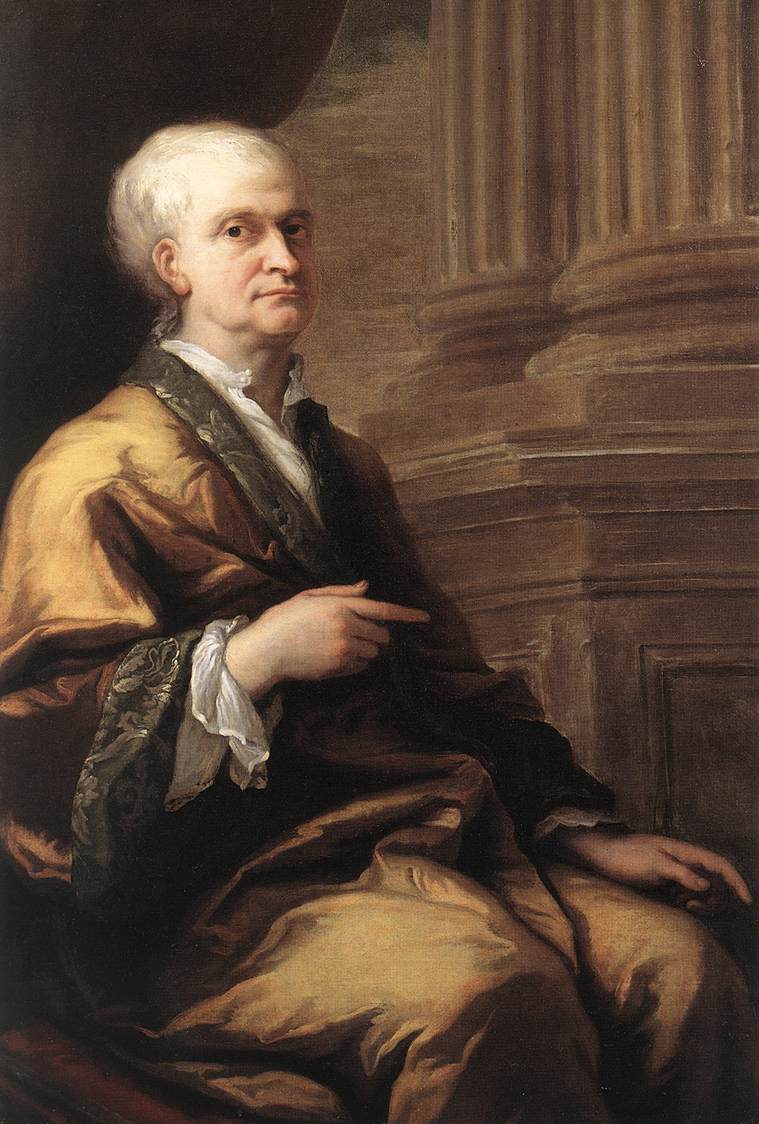
Isaac Newton in a Banyan (c1709, PD) James Newton Thornhill

As this style progressed, buttons became a must and frogging was also a key feature of 18th century first quarter British Banyans to prevent the garment trailing along the floor, a workaround for the lack of Obi it seems. By the 1730s, in London alone there were five general tailor stores or Warehouses which specialised in selling ready-to-wear Banyans made using European and Chinese silks. Other Banyans also had attached waistcoat inserts sewn into Banyans to give the illusion of a waistcoat as well for recieving visitors in the Banyan.[2] 

Thomas Weston (1723, PD) M Dahl
A Rake's Progress (1735, PD) William Hogarth
Figure third from right here wears a Banyan style

Banyan should be regarded as European garment made for European usage, but are distinctly part of European KTC in the sense that they were made, worn and used by Westerners. Banyan were regarded as a sort of unisex loungewear for the well to do about the house, which often co-orded with the furniture.[2] By the 1730's, they were given an intellectual veneer as men of letters often wore them to have their portraits painted in their well endowed libraries. Gentlemen would recieve visitors in them, and as is seen in the Rakes Progress, became the equivalent of a woman in rollers and sweats going to the shop for milk at 11:00PM. Add a fitted collar, and the Rake could be deemed as almost acceptably dressed to go out in public.[2] 

Robe a la Anglaise (English nightgown) Dress (c1785, PD) LACMA

Banyan were also adopted as a form of nightwear by women to worn before dressing in daywear by this time adopting a ribbon or buttons to fasten them.[1] Womens Banyan otherwise were the same shape, a sort of cloak. Womens Banyan often had pleated and broader backs than Mens, and are certainly far scarcer in todays collections. By 1740, the Banyan peaked in popularity and the grammar nazi Samuel Johnson himself noted it in 1755 as a 'Bannian'. Extant examples of the 1760s show the development of a 'Banyan pleat', which consists of 3 inverted box pleats along the spine and sides of the garment to reign in the fabric. These were also made into dresses and were the forerunner of the Robe d'Anglaise fashion which took the pleats from the waist rather than in a backless gown. The 1790 Close bodied (Anglaise) style also revealed the front petticoats, much like the overturned Banyan hems of menswear a century before.

Coromandel Banyan (c1750, PD) Sharon Sadako Takeda

Other countries also assisted in the production and thererby acculturation of these garments, principally China and India.[2] The above garment was a Coromandel (India) Banyan made for the gentleman at home and were popular until the late 18th century when the vogue became more fitted garments once more. This may be due to the popularity of the Banyan as loungewear expanding to wider portions of the Continentals who wanted the look, but didnt want the excess fabric. No, excess fabric ist zur exotisch fur die Kontinentals. Non, they wanted smoking jackets. In this stead, Indian tailoring techniques were also adopted into Banyans and became more fitted and adopted high necklines and tighter sleeves from similar Mughal court dress.

British fitted Banyan (c1780, PD) Andrew Bolton

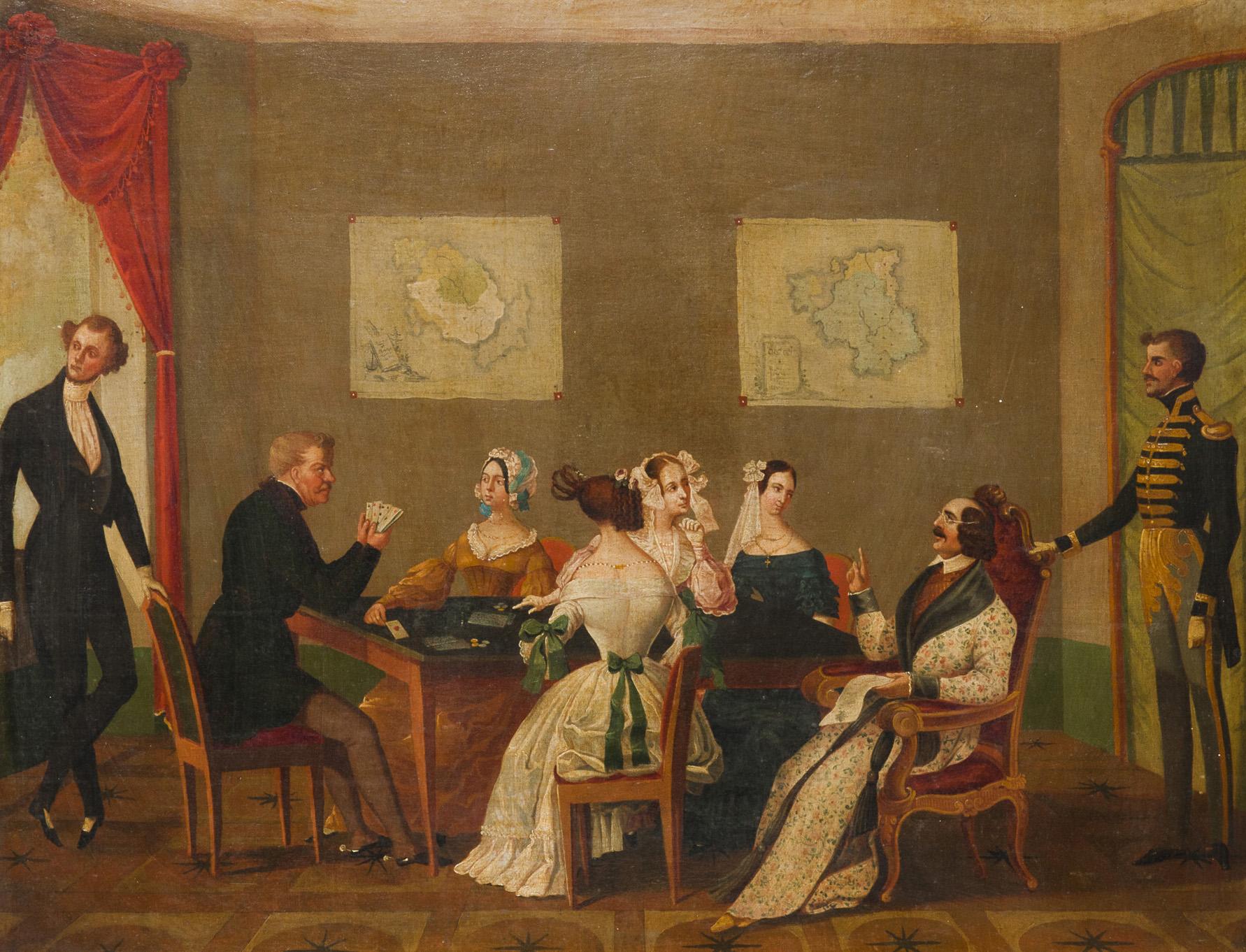
A merry party (c1850, PD) Dorotheum

Instead by around 1780, the Banyan silhouette became more slimmed down and the back of the garment was still incredibly loose, acting as more of a coat than a robe, though retaining the social function as home loungewear. Due to the power of the Ottoman Empire though, new styles began to come into vogue.  Based on Middle Eastern styles, the smoking jacket became more popular by the 1840s. Banyan were still worn however until 1860 as a robe albeit without the excess trailing fabric in the sleeves or length of the 17th century edition. Rather than radical luxury, the Banyan or dressing gown was now the form we use today.

Conclusion

In context the overall picture we can gather of the Banyan is that as a European component of KTC, the Banyan was actively influenced by Kosode design and tailoring from 1665-1720 as an accompaniment to English fashions. 1720-1780 saw this continue with an emphasis on comfort which in France was the Robe Volante style. 1780-1860 saw the inclination towards East and Central Asians styles dominated the designs of Banyans, particularly those in Silks and Brocades.[2] After 1835 in particular, we clearly see the Banyan vogue fading in favour of the smoking jacket style in menswear, and with a similar pleated consensus in womenswear albeit by 1760, evolving into the Close bodied gown style by 1780.

Banyans began as a European alternative to the ludicrously rare Kosode of the mid 17th century and became known by 1700 as the grandfather of the modern dressing gown. Banyan acted as signifiers of taste, wealth and fashionable attire in England and the Dutch Republic at the height of their popularity, amid a time where the landed gentry sought and bought for the Japanese effect, rather than from primary sources such as Japanese artists, unless we are discussing the items were brought by the VOC at the time. The influence thus of Japanese KTC on  European textiles was in allowing greater freedom of movement, comfort and in providing an early form of androgynous or unisex tailoring in Western European tailoring and silhouettes, altering Western aesthetical conceptions of how the body interacted with cloth and space in acceptably modest forms.[2][4]

Additional Examples:

 - https://collections.vam.ac.uk/item/O1244844/night-gown-unknown/ (1720-1750 Banyan)

Bibliography

[1] https://en.wikipedia.org/wiki/Banyan_(clothing)

[2] http://www.fashioningtheearlymodern.ac.uk/wp-content/uploads/2012/02/Banyans-21.pdf | Object in focus: Man’s banyan, Moira Thunder, 2012, Victoria and Albert Musuem for the Europeana Project

[3] https://vogue.sg/history-of-the-three-piece-suit/

[4] https://fashionhistory.fitnyc.edu/robe-a-langlaise/ 

*I use 'Wafuku' instead of Kimono, as always, becuase the term 'Kimono' originated among Japanese people in reaction to the need for a word to distinguish Wafuku and Yofuku becuase foreigners asked for one; without which otherwise there would be difference prior to the 1860s, the Kimono as a social construct only entering global culture after 1918. 

**I presume the object is under the public domain down to age, the file itself is purely used to illustrate on educational content of contemporary fashions and is used here specifically in a non-commercial function. I do not intend to represent the views of the V&A, nor claim any affiliation, nor speak nor write on their behalf but am operating under the fair use clause of the 1988 UK copyright legislation, intentionally in an educational, non-commercial function under good faith. Having read the T&C's, I cannot find a specific license for these images, and thus presume the file is copyrighted and do not condone any third party actions usage of this file. All copyright again belongs to the Museum, not myself and if you wish to use the file, please see the Musuems T&C for use.

Socials:

https://www.pinterest.co.uk/LuckyMangaka/timono/

Sunday, February 20, 2022

壊月堂安度 | Kaigetsudo Ando | 1671–1743 | Bijin #12

Some news, I will only from March onwards be doing this blog fortnightly, as I have put other projects on hold, and they are in dire need of my jump starting them, but I will continue so may there be no doubt in that. In some effort to seperate the Ando school, Im doing this one this month. 

Kaigetsudo Ando (active 1700-1736) was the founder of  the Kaigetsudō school of Ukiyo-e, which included the Bijin-ga genre. He was known for only making paintings, and never woodblock prints though, earmarking him as something of an 'artiste' than simply and artist. One of his great influences was the iconic Hishikawa Moronobu (lauder of the Wakashu Bijin) and Yoshida Hanbei (promoter of the Toned-down Bijin). Ando was particular in following the Suijin-Komin-Chonin lifestyle, and is not out of the ordinary for his time in pursuing making an artform out of what was essentially Gravure ( Glamour photography shots | Gurabia | グラビア). After 1714, Ando left Edo due to scandal but continued to work, perhaps teaching his school to his pupils.[1][2]

The said scandal is rather delicious, the Ejima-Ikushima affair is a detailed love-betrayal story about power. Essentially, Ejima was a member of the Tokugawas harem, the Ooku, and one of her rivals for the shoguns affections was the official shogun wife, Tenei-In. Ejima, who was out after her curfew, had been seeing her lover the Kabuki Actor Ikushima, and was late back. When Ooku who was in the middle of getting her factions heir in the shogunal seat of power caught wind, she reported it and the whole affair eventually won Tenei-In the battle of the harem-women. Ejima was sanctioned, with her borther committing Harry-Karrie.[4] It seems Ando was in some way involved with Ikushima.[1]

Beauty looking Back (1711, PD) Kaigetsudo Ando

A man of Yoshiwara

Ando was active in Asakusa in the early 18th century, not too far away from the legendary Yoshiwara. It is said that he was dominant in the production and promotion of using Yuujo, male and female, in creating Bijin-ga.[1]

It is notable to explore why Yoshiwara was used as a place to scout Ukiyo-E Models at this time. Historically, women on tap was a rich mans game, particularly in Japan, so only the military elites would have held a menagerie of bodily delights. However, this all changed when the Sankin Kotai was enacted and from 1635 on, saw the rise of the new Chonin class. This changed once again by 1685 in reaction from the Bakufu by their growing rich people disgust of the merchant classes spending said money.[2][5] This came in the form of the sumptuary laws, and saw the rise of more covert expenditure, and eventually this meant the start of hierarchical fashion laws (and their cultural reaction of 'Iki') and the confinement of Yuujo to the pleasure districts in a bid to curb the outragerous spending habits of Osaka merchants and Edo Chonin in the creation of GKTC (1688-1704).[2][5][6]

So by the 1710s, when Ando was creating his Kabuki-esque Bijin-ga, he was painting in reaction to the legal limitations imposed since the 1680s on Japanese society, depicting the underground spending which of course still went on but was done more discretely then. This was a world now focused on legal brothels, Wakashu-Kabuki and Shunga. Yoshiwara was simply a sort of Edo cultural hub where all these licentious and titillating fashions, functions and classes converged to do their business. 

Yoshiwara served Asobi and Suijin alike, but most popular certainly was the Wakashu and Kagema, or young male sex worker. This was also the case in Kabuki, all of which had their origins in carnal pleasures and their associated bodily gestures in theatre, but had been stripped back by Laws which saw these things such as women dancing erotically and free sex as rather poor-people-icky. Wakashu certainly with their sexy forelocks.[7]

Andos Bijin

It is thought that Ando was trained in the style of Ema ( wish plaques | 絵馬 ). This is thought to be shown in how he utilises space in composition, an aesthetic known today as Ma.[1] He undoubtedly in my opinion was a man who followed the trend of imitating the 'Kabuki' style or Torii school of Japanese Kabuki posterboard design of the late 17th century.

These designs which are particularly interesting to the fashion historian, detail the most up-to-date fashions which were worn by the lovely people down at Yoshiwara.[1] It was in fact some of these plates which Asobi and Suijin would look to as influence and inspiration from besides the Hinagata Bon (Sample Books) of tailors and Komin like Moronobu and Hanbeis dress manuals.[2][3]

Ando Bijin (c1700-1720, PD) Kaigetsudo Ando

Ando's Bijin-ga draws the time honoured classic of 'this isnt porn, its ART', which Matabei and Moronobu would have rejected completely. Instead, Ando draws upon the idea that Bijin-ga comes from the fine world of Fuzokuga and Buddhist Yamato-E, which eventually became adapted into the Kanbun Bijin (of 'dancers', basically Kabuki actors) by 1666, and which was developed by the Komin in the 1680s into the Kabuki Bijin-ga genre.

This 'respectable' genre was by Andos time heavily intertwined with the Torii school, which defined the style of Kabuki signboards as being those broad brushstrokes still popular today as part of Japanese calligraphy you can often see. This influence is clear in Andos broad stroke lines which dip and rivet in a free flowing manner. The posture of the figure is also reminiscient of the Qiyun quality which Matabei may have approved of in its lifelike mannerisms in the body language.

Features such as Hidden napes and hands saw that Napedness had gone out of the window. Instead 'traditional values' were in vogue, with Andos faces particularly reminiscient of the Yamato-E style of the Emakimono ( Scroll painting object | 絵巻物) in the Onna-E ( women pictures | 女絵 ) style. This style is defined in the lack of recognisable facial characteristics, instead expecting its viewer to focus on the body and subsqeuent attachements rather than the face to evoke a mood and to tell the story Ando would have trying to tell here.[8]

This can be seen in the evocative and interesting way Kimono is used here to tell a story, through the expensive dyes and paints used, the saucy hints of Benibana and subdued floral motifs. The image at face value is meant to leave under a traditional reading the impression of a women who looks over their shoulder, away from the viewer in the typically Buddhist portrayal of figures as being otherworldly saintlike figures who deem mortals as unfit of their gaze. A fascinating two-dimensional flatness particular to the lack of understanding of spacial composition which was to come with Rangaku later that century.

The person themselves here is using the now classic S-silhouette, and displays what may be earmarked as 'traditional' dress here in the styling and omittance of certain details and reliance of a knowledge of fine Japanese arts to complete the picture in the mind of a respectable Bakufu official. However we can see how Ando has cornered the market on his salacious Bijin-ga balancing act. Ando has revealed instead the foot, single hand and hair strands of his model; a Courtesan. She is revealed in her station by these facts, as as a lady of the night, she would have no need for shoes as she would be confined to the pleasure district she laboured in, but would also require befittingly attractive and rich Kimono in order to be able to work successfully.

The Broadstroke Bijin

Contexutally therefore we can see how Ando mixes traditional, or rather appropriately conservative values upon his images, but also successfully comes to allow small glimpses which was the backbone of the Iki Bijin. His models would showcase the latest fashionable Kimono, whilst keeping a series of checks and balances within the established cannon of acceptable art sources under the beauty standards and official judgements of his day. We can also see how in the development of the portrayal of Bijin-ga, Kabuki and sex work continues to influence the Ukiyo-ga world, when we see how the Torii broad stroke style has been transferred by Ando into a purely aesthetical image, fit for public consumption under the sumptuary and regulatory laws of Andos day. Andos images reflect the social morae of the era, a sort of belle epoque for his Kabuki inspired beauties, most of whom dabbled in sex work and yet simultaneously whom had to play the Iki modesty game.

Bibliography

[1] https://en.wikipedia.org/wiki/Kaigetsud%C5%8D_Ando

[2] See the Bijin Timeline

[3] See The Artisans and Hishikawa Moronobu in Essay #8

[4] https://en.wikipedia.org/wiki/Ejima-Ikushima_affair

[5] See Bijin #3

[6] https://www.metmuseum.org/toah/hd/plea/hd_plea.htm

[7]  Youtube (2021), 'Life of a Wakashu, Japan’s Third Gender (Male-Male Romance in Edo Japan)', Linfamy, Available at https://www.youtube.com/watch?v=bzG4UOaGy7M 

[8] https://en.wikipedia.org/wiki/Emakimono#Court_style:_onna-e

Bijin Series Timeline

11th century BCE

- The Ruqun becomes a formal garment in China (1000 BCE) [Coming Soon]

8th century BCE

- Chinese clothing becomes highly hierarchical (771 BCE) [Coming Soon]

0000 Current Era

7th century

Asuka Bijin (from 600) [Coming Soon]

8th century

- Introduction of Chinese Tang Dynasty clothing (710)

- Sumizuri-e (710)

- Classical Chinese Art ; Zhou Fang (active 766-805) ; Qiyun Bijin

- Emakimono Golden Age (799-1400)

15th century 

- Fuzokuga Painting schools; Kano (1450-1868) and Tosa (1330-1690) 

- Machi- Eshi painters; 1336-1650? [Coming Soon] 

16 century 

- Nanbanjin Art (1550-1630) 

- Wamono style begins under Chanoyu teachings (c1550-1580)

- Byobu Screens (1580-1670)

 - End of Sengoku Jidai brings Stabilisation policy (1590-1615)  

17th century  

- Land to Currency based Economy Shift (1601-1655)

- Early Kabuki Culture (1603-1673) ; Yakusha-e or Actor Prints

- Sumptuary legislation in reaction to the wealth of the merchant classes (1604-1685) 

- Regulation of export and imports of foreign trade in silk and cotton (1615-1685)  

Iwasa Matabei (active 1617-1650) ; Yamato-e Bijin  

The Hikone Screen (c.1624-1644) [Coming Soon]

- Sankin-Kotai (1635-1642) creates mass Urbanisation  

- Popular culture and print media production moves from Kyoto to Edo (1635-1650); Kiyohara Yukinobu (1650-1682) ; Manji Classical Beauty

- Shikomi-e (1650-1670) and Kakemono-e which promote Androgynous Beauties;

 Iwasa Katsushige (active 1650-1673) ; Kojin Bijin

- Mass Urbanisation instigates the rise of Chonin Cottage Industry Printing (1660-1690) ; rise of the Kabunakama Guilds and decline of the Samurai

- Kanazoshi Books (1660-1700); Koshokubon Genre (1659?-1661)

- Shunga (1660-1722); Abuna-e

Kanbun Master/School (active during 1661-1673) ; Maiko Bijin 

- Hinagata Bon (1666 - 1850) 

- Ukiyo Monogatari is published by Asai Ryoi (1666) 

Yoshida Hanbei (active 1664-1689) ; Toned-Down Bijin

- Asobi/Suijin Dress Manuals (1660-1700)

- Ukiyo-e Art (1670-1900)

Hishikawa Moronobu (active 1672-1694) ; Wakashu Bijin

- Early Bijin-ga begin to appear as Kakemono (c.1672)  

- The transit point from Kosode to modern Kimono (1680); Furisode, Wider Obi 

- The Genroku Osaka Bijin (1680 - 1700) ; Yuezen Hiinakata

Sugimura Jihei (active 1681-1703) ; Technicolour Bijin 

- The Amorous Tales are published by Ihara Saikaku (1682-1687)

Hishikawa Morofusa (active 1684-1704) [Coming Soon]

- The Beginning of the Genroku Era (1688-1704)

- The rise of the Komin and Yuujo as mainstream popular culture (1688-1880) 

- The consolidation of the Bijinga genre as mainstream pop culture 

- The rise of the Torii school (1688-1799) 

- Tan-E (1688-1710)   

Miyazaki Yuzen (active 1688-1736) ; Genroku Komin and Wamono Bijin 

Torii Kiyonobu (active 1688 - 1729) : Commercial Bijin

Furuyama Moromasa (active 1695-1748)

18th century

Nishikawa Sukenobu (active 1700-1750) [Coming Soon]

Kaigetsudo Ando (active 1700-1736) ; Broadstroke Bijin

Okumura Masanobu (active 1701-1764)

Kaigetsudo Doshin (active 1704-1716) [Coming Soon]

Baioken Eishun (active 1710-1755) [Coming Soon]

Kaigetsudo Anchi (active 1714-1716) [Coming Soon]

1717 Kyoho Reforms

Miyagawa Choshun (active 1718-1753) [Coming Soon]

Miyagawa Issho (active 1718-1780) [Coming Soon]

Nishimura Shigenaga (active 1719-1756) [Coming Soon]

Matsuno Chikanobu (active 1720-1729) [Coming Soon]

- Beni-E (1720-1743)

Torii Kiyonobu II (active 1725-1760) [Coming Soon]

- Uki-E (1735-1760)

Kawamata Tsuneyuki (active 1736-1744) [Coming Soon]

Miyagawa Shunsui (active from 1740-1769) [Coming Soon]

Benizuri-E (1744-1760)

Ishikawa Toyonobu (active 1745-1785) [Coming Soon]

Tsukioka Settei (active 1753-1787) [Coming Soon]

Torii Kiyonaga (active 1756-1787) [Coming Soon]

Shunsho Katsukawa (active 1760-1793) [Coming Soon]

Utagawa Toyoharu (active 1763-1814) [Coming Soon]

Suzuki Harunobu (active 1764-1770) [Coming Soon]

- Nishiki-E (1765-1850)

Torii Kiyonaga (active 1765-1815) [Coming Soon]

Kitao Shigemasa (active 1765-1820) [Coming Soon]

Maruyama Okyo (active 1766-1795) [Coming Soon]

Kitagawa Utamaro (active 1770-1806) [Coming Soon]

Kubo Shunman (active 1774-1820) [Coming Soon]

Tsutaya Juzaburo (active 1774-1797) [Coming Soon]

Utagawa Kunimasa (active from 1780-1810) [Coming Soon]

Tanehiko Takitei (active 1783-1842) [Coming Soon]

Katsukawa Shuncho (active 1783-1795) [Coming Soon]

Choubunsai Eishi (active 1784-1829) [Coming Soon]

Eishosai Choki (active 1786-1808) [Coming Soon]

Rekisentei Eiri (active 1789-1801) [Coming Soon] [https://commons.wikimedia.org/wiki/Category:Ukiyo-e_paintings#/media/File:Rekisentei_Eiri_-_'800),_Beauty_in_a_White_Kimono',_c._1800.jpg]

Chokosai Eisho (active 1792-1799) [Coming Soon]

Kunimaru Utagawa (active 1794-1829) [Coming Soon]

Utagawa Toyokuni II (active 1794 - 1835) [Coming Soon]

Ryūryūkyo Shinsai (active 1799-1823) [Coming Soon]

19th century

Teisai Hokuba (active 1800-1844) [Coming Soon]

Totoya Hokkei (active 1800-1850) [Coming Soon]

Utagawa Kunisada Toyokuni III (active 1800-1865) [Coming Soon]

Urakusai Nagahide (active from 1804) [Coming Soon]

Kitagawa Tsukimaro (active 1804 - 1836)

Kikukawa Eizan (active 1806-1867) [Coming Soon]

Keisai Eisen (active 1808-1848) [Coming Soon]

Utagawa Kuniyoshi (active 1810-1861) [Coming Soon]

Utagawa Hiroshige (active 1811-1858) [Coming Soon]

Yanagawa Shigenobu (active 1818-1832) [Coming Soon]

Utagawa Kunisada II (active 1844-1880) [Coming Soon]

Toyohara Kunichika (active 1847-1900) [Coming Soon]

Tsukioka Yoshitoshi (active 1850-1892) [Coming Soon]

Toyohara Chikanobu (active 1875-1912) [Coming Soon]

Kiyokata Kaburaki (active 1891-1972) [Coming Soon]

Goyo Hashiguchi (active 1899-1921) [Coming Soon]

20th century

Yumeji Takehisa (active 1905-1934) [Coming Soon]

Torii Kotondo (active 1915-1976) [Coming Soon]

Yamakawa Shūhō (active 1927-1944) [Coming Soon]

Social Links

One stop Link shop: https://linktr.ee/Kaguyaschest

https://www.etsy.com/uk/shop/KaguyasChest?ref=seller-platform-mcnav or https://www.instagram.com/kaguyaschest/ or https://www.youtube.com/channel/UC5APstTPbC9IExwar3ViTZw https://www.pinterest.co.uk/LuckyMangaka/hrh-kit-of-the-suke/ 

I had exciting topics

 and then I got sick. and then I got heatstroke. and then my home became 35 degrees. and then i was sick again. and then i got mild food poi...