Her Haughtynesses Decree

Showing posts with label 21stcentury. Show all posts

Monday, July 27, 2026

I had exciting topics

 and then I got sick. and then I got heatstroke. and then my home became 35 degrees. and then i was sick again. and then i got mild food poisoning. and then i broke my stuff. and then it was 35 degrees again. and then i got worried about how much shite was piling up on my calendar. and then it was 34 degrees. So life got in the way as usual.

I have been reading and living life. I actually repaired a bunch of shite and removed some mold from my stuff which was covered in mold becuase of the shite paint used on my building           |                  /

                                                                                                       Me last week :      >:D =======

But life has not been happy with me sitting down and doing anything.                           |                   \

Particularly not anything requiring my body moving more than 2cm off the nearest flat surface, cold thing or particularly cold water based thing nearby.

I hate global warming and now my keyboard is also fucked. I cant play tetris on it anymore. Many things suck. Boo carbon emissions.

Sunday, June 14, 2026

Ai Yamaguchi | Artyfarty

 Ai Yamaguchi is a contemoporary Japanese painter who lives and works in Tokyo.

She graduated from the Women's College for Fine Arts studying arts and crafts, specialising in weaving in 1995.

She began exhibiting in 2000 and continues to do so.

Sunday, September 17, 2023

ヘルマンの'着物' | Herman's 'Kimono' | 2021 | Essay 21

In this essay I look at another Kimonope, specifically another Miss Universe 'national costume' entry.[1] This particular Kimonope represents the legacy of Macarthism's neo-colonial/systemic racism, and subjugation of Japanese soft-power, a follow on of Orientalist late 19th/early 20th century assumptions and stereotypes of Asian culture and peoples which saw their subjugation in American foreign and domestic policy between 1885-1952.[3][4][5][6] In this entry, we see a clear leaning into the 'Cool Japan' aesthetic by the Kimonope's designer, who is not shockingly not Japanese, but Israeli and therefore represents ideas about what Kimono are to this designer than the genuine article would to other participants of KTC, foreigner or otherwise towards 'Kimono'.[1][5]

An example of what should have been (2018, CC4.0) Nesnad

The Individuals Responsible

The great designer himself was the notable Aviad Arik Herman (b.1984), an Israeli costume and fashion designer who seems to work exclusively in pageant costumes.[1] An Israeli designer was chosen to represent the symbolic weight of the 70 year celebration of diplomatic relations between Japan and Israel.[1] Herman was supposedly inspired by 'Harajuku fashion culture' which sounds more something my highschool textiles design teacher came out with than a high level designer on a global stage, but here we are.[1]

Ms Juri Watanabe (b.1995) is arguably American-Asian having grown up in a diverse family, home and school environment, going into the pageant world in 2016.[1][2] 

The Event

The 2021 Miss Universe pageant occurred in Israel at Eilat and the Kimonope worn by the Japanese-Korean representative, Juri Watanabe for the 'National Costume' section.[1] Kimono Wednesdays could never. Yes Im still salty.

I will point you to my previous thoughts on Kimono as 'national costumes':

Kimono after the 1950s fell away from its mores from 1900-1940 of being an exotic, expensive textile, to being a garment worn by a defeated nation when Japan became occupied by the USA from 1946-1952. During this time, elements of society which pushed Longingism, which gained traction from 1885-1920s America with the rise of Asian labour movements and immigration into the USA, created the Kimonope, which associated the Kimono as an 'Oriental' garment.[3]

[For me,] Kimono is a type of clothing which can be worn by anyone, an idea which the broadcaster NHK clearly thought so as well. Japanese Americans, whilst rightfully having the historical claim to the Kimono [...], perhaps did not foresee the global issues that claiming the Kimono as a 'Traditional Garment' may bring [...]. This [Traditional Garment/National Costume] Argument being unfortunately a spearhead of the 'culture wars' inspired by Wilsonianism which declares that non-White powers may not be considered or constituted in the worlds of academic, politics and popular culture [... in] being considered global popular culture. Instead that [...] that 'developing' countries instead be left to 'develop' away from the wealth of the United States, [...] a sort of FU to the fact that Japan had entered the world stage as a great power, and thus denial of all things Japanese as bad. [Instead the benevolent USA must prevent Communism and return ...] everything [...] back to its natural [Wilsonian] order [...]. Kimono as a visible [Asian/Japanese] cultural marker, were by this point definitively recognised by the Japonisme movement at the very least, as global popular culture [in the early 20th century], and thus the birth of the Traditional Argument (ie that Kimono is simply just a Japanese garment only to prevent pan-Asian interests taking root) and breaking down of US-Japanese relations began (seFred Korematsu v United States, 1944-2018). [...This argument is] the very trap Wilsonianism lays for 'developing' nations. It isolates the object in question (here Kimono), rips it asunder from its history, values and context, and flings it to the sorting bins of history where nobody will find it. Kimono Wednesday protests meant well, but in the end, they have sent the wrong messages to the wrong people, and helped to isolate, relegate and simplify Kimono into a relic of the Yamato. That is to say deny how the Kimono played a role in and from Asian Empires, to ignore the Kimono as a global presence in Western and other Art Histories, and to penultimately again, isolate, relegate and simplify the Kimono into an exotic national costume, worn by the Japanese. A label I do not wish to ever have to repeat here or anywhere else [unless quoting]. By this, I mean [Asian-Americans like Ms.Watanabe] have done Wilsons work for him in promoting the idea of the Kimono as an exotic 'ethnic garment' only to be worn by Japanese people and their descendants, and which denies the wider history of Kimono as a cultural touchstone [instead promoting oriental-adjacent Kimonopes ...] essentially saying that Japanese fashion is less important than American fashion, by relegating Kimono to being a product only worn in the past [...] isolating Kimono as something exotic or 'Japanese' (a fraught argument supporting homogeneity and ethnocentrism) and simplifying the complex worlds which KTC operates in as somehow unworthy of note to anyone who isnt Japanese. As such, I refute that Kimono making is a dying industry on the grounds that is a blatant lie, it is in fact adapting to the age it is in, as it has always done as a social construct, and that to think that one thing can belong to only one group as rather part of the 20th century Wilsonian anti-Asian dogma. [...] Until [considering] how ['Kimono'] was created under Chinese and Korean influence during the Asuka and Kofun periods, and as part of globalisation, not simply as 'a national costume appropriated by Westerners', but rather as with the rest of KTC, and other garments, simply a social construct [as with Western garments, e.g. T-shirts]. This is seen in the paintings, Mandalas, Embroideries and texts extant from the period when corrobarated with wider Mainland Asia garment history. I relate this to Kimono [Wednesdays] because it may allow for a wider dialogue on cultural exchange in the hope not everything 'foreign' is labelled exotic, turned into a problem, lost to history or simplified as just being a 'costume' or 'cultural appropriation' [as if graphic T-shirts for example can only be worn by certain groups of Americans as it is a traditional garment or iconic national American costume].[4]

National Costumes, [...] in English [describe ...] the historically European tradition of giving 'National Costumes' to certain groups [begun] in the 18th century [...] to define what a country was and took off in the 19th in the advent of European Colonization [of] pseudo-classif[ications in ...]  series of illustrated books drawn by many European and later American and Asian artists depicting the 'National Dresses' of certain groups [in ...] 'rational' 'native' outfits which continues as National Costume Colouring books today. [...] an example being the controversial Han-fu for China, [... rather than the Qipao]. Nationality like money and gender, is a social construct; one that at times gatekeeps other ethnic identities from exerting any kind of power and suppresses more diverse national stories. In Britain for example, there is no such definitive thing as a Kimono to call a National Costume. Instead we are often represented by tacky costumes only fit for Halloween which riff on the idea of what it means to be 'British', which axiomatically is a million and one things. [... Consecutively, as a] Beefeater (Yeomans Warder) [since] 1962. [...] Other editions [include ...] the latest by Jeaneatte Akua in a bid to the Pearley Kings and Queens of working class London culture. [...] 'National Costumes' [have] carved out a space for themselves, as a need to make space in a dominant cultural identity which threatened to wipe their own out[, e.g. Tartan ...] I in particular do not refer to Kimono as a National Costume or Dress, as it a patriarchal paternalistic notion of hegemonic cultural/White supremacy that Kimono are distinctly outdated womens attire, only fit for the 'lesser race' (in the words of Leonce Benedite) [or the Dying Kimono trope of...] Macarthism. [... which pushes] the idea that traditional Japanese culture is inferior to the superior Western culture. [...] Akiko Kojima [..., another older Miss Universe, wore] Kimono as everyday or at least casual wear, not as a traditional 'Oriental costume'. [... In Kojima's time,] generally civilian Japanese had not got the message yet about Americas superiority complex. [Changing by ...] the 1960s when Japan, as [in 1860 'Westernized' ...] to reclaim its own [... soft power agency]. This internalized Macarthism is reflected in the way Ms. Akiko was represented in American society [... by] Harpers Bazaar, a magazine that refused previously to run models of 'color' in its pages [and was strikingly] presented in Western dress, not Kimono [... telling] us of the fact that Kimono was not considered fashionable enough to be considered as fashion in its own right, instead Akiko wore *acceptable* white brands such as Sarff-Zumpano Inc. [... at a time when Honshu Japanese dealt] with the caveat of internalized inferiority dealt with the idea that 'Japan lost the [Pacific] war'. This attitude in Japan commonly refers to the postwar generation of Japanese Teeners [...] who felt the burden of growing up in the shadow of Macarthism, in a world which saw the subjugation of Japanese culture as 'feudal', saw Japanese people as 'savages' for fighting on the wrong side of WWII and the unlawful incarceration of Nissei Americans (1942-1947). When 'Sukiyaki' was released to Western audiences it gave notions of Beef dinner, to a Japanese Teener, Ue o Muite Arukō (I look up as I walk) was reminiscient of the frustration of dealing with American occupation in the Anpo protests (1959-1970) and the Sunagawa Struggle (1955-1956). Its culmination being the murder of Chinese-American Vincent Chin in 1982 at the hands of Statesian men who thought he was Japanese. [Ergo ...] casual wear of the Kimono becomes a thing of your mothers generation by 1975, and your grandmothers by 1995. [...] When the next winner of Miss Universe wore Kimono, it was as a 'National Costume' in 2007 by Riyo Mori who wore an altered Kimono. Ever since[then] it has been commonly accepted that Japanese pageant goers wear Kimono to the National Costume section of the event. [... Also] 'Cool Japan', a sort of right wing Japanese politicians wet dream of global Japanese hegemony [...] has attempted to adopt the Kimono as a National Costume as well which is a strand of Japanese paternalism [...] about the 'correct way' to wear Kimono [...] mixed with a dash of inferiority complex, [...] is certainly a proponent of the issue of bringing KTC into the global world as global fashion under Macarthism's influence. [Which ...] fosters a disturbingly ethnocentric idea of Kimono, which is also another thorn in the side of KTC. [... Moves towards] national costumes like the Seifuku is particularly reassuring as it is the Death of the 'Dying Kimono' trope, in saying that Kimono is current and alive, and that culturally Japan has more to its 'national' culture than just reasserting 'Wafuku'. Wamono in this sense has shifted to a more inclusive contemporary understanding of the national, away from the stereotypical Longingism of 'coolies' and 'Geisha-girls'. [Overall, ...] many national costumes depends on how we define national culture. Kimono and other 'traditional' garments are often seen as 'national dress' due to the decline of their wear after the introduction of Western power structures, colonization and efforts to 'modernize' under globalisation. After 1955, this evolves from Macarthistic policy, which becomes internalized in Japanese culture by 1970 becoming the 'Dying Kimono' trope, which precipitates that old 'feudal' Japanese culture has been shed off becoming 'modern' Japan. After 1990 though, KTC was revived domestically and has since re-emerged as casual clothing once more both in Japan and globally with the rise of the digital age. [However ...] when we explore how we get to the notion of certain modes of dress being 'Costumes' we can see how this can be a negative reinforcement of existing power structures through lenses such as Macarthism. The Kimonopes which exist in these spaces are often attempts at cultural appreciation, but more often are regarded as objects of cultural appropriation by many. Thankfully, we can also see post 2005, a resurgence in the pageant and fashion worlds of KTC as influential global fashion (for example the 2016 Furisode for Miss Mexico at Miss Latina USA designed by Sueko Oshimoto). This sees the Kimono as a modern incarnation of fashion, part of its revival in the contemporary world we live in and allows Kimono to be seen as desirable in the current beauty standards we ourselves hold, unravelling the work of hwight supremacists. Thus seeing the reemergence of KTC as living, contemporary fashion, as seen in high fashion, beauty pageants and street fashion.[5]
Girl in Harajuku on her phone (2008, CC2.0) Charlotte Marillet

The Result

Watanabe's Highlight Reel (2021, Educational) Youtube

Ms Watanabe finished in 16th place.[2] Thus she did dig her own grave, so perhaps it was quite a spot on Kimonope of a cocktail dress.

As you can see, this resulted in the ... creation before us. This pink-yellow mockery of a cultural besmirching wad of gum underfoot was paraded around by Watanabe in all its stereotypical glory. May we observe the maneki-neko, very Harajuku of course. Or fact this particular design has the Eri folded over incorrectly, such that its wearer may be read as going to her funeral. Muy Harajuku. Perhaps it may be the giant letter scrawled across her bare chest, another set of cultural faux pas in revealing the cleavage or potentially imitating tattoos, a cultural trait seen as inherently negative in its connotations Japan. Sehr Harajuku. We may also observe the perhaps stuck on Chrysanthemum belt or the flags attached to the sleeves. Very, very Harajuku fashion culture.[1] The boots were great though, the 'cocktail dress'[5] not so much. 

Conclusion

In context we can see how two POC people did not quite equal cultural appreciation, but rather an example of cultural appropriation in the promulgation of Kimonope. Rather unnecessarily as well, as members of the definitely not weirdly assimilating free thinking POC block of free-thinkers. Indeed they fell prey to Orientalist, internalized racist tropes which since the 1880s has dictated the terms Kimono's are received to international audiences, that is as objects consumed by white people, for white people. Ignoring the vibrant role of KTC in global history, popular culture and Japanese soft power on the international stage with the advent of Macarthism in the 1940s and the decline of Japanese hard-power during the occupation of Japan by SCAP forces.[3][4][5] This reinforcement of Longingism and Macarthism follows a tradition of seeing Asian-American and Asian workers as 'coolies' and 'Johnny Chinamen' whose labour and culture (the Kimono) was subservient and disposable to that of white North Americans, as seen during the time of Wilsonian and Roosevelt's policy-making, both foreign and domestic.[3][6] 

This inadvertant support of ethnocentrism neo-colonialism makes as much sense as gatekeeping African children from wearing graphic T-shirts Statesian dump on them; (as they are 'products of American culture'/'traditional American dress' and is to only be worn by the 'Statesian race'/that the Pedi Tribe cannot wear Tartan) thrown in the face of Asian-American grandparents who fought to normalize Kimono and other adjacent garments like Qipao, Sari and Việt phục as normal attire against the backdrop of 20th century race relations in neo-colonial systemic structures, which turn the Kimono into an Orientalist costume rather than as contemporary fashion, particularly evident in how people living in Japan reacted to this Kimonope.[1] Kaguyas Verdict: Clear-cut Cultural Appropriation.

Bibliography

[1] https://japantoday.com/category/national/miss-universe-2021-japan-entry-slammed-for-wearing-%27dead-person%E2%80%99s-kimono%27-1

[2] https://conandaily.com/2023/06/01/juri-watanabe-biography-13-things-about-miss-universe-japan-2021/

[3] See Essay #4

[4] See Essay #11

[5] See Essay #16

[6] See Essay #19

Essay Abstracts 

#1 Renee Vivien (1877 - 1909) --- Born Pauline Tarn, was an English lesbian poet. She wrote in French and perhaps English. She took up the style of the Symbolists and Parnassinism and was well known during the era of the Belle Epoque (the Beautiful Age) for producing Sapphic verse and living as an open quasi butch lesbian poet; her verse derived from the ancient poet Sapphos, also famed for her love of women.

# 2 Birth of the Kimonope --- Here I shall introduce the notion of the Kimonope, that is as a garment attached to the social construct of the 'Geisha' in North America. Kimonopes being Orientalized clothing, or 'negatively affiliated or exoticized ethnic dress' which lead to the perceived notion of the Kimono and Geiko as simultaneously both high and low culture to American culture makers, such as film, television, media, writers and some academics. An example of Kimonope are the tacky Halloween costumes you may find at the Dollar store.

#3 The Legacy of the MacArthur Dynasty on KTC & The Problem with the 'Traditional Garment' Argument --- The problem with arguing that the Kimono is a 'Traditional ethnic Garment' is that that assertion is in itself, arguably  Ethnocentrism, which to clarify is the imposition of, in this case, American values onto Japanese cultural values, belaying the 3 pronged pitchfork of idiocy. 

#4 Divine --- Government name Harris Glenn Milstead (1945-1988) was the infamous North American Queen & Drag artist. Specifically, Divine was known for being a character actor, part of her act is well-known for its eccentricity. My personal exposure to Drag lite was Pantomine Grand Dames as a kid, and later when my friends made me watch RuPaul in art classes, so to me this is nothing new, the over the top, the glitter, the upstaging is all part and parcel.

#5 Dori-Style or 21st century Kimono Fashion --- The Dori-Kimono style. Something which I just made up because in going over notes for the first 20 years of 21st century section of Kimono history, I noticed a lack of a clear catchall term for what was happening in Japan at the time, at least in English descriptions of the time. I use the term Dori as I do not want to coin an unrelated term to the topic, but I also am reticent to claim all of Street style as 'Tori' either, whilst a large number of streets upon which the subculture originates in all use the suffix 'dori' (the bottom of Takeshita-dori for example), thence Dori-style.

#6  The Tea Gown --- This essay will cover the aspects of how 19th century Japanese import textiles to Western countries were used and repurposed, as well what their desirability tells us about how Japanese design was regarded and the image which these people held of Japan through the Western lense and consciousness. This follows the progression of how Kimono can be used in the West from the undress of the 1860s, adapting silk bolts in the 1870s to high fashion western daywear, to the 1880s aesthetic movement and 1890 wholesale adoption in the Victorian age to being used prominently by society hostesses as tea gowns by the Edwardian period, and the subsequent change in Japanese export culture which we see in extant textile collections of Japanese textile in Western dresses of the periods.

#7 Kimono and the Pre-Raphaelite Painters --- This essay will cover the aspects of Kimono in the Portraiture of the Pre-Raphaelites. The Pre-Raphaelites were a group of British artists and writers active during the late Victorian period. Unlike the Royal Academy artists, this circle of painters operated outside of the established comfortable boundaries of the expected white, cisgender middle class audience of the Victorian age. The movement is notable for its inclusion and encouragement of women, and in portraying and engaging non-conventional beauty and beauties as figures from the Classical World alongside Religious, Mythological and Folklore Heroines into Victorian 'Femme Fatales'.

#8 Jokyo/Genroku Kimono Textile Culture and the new role of the Komin ---  This essay will return back to GKTC (Genroku Kimono Textile Culture ; 1688-1704) and JoKTC (Jokyo K.T.C. 1684-1688) and the new role of the Komin (Artist caste) in GKTC. JoKTC is notable for being the lead up to GKTC, JoKTC being characterised by its transitory nature in comparison to GKTC, which was far more bold in its relations to what Kosode could and should be. Komin entered the picture at this juncture, and I shall elaborate a little more here than in other posts about why that was. GKTC is notable for its elaborate, perhaps gaudy and innovative Kosode design features, whilst JoKTC more so for the enabling factors of the time, as a sort of incubatory GKTC.

#9 Tagasode Byobu - This essay will explore the art motif known in Japanese art as Tagasode Byobu ( Whose sleeves Screen) This motif is a recurring art form which was particularly popular during the Azuchi-Momoyama era ( 1568-1600 ) as a representation of the ways in which Buddhist sensibilities met with the fast changing events of the end of the Sengoku Jidai (1467-1615) and as an extension of the habit of wealthy women from military families came to own and store a large number of Kimono. Prior to this, Kin Byobu ( Golden Screens) for the most part depicted nature like Sesshuu Touyou (1420-1506) after Chinese Cha'an painter Muxi ( c.1210-1269 ) or 'flower-and-bird' scenes like those of Kano Eitoku (1543-1590), rather than humans or human paraphernalia as an extension of the Zen painting school of thought about materialism.

#10 Cultural Acculturation --- The topic of our essay is on the nature of Cultural Exchange in KTC which will be an ongoing mini-series throughout 2022. This covers the 1000CE - 1500 period in Japanese History.

#11 Cultural Appropriation --- The topic of our essay is on the nature of Cultural Appropriation which will be an ongoing mini-series throughout 2022. 

#12 Cultural Acculturation --- The topic of our essay is on the nature of Cultural Acculturation which will be an ongoing mini-series throughout 2022. This covers the Asuka (Hakuho), Nara (Tempyo), and Heian periods (500CE-1000CE) in Japanese History.

#13 Asai Ryoi --- This essay will explore the legacy of Asai Ryoi on KTC. Who was Asai Ryoi you may ask? Only one of the most important writers for the Ukiyo genre. Asai Ryoi ( act. 1661-1691 ) was a prolific Ukiyo-zoshi ( Books of the floating world )  or Kana-zoshi  ( Heimin Japanese Books ) writer. His leading 1661 publication, lambasted and satirized Buddhism and Samurai culture of restraint in favour of the Chonin lifestyle of worldy excess.

#14 Edith Craig --- This is a post regarding the early adoption and promulgation of the Kimono and Japanese aesthetics in the life of the wonderful Edith Craig (1869-1947), daughter of the famous actress Ellen Terry (1847-1928) and Edward William Godwin (1833-1886). Edith was also known as 'Edy'.

#15 European Banyans --- This essay will explore the European garment known as a Banyan, which originated as a European reaction to Kimono in the 17th century, popular until the end of the 18th century. The word Banyan originates from Arabic ( Banyaan), Portuguese (Banian), Tamil ( Vaaniyan ) and Gujarati ( Vaaniyo ) loanwords meaning 'Merchant'. Alternative versions saw the item fitted with buttons and ribbons to attach the two front sides together. The Banyan was worn by all genders and was particularly regarded in its first iterations as a gentlemanly or intellectual garment worn with a cap to cover the lack of a periwig, and later adopted by women and greatly influenced how British womens garments were designed with preference for comfort in removal of panniers whilst maintaining luxurious, modest 18th century fashions (see Robe a la Anglaise).

#16 Miss Universe and Kimonope --- This essay will explore how Beauty Pageants, principally Miss Universe, has engaged with KTC. While there may be real Kimono worn by Japanese and Japanese adjacent contestants in the 'National Costume' category, I will be focusing on the Kimonope worn by contestants. The idea of Kimono as a 'national costume' sparks interesting conversations on what 'national costumes' are, their target audiences, and how we form ideas about these things to begin with.

#17 Onna-E --- Womens pictures refers to the Nara, Heian and early Kamakura ( 710-1333CE ) practice of drawing women in elongated Hand scrolls, which today are regarded as feminine gender coded Art. Some of these narratives depict the lives of women, their extra diaries, or the literature they wrote. The Onna-E style derives from how mostly Heian women represented themselves and others as a performed self in these scrolls, drawing from their lives indoors at their and the imperial abodes. Whilst a limited number of women could read Kanji, they also used their knowledge of Chinese culture to create and inspire their own culture; the first truly Wamono aesthetics; and it was with these preconditions that Onna-E became established in the Japanese art scene alongside Yamato-E and Oshi-E.

#18 A Jamaican, a Monster and Portuguese bar in the Orient --- This essay looks at the Kimonope attire adopted by North American Dancehall artists Shenseea (Chinsea Linda Lee | 1996 - present ) for the video to 'ShenYeng Anthem'. Whilst the aesthetic derives mostly from East Asian, principally Chinese aesthetics, the language used is specifically Japanese, referring to Chinsea Linda Lee as 'ShenYeng Boss', a perpetuation of the Dragon Lady stereotype. The essay mostly charts how this ridiculous Kimonope derides from the North American Anti-Chinese movement and how this intersects with contemporary Orientalism.

#19 The Red Kimonope --- The Red Kimono is a terribly named racist US silent film from 1925. The Longingist film includes a key scene which the production gets its name from where the protagonist drops her Kimonope, meant to symbolize that she had turned away from sin and prostitution, or in other words equating a wearer of the Kimono as a sex worker which stemmed from another American 'tradition'. This dreadful melodrama features the previously yellowface-accepter Priscilla Bonner as the lead protagonist. Throughout her trials and tribulations, she faces many ups and downs, like becoming a white version of the Lotus Blossom stereotype, because WASPs. I will explore the origins of the Lotus concept and the 'Jade' in more detail here as to provide the contextual background of the productions symbolism.

#20 Housewife, Business Girl, Office Lady --- I explore the concept of the arrival of the Business Girl, and the Shufu ( Censored | Housewife ) of the 1930-1970's period of the 20th century.[1] This intersects with how we see Wafuku represented, in a shifting dynamic that had not shifted so many barriers since the 1870s, and even until the 1990s with the intrusion of Euro/Americentric beauty standards being foisted upon the world during these centuries, in the wardrobes of the upwardly mobile single business women of from 1955-1965. These groups came into being in the 1950s with the advent of the eclipse of settler colonialism and patriarchal standards over women's lives internationally. KTC thus developed in response to these changing, testing and trying times (between 1930-1970).

#21 Herman's 'Kimono' --- In this essay I look at another Kimonope, specifically another Miss Universe 'national costume' entry. This particular Kimonope represents the legacy of Macarthism's neo-colonial/systemic racism, and subjugation of Japanese soft-power, a follow on of Orientalist late 19th/early 20th century assumptions and stereotypes of Asian culture and peoples which saw their subjugation in American foreign and domestic policy between 1885-1952. In this entry, we see a clear leaning into the 'Cool Japan' aesthetic by the Kimonope's designer, who is not shockingly not Japanese, but Israeli and therefore represents ideas about what Kimono are to this designer than the genuine article would to other participants of KTC, foreigner or otherwise towards 'Kimono'.

Social Links

One stop Link shop: https://linktr.ee/Kaguyaschest

https://www.etsy.com/uk/shop/KaguyasChest?ref=seller-platform-mcnav 

https://www.instagram.com/kaguyaschest/ 

https://www.youtube.com/channel/UC5APstTPbC9IExwar3ViTZw 

https://www.pinterest.co.uk/LuckyMangaka/hrh-kit-of-the-suke/ 

Sunday, February 19, 2023

--- | A Jamaican, a Monster and Portuguese bar in the Orient | 1220-2018 | Essay #18

This essay looks at the Kimonope attire adopted by North American Dancehall artists Shenseea (Chinsea Linda Lee hereafter | 1996 - present ) for the video to 'ShenYeng Anthem'. Whilst the aesthetic derives mostly from East Asian, principally Chinese aesthetics, the language used is specifically Japanese, referring to Chinsea Linda Lee as 'ShenYeng Boss', a perpetuation of the Dragon Lady stereotype to boot.[11] The essay mostly charts how this ridiculous Kimonope derides from the North American Anti-Chinese movement and how this intersects with contemporary Orientalism.

Shenseea

Lee is from Jamaica, as were her parents. Her father from whom she is estranged however, was based in Korea where he worked when Lee grew up. The father of her child is from the mainland of North America, the US. Lee's video portrays the Dragon Lady trope, a stereotype used to delegitimize the agency of East Asian women in so called 'white' spaces which is curious given her family background.

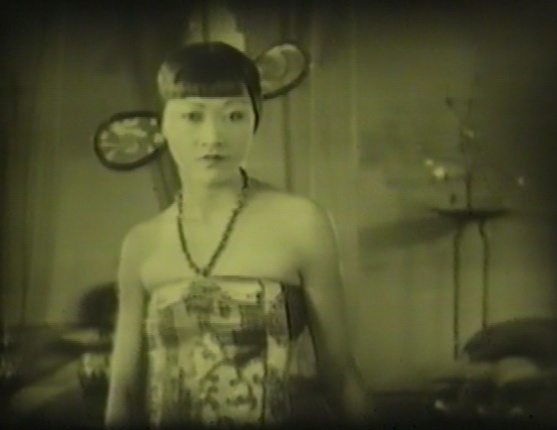
Wong in Thief of Baghdad Still (1924, PD) Arthur Edeson

Anti-Asian and Race Origins

Anti-Asian hate began in Europe when groups like the Huns began to invade and live amongst the Eastern Europeans in the 5th century CE creating the Turkic diaspora, pushing previously Iranian and Germanic groups into the Roman Empires realms.[1] After this, jealousy over wealth disputes continued with the silk trade until the arrival of the Mongols under Genghis Khan (1162-1227) between 1220-1240 CE who pushed for Mongol expansionism as far as Meissen Germany.[1] After this, greater awareness of the 'Orient' a mostly Iberian term returned to describe 'Oriental Moores/Saracens' homelands during the Reconquista to 'reconquer' the Al-Andalus (Muslim Medieval Iberia) from (718)1100-1492 CE, introduced Orientalism into European medieval literature. The Orient just being a word meaning 'East', derived from Roman sources (c.300CE, see Glossary).

Combined, these stories of outsider 'Hordes' (Mediterranean and Asian) invading Europe began to get European Christian scholars knickers in a twist. In their desperation to combat the 'Hordes' (other/perceived threat) and win the Crusades against the 'Saracens', scholars like Otto von Freising (1114-1158CE) began to make up myths about Christian kings who lived far far away in the East~, who would come to save them and together, Asia, or India, or Africa or ??? would come to save the poor European Christians. A prime example being Freising's Prester John (c.1145CE) who wanted to come from a country East of the Tigris to avenge the Crusaders, but unfortunately was a bit busy at the time so instead he decided he would just stay East instead.[3]

Prester John as a Mongol (c.1499, PD) Escargot Land

In 1177, Pope Alexander III (1105-1181) sent word, requesting Prester John's assistance from one of his now 72 kingdoms.[3] Prester John it seems was based on Otto's missattribution of Prester John with the Christian Buddhist dynasty of  Yelü Dashi in 1141 (1087-1143CE) defeating Iranian warlords.[4] With the changeover to the Yuan Dynasty these changes became more appealing to Italian and Viennese merchants when China for the first time was ruled by a non-Han ethnic group. At the court of the Berke, eventually came the Polo family whose son Marco (1254-1324) travelled extensively for as a merchant. Eventually returning home, Marco spread the tale of the 'Far East' and extensive silver deposits.

Later, the Iberian trade routes which were sent to find India, Goa specifically were cited by people like Christopher Columbus as #inspogoals for finding these countries where maybe Prester John existed in his Nestorian Christianity haven. Either way, by the time Vasco de Gama landed in Calicut India in 1498, this started the beginnings of Portuguese and Spanish colonial interests in Asia, supposedly to bring Jesus to the Pagans, but mostly to bring back silver and wealth via monopolized trade routes. During the next century when these Portuguese Jesuits landed in Japan by 1543, they had begun undermining local authorities, denying Kirishitan converts access to higher positions and generally followed the rule of 'Divide and conquer' to gain their ends.

Henry the Slave Trader (1470, PD) Vincent Panels

This had been done successfully since Henry the Navigator had landed in West Africa (1415) to find new trade routes, the most lucrative of which being the pre-existing trade network of slaves which stretched from Morocco to India at that time. Portuguese merchants promoted the idea of race based domination after Gomez de Eanes Zurara (in 1453) defended the Iberian slave trade by asserting that Africans or POC were inferior to their captors, therefore they were 'natural slaves'. Thus Zurara created the first distinct racial/racialist hierarchies or 'scientific racism'.[5] 

Dum Pope (c.1616, PD) Ruben

In order to have capital grow in the budgets of the Iberian kingdoms, foreign assets (slaves) were bought and kept in bondage, and this eventually was expanded to entire cities, cultures, counties, kingdoms and later countries whose borders were redrawn to suit European and often in early ventures Iberian needs (for example Puerto Rico). It was said 'racism is the consequence of slavery'.[6] Thus, Portugal became rich by subjugating other groups, pitting people against one another and eventually bringing an areas resources under its control to profit from these. Or as Francisco de Olandia explained during the San Felipe Incident (1596), 'Spain gained its empire by first converting native populations to Christianity with missionaries and then sending in conquistadors to join the newly converted in an invasion of conquest.'[7] After the Catholic Church encouraged this subjugation of fellow man under the Discovery Doctrine (see Dum Diversas 1453), this set in motion the wheels of race based hierarchies by the 16th century, which lead to the initiation of European global colonialism.

Anti-Chinese

Anti-Chinese sentiment had been around since the days of the 18th century when European powers began to trade with China under Chinese stipulations, Anti-Chinese because the 'free markets' were not 'free' enough for the European monopolies multinationals. When the Opium Wars and other European colonial wars kicked off in the 19th century, these brought instability to China and caused massive migrations from an impoverished Chinese mainland which later became known as the Century of Humiliation. This marked rise in emigration saw increased numbers of emigrants to Global North countries like Murica, Canada, Australia and Europe (not a country). 

One of those who was trafficked or travelled to America was the young lady Afong Moy (c.1815-c.1850) who in 1834 was brought to be displayed in an early example of something akin to a Human Zoo, where she was put on display with other 'Chinese' objects in a bid to sell 'Chinese wares' for the American business brothers the Carnes. By 1848, she had ended up in the poor house when the brothers refused to send her home. Whilst Moy had some agency in dispelling othering rumours, she is also thought to have engendered early stereotypes about the Chinese being a 'backwards race' and was penultimately used a showpiece for selling furniture. Moy may have been the first instance of the China Doll trope, that is an East Asian women who performed for mostly White Men in a submissive manner, almost object like stillness. Bostonians referred to Moy as having 'her feet cut off and stuck into a couple of turnips' as 'well worth looking at' for their 'native nakedness' for example, that is a highly othered exotic image of womanhood to be gawked at, humiliating and depriving Moy of her dignity.[10] This morphed by 1850 into the highly subservient sex worker China Doll stereotype, sex workers making up a good majority of the 'frontiersmen' who wear at the beck and call of white men.
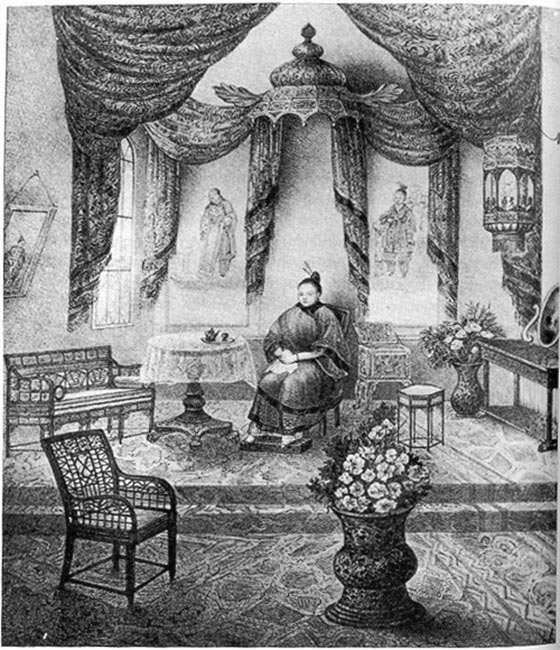
Afong Moy in situ (c.1839, PD) Carne Chinese Curiosities Catalogue Permission

As usual, Murica was one step ahead of all of the other ones and started to deprive Chinese American communities of their rights and dignity early on. In 1852 with the arrival of increasing numbers of gold miners to California, fresh off the genocide of Native Americans, Chinese emigrants were charged a head tax because they were Chinese.[8][9] The Chinese Exclusion Act of 1885 effectively banned all 'coolies' from entering Murica, a legal trend carried on into Canada between 1923-1947, Australia between 1901-1973 and in New Zealand the head tax continued from 1881-1944. Continuing this, Murica's seperate but equal assertions saw PlessyvFerguson (1896) until the fight for civil rights won its first major victory in 1965, saw the Chinese community segregated into 'China Towns', both to appease white majority opinion and to protect Chinese-Americans from white violence.

Yellow Peril

Put together, these stereotypes are part of the 'Yellow Peril' racist ideology which is specifically Anti-Asian or against 'yellow' people. The term 'Yellow Peril' began life as the German propaganda phrase of Die Gelbe Gefahr stemming from the Orientalist 'scholar' Max von Brandt in a time where Germany was courting the favour of European states like Tsarist Russia from 1871-1895. This marked favouritism towards White nation has been a consistent theme of German-Japanese Relations, intitally frosty at their start in 1861, and only thawed by the WWII. I say thawed as Japan was on the Allied side in WWI, defeating the Germans at Tsingtao and only actively courted German interests in the 1930s as it was worried about the attempted takeover of GEACPS resources in South East Asia.[9]

The Perilously Bad Racist Propaganda of the Kaiser (c.1895, PD) Wilhelm

Wilhelm II (1859-1941) was a staunchly white supremacist, overseeing the German genocide in Namibia (then German South West Africa) later on and implementing the rigid 'Gelbe Gefahr' stance against Japan when it became an active Imperial nation in 1895. In reaction to Japan winning against China, he sent the infamous 'Peoples of Europe, guard your most sacred goods' painting depicting the looming 'Other' threat on the horizon as anthropomorphically opposite 'Us' stood ready to defeat this 'Gelbe Gefahr'.[9]


Long live the Glory Days of Britannia, Deutschland (c.1918, PD) HMSO


Dragon Lady

Begun with Wong Liu Tsong's stereotypically cast roles, the Dragon Lady trope began with the Character 'The Dragon Lady' in Terry and the Pirates (1934), a caricature of Wong's femme fatale roles from films like Daughter of the Dragon (1931). The Dragon Lady trope can be thought of as the feminine counterpart to Fu Manchu who first appeared in Sax Rohmers Zayat Kiss (1912), in turn based on the yellowface performer William Ellsworth Robinson (stage name Chung Ling Soo; 1861-1918) stage act arguably begun becuase Robinson was a sore loser who could not beat his Chinese counterpart Ching Ling Foo ( 金陵福 | 1854-1922) at illusion as a theatrical performer or even personality, going so far as to steal his identity, ethnicity, job and then went on to impersonate Chung Soo to spite Chung and humiliate Chung based on his work ethic (to his peers) and ethnic identity (or 'race').

The Dragon Lady Trope is a subversion of acceptable white proximity, that is how much a POC can pass for white. The Lotus Blossom stereotype predates the Dragon Lady precisely because the Blossom/Geisha trope placed Asian women as submissive, docile and subservient to white men in the stories of Loti, Long and Golden. By being dominating and assertive, Wong at least used her agency as a powerful star to pursue representation much in the manner of Hattie McDaniels. When McDaniels for instance was asked why she had played the Mamie stereotype in Gone with the Wind, it was in the acceptable Norms of the times and spaces McDaniels could move in, much as with Josephine Baker who had to wear a string of Bananas to be palatable to French Audiences to fit in the 'primitive' mold of colonial 'native' populations.

For all that Black and Asian beauties were on screen, this is unfortunately where these liberties ended. It is in being palatable, non-threatening and percieved as 'inferior' that some white people only feels safe with approaching POC, Queers and Indigenous topics and people. It is in this vein that when a celebrated Musician 80 years on perpetuates tired internalized racism/colourism tantamount to yellowface, that this emboldens the diseased types to carry on with their assertions of soft-power subjugation. 

Unless I am missing the point, this setup plays very well into the lascivious Geisha stereotype of sexually available objectified bodies, stemming from the Page Act 1875 which stereotyped Chinese and Asian women sex workers and going into the 1910's tropes catalogues, Orientalist stereotypes of the Lotus Blossom and 'Chinese Doll' types. It only appears to transform the trope at all by playing on the cues of the Dragon Lady trope as placing the feminine as superior to the male, even then ridiculing East Asian accents (perhaps Chinese, or Japanese?) and culture out of context and for money no less.

Kimonope

The Kimonope involved is not particularly familiar with anything other than the likes of Fools performative yellowface, stemming from a Wilsonian reworking of history. The trim is more reminiscient of Hanfu styles, the maquillaje irreverently evoking Tang-fastics. The thing resembles a red Furisode that had a lovechild with a golden bathrobe embroidered with dragons.

Overall, a very classic Kimonope, playing more into bizarre Orientalist tropes than trying to use KTC as a transformative way to develop new ways of affirming or normalizing POC agency in the Global North. 

Conclusion

Overall I think it is important to understand these are internalized notions of race popularized by the North American framework of it through the work of American Minstrel shows, Robinson the Fool, China Doll and Dragon Lady stereotypes and political narratives which pushed the Yellow Peril agenda. By wearing this Kimonope alone, it could be transformative in discussing how groups like African-Americans and Chinese-Americans subvert these stereotypes (think Bakers adoption of the primitive aesthetic, Wong's understanding of the times she lived in and her role as representative), however in playing dress up in another groups cultural adjacent garments Longinguistically, it is hoped Lee understands she is playing into the hands of groups who have purposefully subjugated, demeaned and profited from cultural appropriation in close proximity to racist supremacist ideals.

Bibliography

[1] https://en.wikipedia.org/wiki/History_of_the_Huns#Historical_impact

[2] https://en.wikipedia.org/wiki/Mongol_invasion_of_Europe

[3] http://www.mirandakaufmann.com/prester-john.html#:~:text=Prester%20John%20was%20a%20mythical,onwards%20increasingly%20associated%20with%20Ethiopia.

[4] https://en.wikipedia.org/wiki/Prester_John

[5] https://www.washingtonpost.com/local/a-brief-history-of-the-enduring-phony-science-that-perpetuates-white-supremacy/2019/04/29/20e6aef0-5aeb-11e9-a00e-050dc7b82693_story.html

[6] https://www.jstor.org/stable/2953315

[7] https://en.wikipedia.org/wiki/San_Felipe_incident_(1596)

[8] https://en.wikipedia.org/wiki/New_Zealand_head_tax

[9] Japanese-German Relations 1895-1945: War; Diplomacy and Public Opinion, The Yellow Peril and its influence on Japanese-German Relations, Iikura Akira, 2006, pp.80-81

[10] https://www.nyhistory.org/blogs/afong-moy-the-chinese-lady

[11] https://www.youtube.com/watch?v=l94vCs0vtbE

Essay Abstracts 

#1 Renee Vivien (1877 - 1909) --- Born Pauline Tarn, was an English lesbian poet. She wrote in French and perhaps English. She took up the style of the Symbolists and Parnassinism and was well known during the era of the Belle Epoque (the Beautiful Age) for producing Sapphic verse and living as an open quasi butch lesbian poet; her verse derived from the ancient poet Sapphos, also famed for her love of women.

# 2 Birth of the Kimonope --- Here I shall introduce the notion of the Kimonope, that is as a garment attached to the social construct of the 'Geisha' in North America. Kimonopes being Orientalized clothing, or 'negatively affiliated or exoticized ethnic dress' which lead to the perceived notion of the Kimono and Geiko as simultaneously both high and low culture to American culture makers, such as film, television, media, writers and some academics. An example of Kimonope are the tacky Halloween costumes you may find at the Dollar store.

#3 The Legacy of the MacArthur Dynasty on KTC & The Problem with the 'Traditional Garment' Argument --- The problem with arguing that the Kimono is a 'Traditional ethnic Garment' is that that assertion is in itself, arguably  Ethnocentrism, which to clarify is the imposition of, in this case, American values onto Japanese cultural values, belaying the 3 pronged pitchfork of idiocy. 

#4 Divine --- Government name Harris Glenn Milstead (1945-1988) was the infamous North American Queen & Drag artist. Specifically, Divine was known for being a character actor, part of her act is well-known for its eccentricity. My personal exposure to Drag lite was Pantomine Grand Dames as a kid, and later when my friends made me watch RuPaul in art classes, so to me this is nothing new, the over the top, the glitter, the upstaging is all part and parcel.

#5 Dori-Style or 21st century Kimono Fashion --- The Dori-Kimono style. Something which I just made up because in going over notes for the first 20 years of 21st century section of Kimono history, I noticed a lack of a clear catchall term for what was happening in Japan at the time, at least in English descriptions of the time. I use the term Dori as I do not want to coin an unrelated term to the topic, but I also am reticent to claim all of Street style as 'Tori' either, whilst a large number of streets upon which the subculture originates in all use the suffix 'dori' (the bottom of Takeshita-dori for example), thence Dori-style.

#6  The Tea Gown --- This essay will cover the aspects of how 19th century Japanese import textiles to Western countries were used and repurposed, as well what their desirability tells us about how Japanese design was regarded and the image which these people held of Japan through the Western lense and consciousness. This follows the progression of how Kimono can be used in the West from the undress of the 1860s, adapting silk bolts in the 1870s to high fashion western daywear, to the 1880s aesthetic movement and 1890 wholesale adoption in the Victorian age to being used prominently by society hostesses as tea gowns by the Edwardian period, and the subsequent change in Japanese export culture which we see in extant textile collections of Japanese textile in Western dresses of the periods.

#7 Kimono and the Pre-Raphaelite Painters --- This essay will cover the aspects of Kimono in the Portraiture of the Pre-Raphaelites. The Pre-Raphaelites were a group of British artists and writers active during the late Victorian period. Unlike the Royal Academy artists, this circle of painters operated outside of the established comfortable boundaries of the expected white, cisgender middle class audience of the Victorian age. The movement is notable for its inclusion and encouragement of women, and in portraying and engaging non-conventional beauty and beauties as figures from the Classical World alongside Religious, Mythological and Folklore Heroines into Victorian 'Femme Fatales'.

#8 Jokyo/Genroku Kimono Textile Culture and the new role of the Komin ---  This essay will return back to GKTC (Genroku Kimono Textile Culture ; 1688-1704) and JoKTC (Jokyo K.T.C. 1684-1688) and the new role of the Komin (Artist caste) in GKTC. JoKTC is notable for being the lead up to GKTC, JoKTC being characterised by its transitory nature in comparison to GKTC, which was far more bold in its relations to what Kosode could and should be. Komin entered the picture at this juncture, and I shall elaborate a little more here than in other posts about why that was. GKTC is notable for its elaborate, perhaps gaudy and innovative Kosode design features, whilst JoKTC more so for the enabling factors of the time, as a sort of incubatory GKTC.

#9 Tagasode Byobu - This essay will explore the art motif known in Japanese art as Tagasode Byobu ( Whose sleeves Screen) This motif is a recurring art form which was particularly popular during the Azuchi-Momoyama era ( 1568-1600 ) as a representation of the ways in which Buddhist sensibilities met with the fast changing events of the end of the Sengoku Jidai (1467-1615) and as an extension of the habit of wealthy women from military families came to own and store a large number of Kimono. Prior to this, Kin Byobu ( Golden Screens) for the most part depicted nature like Sesshuu Touyou (1420-1506) after Chinese Cha'an painter Muxi ( c.1210-1269 ) or 'flower-and-bird' scenes like those of Kano Eitoku (1543-1590), rather than humans or human paraphernalia as an extension of the Zen painting school of thought about materialism.

#10 Cultural Acculturation --- The topic of our essay is on the nature of Cultural Exchange in KTC which will be an ongoing mini-series throughout 2022. This covers the 1000CE - 1500 period in Japanese History.

#11 Cultural Appropriation --- The topic of our essay is on the nature of Cultural Appropriation which will be an ongoing mini-series throughout 2022. 

#12 Cultural Acculturation --- The topic of our essay is on the nature of Cultural Acculturation which will be an ongoing mini-series throughout 2022. This covers the Asuka (Hakuho), Nara (Tempyo), and Heian periods (500CE-1000CE) in Japanese History.

#13 Asai Ryoi --- This essay will explore the legacy of Asai Ryoi on KTC. Who was Asai Ryoi you may ask? Only one of the most important writers for the Ukiyo genre. Asai Ryoi ( act. 1661-1691 ) was a prolific Ukiyo-zoshi ( Books of the floating world )  or Kana-zoshi  ( Heimin Japanese Books ) writer. His leading 1661 publication, lambasted and satirized Buddhism and Samurai culture of restraint in favour of the Chonin lifestyle of worldy excess.

#14 Edith Craig --- This is a post regarding the early adoption and promulgation of the Kimono and Japanese aesthetics in the life of the wonderful Edith Craig (1869-1947), daughter of the famous actress Ellen Terry (1847-1928) and Edward William Godwin (1833-1886). Edith was also known as 'Edy'.

#15 European Banyans --- This essay will explore the European garment known as a Banyan, which originated as a European reaction to Kimono in the 17th century, popular until the end of the 18th century. The word Banyan originates from Arabic ( Banyaan), Portuguese (Banian), Tamil ( Vaaniyan ) and Gujarati ( Vaaniyo ) loanwords meaning 'Merchant'. Alternative versions saw the item fitted with buttons and ribbons to attach the two front sides together. The Banyan was worn by all genders and was particularly regarded in its first iterations as a gentlemanly or intellectual garment worn with a cap to cover the lack of a periwig, and later adopted by women and greatly influenced how British womens garments were designed with preference for comfort in removal of panniers whilst maintaining luxurious, modest 18th century fashions (see Robe a la Anglaise).

#16 Miss Universe and Kimonope --- This essay will explore how Beauty Pageants, principally Miss Universe, has engaged with KTC. While there may be real Kimono worn by Japanese and Japanese adjacent contestants in the 'National Costume' category, I will be focusing on the Kimonope worn by contestants. The idea of Kimono as a 'national costume' sparks interesting conversations on what 'national costumes' are, their target audiences, and how we form ideas about these things to begin with.

#17 Onna-E --- Womens pictures refers to the Nara, Heian and early Kamakura ( 710-1333CE ) practice of drawing women in elongated Hand scrolls, which today are regarded as feminine gender coded Art. Some of these narratives depict the lives of women, their extra diaries, or the literature they wrote. The Onna-E style derives from how mostly Heian women represented themselves and others as a performed self in these scrolls, drawing from their lives indoors at their and the imperial abodes. Whilst a limited number of women could read Kanji, they also used their knowledge of Chinese culture to create and inspire their own culture; the first truly Wamono aesthetics; and it was with these preconditions that Onna-E became established in the Japanese art scene alongside Yamato-E and Oshi-E.

#18 A Jamaican, a Monster and Portuguese bar in the Orient --- This essay looks at the Kimonope attire adopted by North American Dancehall artists Shenseea (Chinsea Linda Lee | 1996 - present ) for the video to 'ShenYeng Anthem'. Whilst the aesthetic derives mostly from East Asian, principally Chinese aesthetics, the language used is specifically Japanese, referring to Chinsea Linda Lee as 'ShenYeng Boss', a perpetuation of the Dragon Lady stereotype. The essay mostly charts how this ridiculous Kimonope derides from the North American Anti-Chinese movement and how this intersects with contemporary Orientalism.

Sunday, September 18, 2022

ミス・ユニバースとキモノペ | Miss Universe and Kimonope | 1959-2021 | Essay #16

This essay will explore how Beauty Pageants, principally Miss Universe, has engaged with KTC. While there may be real Kimono worn by Japanese and Japanese adjacent contestants in the 'National Costume' category, I will be focusing on the Kimonope worn by contestants. The idea of Kimono as a 'national costume' sparks interesting conversations on what 'national costumes' are, their target audiences, and how we form ideas about these things to begin with.

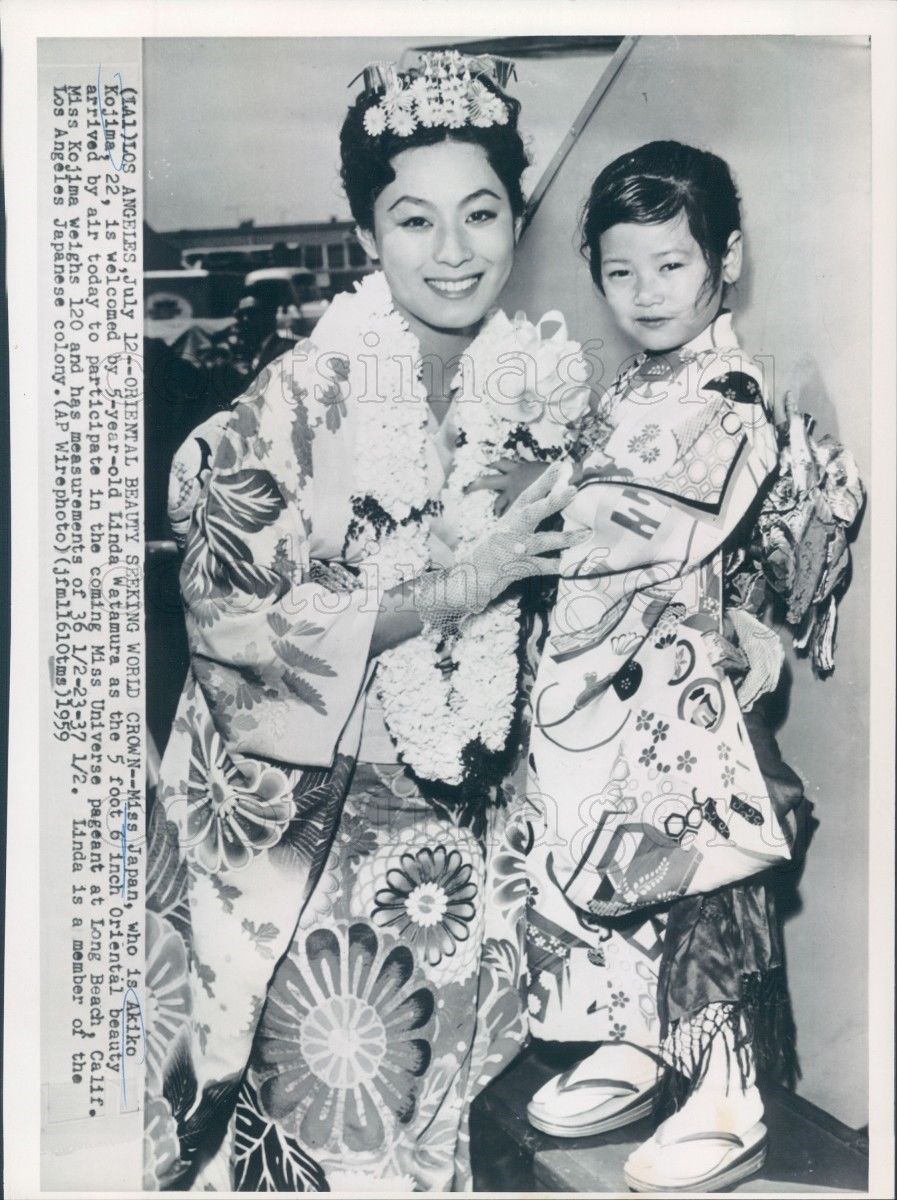
Akiko Kojima with Linda Watamaru in 'Oriental Dress' (1959, PD) Associated Press

Background on Miss Universe

Miss Universe began in 1952 as a marketing ploy by a California company Catalina to sell swimsuits and has continually run for 71 years now as an international arm of the Beauty Pageant Industry. Beauty Pageants such as Miss Universe have gone through many scandals, mostly regarding their lack of diversity, criticism from feminist groups, problems regarding eating disorders, ownership by the fart himself and denying full dignity (in the legal sense) to the incredibly intelligent and hard working women who take part in them.

Contestants today are judged on their looks, personality, aesthetics, knowledge, volunteer work and community based work as well. The Modern Miss Universe often provides opportunities such as modelling contracts, material goods and educational scholarships to winners.

Catalina Advertisement (1955, PD) Photoplay Magazine

Of Nations

Whilst it is rather semantic, a country it must be noted, is not a nation. Just as England is a country, the United Kingdom is the Nation. This I bring up to make note of why the first half of 'national costume' comes into play. The term 'Nation' as we understand it, derives from 18th century German philosophy (a very nasty headspace indeed; see Scientific Racism and Benjamin Rush for our Statesians friends) when the Holy Roman Empire was split up, creating Germany in its wake by 1815 (when your degree is actually useful XD). The idea of nation differs from country in that nation does not require the ownership of land to exist. A country does. It is in this fire and brimstone of the European republics phase that the term 'Nation' or 'Nation-state' came to be defined a group of people with shared attributes. 

The National Costume Narrative

Firstly when we are talking about National Costumes, we must remember that in English we are talking about the historically European tradition of giving 'National Costumes' to certain groups. This began in the 18th century as a way to define what a country was and took off in the 19th in the advent of European Colonization which saw a desire to pseudo-classify and catalogue everything in existence.[5] This saw series of illustrated books drawn by many European and later American and Asian artists depicting the 'National Dresses' of certain groups to quell the thirst of the public appetite for 'rational' 'native' outfits which continues as National Costume Colouring books today. Albeit the focus is more on folklore, shared cultures and mainstream ethnicities today, an example being the controversial Han-fu for China, when instead more people are familiar with the Qipao of the Manchu.

Spanish Beauty [of Havana] (1796, PD) James Gillray, Hannah Humphrey, British Musuem
Whilst the image depicts a Theatre Socialite in Western Europe in 'Roman' dress no less, it is notable that the background highlights Havana, a trope used to denote which part of the world she would have been considered to have her 'heritage' from. This is typical of especially British 18th century ideas about 'nationality', which somewhat remain in Britain today and highlights the uptick in interest of this nature.

The Kimono as a National Costume brings up a series of interesting debates about national identity. That is how to define National Costume. For some countries, it is their traditional dress in a postcolonial world, others their folklore or mythological dress, some unofficial ceremonial garb, particular silhouettes, some particular colours and others types of lavishly decorated fabrics. These things are all subjective though when we consider that Nationality like money and gender, is a social construct; one that at times gatekeeps other ethnic identities from exerting any kind of power and suppresses more diverse national stories.

In Britain for example, there is no such definitive thing as a Kimono to call a National Costume. Instead we are often represented by tacky costumes only fit for Halloween which riff on the idea of what it means to be 'British', which axiomatically is a million and one things. British contestants for example since Kim Carlton (the English semifinalist) dressed up as a Beefeater (Yeomans Warder) in 1962.[1] Other examples include the 1968, 1971, 2010 and 2015 Beefeater costumes.[1][2][3] Other editions draw on the more vague Britannia, Monarchy-adjacent, Union Jack attire, with the latest by Jeaneatte Akua in a bid to the Pearley Kings and Queens of working class London culture.[4]

Pearly King of Upminster in his Skeleton suit (2011, CC2.0) William

In fact Welsh and Scottish (Kilts and Betgwyn) national dress only arose in response in the 19th century as part of the Celtic revival to prevent them from becoming extinct, and to save them for posterity in lieu of the English wool suit. It is in this sense we can see why 'National Costumes' carved out a space for themselves, as a need to make space in a dominant cultural identity which threatened to wipe their own out. Tartan in particular was originally banned by the English in the 1500s, along with the Celtic languages as a way at the time for King Henry VIII; originally Welsh himself; to get England into the Continental European spotlight by pushing a narrative of England first (sound familiar?).[12] It is for this reason I in particular do not refer to Kimono as a National Costume or Dress, as it a patriarchal paternalistic notion of hegemonic cultural/White supremacy that Kimono are distinctly outdated womens attire, only fit for the 'lesser race' (in the words of Leonce Benedite[11]) which I shall hereby Christen : Macarthism.[13]

*C*o*o*l* Japan

When it comes to the Kimono as a National Costume, there are some interesting theories about 'Cool Japan' (japanese conservative soft power push). It is interesting how the 'Dying Kimono' trope works, as it is a principle example of Macarthism at work at pushing the idea that traditional Japanese culture is inferior to the superior Western culture.[13] When we examine Akiko Kojimas original use of Kimono at the Miss Universe pageant for example, whilst she may have done (I cannot exclusively find evidence) she wears Kimono as everyday or at least casual wear, not as a traditional 'Oriental costume'. Kojima wore Kimono to hand accept and handover the 1960 crown, on tour as Miss Universe, to get married and in domestic commericals for example.[14][15] It seems therefore that generally civilian Japanese had not got the message yet about Americas superiority complex. 

This had all changed however by the 1960s when Japan, as it had 100 years before, had to take on another great 'Modernization' period once more to reclaim its own position as great power once more. This internalized Macarthism is reflected in the way Ms. Akiko was represented in American society. In the same year that saw Donyale Luna, she and Akiko entered the pages of the previously all Hwight Harpers Bazaar, a magazine that refused previously to run models of 'color' in its pages. Akiko was presented in Western dress, not Kimono. This is striking as it tells us of the fact that Kimono was not considered fashionable enough to be considered as fashion in its own right, instead Akiko wore *acceptable* white brands such as Sarff-Zumpano Inc.[16]

It is interesting to note though that this comes with the caveat of internalized inferiority dealt with the idea that 'Japan lost the [Pacific] war'. This attitude in Japan commonly refers to the postwar generation of Japanese Teeners (I recently studied the etymology of teenager, never using that one again) who felt the burden of growing up in the shadow of Macarthism, in a world which saw the subjugation of Japanese culture as 'feudal', saw Japanese people as 'savages' for fighting on the wrong side of WWII and the unlawful incarceration of Nissei Americans (1942-1947). When 'Sukiyaki' was released to Western audiences it gave notions of Beef dinner, to a Japanese Teener, Ue o Muite Arukō (I look up as I walk) was reminiscient of the frustration of dealing with American occupation in the Anpo protests (1959-1970) and the Sunagawa Struggle (1955-1956). Its culmination being the murder of Chinese-American Vincent Chin in 1982 at the hands of Statesian men who thought he was Japanese.


Anti-Eisenhower Demonstrations (1960) British Pathe

Anpo Protests (2015) TuCraiN

It is in this cultural hegemony that we see the 'Dying Kimono' trope appear, because casual wear of the Kimono becomes a thing of your mothers generation by 1975, and your grandmothers by 1995. That is, the idiotic idea that Japanese=bad, American=good. When the next winner of Miss Universe wore Kimono, it was as a 'National Costume' in 2007 by Riyo Mori who wore an altered Kimono.[6] Ever since this time it has been commonly accepted that Japanese pageant goers wear Kimono to the National Costume section of the event. It is this internalized effort to become 'global' which has made the Kimono into 'vintage' exclusive fashion, if fashion at all, as Japan has attempted to claw back the image of the Kimono as fashion since the 1990s when it sees a revival amongst young people.

'Cool Japan', a sort of right wing Japanese politicians wet dream of global Japanese hegemony on par with the 1902 Russo-Japanese win in their books, has attempted to adopt the Kimono as a National Costume as well which is a strand of Japanese paternalism which in itself is just a strand of 1690s Iki ideas about the 'correct way' to wear Kimono (all 52 colourways and seasonal motif Houmongi or Komon included) mixed with a dash of inferiority complex, has thankfully yet to make any headway, but is certainly a proponent of the issue of bringing KTC into the global world as global fashion under Macarthism's influence.

It is in this climate that Ayako Hara wore an upcycled (?) Kimono to Universe 2012.[8] Yukimi Matsuo wore a Furisode to Universe 2013.[9] The cringe worthy conservative political version of 'Cool Japan' fosters a disturbingly ethnocentric idea of Kimono, which is also another thorn in the side of KTC. This thankfully saw a divergence when Miss Japan wore a bedazzled Seifuku (Sailor Uniform), influenced by Cosplay and Sailor Moon in 2018.[9] This move into national costumes like the Seifuku is particularly reassuring as it is the Death of the 'Dying Kimono' trope, in saying that Kimono is current and alive, and that culturally Japan has more to its 'national' culture than just reasserting 'Wafuku'. Wamono in this sense has shifted to a more inclusive contemporary understanding of the national, away from the stereotypical Longingism of 'coolies' and 'Geisha-girls'.

Kimonopes

It is in this strand of Kimono as national costume we come to the rather comical if mix of cultural Acculturation and Appropriation. They point thankfully to the more widely accepting side of global fashion which post 2005 began to accept Kimono as a global fashion garment. Post the John Galliano, Vivienne Westwood and Alexander McQueen acceptance of KTC (lets be honest, who remembers half of the shows before the English swooped back in to finish Charles Worth's legacy) we recieve a number of reactions from the Western world which are tantamount to the grey area KTC exists in majority white spaces.

We see the confused 'National Costume' of Emiri Miyasaka who wore a Kimonope to Universe 2009.[7] This particular Kimonope appears to only worn in Summer, as the bottom half of the Susoyoke (Skirt Juban slip) is completely gone with only pink Panty and Stockings left. Designed by a French woman at the Miss Universe offices, a telling piece of Cultural Appropriation.

The absolute corker though that is Juri Watanabe's distinctly Kimo-nope to Universe 2021 is well ... there.[10] The ode to 'Harajuku fashion' (my 15 year old Textile class literally did better) that is that evening dress is stunning in its bid to be fashionable. Certainly more Cultural Acculturation than the mess that was Miyasaka's Kimonope, it still manages to be more Halloween than Ballroom gown. Topped with pink space buns, as you go down, the neckline falls away to reveal the Nihon Kanji etched in Sharpie and a sequined crossover pink cocktail dress with a train (right over left because we are dying of laughter), stretchy yellow polyester belt and 'Kimono' sleeves. Pink go-go boots and two moving beckoning cats complete the Camp.[10] Designed by the Israeli designer Aviad Herman, this Kimonope whilst horrifyingly bad, is a step in the right direction to curb the Dying Kimono trope of Macarthism, in displaying that KTC has made a comeback as global contemporary fashion.

Conclusion

In total we can how the context for many national costumes depends on how we define national culture. Kimono and other 'traditional' garments are often seen as 'national dress' due to the decline of their wear after the introduction of Western power structures, colonization and efforts to 'modernize' under globalisation. After 1955, this evolves from Macarthistic policy, which becomes internalized in Japanese culture by 1970 becoming the 'Dying Kimono' trope, which precipitates that old 'feudal' Japanese culture has been shed off becoming 'modern' Japan. After 1990 though, KTC was revived domestically and has since re-emerged as casual clothing once more both in Japan and globally with the rise of the digital age.

In context therefore, we see how the Kimono has become regarded as a 'National Costume' for Japan, but that when we explore how we get to the notion of certain modes of dress being 'Costumes' we can see how this can be a negative reinforcement of existing power structures through lenses such as Macarthism. The Kimonopes which exist in these spaces are often attempts at cultural appreciation, but more often are regarded as objects of cultural appropriation by many. Thankfully, we can also see post 2005, a resurgence in the pageant and fashion worlds of KTC as influential global fashion (for example the 2016 Furisode for Miss Mexico at Miss Latina USA designed by Sueko Oshimoto).[17] This sees the Kimono as a modern incarnation of fashion, part of its revival in the contemporary world we live in and allows Kimono to be seen as desirable in the current beauty standards we ourselves hold, unravelling the work of hwight supremacists. Thus seeing the reemergence of KTC as living, contemporary fashion, as seen in high fashion, beauty pageants and street fashion.

Bibliography

[1] https://kiddolovesit.wordpress.com/2014/04/03/always-the-bridesmaid-but-never-the-bride-the-curious-case-of-the-united-kingdom-in-miss-universe/

[2] https://metro.co.uk/2010/08/17/tara-vaitiere-hoyos-british-bid-for-miss-universe-dresses-as-beefeater-482213/

[3]  https://www.independent.co.uk/life-style/fashion/features/beefeater-a-yellow-tree-and-an-entire-hockey-game-miss-universe-s-bizarre-national-costumes-9999220.html

[4] https://www.insider.com/miss-universe-wildest-national-costumes-from-pageant-2021-5#miss-great-britain-jeanette-akua-channeled-bridgerton-with-her-royal-ensemble-complete-with-a-glittering-tiara-and-extravagant-cape-18

[5] https://books.google.com/ngrams/graph?content=National+costume&year_start=1500&year_end=2019&corpus=en-2019&smoothing=0&case_insensitive=true

[6] https://richardsamuel888.wordpress.com/2021/01/14/riyo-mori-miss-universe-2007-wore-sytlish-kimono-during-the-pageant-beauty-that-year/

[7] https://japantoday.com/category/national/barrage-of-complaints-force-miss-universe-japan-to-change-costume-for-finals

[8] https://www.ibtimes.co.uk/miss-universe-2012-national-costume-show-photos-415485

[9] https://japantoday.com/category/features/lifestyle/miss-universe-japan-picks-%27sailor-moon%27-ninja-transformation-dress-as-national-costume-for-2018

[10] https://soranews24.com/2021/12/15/miss-universe-2021-japan-entry-slammed-for-wearing-dead-persons-kimono/

[11] Allegorizing Aryanism: Fernand Cormon's The Human Races, Maria P Gindhart, 2008, Volume 9, Online Edition, The Journal of the History of Art (Aurora), WAPACC Organization

[12] http://www.britainusa.com/sections/articles_show_nt1_d_0_i_41110_L1_41013_L2_41013_a_28485.html

[13] Allied Occupation of Japan, Eiji Takemae, 2003, pp.6-7 | See https://books.google.co.uk/books?id=Ba5hXsfeyhMC&pg=PA7&lpg=PA7&dq=Macarthur+boy+of+12+japan&source=bl&ots=zCWRz2JKwM&sig=ACfU3U2yVzbxXPKhsxIIudaoSyEeGqVQRg&hl=en&sa=X&ved=2ahUKEwjp0b7IhZ_6AhWEnVwKHRmVBVoQ6AF6BAgUEAM#v=onepage&q=Macarthur%20boy%20of%2012%20japan&f=false

[14] https://www.insider.com/most-iconic-miss-universe-looks-of-all-time-2019-12#akiko-kojima-of-japan-wowed-in-a-traditional-outfit-before-winning-the-1959-event-23

[15] https://summerballads.wordpress.com/2020/10/02/akiko-kojima-wanita-asia-pertama-yang-menjadi-miss-universe/

[16] https://www.vintag.es/2022/07/akiko-kojima.html

[17] https://www.facebook.com/Kimono-SK-180754161968429/photos/kimono-dress-for-miss-mexico-at-miss-latino-usa-fashion-show-produced-by-virgeli/1201928273184341

Social Links

One stop Link shop: https://linktr.ee/Kaguyaschest

https://www.etsy.com/uk/shop/KaguyasChest?ref=seller-platform-mcnav or https://www.instagram.com/kaguyaschest/ or https://www.youtube.com/channel/UC5APstTPbC9IExwar3ViTZw https://www.pinterest.co.uk/LuckyMangaka/hrh-kit-of-the-suke/ 


I had exciting topics

 and then I got sick. and then I got heatstroke. and then my home became 35 degrees. and then i was sick again. and then i got mild food poi...