This post discusses the influential and cosmopolitan Rouged Meiren of the Tang period. Many of these figures used Buddhism as an agentive street to display their status in life, after death as in the Mogao cave complex through patronage and affiliation with Buddhism.[1] The extravagant Rouged Meiren of the late Tang period emerged from patriarchal beauty standards of the Han Dynasty, a kind of submissive Lotus Beauty, which in the 4th century was defined by men such as Gu Kaizhi (345-406 CE). By the 8th century under the legacy of Empress Wu Zetian, this had developed into the Drunken Lotus trope, as embodied in the work of Zhou Fang (730-800 CE), based on ideas about classical Meiren by Tang women.[2] This cosmopolitan Han woman of means took this pious role, and flipped it on its head, creating new beauty standards and aesthetics which were emulated and admired by many cultures and kingdoms for centuries including Japanese and Korean women.
The painted Meiren first arose in the late Han dynasty as pious figures in burial images, and was developed throughout the spread of folk ballads concerning leading heroines from 200 CE. Female tropes at the time drew upon religious and Daoist principles which resulted in the beauty standard of figures such as Xi Shi.[2] As the female sex's influence rose, their agency was called into question and this became the patriarchal Metaphorical Beauty of Kaizhi (345-406 CE), where only heavenly figures were considered 'beautiful' whilst women like Empress Jian Nanfeng (257-300CE) were to be considered incapable of beauty. This all changed as women gained more agency as dynasties and empires lasted for longer periods and the men could actually do 'they're manly' jobs of 'boy stuff'.[5]
Women had long being holding public office, writing and power since the time of the Duchess of Wey, Ms.Nanzi ( active 534 - 480 BCE ) in lieu of her gay husband, Ban Zhao ( 49-120 CE) of her writings & Empress Jia Nanfeng ( 257-300 CE ) for her disabled husband.[2]
Whilst all of this was going on, Buddhism was introduced into the mix from India around 150 CE, becoming widely accepted by 250 CE.[3] It may be that from the teachings of Buddhism, particularly Buddha's acceptance of female Bodhisattvas, women began to gain more political, social, cultural and religious power between 300 CE and 600 CE in China (see for example Yaśodharā). With this foreign religious influence, Chinese aesthetics and styles developed into more lascivious, exotic styles by 400 CE, as seen in the Longmen Grotto Bodhisattva Statues of the time which had decidedly more curves to them than previous aesthetic ideals may have encouraged in such pious figures before.
By 500 CE, the rise of Gongti or Palace Poetry arose, which placed female and some male protaganists at the center of stories about pining beauties trapped in Jade Mountain terraces, pining after far away lovers over their fans and vanities. This period saw a rise in both explicit beauty standards of the figure as acceptable in Chinese elite society and circles. This was reflected in the difference between the moral lessons of Ban Zhao 600 years earlier or Kaizhi's Wise and Benevolent Women (c.400 CE) which chastised women for attempting to use their looks to gain power, in contrast the Gongti which openly celebrated fleshy white beauties made up in fine outfits with their raven hair, jade ornaments and rouged makeup of the Terrace Beauty.[4][5] This century saw instead the rise of the power wielding female, who in the tradition of Ms.Nanzi, held the real power at court.
Palace poetry is set against the backdrop of the imperial carnage that was the 7th/8th century in Imperial Tang China as caused by squabbling men. A time of constant civil warring until the state was unified under the first outright Empress Wu Zetian ( 624-705 CE) by 665CE which lead to a period of unbridled imperial success, sparking the golden era of Chinese Art, aesthetics and womens rights otherwise known as the Tang era. Following her death in 705, her daughter Princess Taiping (c662 - 713CE) was the real powerhouse behind the throne even though her husband technically was Emperor. When her lesbian lover, Shuangguan Wan'er ( 664-710 ) died, Taiping buried her 'mountain of muse' with a noblewomens burial rites even though she was an unpopular figure in her lifetime.[2]
All of these developments lead to the golden age of Chinese Arts still hailed today as the highpoint of Classical Chinese Art, the Tang Dynasty. During this era, women held great sway over politics and beauty standards, leading to the rise of the plump, comfortable Tang aristocrat who spent her days watching the moon at parties, making poetry and being decadently raunchy in and out of court. Beauty standards still followed previous epochs particularly in makeup though, with the oval face and red face dots ( 花鈿 | Hua Dian) of the Sui. Having eyebrows like Xi Shi in the Tang age for example were highly sought after, and mimicking such a great beauties personality (wink wink) and mannerisms were highly cultivated traits of a beautiful person.[2]

Bodhisattva leads a noblewoman donor (c800-925CE) British Museum
Beauty in the 4th/5th century was still weaponized by men as a byproduct of patriarchy, following the ephemeral/natural beauty standard of a highly patriarchal society when women were considered property to be traded.[2] This developed from perhaps folk ballads like Yuefu, or as Ban Zhao may have encouraged from tales like Yeh-Hsien, into the Drunken Lotus trope, where highly 'religious' women would go about their 'nun-like' ways, whilst downing many a beverage in the evening at their courts and parties listening to the latest poetry, laid out like the Queen of Sheba thinking about which male to devour next in their decadent surroundings.[2][8] All very strangely (wink wink) as Buddhism is a religion which generally does not encourage vanity or material acquirement, early examples of Buddhist Meiren in China appeared by the Tang Dynasty in Western cave complexes.
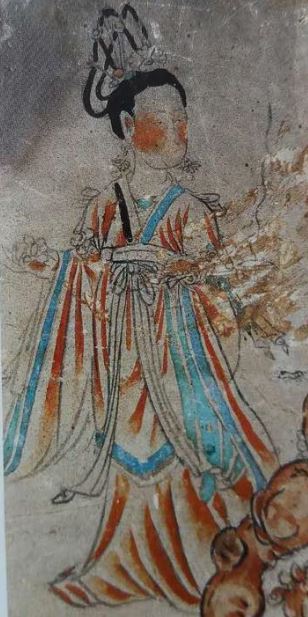
Tang period tombs held larger depictions of their donors to express their wealthy status, and subsequent bequests to the religion and local market activities in the areas they frequented. Paintings were large, sometimes life size, and were painted onto cave walls at the base of the wall near to entrances. Caves often expressed many things of this nature, and often a family standing as a family crypt where relatives would deposit their dead, leave burial objects and devote space for the departed.[6] As the dynasties approached the Tang, Tomb Murals increasingly depicted women as powerful figures. The above figure for example depicts the elaborate beauty standards women had for themselves in this period, but also is reflected in her clout to be beside a god of war.
In being beside a god of war, the image portrays a figure who is befitting of such agency, power and capacity as to be able to hold this position. This was we must remember during a time where women held increasing power under Buddhism as nuns, donors and lovers of prominent court officials and where artistic positions like musicians, dancers and poets were increasingly seens as being worthy of respect and merit in their elite social networks and by outside circles and communities of people as respectable and enviable career paths.

This fresco comes from the tomb of Madam Ch'i-pi (656-721 CE). To have a tomb means that you had given something of your will over to the tombs of Mogao, particularly towards Buddhism. Whilst there is very little on the internet about Ms Ch'i-pi, she may have been given elaborate silk costuming in her life, denoting her high status as a cultured woman who donated to Buddhist causes in her area. The use of extravagant colours, dyes and material wealth display to this day her wealth and luxury status in life. Images like these were known to come almost exclusively from Han Chinese dynasty periods in cave frescos and depicted women donors as according to the beauty standards of their time, when men and women were painted on opposite walls.[6] Those who had converted to Buddhism were also painted ahead of other family members, expressing their closeness to the Buddhist religion.[6]
In having this portrait painted, this was expressing not only the owners wealth, but by the 8th century a resplendent tradition of portraying Buddhist patronage and prosperity, as well as perhaps rites for the deceased in their next cycle on the old Samsara wheel. The rich dyestuff to produce a work like this, the size of the portrait and the individual figure also hint to the figure being of a wealthy household, and cetainly influential enough in their own community to produce the image after death. Tang portraits of these times betrayed their relation to beauty standards of the Han court systems, as their solitary adornments and aeshtetic principles betrayed a plump, decadent figure which incorporated detailed foreign and intercultural dress elements from places like modern day India.[6][7]
As the role of women grew in society with their increased literacy, agency in roles at court and family wealth management, and value as Buddhist's, they increasingly also lead the way in depicting and displaying beauty standards. The High Tang Dynasty aesthetic can be best summed up in the paintings of Zhou Fang (active 766-806), whose beauties often were depicted as plump, white skinned, with buoyant black hair adorned to the gods in expensive rocks, long red robes and delicated features, yet with the supposedly fat eyebrows of Xi Shi and the rouged cheeks of these figures. These were standards imposed by the women at the courts of Wu Zetian and her female relatives who held ultimate power then.

Their size, decadence and lifestyles betrayed what many women in South East Asia at the time did not have complete access to, agency over their lives and choices. Plump figures for example showed a rejection of the submissive, fragile patriarchal beauty standards of the past, and were certainly to be considered role models for the women in Nara and Kyoto who looked across the oceans to their neighbours for cosmopolitan influence, wealth and trends. Even with the Huichang persecution of Buddhists in 845 CE, the popularity of Buddhist sects such as the Chan Dharya (Zen) sect with nobles and Pure Land with Heimin meant that Buddhism still continued on, continuing the traditions of cave portraits.
Mogao Caves
The Mogao Cave complex is a series of burial sites in North Western modern-day China which were attended by Buddhist donors from the 4th century CE until the 1100's.[7] The complex sits in a complex crossroads as a religious site which sits on the silk road, attracting merchants and pilgrims alike. This has resulted in a particularly poignant representation of its donors, many of whom were women and whose choices to be represented shows us how their beauty standards and positions in their respective societies and social circles. Many of these depictions shows how Buddhism influenced China through the Tang Dynasty, becoming a major religion in the area, and also shows through perhaps some of the teachings of Buddhism (women were allowed significant roles in Buddhist dharma by Buddha) that their standing should be respected further than may have been permissible in previous generations in China.

Donors from the Mogao Cave complex show how this complex web of wealth, commerce and religion intersect. The above image was painted by the end of the Tang Dynasty when the reign of Wu Zetian had finally come to an end. The beauty standards of these pieces show how these women displayed their access to material goods in a way typical of the decadence of Zetian's court by expressing their interests, desires and affiliations with Buddhism by being painted together or indiviudually at the site.[7] These expressed a majority of Han dress and aesthetic choices, however their approach to Buddhism is interspersed with local customs and cultural relations such as having a burial portrait in the cave complex. As done for centuries, these groupings of women showed a parsing back of resplendence towards a more sparse religious image and connotations followed in the 3rd century.[6][7] As time progressed, this standard began to shift towards larger facial features, as seen above and below.
In these changing and yet still affluent and artistic times, women turned to Buddhism to convey these markers of wealth, status, cultural and religious affiliation. Cave portraits still reflected contemporaneous beauty standards, yet began to tread the line once more by the 900's of patriarchy and religious piety expected of women by male practitioners. In this sense, a decline in the extravagance and general society is seen in the cave portraits. Portraits still contained the vestiges of previous aesthetics guidelines however, becoming the familiar oval faced, black haired and decorative heavy portraits of their times, albeit in fewer numbers and with smaller more hidden around the back and upper sides of caves.[6] By the end of the Tang period, the Lotus trope dominates rather than the Drunken Lotus as women once again are 'encouraged' to take specific roles for themselves in patriarchal societies, albeit now with their own finances, spaces and values.

Conclusion
In context we see that as Buddhism enters China (around 400 CE), it enables certain new freedoms to certain groups such as to women under the guise of religious perseverance. As the Silk Road brought commercial success and status to many communities, this also brought new cultural imports and ideas about acceptable norms and expectations, moving standards towards financial and ergo material wealth, producing the origins of the Lotus Beauty, a beautiful slim, pious figure represented in early Tang tomb portraits. This cultural and religious exchange culminated in the development of highly intricate tomb murals/silk paintings for figures seen in the High Tang dynasty aesthetic of the plump, decadent, individual figure becoming the Drunken Lotus Meiren, a world reknowned aesthetic which displayed its owners status, power and wealth to establish such decadent trends and hedonistic lifestyles. It was this influential beauty which South East Asian communities looked to in the early Medieval period for beauty standards, even with its decline after 910 CE.
Bibliography
[1] https://commons.wikimedia.org/wiki/Category:Paintings_of_the_Tang_Dynasty
[2] See Bijin #17
[3] https://asiasociety.org/buddhism-china#:~:text=It%20was%20brought%20to%20China,of%20Buddhism's%20success%20was%20Daoism.
[4] See Bijin #19
[5] See Bijin #16
[6] https://www.dunhuang.ds.lib.uw.edu/dunhuang-cave-donors-%E6%95%A6%E7%85%8C%E7%9F%B3%E7%AA%9F%E4%BE%9B%E5%85%BB%E4%BA%BA/
[7] https://en.wikipedia.org/wiki/Mogao_Caves#
[8] https://www.medievalists.net/2020/08/medieval-cinderella/
Bijin Series Timeline
11th century BCE
- The Ruqun becomes a formal garment in China (1045 BCE); Ruqun Mei
8th century BCE
- Chinese clothing becomes highly hierarchical (770 BCE)
3rd century BCE
Xi Shi (flourished c201-900CE); The (Drunken) Lotus Bijin
2cnd century BCE
- The Han Dynasty
1st century BCE
Wang Zhaojun (active 38 - 31 BCE) [Coming Soon]
0000 Current Era
1st century
- Han Tomb portraiture begins as an extension of Confucian Ancestor Worship; first Han aesthetic scholars dictate how East Asian composition and art ethics begin
- Isometric becomes the standard for East Asian Composition (c.100); Dahuting Tomb Murals
- Ban Zhao introduces Imperial Court to her Lessons for Women (c106); Women play major roles in the powerplay of running of China consistently until 1000 CE, influencing Beauty standards
- Buddhism is introduced to China (150 CE)
- Qiyun Shengdong begins to make figures more plump and Bijin-like (c.150) but still pious
Diao Chan (192CE) [Coming Soon]
2cnd century
- Yuefu folk ballads inspire desirable beauty standards of pining women [Coming Soon]
4th century
Gu Kaizhi (active 364-406); Metaphorical Beauty
- Buddhism is introduced to Korea (c.372)
- Chinese Artists begin to make aesthetic beauties in ethereal religious roles of heavenly Nymphs
- Luo River Nymph Tale Scroll (c.400)
- Womens clothing emphasized the waist as the Guiyi (Swallow-Tail Flying Ribbons) style (c.400)
- Wise and Benevolent Women (c.400)
5th century
- Chinese Art becomes decadent; Imperial Culture begins to see more expression in religious statues (c450)
- Longmen Grotto Boddhisattvas (471)
6th century
Xu Ling; (active 537-583); Terrace Meiren
7th century
- Tang Dynasty Art (618-908)
- Rouged Bijin (600-699 CE) https://commons.wikimedia.org/wiki/Category:Paintings_of_the_Tang_Dynasty
Yan Liben (active 642-673); Bodhisattva Bijin [Coming Soon] https://commons.wikimedia.org/wiki/File:%E0%B8%81%E0%B8%A7%E0%B8%99%E0%B8%AD%E0%B8%B4%E0%B8%A1.jpg Guan Yin | https://archive.org/details/viewsfromjadeter00weid/page/22/mode/1up?view=theater
Wu Zetian (active 665-705); The Great Tang Art Patron [Coming Soon]
Asuka Bijin (c.699); The Wa Bijin
8th century
- Princess Yongtai's Veneration Murals (701) [Coming Soon]
- Introduction of Chinese Tang Dynasty clothing (710)
- Sumizuri-e (710)
Yang Yuhuan Guifei (719-756); [Coming Soon] East Asian Supermodel Bijin https://core.ac.uk/download/pdf/275768522.pdf https://factsanddetails.com/china/cat2/4sub9/entry-5437.html#chapter-5
- Astana Cemetery (c.700-750) [Coming Soon]
Zhang Xuan (active 720-755); [Coming Soon]
- What is now Classical Chinese Art forms
- An Lushun Rebellion (757)
Zhou Fang (active 766-805) ; Qiyun Bijin
- Emakimono Golden Age (799-1400)
9th century
- Buddhist Bijin [Coming Soon] https://commons.wikimedia.org/wiki/Category:Paintings_of_the_Tang_Dynasty#/media/File:Noble_Ladies_Worshiping_Buddha.jpg + https://en.wikipedia.org/wiki/Mogao_Caves#/media/File:Anonymous-Bodhisattva_Leading_the_Way.jpg
- Gongti Revival https://www.jstor.org/stable/495525?seq=2#metadata_info_tab_contents
10th century
-End of Tang Art (907)
13th century
- Heimin painters; 1200-1850; Town Beauty
15th century
- Fuzokuga Painting schools; Kano (1450-1868) and Tosa (1330-1690)
Tang Yin (active 1490-1524); Chinese Beauties [Coming Soon] https://www.comuseum.com/painting/masters/tang-yin/
16 century
- Nanbanjin Art (1550-1630)
- Wamono style begins under Chanoyu teachings (c1550-1580)
- Byobu Screens (1580-1670)
- End of Sengoku Jidai brings Stabilisation policy (1590-1615)
17th century
- Land to Currency based Economy Shift (1601-1655)
- Early Kabuki Culture (1603-1673) ; Yakusha-e or Actor Prints
- Machi-Eshi Art ( 1610 - 1710) ; The Town Beauty
- Sumptuary legislation in reaction to the wealth of the merchant classes (1604-1685)
- Regulation of export and imports of foreign trade in silk and cotton (1615-1685)
Iwasa Matabei (active 1617-1650) ; Yamato-e Bijin
The Hikone Screen (c.1624-1644) [Coming Soon]
- Sankin-Kotai (1635-1642) creates mass Urbanisation
- Popular culture and print media production moves from Kyoto to Edo (1635-1650); Kiyohara Yukinobu (1650-1682) ; Manji Classical Beauty
- Shikomi-e (1650-1670) and Kakemono-e which promote Androgynous Beauties;
Iwasa Katsushige (active 1650-1673) ; Kojin Bijin
- Mass Urbanisation instigates the rise of Chonin Cottage Industry Printing (1660-1690) ; rise of the Kabunakama Guilds and decline of the Samurai
- Kanazoshi Books (1660-1700); Koshokubon Genre (1659?-1661)
- Shunga (1660-1722); Abuna-e
Kanbun Master/School (active during 1661-1673) ; Maiko Bijin
- Hinagata Bon (1666 - 1850)
- Ukiyo Monogatari is published by Asai Ryoi (1666)
Yoshida Hanbei (active 1664-1689) ; Toned-Down Bijin
- Asobi/Suijin Dress Manuals (1660-1700)
- Ukiyo-e Art (1670-1900)
Hishikawa Moronobu (active 1672-1694) ; Wakashu Bijin
- Early Bijin-ga begin to appear as Kakemono (c.1672)
- Rise of the Komin-Chonin Relationship (1675-1725)
- The transit point from Kosode to modern Kimono (1680); Furisode, Wider Obi
- The Genroku Osaka Bijin (1680 - 1700) ; Yuezen Hiinakata
Fu Derong (active c.1675-1722) ; [Coming Soon] https://archive.org/details/viewsfromjadeter00weid/page/111/mode/1up?view=theater
Sugimura Jihei (active 1681-1703) ; Technicolour Bijin
- The Amorous Tales are published by Ihara Saikaku (1682-1687)
Hishikawa Morofusa (active 1684-1704) [Coming Soon]
- The Beginning of the Genroku Era (1688-1704)
- The rise of the Komin and Yuujo as mainstream popular culture (1688-1880)
- The consolidation of the Bijinga genre as mainstream pop culture
- The rise of the Torii school (1688-1799)
- Tan-E (1688-1710)
Miyazaki Yuzen (active 1688-1736) ; Genroku Komin and Wamono Bijin
Torii Kiyonobu (active 1688 - 1729) : Commercial Bijin
Furuyama Moromasa (active 1695-1748)
18th century
Nishikawa Sukenobu (active 1700-1750) [Coming Soon]
Kaigetsudo Ando (active 1700-1736) ; Broadstroke Bijin
Okumura Masanobu (active 1701-1764)
Kaigetsudo Doshin (active 1704-1716) [Coming Soon]
Baioken Eishun (active 1710-1755) [Coming Soon]
Kaigetsudo Anchi (active 1714-1716) [Coming Soon]
Yamazaki Joryu (active 1716-1744) [Coming Soon] | https://www.jstor.org/stable/25790976?seq=5
1717 Kyoho Reforms
Miyagawa Choshun (active 1718-1753) [Coming Soon]
Miyagawa Issho (active 1718-1780) [Coming Soon]
Nishimura Shigenaga (active 1719-1756) [Coming Soon]
Matsuno Chikanobu (active 1720-1729) [Coming Soon]
- Beni-E (1720-1743)
Torii Kiyonobu II (active 1725-1760) [Coming Soon]
- Uki-E (1735-1760)
Kawamata Tsuneyuki (active 1736-1744) [Coming Soon]
Kitao Shigemasa (1739-1820)
Miyagawa Shunsui (active from 1740-1769) [Coming Soon]
Benizuri-E (1744-1760)
Ishikawa Toyonobu (active 1745-1785) [Coming Soon]
Tsukioka Settei (active 1753-1787) [Coming Soon]
Torii Kiyonaga (active 1756-1787) [Coming Soon]
Shunsho Katsukawa (active 1760-1793) [Coming Soon]
Utagawa Toyoharu (active 1763-1814) [Coming Soon]
Suzuki Harunobu (active 1764-1770) [Coming Soon]
- Nishiki-E (1765-1850)
Torii Kiyonaga (active 1765-1815) [Coming Soon]
Kitao Shigemasa (active 1765-1820) [Coming Soon]
Maruyama Okyo (active 1766-1795) [Coming Soon]
Kitagawa Utamaro (active 1770-1806) [Coming Soon]
Kubo Shunman (active 1774-1820) [Coming Soon]
Tsutaya Juzaburo (active 1774-1797) [Coming Soon]
Utagawa Kunimasa (active from 1780-1810) [Coming Soon]
Tanehiko Takitei (active 1783-1842) [Coming Soon]
Katsukawa Shuncho (active 1783-1795) [Coming Soon]
Choubunsai Eishi (active 1784-1829) [Coming Soon]
Eishosai Choki (active 1786-1808) [Coming Soon]
Rekisentei Eiri (active 1789-1801) [Coming Soon] [https://commons.wikimedia.org/wiki/Category:Ukiyo-e_paintings#/media/File:Rekisentei_Eiri_-_'800),_Beauty_in_a_White_Kimono',_c._1800.jpg]
Sakurai Seppo (active 1790-1824) [Coming Soon]
Chokosai Eisho (active 1792-1799) [Coming Soon]
Kunimaru Utagawa (active 1794-1829) [Coming Soon]
Utagawa Toyokuni II (active 1794 - 1835) [Coming Soon]
Ryūryūkyo Shinsai (active 1799-1823) [Coming Soon]
19th century
Teisai Hokuba (active 1800-1844) [Coming Soon]
Totoya Hokkei (active 1800-1850) [Coming Soon]
Utagawa Kunisada Toyokuni III (active 1800-1865) [Coming Soon]
Urakusai Nagahide (active from 1804) [Coming Soon]
Kitagawa Tsukimaro (active 1804 - 1836)
Kikukawa Eizan (active 1806-1867) [Coming Soon]
Keisai Eisen (active 1808-1848) [Coming Soon]
Utagawa Kuniyoshi (active 1810-1861) [Coming Soon]
Utagawa Hiroshige (active 1811-1858) [Coming Soon]
Yanagawa Shigenobu (active 1818-1832) [Coming Soon]
Katsushika Oi (active 1824-1866) [Coming Soon]
Hirai Renzan (active 1838ー?) [Coming Soon]
Utagawa Kunisada II (active 1844-1880) [Coming Soon]
Yamada Otokawa (active 1845) [Coming Soon] | 山田音羽子 https://www.jstor.org/stable/25790976?seq=10
Toyohara Kunichika (active 1847-1900) [Coming Soon]
Kano Hogai (active 1848-1888) [Coming Soon]
Tsukioka Yoshitoshi (active 1850-1892) [Coming Soon]
Noguchi Shohin (active c1860-1917) [Coming Soon]
Toyohara Chikanobu (active 1875-1912) [Coming Soon]
Uemura Shoen (active 1887-1949) [Coming Soon]
Kiyokata Kaburaki (active 1891-1972) [Coming Soon]
Goyo Hashiguchi (active 1899-1921) [Coming Soon]
20th century
Yumeji Takehisa (active 1905-1934) [Coming Soon]
Torii Kotondo (active 1915-1976) [Coming Soon]
Hisako Kajiwara (active 1918-1988) [Coming Soon] https://www.roningallery.com/artists/kajiwara-hisako | https://www.jstor.org/stable/25790976
Yamakawa Shūhō (active 1927-1944) [Coming Soon]
Social Links
One stop Link shop: https://linktr.ee/Kaguyaschest
https://www.etsy.com/uk/shop/KaguyasChest?ref=seller-platform-mcnav
https://www.instagram.com/kaguyaschest/
https://www.youtube.com/channel/UC5APstTPbC9IExwar3ViTZw
https://www.pinterest.co.uk/LuckyMangaka/hrh-kit-of-the-suke/

_-_1998.78.6_-_Cleveland_Museum_of_Art.jpeg)


