Her Haughtynesses Decree

Showing posts with label Stencil. Show all posts

Sunday, February 18, 2024

塩沢おめし | Shiozawa Omeshi | Shiozawa Twist Dye Ikat | Fabrics #23

Shiozawa is a type of Omeshi made around Niigata prefecture. It is designated as Juji Gasuri ( じゅじがすり|crossed splash patterns ) which denotes the specific cross styles found across the tanimono.  Threads were first tye-dyed.[1] The weft is tightly wound before being spun and then placed onto a Takahata loom which leaves these distinctive cross patterns.[2] All bolts are to this day made by hand on these looms.[1] Warp threads are then dyed using tye-dye, stencils dyes or paper stencils.[3] These patterns can also be used to make different layers and levels of the work to leave a distinctive fabric gradient type effect on the final bolt. A type of silk crepe, Shiozawa uses these effects to leave a light textile crimp, much like linen.[2] Afterwards the cloth is washed in hot water and left to dry leaving the crosses exposed to the eye.[2]

Shiozawa Town (2016, CC4.0) Tariqsheikh

The murky proto history of Shiozawa Omeshi emerges from a Ramie sample known as Echigo Jofu found in the Shosoin, around 794 CE.[3] Shiozawa Hon emerged around 1750, after the Komin Masatoshi Hori created the modern hard-twist thread method used to make Shiozawa Omeshi by 1679 CE.[2][3] These were artisanal works though and are mostly thought to have been workshop specific pieces until the 20th century.[3] Modern Shiozawa Omeshi arose out of a need to create a new market for fabric in the area when industrialisation took root in the Taisho period (1912-1926). Shiozawa bolts were mostly created in masculine coded colours such as brown, blue, black and white. As time has gone on and the methods of production have turned to more fashion oriented needs rather than as everyday items, more variety has become available since the 1960s when presumably Shufu were targeted and has been made in more bold colours like reds.[1] 

Bibliography

[1] http://www.kimono.or.jp/dictionary/eng/honshiozawa.html

[2] https://kougeihin.jp/en/craft/0114/

[3] https://kogeijapan.com/locale/en_US/honshiozawa/

Socials:

One stop Link shop: https://linktr.ee/Kaguyaschest
https://www.etsy.com/uk/shop/KaguyasChest?ref=seller-platform-mcnav 
https://www.instagram.com/kaguyaschest/ 
https://www.youtube.com/channel/UC5APstTPbC9IExwar3ViTZw 
https://www.pinterest.co.uk/LuckyMangaka/hrh-kit-of-the-suke/ 

Sunday, March 27, 2022

茶屋辻 | Chayatsuji | Waterside Indigo | Patterns #12T

Chayatsuji is a pattern which traditionally depicted waterside scenes in summer kimono which are dyed in indigo and complemented by orange-yellows. The term Chaya, refers to Chaya-zome (Chaya dyed) after its origins from the Chaya family (active circa 1575) member Chaya Munekiyo (1593-1627).[4][5] It is guesstimated that this process of going from a dye to design process, helped to inspire Miyazaki Yuzen (1654-1736) in the creation of his fan paintings on Kosode.[1]

Chaya-zome dye with Indigo designs (c1986, CC4.0) Wikimedia Commons 

The Chaya family were an influential Daimyo family in the late Sengoku Jidai (1568-1600).[5] During the early Sengoku Jidai, they adopted a wandering Ronin (  浪人 | clan-less warrior ) from the Nakajima family whom they designated as Chaya Shirojiro ( しろじろきよのぶ | 1545-1596 ) I. Shirojiro I became a Komin, setting up a shop in Kyoto selling fabric to his wealthy friends who introduced him to more Komin pursuits like lacquerware and making tea ceremony paraphenalia.[4] During this time, he befriended people like Honnami Koetsu ( 本阿弥 光悦 | 1558-1637)[4] and Matsudaira Hirotada ( 松平 広忠 |1526-1549).[6] This proved useful later when Matsudaira's son, Tokugawa Ieyasu ( (徳川家康 | 1543-1616) needed a squire for which Shirojiro I, sent Shirjiro II to fill the job vacancy.[6]

In this way, Shirojiro I became very wealthy very quickly, becoming what is known as a Fudai ( 譜代 | Insider of the Tokugawa circle ) samurai by 1573 making all of Ieyasu's clothes and being a spy for the Tokugawa family. They even went to war together! Shirojiro I first acquired a Shuinjo ( 朱印船 | Foreign Traders Licence ) during Hideyoshi's rule by the 1580s, trading silks with South Vietnam. This carried on until his death, when his son Kiyotada (1584-1603) took over the family workshop and fought at the battle of Sekigahara (1600). In 1603, the business was taken over by Kiyotsugu (1584-1622) who began a silk trade monopoly and overseeing the Nagasaki trade port to prevent Christianisation in Japan. In 1612 the Chaya workshop was issued a Shuinjo for Vietnam again resuming their monopoly officially in the new Tokugawa administration.[6]

During this golden period for the Chaya business, Kiyotsugu's successors Kagayoshi and Munekiyo (active 1630-1639) opened two new branches under the silk monopoly income. However, it was during this time that the Bakufu established Sakoku trade policies to enforce the ban on foreign elements gaining ground with the Heimin, plummeting Chaya's profit margins.[6] During this decade (1630-1640), the Komin Chaya Munekiyo (1593-1627) invented the Chaya-zome technique of using indigo dyes to decorate Katabira by the second half of the 1630s.[4] 

It is likely these designs made use of easily accessed indigo in light of the rising cost of importing other fabrics and dyestuffs by 1635. It is perhaps likely influenced by the avant garde aesthetic world of the Kyoto elites and Komin who resided there at the time, who sought out 'Wamono' in their work to get around the new Sumptuary Laws and used new techniques like direct painting which Machi-Eshi in their untraditional splendour were apt to take up to make sales. It was this 'Shari' ( Witty design ) environment forged by Sengoku Jidai Daimyo excess from the 1590s - 1610s and patriotic Machi-Shu Wamono Yamato-E Shari culture from 1620-1660 which came before the Ukiyo world of the Kambun era.[4][7] This shift from Daimyou to Chonin patronage may be the catalyst for the switch to indigo designs, eventually being the source of fame for the Chaya wholesaler, who became popular with the masses for their Chaya-zome Katabira by 1640.

The origins of the Chaya-tsuji motif comes from the Kambun era (1661-1673) when the design was first printed on Hemp Katabira (帷子) Kimono. Katabira being the predeccessor of Hitoe Kimono and Yukata. The first text appearance of the motif is in the On-Hiinakata (first Kosode pattern book; 1667) which uses the dye Chaya-zome as a ground colour for the Kosode. It is thought the Chaya wholesale store made popular Kosode with waterside motifs using indigo dye, which is how the Chayatsuji motif came to be born at least by the beginning of the Enpo period (1673-1681), during which time this referred to a graduated dye pattern of indigo and light oranges or yellow-greens worn by women.[1][4] By the Genroku period (1688-1704) a technique called Noribosen (two sided resist paste stencil) was created. After this time the stencil depicted delicate patterns, often related to water or fans, and Chayatsuji was born.[1] 

With the introduction and popularity of Yuzen-zome, the fad of Chaya-zome and Chayatsuji waned as Yuzen designs took over by 1705.[1] These were changes driven by the wealthier Chonin classes though as: 

when the Sankin Kotai was enacted [...] from 1635 [this lead to] the rise of the new Chonin class. This changed [...] by 1685 in reaction from the Bakufu by their growing rich people disgust of the merchant classes spending said money. This came in the form of the sumptuary laws, and saw the rise of more covert expenditure, and eventually this meant the start of hierarchical fashion laws (and their cultural reaction of 'Iki') [...] in a bid to curb the outragerous spending habits of Osaka merchants and Edo Chonin in the creation of GKTC (1688-1704).[2]
During this bout of sumptuary laws, one of these such initiatives to keep the Bakufu afloat and I quote 'Yoshimune found it necessary to shelve certain Confucian principles that were hampering his reform process.'[3] In other words, he threw out centuries old principles because he was cash strapped, but is still ordering his subjects to go without and lecturing them on their spending habits. Some things never do change do they? Either way, Yoshimune enacted the Kyoho reforms ( 享保の改革 |1736 sumptuary and rice-as-money restructuring reforms), and Chaya-zome Kosode, which was an expensive Kosode to own and have made, were dropped by the Chonin inline with more Iki styles. Samurai ladies though had other ideas and began wearing them, and down the years the patterns became smaller and smaller until it was accepted by the cultural elites as a motif rather than a whole design by 1711.[1] 

By 1850, the design was considered so bourgeois that it was part of the domestic court dress of Edo castle for the ladies in waiting to wear. It was at this point, that the motif became fixed as it is known today. Today the pattern is worn mostly on Houmongi (formalwear Kimono) and Tomesode (black formalwear Kimono).[1]

Bibliography

[1] https://www.japanese-wiki-corpus.org/culture/Chayatsuji.html 

[2] See A man of Yoshiwara in Bijin #12

[3] https://en.wikipedia.org/wiki/Ky%C5%8Dh%C5%8D_Reforms#Purpose_of_the_reforms

[4] Japanese Art, Aesthetics, and a European Discourse: Unraveling Sharawadgi, Wybe Kuitert, 2014, No.27, p.86, Japan Review

[5] Japan Encyclopedia, Louis Frederic, 2002, p.109

[6] https://en.wikipedia.org/wiki/Chaya_Shir%C5%8Djir%C5%8D

[7] See The Town Painter in Bijin #15

Social Links:

Linktree (One click to all and extended Links): https://linktr.ee/Kaguyaschest

https://www.etsy.com/uk/shop/KaguyasChest?ref=seller-platform-mcnav or https://www.instagram.com/kaguyaschest/ or https://www.youtube.com/channel/UC5APstTPbC9IExwar3ViTZw https://www.pinterest.co.uk/LuckyMangaka/hrh-kit-of-the-suke/

Sunday, February 27, 2022

羊毛 | Youmou | Wool | Fabrics #12

Wool has been used in KTC as technically Tsumugi, Kasuri Ikat and Pongee weaves for over 100 years at least and was initially considered to be a luxury fabric in Japan, worn by the military and other elites.[2][5] A lot of made-in-Japan Youmou comes currently from around 20,000+ Suffolk Sheep, with the bulk of Japanese wool being imported from Australia.[2][4][6] The advent of wool in the late 19th century saw the rise of a new sleeker winter silhouette for Kimono, and new Inverness style capes being added into KTC and designs which remain popular today among Kimono revival vintage collectors and designers alike as a fashionable 'Kawaii' accessory, mostly in Merino and Muslin wools.[11]

Young Boys Jinbaori (c1799, CC1.0) Meturoporitan


Wool is made as in most places by taking the yarns from mammals such as sheep, alpacas and llamas and turning the yarns into threads, dependent on the density and fibres of the yarns. These yarns are now processed by mechanical means, but before industry had reached Japan were sorted for dying and weaving. Wool is first sheared, scoured and then put through a carding machine to be spun into yarns via the worsted or woollen systems. Most of the wool we encounter in Kimono is worsted for its dense nature, but some lighter fluffier fabrics use the Woollen production system for wools like Cashmere. These yarns are wrapped around Bobbins and woven into the worsted plain weave or the woollen twill weave. Crabbing and Decating may also occur to tighten the fibers of these weaves so that they do not shrink or loosen. A Wools Crimp describes how heavy it is basically and as British worsted wool is best, is still used in futon making today for its lightweight feel which retains heat.[6][9]

Historically, Broadcloth, Grofgrain and Raxa Wool was first imported by Europeans during the Nanbanjin trade between 1613-1639. It was considered a luxury import item at the time and used as a trim of sorts for elites to make Obi and eyecatching red Jinbaori.[10][11] Raxa also became used as a fire-retardant material worn to put out fires. Worsted Serge was also used to make Kappa ( raincoat capes | 合羽). Raxa became Raseita, and Grofgrain became Gorofukurin during this time. Even Hakama were found made with Grofgrain, often in red or violet and were more costly than silk. Between 1800-1804, the Bakufu negotiated with the Dutch and Chinese to import sheep to make a local Wool industry but with all attempts unfruitful.[11] 

Kabuki actor as a Firefighter (1860, PD) Utagawa Yoshitsuya

Wool was first imported en masse for the production of western military garments after 1850, when local Raseita and Goro Wools were used.[5][10][11] European Wool farming in Japan is first said to have begun in the Meiji Period (1868-1912) with the advent of the push for Westernisation and was based on the British industrial revolution model in Yorkshire mills.[4][6] Wool outfits were first adopted by the Imperial Japanese family to receive the visiting Duke of Edinburgh in 1869, which promoted Westernisation, prominently British and Prussian dress due to the perception that Wafuku was effiminate and Yofuku (Western dress) as masculine. Chirimen-goro, or French Muslin Wool, was introduced in 1872 and was popular as a cheap alternative to Chirimen silks and was used primarily for Juban ( Underrobe | 襦袢).[11] Inoue Shozo introduced worsted production to Japan in 1878 creating the Senjuu Mill based on German manufacturing models.[10] This included the adoption of western military attire, which at the time, used a lot of stiff and hard woollen fabrics and textiles.[4]

Saigo Takamori in Yofuku Worsted Military Uniform (1877, PD) Yoshu Chikanobu

With the 1868 reinstatement of the Emperor the prior sumptuary laws (put in place from 1604-1685), fell away opening the door to bright bold and fantastical designs in the 1870s.[11] Imported wool become a popular alternative for Kimono again beginning in the 1880s, particularly Red shawls for women.[10] Designers like Kimura Otokichi created ways to put popular Yuzen designs (Yuzen-moyo) onto Mosurin, or Hirose Jisuke who designed Yuzen Katagami (Stencils).[11] In 1881, Okajima Chiyozo developed a printing technique to print Japanese designs onto Mosurin which became known as Yuzen Muslins, after our Genroku friend Miyazaki Yuzen (1654-1736) and replaced Silk Crepe Chirimen Muslin.[11] In 1889, Australian wools began to be sourced by the Kanematsu Fusajiro Store to meet this growing demand for Mosurin wools.[11] By 1896 these imported luxury Muslin Wool materials accounted for 40% of the Wool Market and part of daily Japanese KTC.[10] These Yuzen designs and bright dyes also imported from the Occident created a new craze we still feel today.[11]

Seeing as these garments were made from Wool, it replaced the need to layer multiple garments over other Kimono as had previously been done and changed the winter silhouette for a time. Japan Wool Textile Co., Ltd was an early introducer of Wool as part of KTC when it began production in 1896.[1] It was in this time when the importation of Wool was particularly high, with most imports coming from England and Germany in 1898.[5] The suppliers of Wool of at this time came mostly from Western Mills, such as the A W Hainsworth Mill (est.1793), which in 1899 recieved an order for 'Black serge' wool to be delivered to Yokohama. This saw the introduction of new types of overcoats and capes such as the Tombi, Nijuumawashi, and Azumakouto.[5][10] 

Tombi Coat (1903, PD) 衣服改良会, Benichan
Wool Azumakouto cover (1910, PD) Jukichi Inoue

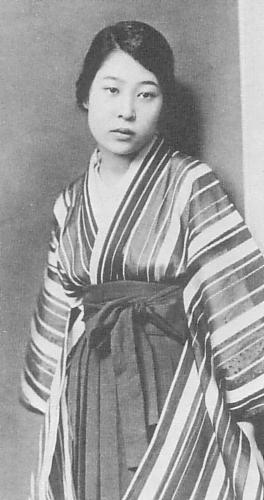
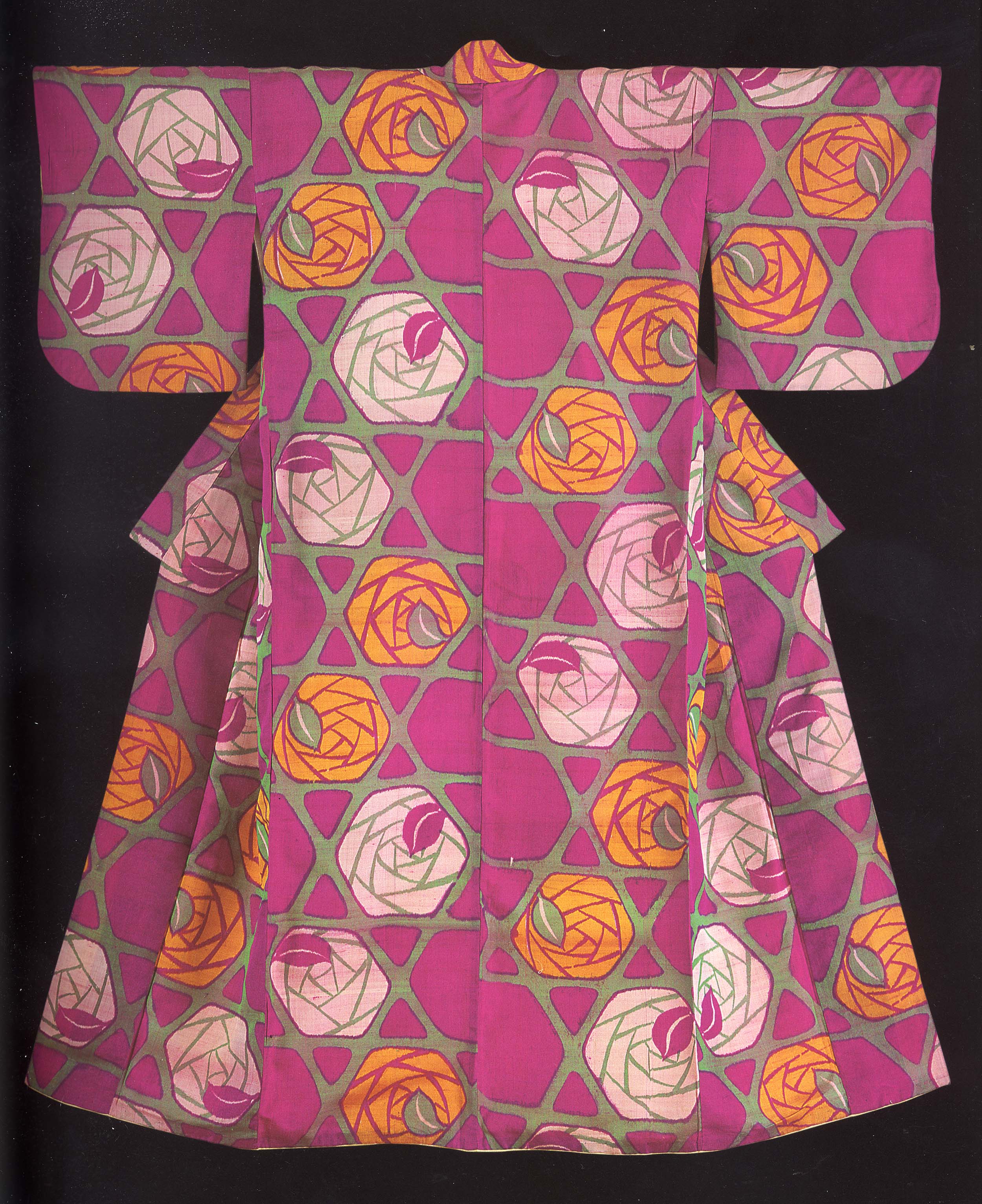
By 1900 department stores such as Takashimaya and Mitsukoshi began to stock Mosurin ( Wool Muslin | モスリン) or thin plain weave worsted muslin wools for purchase. At the time these were often red and overtook cotton muslin in popularity among Children and Young Adults for their Kimono. Worsted was bought from Tokyo, and domestic Goro Mosurin from Osaka & Kobe. By the middle of the decade, Mosurin designs would be readily available at Depato and many aimed at the new market of young women consumers as they were more cheaply priced than silk kimono. Mosurin Kimono specifically were pushed to these Young Bright Things through posters and magazines and at events held annually at the Depato themselves. The Gofukuten ( Big Kimono Stores | 呉服店 ) like Mitsukoshi (三越), Takashimaya (高島屋) and Daimaru (大丸) who would set the trends each year. Taisho Mosurin was big business certainly among teenagers and started the emergence of Miss Haikara-san (Ms.High Collar | はいからさん ) which referred to the 'Smartly' dressed young women who adopted western fashions, and displayed a kinship with the Occidental New Woman phenonmenon.[11] This was the sort of It girl Chic of 1910-1920, with short hair, Hakama, textbooks, western boots, Mosurin western motiffed Kimono and a Bow atop the hair, was the Haikara-san charicature of the New Japan. Motifs included Roses, Chrysanthemums and Sunflowers and all in fast bright and bold synthetic dyes.[11]

Female student in Hakama (c1912, PD) Agesa

Wool worsted began to be associated as an English fabric due to its use in the British suit, and Wool was sold in imitation of the English model at stores like Selfridges, Kendals and Harrods besides the railways of Osacca and Tokio for the established gentleman.[6][10] Working class Japanese citizens may have also first come into contact with Wool when their uniforms and issued blankets were made from Wool for the 1904 invasion of the Dalian Peninsula.[6] The process became even more commonplace when the process of printing on Woolen Muslin became mechanized in 1907 by Inahata Katsutaro in Osaka leading to a domestic boom in Wool Mills for these soft lightweight and cheerful fabrics.[10]

With all of the popularity, demand and reliance on foreign imports of woolen goods, factories and due to this whole WWI thing going on, in 1917, the Agricultural and Farming Ministry declared Japan would begin to become self-sufficient in the production of Wool. This was implemented by the building of the Daidoh Wool Kaisha in 1918.[7] This ended by 1920 however as dense wool demand declined in the domestic Japanese market.[3] The Kanto Earthquake (1923) brought all this domestic Wool producting industry to a halt, until it revitalised by the 1930s.

By 1932, Mosurin peaked at it heights of popularity, as Japan turned away from Western inspired motifs like Art Deco, Expressionism and Modernism and with this came the Society of Kyōto Muslin designers and the Ōsaka Designers Union had recently formed.[11] Depato often held contests to design Yuzen inspired Mosurin Katagami designs, and the art of designing onto soft Worsted Mosurin Wool had become a respectable Nihongo art venture. Something that with the expanding Greater Co Prosperity Sphere had turned into fervent passion for militarism and by 1936, the Wool Industry had returned chiefly active in Nagoya, Aichi and Osaka and Ichinomiya, albeit still reliant on imported resources from at first Australia, but China by this time.[10?] Wool Kimono instead began its militarist phase depicting Childrens Kimono with motifs about Japanese warplanes, military prowess and softpower acts like their 'Benevolence' towards Ethiopia as depicted below. By the 1940s, Japan dominated the global wool industry.[6]

Mussolini in Ethiopia Detail on Mosurin (c1935[2015], CC4.0) Sam Perkins

After the Pacific War, the Japan-Australia Commerce Agreement (1957) saw the reinstatement of Australian resources being used to make Japanese wool textiles. After the resolution of the Anglo-Japanese Commerce Treaty (1962), by 1964 there was also seen in an uptick of Japanese department stores stocking soft Wool fabrics and some Kimono also being made from them. Up until the 1980s, it was still said that many in the know consumers still bought British sourced wools in Japan to make textiles and goods.[6] A great number of these Taisho Yofuku-Wamono and Depato Mosurin Kimono are also greatly credited in more recent literature as the start of 'Kawaii' culture as well, and certainly play a large role in helping to popularise modern and global KTC due to their bright appearance.[11] Furifu most recently issued a series of Wool Capes in their 2020 Autumn/Winter Season Collection for example, showing the enduring popularity of Wool within JKTC Kitsuke.[8]

Bibliography

[1] https://www.woolmark.com/industry/use-wool/wool-processing/japan-wool-textile-company/ 

[2] https://sumono.design/japanese-fabric-bolts/wool-kasuri-ikat-woven-full-bolt-japanese-fabric

[3] https://the-japan-news.com/news/article/0007887290

[4] http://www.fragmentsmag.com/en/2014/06/ami-tsumuli-4/ 

[5] https://en.wikipedia.org/wiki/Japanese_clothing_during_the_Meiji_period 

[6] Britain & Japan : biographical portraits Vol X, Hugh Cortazzi, 2016, pp.481-487

[7] https://www.daidoh-limited.com/english/company/history.html 

[8] https://furifu.com/en/news/en-items/2199/ 

[9] https://www.masterclass.com/articles/guide-to-wool-fabric#9-different-types-of-wool 

[10] The Dying Case of the Kimono:The Influence of Changing Fashions on the Development of the Japanese Woolen Industry, Keiichirō Nakagawa, Henry Rosovsky, 1963, Vol.37, No.2, pp.59-80, The Business History Review | Available online at https://www.jstor.org/stable/3112093, Accessed 26/02/2022

[11] Woolen Cloths and the Boom of Fancy Kimono: Worsted Muslin and the Development of 'Kawaii' Designs in Japan from Fashion Identity and Power in Modern Asia, Sugimoto Seiko, 2018, Chapter 11, pp.259-284

Socials:

https://linktr.ee/Kaguyaschest

https://www.etsy.com/uk/shop/KaguyasChest?ref=seller-platform-mcnav or https://www.instagram.com/kaguyaschest/ or https://www.youtube.com/channel/UC5APstTPbC9IExwar3ViTZw, or https://www.pinterest.co.uk/LuckyMangaka/hrh-kit-of-the-suke/

Saturday, October 30, 2021

元禄織物における小袖と職人の新たな役割 | Jo/GKTC and the new role of the Komin | 1666-1704 | Essay #8

 This essay will return back to GKTC (Genroku Kimono Textile Culture ; 1688-1704) and JoKTC (Jokyo K.T.C. 1684-1688) and the new role of the Komin (Artist caste) in GKTC. JoKTC is notable for being the lead up to GKTC, JoKTC being characterised by its transitory nature in comparison to GKTC, which was far more bold in its relations to what Kosode could and should be. Komin entered the picture at this juncture, and I shall elaborate a little more here than in other posts about why that was. GKTC is notable for its elaborate, perhaps gaudy and innovative Kosode design features, whilst JoKTC more so for the enabling factors of the time, as a sort of incubatory GKTC.

Shibori Chrysanthemum Kosode design ground on Indigo Satin (17th century) Tokyo National Museum

Land to Money Economy

During the Muromachi period (1336-1573), local coinage supply was insufficient and too sporadic to totally meet Japanese demand, and was supplemented by Ming Chinese coins. Instead, the economy was regulated in Rice stipends by the Kokudaka (rice system?) as a land economy, overseen by rice brokers, who made their money by storing Daimyou rice crops in their storehouses. However with the end of the Sengoku Jidai and stabilisation policies promoted by the Tokugawa, coins began to become a rival form of currency by the Tenna period.[3] By this time, the Kyoto and more so Osaka ricebrokers had developed comprehensive networks of storehouses, which they exchanged for tickets, an early form of paper currency. As the economy stabilised and the need for war evaporated, and domestic market demand increased[14] A system which dirty dirty Chonin (in the mind of the Kuge) came to use as they were unable to make ends meet by hoping Kuge senpai might notice them. By 1601, coinage became standardised. Local trade networks for things such as imported goods and 'dirty' trades developed, and on the back of this Chonin began their own business between 1610-1630, bolstering work for tradesmen (cart-sellers and day labourers).[1][2] From 1635 the abolishment or decline of trade monopolies in the Bunkoku 分(国 ; trading zone) by the upper class merchants (the likes of Murayama Tōan) from schemes like the Itowappu Nakama (Silk Guild), broke up even more industries into wider unregulated trading goods. Urbanisation from 1635-1665 then saw to the rise of cottage industries to supplment the replacement of rice to coin. 

1666-1681

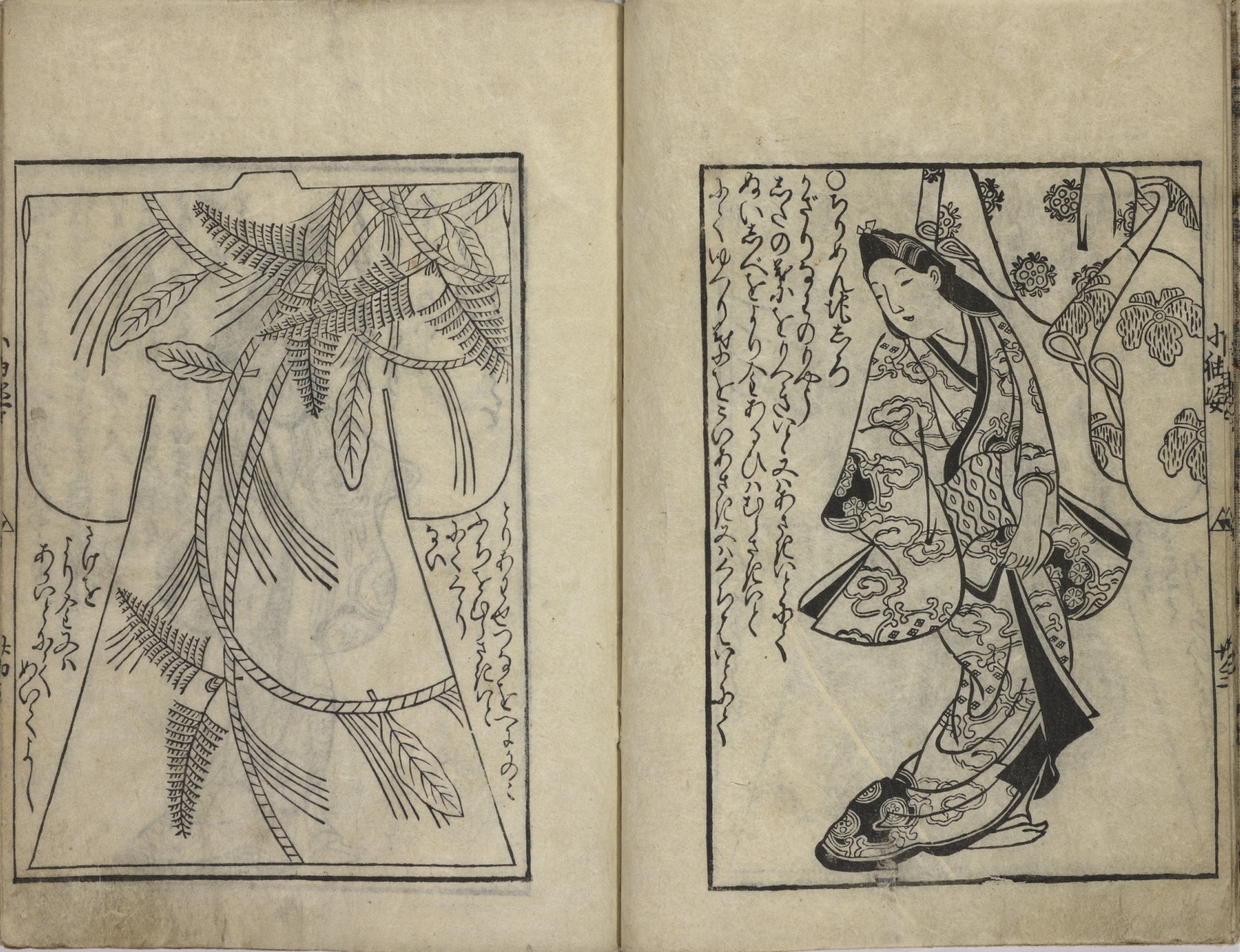
With the lasting effects of population upheaval, the rise of the merchant class and transfer of wealth distribution from samurai to Chonin castes, the landscape of Japanese demographics changed heavily from 1635-1660. The Kambun (1661-1673) and Enpo (1673-1681) eras saw mild shifts in the acceptability of beauty standards, a shift in power dynamics between geo-political centers of soft power figureheads, and the rise of the printing industry.[1] This led to the Yakusha-e, Hinagata Bon and many other images and rules surrounding the acceptability of fabrics, conduct, expense, design and persons surrounding the design of Kosode.

Kosode Designs (1677) Hishikawa Moronobu

Kosode at the time conformed to both regulations and certain beauty standards. Regulations depending on the era (becoming more stringent after 1670) often forbade Chonin from taking on particularly luxury fabrics and dyes like gold, red, or some silks and wearing them in public. Beauty standards forbade this as well, so simple was the call of the day for Kosode designs in Hinagata Bon of the day. Kosode in this time often had colour schemes strictly of no more than 2-3 colours for wealthier Chonin, and the Heimin (farmers, leather workers, tanners) often made do by having a single base colour which contrasted against another relief design feature such as Shibori. Beauty standards often encouraged the design to incorporate Japanese motif instead by referring to allegory, scripture or popular culture instead of splashing the cash.

Therefore from 1608-1665:

- Rise of the publishing industry (1608-1670) 

 - Land to Money Economy (1615-1660) 

 - Urbanisation (1635-1665) 

1681-1684

In the Tenna period the delicate balance of societal wealth distribution fell in favour of the Chonin, who by now had amassed a wealth greater than the stipends of their samurai counterpart's Koku stipends. The Tenna period saw the rise of local industries particularly around the production of Japanese made silks, as part of the governments fights with Chinese and Japanese piracy and tariffs on incoming Chinese silks which were being sold on the cheap. With this came the decline of the trade guilds in the Bunkoku and the rise of the thrifty Chonin wholesale merchant.

Osaka

Osaka in particular was known for its nifty and thrifty Chonin who had a large market share of rice brokerage.[14] With the ebb and flow of the Itowappu system, this gave rise to the financial power of the Chonin (almost black) market by 1685. Osaka merchants lived nearby to import markets and also to Kyoto, where most silk was produced at the time, making it an ideal location giving its already built up infrastructure, and cheaper prices than Kyoto levels. Osaka merchants prominently were known for their wealth, and were reknowned for their nouveau riche lifestyles as such due to their newfound wealth, a regional Japanese stereotype which has stuck ever since.

However whilst particularly prominent in Osaka, all Chonin during Tenna more so appreciated the finer; material, things in life. Samurai were more so at the time buying other goods such as roof tiles for their leaky palaces and creaky moats. Chonin tastes had with their abundant mastery over their own little corporations, come to enjoy greater say in the wider society they lived in as wealth distribution shifted in their favour. In this way, Chonin became the arbiters of taste during the Tenna period when regulations were somewhat lax and spending habits high.[6] 

With increased expenditure however, came more problems for the Chonin. Problems such as their refinement, karmic influence and worldly standing. It was a world of hedonism certainly by Medieval European standards, and this saw the launch of popular trends amongst Chonin. Chonin would often compete to outdo the other, certainly in the bigger cities of Osaka, Edo and Kyoto. Kosode design became more elaborate and distinct, allowing the Heimin a complicit understanding that the wearer of finer Kosode were well-to-do, well off and were learned individuals, literate in the Buddhist texts, popular tales of the day, the classics, up-to-date on the latest art trends and who had access to the latest and greatest Kabuki and cash-spalshing textiles such as fine silks, gold embroidery and the ever coveted Beni. As such, artist became ever more involved in the creation of these elaborate Kosode, as they became evermore bespoke and tailored to their first wearers.

The Four occupations (1883) Ozawa Nankoku

The Artisans

Komin, otherwise known as the artist group under Confucian teachings, forming the theoretical Ko caste of the Shi-no-ko-sho ( Four Occupation Groups; Scholars/Warriors: 士 Farmers/Heimin:  Artisans: 工 Merchants: 商 ) which had been in use in China since their Warring States Period (403-221BCE) and introduced by the Tokugawa in their bid to bring about stability.[4][5] Often in Tokugawa Japan however, the Ko and Sho castes overlapped frequently, and as such, are an unreliable category set but are useful as a framework understood at the time by Japanese writers. A Komin as such, is a person who makes art, or works in a craft. For Japanese creatives, this is a blurry distinction as art and crafts are one in the same process, unlike in the West when during the Renaissance they split under secularisation during the Enlightenment period through the rationalism (in the art world, nature) vs empiricism (mechanised) debates into Art (divine works of nature) and the lesser crafts (mechanial and hand labour work) in the Occident. Komin often were poor creators, and relied heavily on the patronage of wealthier clients and patrons, particular in the 17th century.

Komin as such accepted work for clients. At the beginning of the 17th century, most of their work was more purely religious based iconogrpahy to accompany religious texts or to adorn castles, later alongside Buddhist catechisms. This changed though, with the inclusion of increasing numbers of wealthier Chonin merchant clientele in the later half of the century. Komin would principally still at first be asked to create images or scrolls for religious or pious reasons in the 1650s. By the 1660s, the scrolls begin to become a little saucier, a bit of neck, some wrist here and there. By the 1670s the mass print has become available for pennies, and by the 1680s these have become full on Abuna-e, Richards, Lady Gardens and all. These tastes would have been reflected in the homes certainly of a few Chonin, as these were printed and bought by the masses, not just the sleazier Sho.

As such great relationships between the Komin and Chonin had developed by the 1670s. These symbiotic relationships complemented one another when we consider that if a book wasnt selling like hotcakes, the addition of a good painter and some Abuna-e certainly may shift it from the peddlers streetside cart or Gyosho Bako (Merchants box). The earlier and more interesting melding of the Komin and Chonin though however may more likely have come from earlier channels. Evidence exists that as Chonin became ever more regulated under the Sumptuary regulations of the Tokugawa, they sought other avenues to spend their lavish fortunes. This by the 1660s had become Kosode, as evidenced by the Hinagata Bon, the earliest extant examples of which come from 1666. 

Kosode as such were being designed by Komin book illustrators, painters, and designers. This was beneficial for the Chonin, as whilst imparting their well placed patronage of the arts and reflection of their knowledge of the Chinese classics in their choice of motifs, it was also a wise investment, as when the Kokudaka collector came collecting, he had no warrant to collect Kosode, which unfortunately for the state, was not rice. Iemitsu really liked rice you see.[5] Instead, by the 1690s certainly, this proponent of Osaka and Edo Kosode design, had become one of the main features of GKTC.

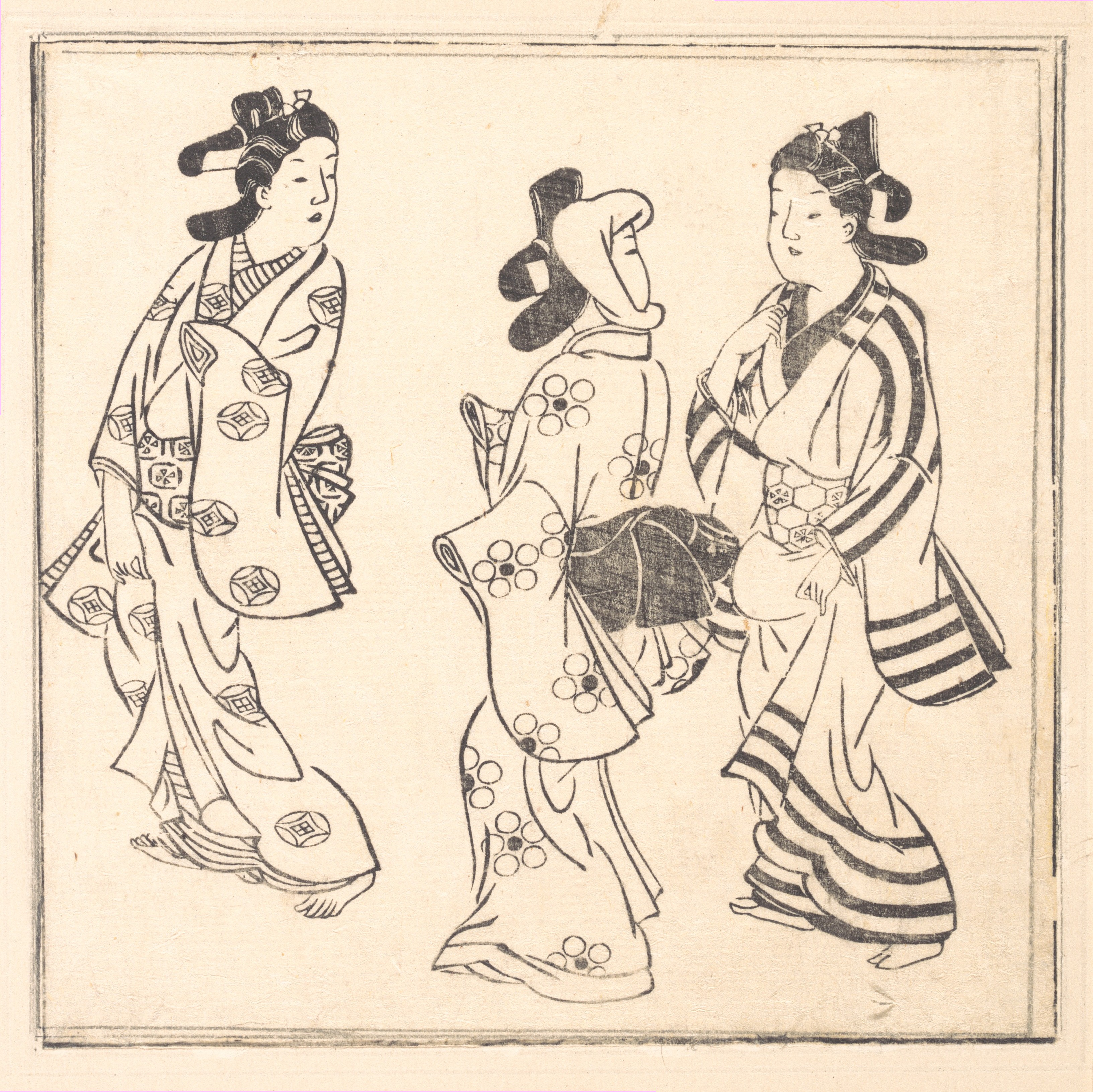
Hishikawa Moronobu

Hinagata Bon and Wakashu (1682) Hishikawa Moronobu
100 Japanese Women (c1685-1694) Hishikawa Moronobu

Hishikawa Moronobu was a defining Komin of the 1670s and 1680s lead in to Genroku period. From 1683, his publisher was Urokogataya Sanzaemon  active c1677-1694).[7] Indeed by the Genroku period, Moronobu was considered to be the  founder of Ukiyo-e, such was his popularity. As a Komin, Moronobus style was greatly admired, and his personal style became one of the most desired formats at the time.[8] Moronobu, who came from a family of textile designers, contributed to GKTC in his creation of Hinagata Bon to capitalise on his success. His designs were not particularly groundbreaking, often relying on Buddhist iconography in their motif, but were more so popular in the Abuna-e, which most likely caused Moronobus Wakashu styled Kosode to enter vogue.[9]

Yuezen Hiinakata

See the right hand side Kosode for the effect (c1686) Unknown

Yuezen was a significant trendsetting monk Komin who made large text and calligraphy painting styles popular on Kosode. Yuezen developed a vogue in GKTC for large calligraphic text to sprawl across, usually, the right hand side of the upper Kosode sleeves and back, imitating the style found on Kakemono scrolls.[11] This style was popularly designed using Shibori or stencilling techniques at the time.

Yuzen Miyazaki

 Yuzen influenced Kosode (c1700,CC1.0) Daderot, Ishikawa Prefectural Musuem of T. Arts & Crafts 

Miyazaki (1654-1736)[6] was a fan painter and creator of the Yuzen dying technique. Yuzen contributed to GKTC by creating Yuzen dyeing by applying rice paste to resist-dye cloth, which he called Yuzen-zome ( 友禅染 | resist-paste design ). His painting style was also immensely popular and featured on a number of Kosode from the time by painting his fan designs directly onto the surface of Kosode which became popular by 1688. By 1690, Yuzen had become a widely established tecnhique which was popular certainly with the Kyoto Chonin classes.[10]

Ogata Korin

Karamonoya store, these spread Korins art across Japan (1798) Niwa Tohkei

Ogata Korin's family owned a family goods store in Kyoto in his younger years, which supplied textiles to the Empress Toufukumon-in (1607–­1678) at her court, which inspired his own designs reflected by incorporating textiles design techniques such as repetition stencilling into his paintings and screens. It is likely that this will have been how Ogata the painter and Ogata in the textile world were introduced to one another. Korin certainly set the late trends of motifs at the end of the Genroku period. By 1700 these had become Korin monyou (motifs) which were popularly reproduced in varying styles in Hinagata Bon, which were mostly bought by the wealthy or elites of Kyoto who could afford them. These patterns became popular when Kabuki actors wore them onstage, setting the trend for these designs and thus disseminating them amongst the general populace. Examples included Ogata's rounded flowers and distinctive shading. His customers included Nijō Tsunahira (1672–­1732), Nakamura Kuranosuke (1668–­1730) and Sakai and Tsugaru Daimyo families.[6] 

The Komin therefore played a definitive role in the development of the new aesthetical and DIY craft sensibilities brought into vogue in GKTC. When Chonin became their patrons, Komin's work was elevated to new heights in setting trends and defining popular new design aesthetics. Komin frequently were already established as painters or from wealthy families already familiar with textile design, which is how the easy switch of occupation from potter, painter or weaver to designer was allowed, celebrated and circumvented in Japanese society. This was accomplished however, by the elevation by previously unfit peoples, such as the money handling Chonin class, into the Komin class as a way to elevate the station of the Chonin themselves befitting of their new monetary and financial clout without threatening the status quo held in the Shinokosho system in the Genroku period.

In context therefore we can see that the Tokugawa stabilisation policy led to deliberate and direct control of the import/export market through the transformation of the Japanese economy from a land-based to money-based society. These had the effect of increasing urbanisation which led to the growth of local home industries owned by wealthy Chonin, primarily for our interests in the concentration of publishing. This increase in wealth distribution altered the layout of the landscape of art patronage, leading to an increased visibility of Chonin as tastemakers, following the Kabuki actors who were trendsetters.[12] This was primarily by 1688 lead by the Kyoto and Osaka merchants who defined tastes by their patronage of particular Komin.[13] Komin therefore heavily influenced popular GKTC, as they became the innovators of new dye, painting and motif techniques such as the Yuzen dye technique. This lead to the advancement and progression by 1700 of established GKTC, a particularly more 'crass' set of design aesthetics than the leading samurai classes hoped the Heimin to hold. 

Essay# 9 will cover a little on Tagasode Byobu.

For more see this lecture :  https://www.japaneseartsoc.org/2021/04/lecture-the-birth-of-fashion-in-japanese-textile-art/

Bibliography

[1] See Bijin #8

[2] https://en.wikipedia.org/wiki/Japanese_currency

[3] From the Tokugawa period to the Meiji Restoration, Eijiro Honjo, 1932, Vol. 7, pp.32-51, Kyoto University Economic Review

[4] https://en.wikipedia.org/wiki/Four_occupations

[5] https://en.wikipedia.org/wiki/Edo_society#Four_Classes

[6] https://quod.lib.umich.edu/a/ars/13441566.0047.006/--sartorial-identity-early-modern-japanese-textile-patterns?rgn=main&view=fulltext#N2

[7] https://www.britishmuseum.org/collection/term/BIOG7145

[8] https://www.britishmuseum.org/collection/term/BIOG4068

[9] See Bijin #2

[10] https://en.wikipedia.org/wiki/Miyazaki_Y%C5%ABzen

[11] https://fashiondocbox.com/Accessories/70488710-Toomey-1-kosode-and-the-class-system-of-edo-period-japan-caroline-toomey-art-history-106-art-in-east-asia.html

[12] See Bijin #3

[13] https://ja.wikipedia.org/wiki/%E5%85%83%E7%A6%84%E6%96%87%E5%8C%96

[14] https://en.wikipedia.org/wiki/Rice_broker

Social Links

One stop Link shop: https://linktr.ee/Kaguyaschest

https://www.etsy.com/uk/shop/KaguyasChest?ref=seller-platform-mcnav or https://www.instagram.com/kaguyaschest/ or https://www.youtube.com/channel/UC5APstTPbC9IExwar3ViTZw https://www.pinterest.co.uk/LuckyMangaka/hrh-kit-of-the-suke/


Friday, July 23, 2021

銘仙 | Meisen | Woven or Pongee Silk | Fabrics #5

As promised for once (seeing as I doubled up on Essays and then instead did a Pride Kimono Essay, I still have so much E&AKTC media I want to analyse so badly!) I will be reintroducing you to the wider history of Meisen (woven or Pongee) Silk. To the touch, it is immediately recognisable as it the rougher, heavier silks which are recommended for work and winter.

Meisen is a woven or spun silk, produced from waste cocoons/raw of pre-dyed silk threads, and is a popular everyday silk for its durability and its ability to be reused as a fabric even when worn frequently as workwear. This technique is also known as Ikat, but Japanese Ikat or Meisen is known as the thickest or heaviest Ikat weave, also known as double Ikat weave.[1][2] Now I will admit, in softness to DEAR GOD THAT SCRATCHY- the order goes Omeshi, Meisen, Tsumugi, Omeshi being cotton smooth, Meisen the itchy stuff and Tsumugi the dark brown material only scratchlords love, but Meisen often falls into the scratchier rougher silks in my handling experiences as a textile collector myself.

When the threads are woven, they commonly apply loose waste silks to the weave, or by stretching the threads to the desired length and tightly binding the design before the dying process known as Nassen. The dye method of production in creating a design is known in Japan as Kasuri (resist dye) which gives Meisen its signature patchy, rough edged or blurred design look when the design stencilling (the stencils made from mulberry paper reinforced with Toxicodendron vernicifluum or since the 1960s plastics) is applied atop; using a spatula or wide hand brush called a Hake (刷毛).[7][8][14] Stencils are also cut with a knife or precision instrument.[9] The dyed yarn is then rolled up and placed into a Mushibako (a steam tube).[9] The final design is adjusted by applying hand painting or embroidery.[1] In Ikat, this process can be repeated multiple times to produce elaborate, multicolored patterns by dye, whereas Meisen also applies dye after the fabric has been woven as well. The tighter the weave, the greater the skill of the craftspeople involved due to the loose threads involved often being shorter than desirable for silk production. Meisen patterns show up on both side of the finished product due to the double printed design formed through Hogushi Nassen.[2] Meiji Meisen peices used chemical dyes to create the design, mixing rice paste or Konjac paste atop the stencilling process to warp threads after being woven with the weft. The weft threads were then undone, taken out and replaced for reuse on old boards, this being a new Meiji technique which replaced traditional Ikat production of kasuri in which chunks of threads were tye-dyed on their own in a slow and repetitive process by hand to avoid unwanted dye being spread during skein contact.[7] 

Historically, Ikat originated in South East or Central Asia, sometime before 3000BC.[2]  Double Itak originated in Tenganan, East Bali, Indonesia as Geringsing Double Itak. This spread via the vast trade networks of the great Asian empires of modern day India and China to as far as Egypt and became a widely available textile.[4] Ikat then arrived in modern day Japan around 1100AD, eventually entering Japan proper in the 1300's when the Ryukyuan Kingdom began trading with Japan. After 1609 when both Kingdoms merged, the Ikat technique began to be used in Kyushuu. By 1750 with continuing growth of the Honshu population and demand for greater cotton production, the technique had moved into Nara.[6] With the increasing growth of Ikat production in Japan, Ikat weaving became a Honshu cottage industry produced in specific villages which gave rise the creation of Ikat as a local Japanese textile, or textiles which became Meisen. By 1850, Bingo or modern day Hiroshima had its own local variant for example.[5] In Japan from 1868, Meisen grew in popularity due to Ikats popularity as textile abroad. In 1873, Japan first participated in the International Exhibitions where it is thought Japanese artisans first began bringing new European chemical dyes back to Japan to work with.[16] In 1882, it was said that expats such as Kondo Tokutaro and Inabata Katsutaro (1862-1949) began to return from Lyons France and reinvigorated the trade of Ikat weaving in Japan.[12] This became Chichibu Meisen when Sotaro Sakamoto (坂本宗太郎) patented another Meisen technique in Chichibu in 1908.[9] Between WWI (1914-1918) and the devastating 1923 earthquake silk production costs fell as Japan reaped the rewards of being a major power who had bolstered heavy industry in the Taisho era.[13] Cheaper silks thence began to be easier to produce due to advances in weaving technologies and new chemical dyes on production lines made Meisen Kimono incredibly cheap, incredibly decorative and incredibly bright Kimono.[9][15] From 1910 - 1935 therefore was the Meisen Renaissance.

Meisen machine made Kimono (Taishou) Khalili Collection

From 1920 - 1939 Meisen therefore became fashionable everyday wear and it was during this period that Meisen became most popular, with work being outsourced to the Greater Co Prosperity Circle as it was known for the cheaper labour of Korean and Chinese workers.[5]  It was said that 50% of the women in Ginza at this time wore a Meisen Kimono and became what can be regarded as Taisho 'fast fashion' by 1920 and would set you back today by 20-30,000¥/£2-300/$250-350 in todays money.[8][14] This Meisen renaissance saw the proliferation of these garments in large Department stores with popular actresses of the Taishou and early Showa eras.[7] This in keeping with the times allowed for the proliferation and greater production of Meisen silk with production reaching its peak by the 1930s. With the increasing global role Japan played on the world stage, the textile industry incorporated foreign cultures and motifs such as European Art Deco, Fauvism and later Cubism and Modernism for example into their own designs.[12][16] This is seen in the pizza effect of Meisen Kimono's flowing water motif and ribbons said to guard against evil spirits, motifs regurgitated through the Glasgow modern style, being used by the Finnish/Swedish company Marimekko who were inspired by Meisen Taishou design of 'stripes, cross[es &] arrow feathers' in the 1960's and 1970s.[11][12][16]

After WWII production began to slope downwards from the loss of the labour pool and that as an everyday, common, durable reusable fabric, secondhand long lasting Meisen silk had a larger supply in the market which made new production particularly unprofitable. By 1960 with the consumption and promotion of western styles, Meisen production declined drastically and as a readily available fabric with no demand, production almost ceased. Today the majority of Meisen is made in Honshu, focused in Gunma and the Kanto region using Tama-ito (Dense raw summer silk yarns) and Noshi-itou (Silk thrums), also other smaller sites include Kyoto, Isezaki, Chichibu, Ashikaga, Kiryuu, Hiroshima and Hachiouji and in Okinawa as Tate-Yoko in Kurume and Ryukyuu.[1][2][3][10] Modern artists like Michiko Sugihara of Isesaki who stages a Meisen fashion show each year, and Tamayo Kanai the curator of the Isesaki Meiji Musuem, today keep the tradition and history of Meisen alive in modern Japan, partially as Upholstery fabric for interior design and small personal items such as handbags.[7][10] Other artisans like Yasuo Kikuchi, who are increasingly retiring as with many heritage trades like Bashofu weavers for example, keep the tradition alive by offering classes and demonstration workshops in the Chichibu Meisen Museum.[9] Other Meisen musuems are available. 

Scholars such as Anna Jackson and Karun Thakar have also published work on Meisen Kimono in 2015 (Kimono Meisen: The Karun Thakar Collection, which holds 250 Meisen Kimono from 1300 on), and were held on display at the V&A in the Kyoto to Catwalk 2020 Exhibition. For further photos and details on Meiji era machinery, see SalzTokyo's excellent blog on Meisen in Chichibu: https://www.salz-tokyo.com/chichibu-meisen-hogushi-weaving/.

Patterns #6 will be on Tate-Yoko-Kasuri, another Ikat derivative.

Bibliography

[1] https://www.faburiq.com/blog/2014/10/21/0wtatbkndhaesj8ccxt6a9wq8878nm

[2] https://en.wikipedia.org/wiki/Ikat

[3] http://www.johnmarshall.to/H-TradTech-Tategasuri.htm

[4] https://www.wowshack.com/the-amazing-story-of-ikat-how-a-textile-wove-itself-into-indonesian-history/

[5] https://en.wikipedia.org/wiki/Kasuri

[6] https://en.wikipedia.org/wiki/Demographic_history_of_Japan_before_the_Meiji_Restoration#Population_during_the_Edo_and_early_Meiji_eras_(1600_to_1873)

[7] https://www.vam.ac.uk/blog/news/japanese-meisen-dyeing

[8] https://home.ginza.kokosil.net/en/archives/72310

[9] http://www.salz-tokyo.com/chichibu-meisen-museum-nassen-dyeing/

[10] https://www.salz-tokyo.com/chichibu-meisen-hogushi-weaving/

[11] https://www.rundetaarn.dk/en/event/meisen-kimono-2/

[12] https://www.meisenkimonocollection.com/thestoryofmeisen

[13] https://wattention.com/meisen-the-funky-kimono/

[14] http://nationalclothing.org/asia/28-japan/329-meisen-kimonos-launched-a-new-trend-in-japanese-folk-fashion-in-the-early-20th-century.html

[15] https://hali.com/news/meisen-kimono/

[16] https://reader.exacteditions.com/issues/43418/page/90

Socials:

https://linktr.ee/Kaguyaschest

https://www.etsy.com/uk/shop/KaguyasChest?ref=seller-platform-mcnav or https://www.instagram.com/kaguyaschest/ or https://www.youtube.com/channel/UC5APstTPbC9IExwar3ViTZw, or https://www.pinterest.co.uk/LuckyMangaka/hrh-kit-of-the-suke/

Sunday, June 20, 2021

秩父銘仙 | Chichibu Meisen | Chichibu Woven Silk | Fabrics #4

Chichibu Meisen is a double sided woven silk made in Chichibu, Saitama, Honshu. CM is made from raw, dupioni raw, floss, or spun silk made from waste cocoons and waste raw silk, and is a popular everyday silk for its durability and easy capacity to wish and reuse it.[1] 

Historically CM began around the time sericulture and silk weaving was introduced from Korea or China between 300-800AD.[2] Local traditions hold that this was the local Shinto deity Chichibu Hiko-no-mikoto who did this.  The local topography was heavily built up with mountains, which made rice grops difficult to grow, so sericulture eventually become the main local commodity in Chichibu. CM was at first due to its nature as a stubborn material or Futo-Ori (| Thick weave) made from waste product, worn by Chichibu farmers. In time, CM spread outside of Chichibu, and was known as Oni-chichibu, and eventually became an acceptable fabric for the Samurai class to wear due to its durability and sheen. This production was well established by the 18th century.[4]


Chichibu Saitama
A Moga (1927)

By the 1890s, the Japanese goverment sensing the encroachment of Westernisation and seeing the effect of Western colonisation in Asia, began to promote traditional Japanese arts and art or cottage industries. These led to the promulgation of traditional trades like CM production becoming joint with technology, producing new techniques like Hogushi-Ori (Virgin Thread sorting).[4] In 1908, the first Hogushi Nassen (ほぐし捺染 | Loose silk threads first dyed and then woven) technology was patented in Japan allowing for more elaborate patterns to be created.[1] Meisen then by the 1920's with an increased production capacity due to the increase of heavy textile industry began to become worn as a staple in womens fashion, most commonly worn by the Moga (モダンガール | Modern Girl).[5] The colours of Chichibu Meisen were particularly bright, and the patterns made allowed for a greater variation in Ji-monnyu than had previously being available to Kimono designers.[4] Moga often bought these kimono in Department stores, which popularised art deco Meisen and showed the modernisation of the 'New Japan' (itself arguably an adapted Western ideology deriving from contact with Western through 1853-1876), with skyscrapers, high-speed trains, and plane motifs from 1910-1930. From 1930-1940 with the changing political landscape of Japan, these patterns frequently became more charged and tied to national patriotism, such as Meisen depicting military themes, often made in rayon, mainly in regions north of Tokyo.[6] When Longingism took hold in the court of the MacArthur shogunate, Kimono become 'the old thing to wear' so to speak and 'modern Japan' once again took off from where Old 'New Japan' had taken and production of new Meisen declined rapidly, reverting back to workwear rather than being a trendy garment from the 1960s onwards, and may have seen an uptick of resurgence as a fashion item from 1990-2009 in Japanese and foreign womens Kimono from the bright designs of Taisho Meisen kimono, a large number of which survive because they are Chichibu Meisen as part of the historical revival moment in Kimono-Hime, popularized in the west at least in the fanzine Kimono Hime.

A Meisen Haori with Battleship motif (1926-1945) CC

Chichibu Meisen is made with leftover silk threads and is created by Temporal weaving, Printing, Steaming, Drying, Rollback & Weaving. Weaving is first done by sorting the white warp threads into the desired length and number and set in the loom and the weft threads wound around tubes. Temporal weaving refers to creating the desired pattern with the weft threads in the loom which prevents shrinkage during the Katazome process. The warp threads are then spread from the tubes over a printing stand and Katazome is applied to them using one stencil at a time. A frame with the pattern inside is placed atop the warp thread stand and the pattern is gradually applied by moving the frame and applying dye through the stencil with a brush. More than one colour requires the warp threads to be redyed as many times as there are colours. By dying the weft and warp threads this creates the double-sided effect or Hogushi Nassen technique of CM. The threads are then refined by immersing them in Shinsen which bonds the dye agent to the threads, then placed in a Mushibako (steam box or tube) which fixes the dye to the threads. The threads are removed and left to dry by tumble drying. The warp threads are then rolled back and check over and adjusted as needed, a process known as rollback.  

Weaving is then done by setting the warp threads in the loom and sorting and loosening (Hogushi-Ori) the weft threads to fit the end pattern using hand-thrown/flying shuttles with a treadle. The shuttles slide the weft threads in the loom, auto-weaving machines and shuttle looms which replace weft threads are also used to prevent breakage. Hogushi-ori/-nassen (Loose sorting/dying) creates the double sided sheen when the warp and weft threads join in CM silks, which was valued by Samurai for its durable and shiny qualities.[1] CM is still made today in Chichibu, being regarded a Traditional Crafts of Japan in 2013; to learn more you can visit the Meisen Kan Musuem in Chichibu.[3]

Fabrics #5 will be on the wider history of Meisen fabrics, next post will be on the Dori-Kimono style.

Bibliography

[1] https://kogeijapan.com/locale/en_US/chichibumeisen/

[2] See Fabrics #3

[3] http://www.meisenkan.com/english/

[4] https://www.ana.co.jp/en/gb/japan-travel-planner/saitama/0000013.html

[5] https://www.researchgate.net/publication/235733818_Why_was_Meisen_Japan's_traditional_working_clothe_accepted_well_in_the_market_as_everyday_clothes_and_stylish_garments_between1900_to1930

[6] https://www.thecityreview.com/kimono.html

Social Links:

Linktree (One click to all and extended Links): https://linktr.ee/Kaguyaschest

https://www.etsy.com/uk/shop/KaguyasChest?ref=seller-platform-mcnav or https://www.instagram.com/kaguyaschest/ or https://www.youtube.com/channel/UC5APstTPbC9IExwar3ViTZw https://www.pinterest.co.uk/LuckyMangaka/hrh-kit-of-the-suke/

Sunday, April 18, 2021

井原 西鶴 | Ihara Saikaku | 1642-1693 | Bijin #3 | The Genroku Bijin

Ihara Saikaku, born Hirayama Tōgo (平山藤五), was a Japanese poet and creator of the "floating world" genre of Japanese prose (ukiyo-zōshi). He was the son of a wealthy merchant in Osaka, and by 1662 he became a haikai-no-renga (俳諧の連歌| linked-verse-haiku-chain) master and began to establish himself as a popular haikai poet. In 1670, he had become an established writer with his own writing style, which frequently depicted merchants or Chonin (町人|'town-people') in their natural habitat, The pleasure districts. In 1675 his wife died and he composed a hella long poem, taking 12 hours to write, written in her memory. It is said that it is this which prompted him to began writing novels. When his youngest daughter also died, he became a non-practicing-monk and began travelling around Japan. By 1677 he returned to Osaka, and hearing of the success of his 1675 poem took up writing again.

He then began writing prose fiction and he had published The Life of an Amorous Man (1682), The Great Mirror of Beauties: Son of an Amorous Man (1684), Five Women Who Loved Love (1685), The Life of an Amorous Woman (1686) and The Great Mirror of Male Love (1687) which was particularly detailed, and Comrade Loves of the Samurai (1687, Translated Collation). These later works have aged like good wine so to speak, as they were highly popular at their time of release (puns) and have remained incredibly popular among the LGBTQIA community today for their elaborative detail in Japanese history on the matter, popularised in the UK by Edward Carpenter himself (1844-1929).[1] These Erotica drew on Ihara's Chonin stories, which are said to be both satirical and comical.[2] His style was said to be so outlandish its only reference point was to the exotic 'Dutch' styles brought in by Dutch sailors into Dejima. His 1686 'Amorous Woman' novel is best remembered.[3] In 1952 it was made into the Life of Oharu.[4]

Yonosuke with a Telescope (1686) Ihara Saikaku

From Osacca to Iedo (1680)

Ihara had begun upping-the-ante and created incredibly lude E compared to what had gone before in Japans historical figure art (the majority, even in Abuna-e being clothed up to this time). His accounts were mostly like saucy novellas of the lives of people from the new wealthy Chonin and their lovers, but its Osaka. His 1682 novel for instance, has the protaganist Yonosuke, who from 6-60 goes about on a island populated only by women in a bid for devoted love. These books were written to be circulated by the wider public, but the market was made due to the demand for merchant whimsy fulfillment, particularly around the pleasure district genre.[3] 

A Pleasure district worker, flashing their ankles (1723) Nishikawa Sukenobu

As a result of his works being set amongst the Chonin, his works are both evocative of a sort of new-money beauty, which was considered rather tacky amongst the upper samurai of the time. There is indeed a lot of questionable material, but also offer a glimpse into the average kosode of the time, and some of the varied levels beauty began to take. Cheap to the rich, is not cheap to the poor as we all well know, you can only afford so many Obi before customs comes for your neck on a silver platter after all.

The kosode seen in the Sumizuri-e accompanying his 1682-1687 erotica therefore are a good indicator of what consituted the Chonins Bijin so to speak. Whilst images of finely dressed Tayuu were common to the hoi polloi as they would have been seen parading down the long avenues with their 2 child attendants and set trends, this was more of a trickle-down-economics approach. The Kosode popular in these E therefore are simpler, often using only one motif and one colour. Richer Chonin have more motifs, more colours etc but this is also due to the constraint of the sumptuary laws set by the Tokugawa Shogunates Government. This was particularly true in Osaka, a city known in Japan for its big-spenders (Japanese stereotype not mine), in the vein of Kaneo Takarada from Kill la Kill.

Ihara's Bijin in his Suzumuri-e reflected national standards and as such are reflective of the wider merchant patronage of the arts, which lead to the creation of the new textile culture in the Kansai region in the Genroku period, leading to the merchants patronage of Genroku textile culture by Osaka Genroku Nakama. This textile culture however sprang from a combination of:-

 - Stabilisation policy after civil war (1590-1615) 

 - Sumptuary legislation in reaction to the wealth of the merchant classes (1604-1685) 

 - Regulation of export and imports of foreign trade in silk and cotton (1615-1685) 

which merchants combated by using workarounds to create new kosode cultures through art patronage, woodblock prints and by merging old artforms together to create unique new kimono and art objects.

A spot of wrestling, in the fashions of 1702 (c.1711-16) Artist Unknown

Sumptuous Silky and Silvery Sanctions and the rise of the Chonin (1590-1700)

Sankin Kotai procession

Stabilisation Policy (1590-1615)

With the end of the Sengoku Jidai (戦国時代|Age of the country at war) over the Keicho period (1596-1615) came the emergence of the Sankin Kotai, when people began to move into the cities to be with their newly roving lords at first, and later to engage in the business that catered to the roving lords, with merchants owning a store in the city, and another in the countryside.[9] This was due to a policy of stabilsation and appeasement furthered by the last of the 2 unifiers of Japan, Hideyoshi Toyotomi and Ieyasu Tokugawa. Policy changes included the 1596 Hideyoshi edict which removed a large number of swords from practicing samurai in an effort to curb violent crime for example. The 1590's brought an increased trade for Kyoto Nishijin-ori silk merchants amongst these stabile trade conditions from wealthy clients.[8] 

Instability however until 1615 however was rife with vigilante justice, with many Kabukimono (傾奇者|samurai gangs) & Machi-yakko (町奴|village paramilitiaries) who comprised the leftover Ronin (wandering samurai) left behind or without an overseer due to the end of Japan's many civil and local wars, which the policies aimed to regulate by creating new national workforces and systems for these displaced persons.[18] Machi Yakko contributed to the disruption of these policies by practicing non-conformity, one of their Mon crests for example combined a Kama (sickle), Wa (Circle) & the Kana phoneme for 'nu' to make Kama-wa-nu, literally "who cares", which directly questioned the political authority of sumptuary laws and the bias class structures at a time when mass hunger and infanticide were common amongst townspeople, but not amongst their ruling overlords.[11]

Osaka posh totties (1680) Tamura Suio

Sumptuary Laws (1604-1685)

Sumptuary laws simply put in England were used to dictate who could wear what colours, type of clothing, furs, fabrics, and trims from the serfs to the King. This was to establish class hierarchy, or material textile culture (so why we think Velvet is a fancy material for example, as it was Henry VIII's textile of choice) and also to regulate the English textile industry in exports and imports to bring revenue into England and to keep it out of France (a tough job as English exports were basically wool and the itchy grey broadcloth). This general idea times by about 100 applies to why the Shogunate governate regulated the Japanese textile culture and market. Whereas England has tips, Japan had R-U-L-E-S.[5] From arguably 1604-1684, new laws were put in place to try to limit the expediency of frugal Chonin. However by 1688-1720, these new Chonin had become wise to the sumptuary laws and began becoming patrons of the arts. The Chonin's spending power was vast under military policy, and and during the Kan'ei-Enpo periods (1624-1681) began to be spent on Kabuki actors and around pleasure districts. These designs quickly began to be flashier and often outshone the Kosode worn by the Bakufu (幕府|tent-government). Eventually to save face, the upper classes began to adopt these evermore expensive outfits, to keep up with the times.[9] This however became an increasingly non-option for the Bakufu who were used to living above the peasants, not borrowing from them.

Tsumugi Silk on the left; Ie, cheapy scratchy silk

Sumptuary laws stipulated things such as what fabrics and dyes could be used based upon a persons rank, decided by bloodlines at the time. The lowest of society like farmers (principally merchants though), for instance could not wear silk unless it was Tsumugi silk (waste-silk), Hemp, arrowroot, wisteria or Tilia Japonica fibres instead. The Hollyhock, Paulownia and Chrysanthemum and Beni/Murasaki dye only being allowed to be worn by nobility etc etc.[11] Merchants were later denied wearing red by the late 18th century as it was a sign of nobility and so on. This went further when considering how merchants came by their fortunes, as noble Japanese men only were allowed to make their fortunes by selling their own wares. If like merchants you sold other peoples wares, you were seen as belonging with the pondscum of society.

Beni Dyed Kimono (1850)
The Meireki Fire of 1657 (1661) Terajima Ryoan

In Edo, merchants (Fudasashi) dealt in rice. In Osaka, these bigger merchants were the Kakeya (Moneylender) and Kuramoto (Salesman), some of whom had begun to wear the shorter sword of the samurai class, which under Confucian Buddhist Japanese standards was a no-no. Particularly to the disgruntled Tozama daimyou (outsider lords) at first. Other smaller merchants such as peddlers, entertainers and manual labourers were also gaining more wealth. Merchants in Kyoto were known for their culture, Edo for their power, and Osaka for their money. Ihara himself noted the expediency of Osaka merchants money related priorities, a pride in enterprise they held in high esteem for themselves and their wider families. This was found in self-made merchants like Kawamura Zuiken (1614-1700) who began as a cart-peddlar, and whose quick thinking after the 1657 great fire of Edo in buying local timber made him rich overnight. Edo merchants such as Kinokuniya Bunzaemon (紀伊国屋文左衛門, 1669 – 1734) were particularly known in the pleasure districts for their lavish spending.[14] 

The Matsuura Byobu depicting contemporary fashions (c.1650) Iwasa Matabei

By the 1660's, Osaka Kuramoto and Kabunakama who specialised in the cash crop Cotton, instead began making domestic Kosode from Indian Sarasa prints.[8][16] The Kabunakama (株仲間|merchant guilds) began developing due to broken Nakama (contract-merchants) contracts and the cooperation and social contacts between provincial, regional and city merchants began to grow into the recognisable new flourishing Chonin class.[8][15] The Chonin according to the Chonin themselves therefore upon retirement, was to leave behind his wealth, and live a life of refinement in following Kodou, Shudo, Chado, Archery, Waka, Music, and to refrain from swearing in tripping over his purple hems.[14] In the Genroku period (1688-1704) the Chonin began to become wealthier than the Bakufu, given the Chonin dealt in coin, whereas the Japanese Warrior (read:Samurai) dealt in rice, and thereby died by the Koku-stipend.[10]  Rice goes off however, so generally Chonin had a bit more leverage with accumulating wealth, from their businesses in printing, textiles, etc to meet the ratio of Supply and Demand creating in the years of population control and stabilisation policy under the new Shogunate. 

Eventually the Bakufu or upper classes became evermore indebted to the Chonin or middle classes, a situation seen as untenable by the Bakufu who began issuing more stringent Sumptuary laws.[8][9] In 1683 laws were made denying lower classes from using embroidered crests and dyers could not use certain dye-processes to increase the shine or silk reflection in a kosode, and by 1684 Chonin and artisans classes were warned against using flamboyant silks and instead to wear pongee Kosode.[11] By 1685 though these Sumptuary laws directly targeted the Chonin in favour of the indebted upper classes, banning lucrative trade and displays of Confucian vulgarity; banning the merchants from flaunting their wealth in luxurious textiles. 

Genroku Kosode, known for its full red Kosodes, Kana and Shibori designs (c. late 17th century)
Gneroku Kosode Design from a sample book, note the Red Shibori fans (c.1680's) 
Shunga Trio in Genroku Kosode (c.1690-1740) Miyagawa Chosun

These laws began as a Tokugawa reaction against Chonin Genroku Textile Culture.[11] But the laws in the end had little effect with textile production and culture only shifting to fit the needs of the clients.[9] As Tenka no Shonin (merchants of the nation), they held themselves now to higher callings, one of these being the elevation of the common art of clothing. Although it was more common to see Kyoto and Edo merchants spending lavish amounts, Osaka merchants were more known for their originality due to their frugality[14] leading to more cultural awareness at times than old Kyoto culture and city dwelling Edo merchants. 

Courtesan and Attendant, note the courtesans Iki Kosode, and how they sit atop Genroku Kosode (c.1688) Hishikawa Moronobu

Osaka Genroku culture, was bold, loud, brash and in your face- the new money of entrepreneurs. In contrast for the old money, this also resulted in the pushing of the notion of Iki (being chic and reserved) by the upper classes in conformity with Confucian ideas of propriety and dress derived from Buddhist Wabi Sabi aesthetics of finding the hidden beauty in the non-material. How you dressed therefore was also a politicial statement of your background.[11]

The world after the partition for Spain and Portugal under the Treaty of Tordesillas (1494)

Regulation of Foreign Trade (1615-1640)

The final component of the catalyst for Genroku merchant culture was the control of foreign goods to create their luxurious textiles and goods. Foreign trade was regulated and imposed upon most heavily during the Genna period, but had its roots in the Ito-wappu Nakama system founded in 1604 which regulated which cities could import raw silk fibres into Japan.[17] With a number of extraterritorial incidents from 1595-1615 from European powers, the Bakufu became increasingly wary of foreign tradesmen and so-called-diplomats from these countries, particularly as under the Treaty of Tordesillas (1494) Spain could have laid claim to Honshu, Hokkaido and Shikoku and Portugal to Kyushu. 

Portugal for instance had begun converting heavily in the 1590s, bringing new technology such as the printing press from Korea and cotton from India in small amounts to Japan. It was under the Bakufu inauspicious reservations in the Genna period (1615-1624) of these powers, that Osaka Chonin beginning in 1624 had begun to become rich from the sale of textiles like Cotton and Silk, first traded with China and India.[6] It was this homegrown cotton industry created by the Genna Chonin which allowed Kosode to become a mass consumer product amongst the Chonin, and demonstrated their new middle class spending power with the Commonfolk however still dressed in local fabrics (Hemp, Linen, Ramie, and Bashofu) though to make their Kimono.[7][8] 

Indian Coromandel Sarassa export sample for the Japanese market (c.1675-1725)

The import of foreign textiles even extended to the Fundoshi which Chonin began making out of Indian silk.[9] Indian Chintz or Sarasa also began to be imported from Coromandel Coast, India, by the Portuguese as Sarassa which hold religious significance in certain areas of India. Most likely introduced around Nagasaki or Osaka, these printed calico fabrics being cheap to produce and brightly coloured textiles quickly became a new opportunity for Osaka merchants to make purses, Furoshiki (風呂敷|wrapping cloths) and tea related paraphenalia to attach to Kosode.[16] 

Sanctions on imports against European trade was made by the Bakufu in an effort to control the outflow of silver from Japan, the English leaving Japan in 1623, the Dutch being allowed to trade only in Dejima after 1635 and the total expulsion of Iberian traders after 1639. Further consolidation of the Bakufu's sakoku policy followed, when in 1631 the Ito-wappu system was extended to Osaka to regulate the silk trade directly under the Shogunates rule.[17]  From 1655-1685 this saw a level decline with the Kyoto Chonin seeing a new demand for silk after the reintroduction of Ito-wappu in 1685 saw the creation of a homegrown market around Kansai for silk, alongside the ban of Chinese imported silk to Japan in the same year.[7][8] This focused textile production in a closed national Japanese system of production creating the conditions to focus on home-made textiles.

The Genroku Osaka Bijin (1680 - 1700)

The Osaka merchants of the Genroku period became well known as the highpoint of Kabuki and pleasure district culture, promoting the arts of theatre and Asobi-dressing. It was said by the essayist Kato Eibian (1763–1829) in the 1820s, that by Genroku accounts that Osaka was 'by day a paradise, and by night as lavish as the dragon-kings palace'.[14] This lead to the proliferation of textile culture and print media, most easily summed up in the invention of the Yakusha-e (役者絵|Actor-print), one of the defining features of Ukiyo-e for print collectors today. Yakusha-e and Kabuki, and art patronage combined dramatically to transform the importance of dress, and how Kosode could and should be worn. An impetus for aesthetical dress you could say like the artistic dress of 1860-1890 in England.

Nuishime-shibori roundels (c.1568-1615)

Hanging scroll (1690) Miyazaki Yuzen
Sashiko stitch examples (c.1850)

Locally produced Japanese Sarasa fabrics and stencils (c.1700)

Under these new conditions Kosode became ever more elaborate and ornate, reflecting popular art styles of the time. Techniques such as the Nuishime Shibori (Stitch Resist Tie-dye) were created.[9][12] Yuzen (友禅染|resist dye) from the fan-painter Miyazaki Yūzen (宮崎 友禅斎, 1654-1736), and the calligrapher Yuezen Hiinakata (dates unknown) also emerged in reaction against sumptuary laws where Kana and fan painting were applied directly to Kosode in imitation of hanging scrolls.[9][13] Kogin stitch (counted thread embroidery) was pioneered for farmers working in winter.[11] Katazome (rice paste resist dyeing) Katagami (Katazome premade-stencils) were applied by Kuramoto to Kosode to make Sarasa prints (Indian themed patterns) in floral and animal motifs.[16] Art and textile in Japan therefore became one and the same, developed through older Heian, Shinto and Buddhist aesthetic and visual traditions. 

Kambun 2 tone Kosode (c.1660)
Kambun Kosode metallic thread details (c.1660-1670)
Genroku Kosode Spatial Arrangement being Bottom Heavy (c.1680)

In the Kambun era (1661-1673) Kosode were generally two colours and woven with metallic thread and goldleaf. During the introduction of foreign textiles and rise of the new middle classes from the import of cotton and sarasa, tastes, colour schemes and bank balances changed. By 1684, the colour schemes of Kosode worn by the townspeople and Bakufu became darker at the bottom, lighter at the top, to show off wealth as darker Kosode meant more dye, which required deep pockets which more than often were worn by Chonin wives, well paid Kabuki performers, and the Tayuu which became 'Iki' (1680s sexy). Popular dark dyes included Beni reds (amongst samurai) / Nise-kurenai (fake/ Dutch reds for the rest) and purples.[9] A pound of Beni pigment was said to be worth a pound of gold.[11]

By 1688-1690, Yuzen dyed Kosode had become popular.[13] Uchikake also began to take on their 'furi-furi' (flapping sound) effect for young women, Kabuki performers and Asobi at this time, becoming licentious to the male population as a symbol of youth, with intricate and minute but everyday motifs like fans in ode to Buddhist humility. Regular women would simply don striped variations, or indigo Kimono which singular motifs, and both would go decorate their Kosode with wordly scenes, so scenes of the city. Bakufu wives may instead have decorated using more ethereal and abstract source material such as Genji, or the Hawks feathers to evoke classical Heian themes of love, bravery and piety.[9][11] 

Chonin however set the standard for the Kosode's spatial arrangement and composition.[9] Provincial districts and merchants now set the new standard, with Osaka frequently overtaking Kyoto artwares as fashionable.[14] The Kosode of the Genroku Bijin therefore would most likely be depicted dependent upon the subject matter, but would often have use new technologies to create vivid, wordly scenery on their kosode, Onnagata and Tayuu were often seen in these styles. Younger and poorer women sticking to older Kosode fabrics such as hemp, striped cottons, linens, ramie, plant fibres or indigos with layered recycled fabrics involving the Sashiko stitch (Stab stitch).[8] They indeed often made their own Kosode, and by the middle of the 17th century weaving was a valuable skill for rural women. Richer merchants in the Genroku period would have worn deep reds, blue and purples and the closer a merchant became a samurai, the more otherwordly his garb would become, more likely to be wearing Kyoto Beni silks, than an Osaka Kuramoto's Sarasa patterned Kosode. All of this brought about new questions at the time over agency, social climbing, job security and rank throughout Japanese society as the Osaka merchants welcomed in poor and rural workers the upper classes would or did not.[11]

From Amorous Women, note the 'extreme' length of the sleeves (1686) Ihara Saikaku

Ihara noted that ;-

"In everything people have a liking for finery above their station. Women’s clothes in particular go to extremes.".[11]

Therefore when we see the Bijin figures in Ihara's Suzumi-e, even in the pared down variant of Ihara who preached the 'less is more' approach himself to Kosode (given the garish, financial, illegal and dubious ethical toll of expensive dress), we can see how local cottage industries which produced recycled garments, had entered into the next epoch of faster fashion, with the inclusion of new technologies, fabrics and ideas of aesthetical acceptability fostered by the Osaka floating world and entrepreneurial merchant classes, colliding with the older more traditional notions of dress, sumptuary laws informed by Confucian ideas of propriety (which formed the notion for Iki; or Chic reservedness) amongst the Bakufu and how these were combined to make Genroku textile culture, which produced more vivid, ostentatious and elaborate layered kosode from (1630-1670), and darker garments toned down garments from (1670-1700) seen in the Suzumi-e of Ihara Saikaku in his 1680 erotica and other print media of the period which incorporated Indian, Chinese, Dutch, Portuguese and Japanese design techniques and technologies. Womens dress had become more 'furi' as Japanese society base grew to be more consumer orientated as it shifted away from feudalism, with the birth of the flamboyant or being extra Bijin, who may be austere on top, but is certainly sumptuous underneath with their flash of handpainted cheap red (the cheetah print of its day), a dynamic which defines the Kimono-Hime of today in the balancing act of understatement and flamboyance.[11]

Bibliography 

[1] https://www.universitypressscholarship.com/view/10.21313/hawaii/9780824866693.001.0001/upso-9780824866693-chapter-012

[2] https://endpaper60.rssing.com/chan-12330711/article379.html

[3] https://www.britannica.com/biography/Ihara-Saikaku

[4] https://en.wikipedia.org/wiki/Ihara_Saikaku

[5] https://en.wikipedia.org/wiki/Sumptuary_law [sidenote for those interested; broadcloth was frequent cause for argument among the EIC in Japan during the 1620s as it was seen as a lower form of fabric than silk when the English tried to sell it in Japan.]

[6] https://blog.patra.com/2020/09/11/history-of-japanese-silk/

[7] https://www.edo-now.com/project-05

[8] https://digitalcommons.unl.edu/cgi/viewcontent.cgi?article=1605&context=tsaconf

[9] http://media.virbcdn.com/files/66/FileItem-252534-Kimono_Paper.pdf

[10] https://doctorjhwatson.wordpress.com/2015/11/18/the-koku-system/#:~:text=A%2050%2Dkoku%20stipend%20would,a%20great%20deal%20of%20strain.

[11] https://betweenthewarpandweft.wordpress.com/japanese-textiles-research-project/

[12] http://www.wodefordhall.com/page13.html

[13] https://en.wikipedia.org/wiki/Y%C5%ABzen

[14] Merchants and Society in Tokugawa Japan, Charles Sheldon, 1983, pp.481-484, Modern Asian Studies

[15] https://en.wikipedia.org/wiki/Kabunakama

[16] https://www.kimonoboy.com/sarasa.html

[17] https://www.japanese-wiki-corpus.org/history/Itowappu.html

[18] https://en.wikipedia.org/wiki/Kabukimono

https://www.etsy.com/uk/shop/KaguyasChest?ref=seller-platform-mcnav or https://www.instagram.com/kaguyaschest/ or https://www.youtube.com/channel/UC5APstTPbC9IExwar3ViTZw, or https://www.pinterest.co.uk/LuckyMangaka/hrh-kit-of-the-suke/

I had exciting topics

 and then I got sick. and then I got heatstroke. and then my home became 35 degrees. and then i was sick again. and then i got mild food poi...