Her Haughtynesses Decree

Showing posts with label Osaka. Show all posts

Friday, August 18, 2023

ひらがな | Hiragana | Text | Pattern series #20

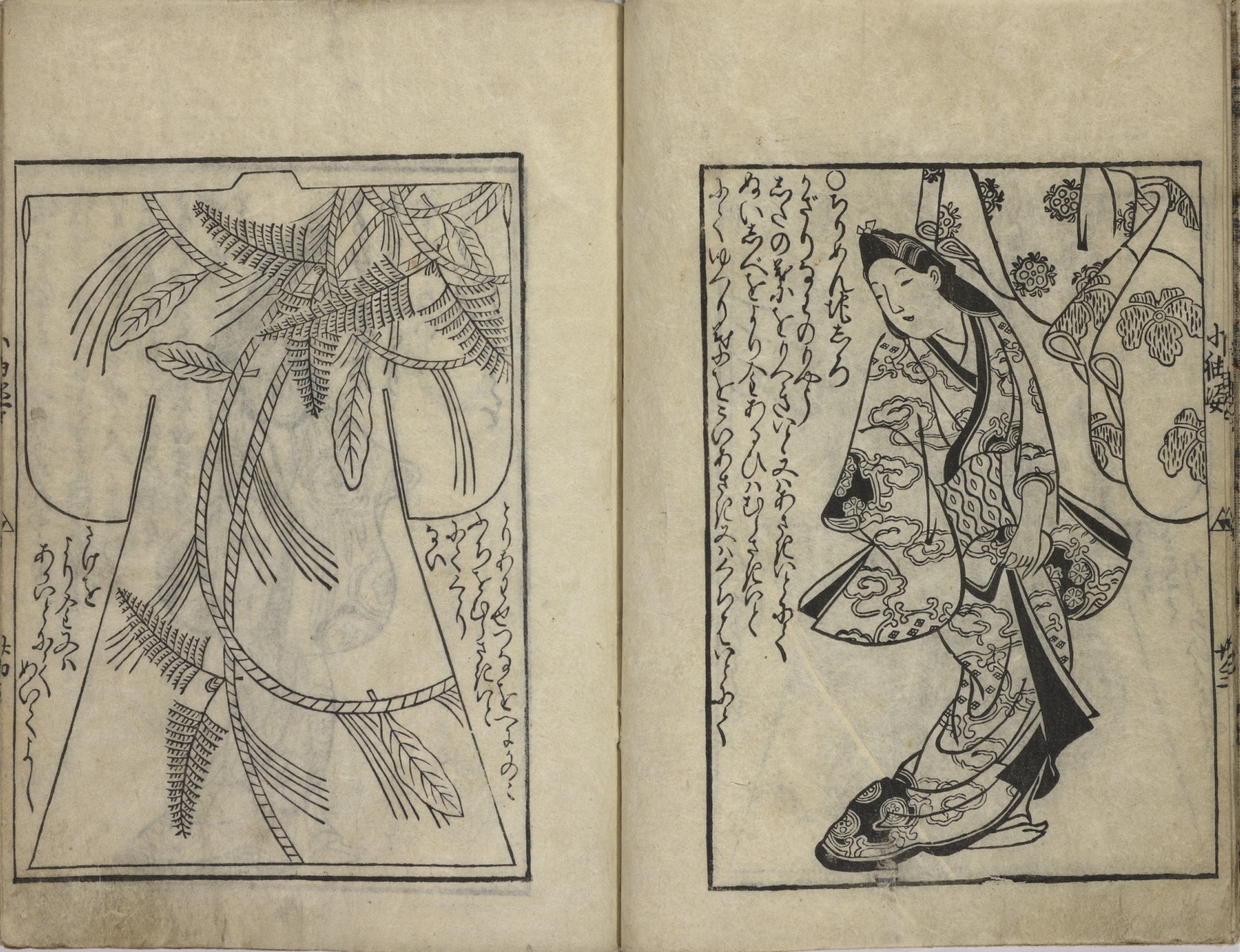
Hiragana whilst a seemingly unlikely contender has been a motif used on kimono for centuries. Text on Kimono is used often to add poetical effect to an image, in imitation of the Heian period motif of Ashida-E. Most motifs which include this in 17th century Kimono are very large often draped across the shoulder expressively on what at the time was the new silhouette of furisode, whilst modern Kimono only use this motif in smaller fonts and styles a stylistic motif to marry images and texts.[1] For example, having a waka or haiku across the front of a masters craftsmen work are some I have seen used myself, but this is an exceedingly rare and unique motif in Kimono generally speaking. Different stylsitic writing styles are used to get across different aesthetics and meanings within the space they use, as will all graphic design processes.

Hinagata-Bon showing Hiragana on Kimono design (c.1667, PD) Japan  

Historically, Ashida-E (reed writing) were a sort of insider message to those who knew the reference which the text and image correlated with during the Peace Epoch. Distinctive and 'gaudy' Kimono became the rage by the 1670s among the middle classes of Edo and Osaka due to the side effects of Tokugawa Sumptuary Legislation which saw a rise in coinage, leading to urbanisation and local industry, whose more profitable industry leaders desired exciting new ways to show their wealth due to the sumptuary legislation of their day increasingly curtailing their spending and extravagances. They got around this by buying their Distinctive gaudy Kosode made by local Machi-Eshi (Town artists) like Yuezen Hiinakatta who imitated Kakemono scrolls by writing on Kimono, a now vital trend of Genroku KTC.[2][3] This trend continued until the 18th century, but fell out of favour with new money as it was regarded as tacky, becoming instead a smaller variation by 1800 and falling out of use by 1900. Some modern kimono may use it as an advertising motif or for poetical connotation, but this is rare.

Bibliography

[1] See Bijin series #15

[2] See Essay series #8

[3] See The Bijin has Arrived in Bijin #15

Apologies that this is up a day before it should be, but honestly, I am frazzled with stress at the moment between juggling my current schedule and switching over to a new one which has been frustrating to say the least as most of the stuff that is affecting my life is out of my hands. On the plus side, it means I have more control over my schedule in the future and that I will be reopening the shop at some point in the near future, somewhere between applying for my first real career role, volunteering, part time work. full time studying, learning Japanese and slowly going absolutely insane over the absolute hair pulling out exercise that is trying to get people in cushy offices to actually answer their GODDAMN EMAILS. Either way, I am getting rather burned out and need a day off before I have to start making more phone calls, emails and frustrated page scrolling to do these peoples jobs for them and apparently also everything else that involves which is *testing* my soul. Either way, heres to the future! Sorry about the rant, I just like to be organized and this has been the month from hell for me. Toodaloo~!

Socials:

One stop Link shop: https://linktr.ee/Kaguyaschest
https://www.etsy.com/uk/shop/KaguyasChest?ref=seller-platform-mcnav 
https://www.instagram.com/kaguyaschest/ 
https://www.youtube.com/channel/UC5APstTPbC9IExwar3ViTZw 
https://www.pinterest.co.uk/LuckyMangaka/hrh-kit-of-the-suke/ 

Saturday, April 1, 2023

刺し子 | Sashiko | Little Stab Stitch | Pattern #18

Sashiko ( 刺し子 | Little Stab ) is a simple continuous running stitch design atop a surface. The stitch is slightly longer atop than on the underneath.[1] Often many Sashiko designs are done in an interlocking, repetitive or overlapping manner, often using indigo cloth and white thread.[3] The nature of Boro and Sashiko traps heat, making it more likely to be found in the North of Japan where it is colder, also helping enable the cloth to last longer. Many of the motifs common to traditional Sashiko designs are from plants, animals or nature like clouds and steam.[3] Many Sashiko techniques and styles derive from local folklore and rural communities and were made for practical everyday wear.[4][5]

Fireman's Sashiko Jacket (c.1865, PD) LACMA

Sashiko began as a practical design element for the Heimin wives of farms/fisheries to show off their Embroidery skills in making kimono, like repairing Boro Kosode.[3] Due to the influence of the sumptuary laws, most Boro and Hemp Kimono were made creative by dying them in indigo, a readily available local dye for Heimin and some Chonin who travelled around for Sankin Kotai.[4][7] Japanese firemen until the 19th century used to have their uniform made from Sashiko stitch with padding, which was drenched in water to act a shield from fire during rescue attempts.[2] By the late 17th century however, these designs began to become part and parcel of a wider revolutionary aesthetic reform of Kosode surfaces which made the Chonin look more powerful than the Samurai, which was a no-no for the Fudai and Kuge Daimyo. In a bid to curb these powerful aesthetic markers of status, the Heimin were given designated fabrics and dyes which saw a rise in the popularity of Indigo Sashiko.[4]

Hokusai's New Patterns (1824, PD/CC4.0) British Musuem, Katsushika Hokusai

By the 18th century, fashionable Sashiko Kosode used local folklore to distinguish local meanings specific to their maker and communities, like the Hoshi-ami (干し網|Fish Net) design used by fishermen's wives when making Donzu/Noragi Coats, or for some Chonin the common characteristics of their daily lives from the city.[3][5] Particularly in the merchant town of Osaka, Sashiko would have a popular infusion of mother's frugal stitchwork, and being part of the new fashionable elite emerging there. By the 19th century, these designs were incredibly intricate and were no longer done in the Boro spirit, but to show off how skilled their creator artisan/embroiderer was.[5] For example the designs of  Hokusai-Moyo ( 北斎模様 | Hokusai-patterns/designs) which were particularly popular after Hokusai published his 'New Patterns' ( 新形小紋帳 | 1824).[8]

Decorative Harakata Sashiko (2019, CC4.0) 漱石の猫

Ms Endo teaches Harakata Sashiko (2018, FU; Education) Copyright Yamagata Newspaper Broadcasting 

 With the introduction of new chemical dyes and machine made textiles, Kimono were increasingly less labour intensive by the early 20th century seeing a decline in the popularity of Sashiko designs from 1950-1980.[6] As part of the 1990s Web Kimono boom however, teachers like Kiyoko Endo (dates unknown) began teaching laymen artisans and craftspeople how Sashiko is used as a folk art (Endo teaches Harakata Sashiko, a Yonezawa style) and has become popular today in the West amongst embroiderers.

Bibliography

[1] https://www.athreadedneedle.com/blogs/with-a-threaded-needle/sashiko-kogin-hitomezashi-boro-what-are-we-stitching 

[2] https://collections.vam.ac.uk/item/O18904/firemans-hood-unknown/

[3] https://indigoniche.com/2018/06/26/sashiko-origins-and-designs/#:~:text=Sashiko%20is%20a%20Japanese%20folk,in%20repeating%20or%20interlocking%20patterns.

[4] See Sumptuary Laws (1604-1685) in Bijin #3

[5] See The Genroku Osaka Bijin (1680 - 1700) in Bijin #3

[6] https://www.inspirationsstudios.com/the-history-of-sashiko/

[7] See Patterns #17

[8] https://mag.japaaan.com/archives/113368

Social Links:

Linktree (One click to all and extended Links): https://linktr.ee/Kaguyaschest

https://www.etsy.com/uk/shop/KaguyasChest?ref=seller-platform-mcnav or https://www.instagram.com/kaguyaschest/ or https://www.youtube.com/channel/UC5APstTPbC9IExwar3ViTZw

Saturday, April 23, 2022

西川 祐信 | Nishikawa Sukenobu | 1671-1750 | Bijin #13

Nishikawa Sukenobu (active 1690/1700-1750) was a Ukiyo-E designer of illustrations for books who is mostly known for his at the time, unique, depictions of women. His repuatation in posterity is his Appreciating 100 Women (1723) which illustrated 100 different types of women in Edo period society. He was rather unusal for his time as he was based in Kyoto, away from the epicentre of popular Ukiyo-E, Edo. He was said to have been inspired by the Bijinga of Hishikawa Moronobu, who died when Nishikawa was 23.[1][2] The Nishikawa school was begun by Sukenobu sometime in the 18th century.[4]

Nishikawa grew up in the times where conservative depictions of the human figure were giving way in popular culture to lascivious depictions of beautiful people doing beautiful things, otherwise Abuna-e and the like. Indeed, keeping in mind high art depictions of worldly bodies were Matabei's experimental portrait in 1650, perhaps inspired by the Kano schools fascination with the exotic beginning in the 1590s, the outcome by the 1680s of the accepatability of 'Urban activities' (having coetus) being shown in books was quite a leap. All male Kabuki, Chonin-Komin relationship and Sumptuary laws defined whatever education Nishikawa may have recieved.[3] This primary education was most likely with Tosa Mitsusuke (1675-1710) & Kano Eino (1631-1697) between 1680-1700.[4]

Sukenobu appears to have being considered a skilled artisan who operated just beyond the boundaries of the Emperors art court due to his popularity in Osaka and Kyoto. His style of melding, fusing and blurring styles with Ukiyo-E highlights and his connections to the court allowed to run a successful venture in painting and designing illustrated Ukiyo-e novels (Ehon Komin) by 1699. Other fun caveats are that he also produced Hinagata-Bon, and Shunga by 1711 in a softer or more refined nature than preious raunchier works.[3]

Bijin and the clock (c1708, PD) Nishikawa Sukenobu

Nishikawas Remix Bijin

The Nishikawa Bijin though can be said to follow quite a number of conventional attribution to its predecessor from the Tosa school such as small appendages, facial features and composition. What seems to be new from my understanding here is that of the focus of the image on the bodily form than on other items in the image. Sukenobus backgrounds are rather sparse and uncomplicated in their details, and seem to take after the backgrounds of Bijinga Kakemono which more often omit than include details. It is this melding of popular (Chonin), high (Court or Tosa), and fine art (Komin or Kano) features which make a Nishikawa picture.[3]

Nishikawas Bijin were particularly popular due to their many postures and clearly are something Nishikawa practiced a lot of, and this is reflected in his legacy around the Osaka-Kyoto area as many of his poses were copied for many years.[3] One such Artist who he left an impression on, being Suzuki Harunobu (1725-1770) no less.[2]

The Bijin depicted above follows the regular conventions of the Yamato-E style, but again, fuses the figures in a new way. Small hands and feets for example are recognisably still in favour with Sukenobu at this juncture, but he also uses a more slender and elongated figure than was totally in fashion for the early 18th century. The wash of colours have the application of a woodcut block draftsmans hand, but the Bijin clearly follows conventional Kosode motifs for a Yuujo. What this image is essentially saying, is that by this time (around 1720) the Chonin had become familiar and comfortable with the fleshy body being displayed in art, unlike a majority of court art which still focused on Chinese and Buddhist themes.

Perhaps the popularity of Nishikawa was his use of colour, which showed the touch of an artist, rather than that of a woodcutter in his handling of the application of bold pallettes for the time. In the Western sense of the word, he can thought of as the Victorians did of Illustrators in the Golden Age of Illustration (1875-1930), that is as an illustrator first than painter first. Nishikawas Bijinga with brash reds, understanding of fabric draping across the body, and technology like European clocks all spoke to the more widespread acceptance of the exotic which the Kano school first adopted, and which GKTC reflected as part of townspeople culture.

Conclusion

In context, we see that Nishikawa was popular due to the makeup of Japanese society at the time, in the developing Komin-Chonin relationship as Merchants changed with their wallets the what the new taste for fashionable art could be between 1675-1725. Nishikawas ability to blend components such as Draped fabrics, a focus on the flesh and his background in Yamato-E clearly appealed as an exciting new 'Japanese' take of the exotic into the mundane. Nishikawa brought a refined painters brush to more risque elements of Chonin culture, making the brashness more respectable and closer to what the elites may have thought of as an acceptable Japanese aesthetic, buying into the Iki inclination of this time so to speak. Nishikawa brought together, as did Matabei in the 1640s, the world of High and Lowbrow art and their affiliated artforms and thus the Bijin-ga genre became an acceptable artform rathern than just what the elites may have thought of as the 18th century version of Waifu compilations on someones harddrive today.

Bibliography

[1] https://en.wikipedia.org/wiki/Nishikawa_Sukenobu

[2]  https://www.britannica.com/biography/Nishikawa-Sukenobu

[3] https://www.viewingjapaneseprints.net/texts/ukiyoe/sukenobu.html

[4] https://www.britishmuseum.org/collection/term/BIOG6262

Bijin Series Timeline

11th century BCE

- The Ruqun becomes a formal garment in China (1000 BCE) [Coming Soon]

8th century BCE

- Chinese clothing becomes highly hierarchical (771 BCE) [Coming Soon]

0000 Current Era

7th century

Asuka Bijin (from 600) [Coming Soon]

8th century

- Introduction of Chinese Tang Dynasty clothing (710)

- Sumizuri-e (710)

- Classical Chinese Art ; Zhou Fang (active 766-805) ; Qiyun Bijin

- Emakimono Golden Age (799-1400)

15th century 

- Fuzokuga Painting schools; Kano (1450-1868) and Tosa (1330-1690) 

- Machi- Eshi painters; 1336-1650? [Coming Soon] 

16 century 

- Nanbanjin Art (1550-1630) 

- Wamono style begins under Chanoyu teachings (c1550-1580)

- Byobu Screens (1580-1670)

 - End of Sengoku Jidai brings Stabilisation policy (1590-1615)  

17th century  

- Land to Currency based Economy Shift (1601-1655)

- Early Kabuki Culture (1603-1673) ; Yakusha-e or Actor Prints

- Sumptuary legislation in reaction to the wealth of the merchant classes (1604-1685) 

- Regulation of export and imports of foreign trade in silk and cotton (1615-1685)  

Iwasa Matabei (active 1617-1650) ; Yamato-e Bijin  

The Hikone Screen (c.1624-1644) [Coming Soon]

- Sankin-Kotai (1635-1642) creates mass Urbanisation  

- Popular culture and print media production moves from Kyoto to Edo (1635-1650); Kiyohara Yukinobu (1650-1682) ; Manji Classical Beauty

- Shikomi-e (1650-1670) and Kakemono-e which promote Androgynous Beauties;

 Iwasa Katsushige (active 1650-1673) ; Kojin Bijin

- Mass Urbanisation instigates the rise of Chonin Cottage Industry Printing (1660-1690) ; rise of the Kabunakama Guilds and decline of the Samurai

- Kanazoshi Books (1660-1700); Koshokubon Genre (1659?-1661)

- Shunga (1660-1722); Abuna-e

Kanbun Master/School (active during 1661-1673) ; Maiko Bijin 

- Hinagata Bon (1666 - 1850) 

- Ukiyo Monogatari is published by Asai Ryoi (1666) 

Yoshida Hanbei (active 1664-1689) ; Toned-Down Bijin

- Asobi/Suijin Dress Manuals (1660-1700)

- Ukiyo-e Art (1670-1900)

Hishikawa Moronobu (active 1672-1694) ; Wakashu Bijin

- Early Bijin-ga begin to appear as Kakemono (c.1672)  

- Rise of the Komin-Chonin Relationship (1675-1725)

- The transit point from Kosode to modern Kimono (1680); Furisode, Wider Obi 

- The Genroku Osaka Bijin (1680 - 1700) ; Yuezen Hiinakata

Sugimura Jihei (active 1681-1703) ; Technicolour Bijin 

- The Amorous Tales are published by Ihara Saikaku (1682-1687)

Hishikawa Morofusa (active 1684-1704) [Coming Soon]

- The Beginning of the Genroku Era (1688-1704)

- The rise of the Komin and Yuujo as mainstream popular culture (1688-1880) 

- The consolidation of the Bijinga genre as mainstream pop culture 

- The rise of the Torii school (1688-1799) 

- Tan-E (1688-1710)   

Miyazaki Yuzen (active 1688-1736) ; Genroku Komin and Wamono Bijin 

Torii Kiyonobu (active 1688 - 1729) : Commercial Bijin

Furuyama Moromasa (active 1695-1748)

18th century

Nishikawa Sukenobu (active 1700-1750) [Coming Soon]

Kaigetsudo Ando (active 1700-1736) ; Broadstroke Bijin

Okumura Masanobu (active 1701-1764)

Kaigetsudo Doshin (active 1704-1716) [Coming Soon]

Baioken Eishun (active 1710-1755) [Coming Soon]

Kaigetsudo Anchi (active 1714-1716) [Coming Soon]

1717 Kyoho Reforms

Miyagawa Choshun (active 1718-1753) [Coming Soon]

Miyagawa Issho (active 1718-1780) [Coming Soon]

Nishimura Shigenaga (active 1719-1756) [Coming Soon]

Matsuno Chikanobu (active 1720-1729) [Coming Soon]

- Beni-E (1720-1743)

Torii Kiyonobu II (active 1725-1760) [Coming Soon]

- Uki-E (1735-1760)

Kawamata Tsuneyuki (active 1736-1744) [Coming Soon]

Kitao Shigemasa (1739-1820)

Miyagawa Shunsui (active from 1740-1769) [Coming Soon]

Benizuri-E (1744-1760)

Ishikawa Toyonobu (active 1745-1785) [Coming Soon]

Tsukioka Settei (active 1753-1787) [Coming Soon]

Torii Kiyonaga (active 1756-1787) [Coming Soon]

Shunsho Katsukawa (active 1760-1793) [Coming Soon]

Utagawa Toyoharu (active 1763-1814) [Coming Soon]

Suzuki Harunobu (active 1764-1770) [Coming Soon]

- Nishiki-E (1765-1850)

Torii Kiyonaga (active 1765-1815) [Coming Soon]

Kitao Shigemasa (active 1765-1820) [Coming Soon]

Maruyama Okyo (active 1766-1795) [Coming Soon]

Kitagawa Utamaro (active 1770-1806) [Coming Soon]

Kubo Shunman (active 1774-1820) [Coming Soon]

Tsutaya Juzaburo (active 1774-1797) [Coming Soon]

Utagawa Kunimasa (active from 1780-1810) [Coming Soon]

Tanehiko Takitei (active 1783-1842) [Coming Soon]

Katsukawa Shuncho (active 1783-1795) [Coming Soon]

Choubunsai Eishi (active 1784-1829) [Coming Soon]

Eishosai Choki (active 1786-1808) [Coming Soon]

Rekisentei Eiri (active 1789-1801) [Coming Soon] [https://commons.wikimedia.org/wiki/Category:Ukiyo-e_paintings#/media/File:Rekisentei_Eiri_-_'800),_Beauty_in_a_White_Kimono',_c._1800.jpg]

Chokosai Eisho (active 1792-1799) [Coming Soon]

Kunimaru Utagawa (active 1794-1829) [Coming Soon]

Utagawa Toyokuni II (active 1794 - 1835) [Coming Soon]

Ryūryūkyo Shinsai (active 1799-1823) [Coming Soon]

19th century

Teisai Hokuba (active 1800-1844) [Coming Soon]

Totoya Hokkei (active 1800-1850) [Coming Soon]

Utagawa Kunisada Toyokuni III (active 1800-1865) [Coming Soon]

Urakusai Nagahide (active from 1804) [Coming Soon]

Kitagawa Tsukimaro (active 1804 - 1836)

Kikukawa Eizan (active 1806-1867) [Coming Soon]

Keisai Eisen (active 1808-1848) [Coming Soon]

Utagawa Kuniyoshi (active 1810-1861) [Coming Soon]

Utagawa Hiroshige (active 1811-1858) [Coming Soon]

Yanagawa Shigenobu (active 1818-1832) [Coming Soon]

Utagawa Kunisada II (active 1844-1880) [Coming Soon]

Toyohara Kunichika (active 1847-1900) [Coming Soon]

Tsukioka Yoshitoshi (active 1850-1892) [Coming Soon]

Toyohara Chikanobu (active 1875-1912) [Coming Soon]

Kiyokata Kaburaki (active 1891-1972) [Coming Soon]

Goyo Hashiguchi (active 1899-1921) [Coming Soon]

20th century

Yumeji Takehisa (active 1905-1934) [Coming Soon]

Torii Kotondo (active 1915-1976) [Coming Soon]

Yamakawa Shūhō (active 1927-1944) [Coming Soon]

Social Links

One stop Link shop: https://linktr.ee/Kaguyaschest

https://www.etsy.com/uk/shop/KaguyasChest?ref=seller-platform-mcnav or https://www.instagram.com/kaguyaschest/ or https://www.youtube.com/channel/UC5APstTPbC9IExwar3ViTZw https://www.pinterest.co.uk/LuckyMangaka/hrh-kit-of-the-suke/ 

Also might it be added whoever decided in the last week to put my blog through plagiarism dot commercial, please see Section 107 of the Copyright Act in the US, fair dealing in Section 29 of the Copyright Act of Canada (1921-1997) and Copyright Modernization Act (2012), https://www.gov.uk/guidance/exceptions-to-copyright in the UK and keeping in mind that this blog is purely non-commercial and therefore falls under these pieces of legislation. Japanese related content such as the image above is taken from Wikimedia Commons and therefore fall under the jurisdiction of their original posters to place them into a Creative Commons framework (RIPublic Domain Aaron Schwartz, may the mouse repent and long live the rat). Most of these works, as above, have entered the Public Domain. If you wish to remove any of your copyrighted material, please feel free to contact me with the knowledge I reserve the right to use some works under fair use and for non-commercial purposes. If this is in regards to text passages, these can be omitted quite easily and I will very happily take anything from 1925 on down upon request, within a reasonable timeframe. If you are a Japanese copyright owner, please note your copyright ownership rights are for works in which thoughts or sentiments are expressed in a creative way, and which falls within the literary, scientific, artistic or musical domain. Honestly, work not being able to be regarded as public domain, instead the property of corporate persons (companies) is highly damaging to the moral and ethic fabric of society and detrimental to the advancement of our knowledge, research and studying of the materials we have. Please remember that plagiarism is yes, stuffed up, but at the same time, this blog is not a commodity, it is for research and educational purposes only. It is something I enjoy learning and sharing and I do not believe that everything should be locked away behind a paywall simply so that ALADDIN can be satisfied. If you do not understand what I am sourcing from, the nature of the allowances or anything else you feel, all of my contact info is on every blog post, and also, please be creative commons literate and aware. 

Saturday, October 30, 2021

元禄織物における小袖と職人の新たな役割 | Jo/GKTC and the new role of the Komin | 1666-1704 | Essay #8

 This essay will return back to GKTC (Genroku Kimono Textile Culture ; 1688-1704) and JoKTC (Jokyo K.T.C. 1684-1688) and the new role of the Komin (Artist caste) in GKTC. JoKTC is notable for being the lead up to GKTC, JoKTC being characterised by its transitory nature in comparison to GKTC, which was far more bold in its relations to what Kosode could and should be. Komin entered the picture at this juncture, and I shall elaborate a little more here than in other posts about why that was. GKTC is notable for its elaborate, perhaps gaudy and innovative Kosode design features, whilst JoKTC more so for the enabling factors of the time, as a sort of incubatory GKTC.

Shibori Chrysanthemum Kosode design ground on Indigo Satin (17th century) Tokyo National Museum

Land to Money Economy

During the Muromachi period (1336-1573), local coinage supply was insufficient and too sporadic to totally meet Japanese demand, and was supplemented by Ming Chinese coins. Instead, the economy was regulated in Rice stipends by the Kokudaka (rice system?) as a land economy, overseen by rice brokers, who made their money by storing Daimyou rice crops in their storehouses. However with the end of the Sengoku Jidai and stabilisation policies promoted by the Tokugawa, coins began to become a rival form of currency by the Tenna period.[3] By this time, the Kyoto and more so Osaka ricebrokers had developed comprehensive networks of storehouses, which they exchanged for tickets, an early form of paper currency. As the economy stabilised and the need for war evaporated, and domestic market demand increased[14] A system which dirty dirty Chonin (in the mind of the Kuge) came to use as they were unable to make ends meet by hoping Kuge senpai might notice them. By 1601, coinage became standardised. Local trade networks for things such as imported goods and 'dirty' trades developed, and on the back of this Chonin began their own business between 1610-1630, bolstering work for tradesmen (cart-sellers and day labourers).[1][2] From 1635 the abolishment or decline of trade monopolies in the Bunkoku 分(国 ; trading zone) by the upper class merchants (the likes of Murayama Tōan) from schemes like the Itowappu Nakama (Silk Guild), broke up even more industries into wider unregulated trading goods. Urbanisation from 1635-1665 then saw to the rise of cottage industries to supplment the replacement of rice to coin. 

1666-1681

With the lasting effects of population upheaval, the rise of the merchant class and transfer of wealth distribution from samurai to Chonin castes, the landscape of Japanese demographics changed heavily from 1635-1660. The Kambun (1661-1673) and Enpo (1673-1681) eras saw mild shifts in the acceptability of beauty standards, a shift in power dynamics between geo-political centers of soft power figureheads, and the rise of the printing industry.[1] This led to the Yakusha-e, Hinagata Bon and many other images and rules surrounding the acceptability of fabrics, conduct, expense, design and persons surrounding the design of Kosode.

Kosode Designs (1677) Hishikawa Moronobu

Kosode at the time conformed to both regulations and certain beauty standards. Regulations depending on the era (becoming more stringent after 1670) often forbade Chonin from taking on particularly luxury fabrics and dyes like gold, red, or some silks and wearing them in public. Beauty standards forbade this as well, so simple was the call of the day for Kosode designs in Hinagata Bon of the day. Kosode in this time often had colour schemes strictly of no more than 2-3 colours for wealthier Chonin, and the Heimin (farmers, leather workers, tanners) often made do by having a single base colour which contrasted against another relief design feature such as Shibori. Beauty standards often encouraged the design to incorporate Japanese motif instead by referring to allegory, scripture or popular culture instead of splashing the cash.

Therefore from 1608-1665:

- Rise of the publishing industry (1608-1670) 

 - Land to Money Economy (1615-1660) 

 - Urbanisation (1635-1665) 

1681-1684

In the Tenna period the delicate balance of societal wealth distribution fell in favour of the Chonin, who by now had amassed a wealth greater than the stipends of their samurai counterpart's Koku stipends. The Tenna period saw the rise of local industries particularly around the production of Japanese made silks, as part of the governments fights with Chinese and Japanese piracy and tariffs on incoming Chinese silks which were being sold on the cheap. With this came the decline of the trade guilds in the Bunkoku and the rise of the thrifty Chonin wholesale merchant.

Osaka

Osaka in particular was known for its nifty and thrifty Chonin who had a large market share of rice brokerage.[14] With the ebb and flow of the Itowappu system, this gave rise to the financial power of the Chonin (almost black) market by 1685. Osaka merchants lived nearby to import markets and also to Kyoto, where most silk was produced at the time, making it an ideal location giving its already built up infrastructure, and cheaper prices than Kyoto levels. Osaka merchants prominently were known for their wealth, and were reknowned for their nouveau riche lifestyles as such due to their newfound wealth, a regional Japanese stereotype which has stuck ever since.

However whilst particularly prominent in Osaka, all Chonin during Tenna more so appreciated the finer; material, things in life. Samurai were more so at the time buying other goods such as roof tiles for their leaky palaces and creaky moats. Chonin tastes had with their abundant mastery over their own little corporations, come to enjoy greater say in the wider society they lived in as wealth distribution shifted in their favour. In this way, Chonin became the arbiters of taste during the Tenna period when regulations were somewhat lax and spending habits high.[6] 

With increased expenditure however, came more problems for the Chonin. Problems such as their refinement, karmic influence and worldly standing. It was a world of hedonism certainly by Medieval European standards, and this saw the launch of popular trends amongst Chonin. Chonin would often compete to outdo the other, certainly in the bigger cities of Osaka, Edo and Kyoto. Kosode design became more elaborate and distinct, allowing the Heimin a complicit understanding that the wearer of finer Kosode were well-to-do, well off and were learned individuals, literate in the Buddhist texts, popular tales of the day, the classics, up-to-date on the latest art trends and who had access to the latest and greatest Kabuki and cash-spalshing textiles such as fine silks, gold embroidery and the ever coveted Beni. As such, artist became ever more involved in the creation of these elaborate Kosode, as they became evermore bespoke and tailored to their first wearers.

The Four occupations (1883) Ozawa Nankoku

The Artisans

Komin, otherwise known as the artist group under Confucian teachings, forming the theoretical Ko caste of the Shi-no-ko-sho ( Four Occupation Groups; Scholars/Warriors: 士 Farmers/Heimin:  Artisans: 工 Merchants: 商 ) which had been in use in China since their Warring States Period (403-221BCE) and introduced by the Tokugawa in their bid to bring about stability.[4][5] Often in Tokugawa Japan however, the Ko and Sho castes overlapped frequently, and as such, are an unreliable category set but are useful as a framework understood at the time by Japanese writers. A Komin as such, is a person who makes art, or works in a craft. For Japanese creatives, this is a blurry distinction as art and crafts are one in the same process, unlike in the West when during the Renaissance they split under secularisation during the Enlightenment period through the rationalism (in the art world, nature) vs empiricism (mechanised) debates into Art (divine works of nature) and the lesser crafts (mechanial and hand labour work) in the Occident. Komin often were poor creators, and relied heavily on the patronage of wealthier clients and patrons, particular in the 17th century.

Komin as such accepted work for clients. At the beginning of the 17th century, most of their work was more purely religious based iconogrpahy to accompany religious texts or to adorn castles, later alongside Buddhist catechisms. This changed though, with the inclusion of increasing numbers of wealthier Chonin merchant clientele in the later half of the century. Komin would principally still at first be asked to create images or scrolls for religious or pious reasons in the 1650s. By the 1660s, the scrolls begin to become a little saucier, a bit of neck, some wrist here and there. By the 1670s the mass print has become available for pennies, and by the 1680s these have become full on Abuna-e, Richards, Lady Gardens and all. These tastes would have been reflected in the homes certainly of a few Chonin, as these were printed and bought by the masses, not just the sleazier Sho.

As such great relationships between the Komin and Chonin had developed by the 1670s. These symbiotic relationships complemented one another when we consider that if a book wasnt selling like hotcakes, the addition of a good painter and some Abuna-e certainly may shift it from the peddlers streetside cart or Gyosho Bako (Merchants box). The earlier and more interesting melding of the Komin and Chonin though however may more likely have come from earlier channels. Evidence exists that as Chonin became ever more regulated under the Sumptuary regulations of the Tokugawa, they sought other avenues to spend their lavish fortunes. This by the 1660s had become Kosode, as evidenced by the Hinagata Bon, the earliest extant examples of which come from 1666. 

Kosode as such were being designed by Komin book illustrators, painters, and designers. This was beneficial for the Chonin, as whilst imparting their well placed patronage of the arts and reflection of their knowledge of the Chinese classics in their choice of motifs, it was also a wise investment, as when the Kokudaka collector came collecting, he had no warrant to collect Kosode, which unfortunately for the state, was not rice. Iemitsu really liked rice you see.[5] Instead, by the 1690s certainly, this proponent of Osaka and Edo Kosode design, had become one of the main features of GKTC.

Hishikawa Moronobu

Hinagata Bon and Wakashu (1682) Hishikawa Moronobu
100 Japanese Women (c1685-1694) Hishikawa Moronobu

Hishikawa Moronobu was a defining Komin of the 1670s and 1680s lead in to Genroku period. From 1683, his publisher was Urokogataya Sanzaemon  active c1677-1694).[7] Indeed by the Genroku period, Moronobu was considered to be the  founder of Ukiyo-e, such was his popularity. As a Komin, Moronobus style was greatly admired, and his personal style became one of the most desired formats at the time.[8] Moronobu, who came from a family of textile designers, contributed to GKTC in his creation of Hinagata Bon to capitalise on his success. His designs were not particularly groundbreaking, often relying on Buddhist iconography in their motif, but were more so popular in the Abuna-e, which most likely caused Moronobus Wakashu styled Kosode to enter vogue.[9]

Yuezen Hiinakata

See the right hand side Kosode for the effect (c1686) Unknown

Yuezen was a significant trendsetting monk Komin who made large text and calligraphy painting styles popular on Kosode. Yuezen developed a vogue in GKTC for large calligraphic text to sprawl across, usually, the right hand side of the upper Kosode sleeves and back, imitating the style found on Kakemono scrolls.[11] This style was popularly designed using Shibori or stencilling techniques at the time.

Yuzen Miyazaki

 Yuzen influenced Kosode (c1700,CC1.0) Daderot, Ishikawa Prefectural Musuem of T. Arts & Crafts 

Miyazaki (1654-1736)[6] was a fan painter and creator of the Yuzen dying technique. Yuzen contributed to GKTC by creating Yuzen dyeing by applying rice paste to resist-dye cloth, which he called Yuzen-zome ( 友禅染 | resist-paste design ). His painting style was also immensely popular and featured on a number of Kosode from the time by painting his fan designs directly onto the surface of Kosode which became popular by 1688. By 1690, Yuzen had become a widely established tecnhique which was popular certainly with the Kyoto Chonin classes.[10]

Ogata Korin

Karamonoya store, these spread Korins art across Japan (1798) Niwa Tohkei

Ogata Korin's family owned a family goods store in Kyoto in his younger years, which supplied textiles to the Empress Toufukumon-in (1607–­1678) at her court, which inspired his own designs reflected by incorporating textiles design techniques such as repetition stencilling into his paintings and screens. It is likely that this will have been how Ogata the painter and Ogata in the textile world were introduced to one another. Korin certainly set the late trends of motifs at the end of the Genroku period. By 1700 these had become Korin monyou (motifs) which were popularly reproduced in varying styles in Hinagata Bon, which were mostly bought by the wealthy or elites of Kyoto who could afford them. These patterns became popular when Kabuki actors wore them onstage, setting the trend for these designs and thus disseminating them amongst the general populace. Examples included Ogata's rounded flowers and distinctive shading. His customers included Nijō Tsunahira (1672–­1732), Nakamura Kuranosuke (1668–­1730) and Sakai and Tsugaru Daimyo families.[6] 

The Komin therefore played a definitive role in the development of the new aesthetical and DIY craft sensibilities brought into vogue in GKTC. When Chonin became their patrons, Komin's work was elevated to new heights in setting trends and defining popular new design aesthetics. Komin frequently were already established as painters or from wealthy families already familiar with textile design, which is how the easy switch of occupation from potter, painter or weaver to designer was allowed, celebrated and circumvented in Japanese society. This was accomplished however, by the elevation by previously unfit peoples, such as the money handling Chonin class, into the Komin class as a way to elevate the station of the Chonin themselves befitting of their new monetary and financial clout without threatening the status quo held in the Shinokosho system in the Genroku period.

In context therefore we can see that the Tokugawa stabilisation policy led to deliberate and direct control of the import/export market through the transformation of the Japanese economy from a land-based to money-based society. These had the effect of increasing urbanisation which led to the growth of local home industries owned by wealthy Chonin, primarily for our interests in the concentration of publishing. This increase in wealth distribution altered the layout of the landscape of art patronage, leading to an increased visibility of Chonin as tastemakers, following the Kabuki actors who were trendsetters.[12] This was primarily by 1688 lead by the Kyoto and Osaka merchants who defined tastes by their patronage of particular Komin.[13] Komin therefore heavily influenced popular GKTC, as they became the innovators of new dye, painting and motif techniques such as the Yuzen dye technique. This lead to the advancement and progression by 1700 of established GKTC, a particularly more 'crass' set of design aesthetics than the leading samurai classes hoped the Heimin to hold. 

Essay# 9 will cover a little on Tagasode Byobu.

For more see this lecture :  https://www.japaneseartsoc.org/2021/04/lecture-the-birth-of-fashion-in-japanese-textile-art/

Bibliography

[1] See Bijin #8

[2] https://en.wikipedia.org/wiki/Japanese_currency

[3] From the Tokugawa period to the Meiji Restoration, Eijiro Honjo, 1932, Vol. 7, pp.32-51, Kyoto University Economic Review

[4] https://en.wikipedia.org/wiki/Four_occupations

[5] https://en.wikipedia.org/wiki/Edo_society#Four_Classes

[6] https://quod.lib.umich.edu/a/ars/13441566.0047.006/--sartorial-identity-early-modern-japanese-textile-patterns?rgn=main&view=fulltext#N2

[7] https://www.britishmuseum.org/collection/term/BIOG7145

[8] https://www.britishmuseum.org/collection/term/BIOG4068

[9] See Bijin #2

[10] https://en.wikipedia.org/wiki/Miyazaki_Y%C5%ABzen

[11] https://fashiondocbox.com/Accessories/70488710-Toomey-1-kosode-and-the-class-system-of-edo-period-japan-caroline-toomey-art-history-106-art-in-east-asia.html

[12] See Bijin #3

[13] https://ja.wikipedia.org/wiki/%E5%85%83%E7%A6%84%E6%96%87%E5%8C%96

[14] https://en.wikipedia.org/wiki/Rice_broker

Social Links

One stop Link shop: https://linktr.ee/Kaguyaschest

https://www.etsy.com/uk/shop/KaguyasChest?ref=seller-platform-mcnav or https://www.instagram.com/kaguyaschest/ or https://www.youtube.com/channel/UC5APstTPbC9IExwar3ViTZw https://www.pinterest.co.uk/LuckyMangaka/hrh-kit-of-the-suke/


Sunday, April 18, 2021

井原 西鶴 | Ihara Saikaku | 1642-1693 | Bijin #3 | The Genroku Bijin

Ihara Saikaku, born Hirayama Tōgo (平山藤五), was a Japanese poet and creator of the "floating world" genre of Japanese prose (ukiyo-zōshi). He was the son of a wealthy merchant in Osaka, and by 1662 he became a haikai-no-renga (俳諧の連歌| linked-verse-haiku-chain) master and began to establish himself as a popular haikai poet. In 1670, he had become an established writer with his own writing style, which frequently depicted merchants or Chonin (町人|'town-people') in their natural habitat, The pleasure districts. In 1675 his wife died and he composed a hella long poem, taking 12 hours to write, written in her memory. It is said that it is this which prompted him to began writing novels. When his youngest daughter also died, he became a non-practicing-monk and began travelling around Japan. By 1677 he returned to Osaka, and hearing of the success of his 1675 poem took up writing again.

He then began writing prose fiction and he had published The Life of an Amorous Man (1682), The Great Mirror of Beauties: Son of an Amorous Man (1684), Five Women Who Loved Love (1685), The Life of an Amorous Woman (1686) and The Great Mirror of Male Love (1687) which was particularly detailed, and Comrade Loves of the Samurai (1687, Translated Collation). These later works have aged like good wine so to speak, as they were highly popular at their time of release (puns) and have remained incredibly popular among the LGBTQIA community today for their elaborative detail in Japanese history on the matter, popularised in the UK by Edward Carpenter himself (1844-1929).[1] These Erotica drew on Ihara's Chonin stories, which are said to be both satirical and comical.[2] His style was said to be so outlandish its only reference point was to the exotic 'Dutch' styles brought in by Dutch sailors into Dejima. His 1686 'Amorous Woman' novel is best remembered.[3] In 1952 it was made into the Life of Oharu.[4]

Yonosuke with a Telescope (1686) Ihara Saikaku

From Osacca to Iedo (1680)

Ihara had begun upping-the-ante and created incredibly lude E compared to what had gone before in Japans historical figure art (the majority, even in Abuna-e being clothed up to this time). His accounts were mostly like saucy novellas of the lives of people from the new wealthy Chonin and their lovers, but its Osaka. His 1682 novel for instance, has the protaganist Yonosuke, who from 6-60 goes about on a island populated only by women in a bid for devoted love. These books were written to be circulated by the wider public, but the market was made due to the demand for merchant whimsy fulfillment, particularly around the pleasure district genre.[3] 

A Pleasure district worker, flashing their ankles (1723) Nishikawa Sukenobu

As a result of his works being set amongst the Chonin, his works are both evocative of a sort of new-money beauty, which was considered rather tacky amongst the upper samurai of the time. There is indeed a lot of questionable material, but also offer a glimpse into the average kosode of the time, and some of the varied levels beauty began to take. Cheap to the rich, is not cheap to the poor as we all well know, you can only afford so many Obi before customs comes for your neck on a silver platter after all.

The kosode seen in the Sumizuri-e accompanying his 1682-1687 erotica therefore are a good indicator of what consituted the Chonins Bijin so to speak. Whilst images of finely dressed Tayuu were common to the hoi polloi as they would have been seen parading down the long avenues with their 2 child attendants and set trends, this was more of a trickle-down-economics approach. The Kosode popular in these E therefore are simpler, often using only one motif and one colour. Richer Chonin have more motifs, more colours etc but this is also due to the constraint of the sumptuary laws set by the Tokugawa Shogunates Government. This was particularly true in Osaka, a city known in Japan for its big-spenders (Japanese stereotype not mine), in the vein of Kaneo Takarada from Kill la Kill.

Ihara's Bijin in his Suzumuri-e reflected national standards and as such are reflective of the wider merchant patronage of the arts, which lead to the creation of the new textile culture in the Kansai region in the Genroku period, leading to the merchants patronage of Genroku textile culture by Osaka Genroku Nakama. This textile culture however sprang from a combination of:-

 - Stabilisation policy after civil war (1590-1615) 

 - Sumptuary legislation in reaction to the wealth of the merchant classes (1604-1685) 

 - Regulation of export and imports of foreign trade in silk and cotton (1615-1685) 

which merchants combated by using workarounds to create new kosode cultures through art patronage, woodblock prints and by merging old artforms together to create unique new kimono and art objects.

A spot of wrestling, in the fashions of 1702 (c.1711-16) Artist Unknown

Sumptuous Silky and Silvery Sanctions and the rise of the Chonin (1590-1700)

Sankin Kotai procession

Stabilisation Policy (1590-1615)

With the end of the Sengoku Jidai (戦国時代|Age of the country at war) over the Keicho period (1596-1615) came the emergence of the Sankin Kotai, when people began to move into the cities to be with their newly roving lords at first, and later to engage in the business that catered to the roving lords, with merchants owning a store in the city, and another in the countryside.[9] This was due to a policy of stabilsation and appeasement furthered by the last of the 2 unifiers of Japan, Hideyoshi Toyotomi and Ieyasu Tokugawa. Policy changes included the 1596 Hideyoshi edict which removed a large number of swords from practicing samurai in an effort to curb violent crime for example. The 1590's brought an increased trade for Kyoto Nishijin-ori silk merchants amongst these stabile trade conditions from wealthy clients.[8] 

Instability however until 1615 however was rife with vigilante justice, with many Kabukimono (傾奇者|samurai gangs) & Machi-yakko (町奴|village paramilitiaries) who comprised the leftover Ronin (wandering samurai) left behind or without an overseer due to the end of Japan's many civil and local wars, which the policies aimed to regulate by creating new national workforces and systems for these displaced persons.[18] Machi Yakko contributed to the disruption of these policies by practicing non-conformity, one of their Mon crests for example combined a Kama (sickle), Wa (Circle) & the Kana phoneme for 'nu' to make Kama-wa-nu, literally "who cares", which directly questioned the political authority of sumptuary laws and the bias class structures at a time when mass hunger and infanticide were common amongst townspeople, but not amongst their ruling overlords.[11]

Osaka posh totties (1680) Tamura Suio

Sumptuary Laws (1604-1685)

Sumptuary laws simply put in England were used to dictate who could wear what colours, type of clothing, furs, fabrics, and trims from the serfs to the King. This was to establish class hierarchy, or material textile culture (so why we think Velvet is a fancy material for example, as it was Henry VIII's textile of choice) and also to regulate the English textile industry in exports and imports to bring revenue into England and to keep it out of France (a tough job as English exports were basically wool and the itchy grey broadcloth). This general idea times by about 100 applies to why the Shogunate governate regulated the Japanese textile culture and market. Whereas England has tips, Japan had R-U-L-E-S.[5] From arguably 1604-1684, new laws were put in place to try to limit the expediency of frugal Chonin. However by 1688-1720, these new Chonin had become wise to the sumptuary laws and began becoming patrons of the arts. The Chonin's spending power was vast under military policy, and and during the Kan'ei-Enpo periods (1624-1681) began to be spent on Kabuki actors and around pleasure districts. These designs quickly began to be flashier and often outshone the Kosode worn by the Bakufu (幕府|tent-government). Eventually to save face, the upper classes began to adopt these evermore expensive outfits, to keep up with the times.[9] This however became an increasingly non-option for the Bakufu who were used to living above the peasants, not borrowing from them.

Tsumugi Silk on the left; Ie, cheapy scratchy silk

Sumptuary laws stipulated things such as what fabrics and dyes could be used based upon a persons rank, decided by bloodlines at the time. The lowest of society like farmers (principally merchants though), for instance could not wear silk unless it was Tsumugi silk (waste-silk), Hemp, arrowroot, wisteria or Tilia Japonica fibres instead. The Hollyhock, Paulownia and Chrysanthemum and Beni/Murasaki dye only being allowed to be worn by nobility etc etc.[11] Merchants were later denied wearing red by the late 18th century as it was a sign of nobility and so on. This went further when considering how merchants came by their fortunes, as noble Japanese men only were allowed to make their fortunes by selling their own wares. If like merchants you sold other peoples wares, you were seen as belonging with the pondscum of society.

Beni Dyed Kimono (1850)
The Meireki Fire of 1657 (1661) Terajima Ryoan

In Edo, merchants (Fudasashi) dealt in rice. In Osaka, these bigger merchants were the Kakeya (Moneylender) and Kuramoto (Salesman), some of whom had begun to wear the shorter sword of the samurai class, which under Confucian Buddhist Japanese standards was a no-no. Particularly to the disgruntled Tozama daimyou (outsider lords) at first. Other smaller merchants such as peddlers, entertainers and manual labourers were also gaining more wealth. Merchants in Kyoto were known for their culture, Edo for their power, and Osaka for their money. Ihara himself noted the expediency of Osaka merchants money related priorities, a pride in enterprise they held in high esteem for themselves and their wider families. This was found in self-made merchants like Kawamura Zuiken (1614-1700) who began as a cart-peddlar, and whose quick thinking after the 1657 great fire of Edo in buying local timber made him rich overnight. Edo merchants such as Kinokuniya Bunzaemon (紀伊国屋文左衛門, 1669 – 1734) were particularly known in the pleasure districts for their lavish spending.[14] 

The Matsuura Byobu depicting contemporary fashions (c.1650) Iwasa Matabei

By the 1660's, Osaka Kuramoto and Kabunakama who specialised in the cash crop Cotton, instead began making domestic Kosode from Indian Sarasa prints.[8][16] The Kabunakama (株仲間|merchant guilds) began developing due to broken Nakama (contract-merchants) contracts and the cooperation and social contacts between provincial, regional and city merchants began to grow into the recognisable new flourishing Chonin class.[8][15] The Chonin according to the Chonin themselves therefore upon retirement, was to leave behind his wealth, and live a life of refinement in following Kodou, Shudo, Chado, Archery, Waka, Music, and to refrain from swearing in tripping over his purple hems.[14] In the Genroku period (1688-1704) the Chonin began to become wealthier than the Bakufu, given the Chonin dealt in coin, whereas the Japanese Warrior (read:Samurai) dealt in rice, and thereby died by the Koku-stipend.[10]  Rice goes off however, so generally Chonin had a bit more leverage with accumulating wealth, from their businesses in printing, textiles, etc to meet the ratio of Supply and Demand creating in the years of population control and stabilisation policy under the new Shogunate. 

Eventually the Bakufu or upper classes became evermore indebted to the Chonin or middle classes, a situation seen as untenable by the Bakufu who began issuing more stringent Sumptuary laws.[8][9] In 1683 laws were made denying lower classes from using embroidered crests and dyers could not use certain dye-processes to increase the shine or silk reflection in a kosode, and by 1684 Chonin and artisans classes were warned against using flamboyant silks and instead to wear pongee Kosode.[11] By 1685 though these Sumptuary laws directly targeted the Chonin in favour of the indebted upper classes, banning lucrative trade and displays of Confucian vulgarity; banning the merchants from flaunting their wealth in luxurious textiles. 

Genroku Kosode, known for its full red Kosodes, Kana and Shibori designs (c. late 17th century)
Gneroku Kosode Design from a sample book, note the Red Shibori fans (c.1680's) 
Shunga Trio in Genroku Kosode (c.1690-1740) Miyagawa Chosun

These laws began as a Tokugawa reaction against Chonin Genroku Textile Culture.[11] But the laws in the end had little effect with textile production and culture only shifting to fit the needs of the clients.[9] As Tenka no Shonin (merchants of the nation), they held themselves now to higher callings, one of these being the elevation of the common art of clothing. Although it was more common to see Kyoto and Edo merchants spending lavish amounts, Osaka merchants were more known for their originality due to their frugality[14] leading to more cultural awareness at times than old Kyoto culture and city dwelling Edo merchants. 

Courtesan and Attendant, note the courtesans Iki Kosode, and how they sit atop Genroku Kosode (c.1688) Hishikawa Moronobu

Osaka Genroku culture, was bold, loud, brash and in your face- the new money of entrepreneurs. In contrast for the old money, this also resulted in the pushing of the notion of Iki (being chic and reserved) by the upper classes in conformity with Confucian ideas of propriety and dress derived from Buddhist Wabi Sabi aesthetics of finding the hidden beauty in the non-material. How you dressed therefore was also a politicial statement of your background.[11]

The world after the partition for Spain and Portugal under the Treaty of Tordesillas (1494)

Regulation of Foreign Trade (1615-1640)

The final component of the catalyst for Genroku merchant culture was the control of foreign goods to create their luxurious textiles and goods. Foreign trade was regulated and imposed upon most heavily during the Genna period, but had its roots in the Ito-wappu Nakama system founded in 1604 which regulated which cities could import raw silk fibres into Japan.[17] With a number of extraterritorial incidents from 1595-1615 from European powers, the Bakufu became increasingly wary of foreign tradesmen and so-called-diplomats from these countries, particularly as under the Treaty of Tordesillas (1494) Spain could have laid claim to Honshu, Hokkaido and Shikoku and Portugal to Kyushu. 

Portugal for instance had begun converting heavily in the 1590s, bringing new technology such as the printing press from Korea and cotton from India in small amounts to Japan. It was under the Bakufu inauspicious reservations in the Genna period (1615-1624) of these powers, that Osaka Chonin beginning in 1624 had begun to become rich from the sale of textiles like Cotton and Silk, first traded with China and India.[6] It was this homegrown cotton industry created by the Genna Chonin which allowed Kosode to become a mass consumer product amongst the Chonin, and demonstrated their new middle class spending power with the Commonfolk however still dressed in local fabrics (Hemp, Linen, Ramie, and Bashofu) though to make their Kimono.[7][8] 

Indian Coromandel Sarassa export sample for the Japanese market (c.1675-1725)

The import of foreign textiles even extended to the Fundoshi which Chonin began making out of Indian silk.[9] Indian Chintz or Sarasa also began to be imported from Coromandel Coast, India, by the Portuguese as Sarassa which hold religious significance in certain areas of India. Most likely introduced around Nagasaki or Osaka, these printed calico fabrics being cheap to produce and brightly coloured textiles quickly became a new opportunity for Osaka merchants to make purses, Furoshiki (風呂敷|wrapping cloths) and tea related paraphenalia to attach to Kosode.[16] 

Sanctions on imports against European trade was made by the Bakufu in an effort to control the outflow of silver from Japan, the English leaving Japan in 1623, the Dutch being allowed to trade only in Dejima after 1635 and the total expulsion of Iberian traders after 1639. Further consolidation of the Bakufu's sakoku policy followed, when in 1631 the Ito-wappu system was extended to Osaka to regulate the silk trade directly under the Shogunates rule.[17]  From 1655-1685 this saw a level decline with the Kyoto Chonin seeing a new demand for silk after the reintroduction of Ito-wappu in 1685 saw the creation of a homegrown market around Kansai for silk, alongside the ban of Chinese imported silk to Japan in the same year.[7][8] This focused textile production in a closed national Japanese system of production creating the conditions to focus on home-made textiles.

The Genroku Osaka Bijin (1680 - 1700)

The Osaka merchants of the Genroku period became well known as the highpoint of Kabuki and pleasure district culture, promoting the arts of theatre and Asobi-dressing. It was said by the essayist Kato Eibian (1763–1829) in the 1820s, that by Genroku accounts that Osaka was 'by day a paradise, and by night as lavish as the dragon-kings palace'.[14] This lead to the proliferation of textile culture and print media, most easily summed up in the invention of the Yakusha-e (役者絵|Actor-print), one of the defining features of Ukiyo-e for print collectors today. Yakusha-e and Kabuki, and art patronage combined dramatically to transform the importance of dress, and how Kosode could and should be worn. An impetus for aesthetical dress you could say like the artistic dress of 1860-1890 in England.

Nuishime-shibori roundels (c.1568-1615)

Hanging scroll (1690) Miyazaki Yuzen
Sashiko stitch examples (c.1850)

Locally produced Japanese Sarasa fabrics and stencils (c.1700)

Under these new conditions Kosode became ever more elaborate and ornate, reflecting popular art styles of the time. Techniques such as the Nuishime Shibori (Stitch Resist Tie-dye) were created.[9][12] Yuzen (友禅染|resist dye) from the fan-painter Miyazaki Yūzen (宮崎 友禅斎, 1654-1736), and the calligrapher Yuezen Hiinakata (dates unknown) also emerged in reaction against sumptuary laws where Kana and fan painting were applied directly to Kosode in imitation of hanging scrolls.[9][13] Kogin stitch (counted thread embroidery) was pioneered for farmers working in winter.[11] Katazome (rice paste resist dyeing) Katagami (Katazome premade-stencils) were applied by Kuramoto to Kosode to make Sarasa prints (Indian themed patterns) in floral and animal motifs.[16] Art and textile in Japan therefore became one and the same, developed through older Heian, Shinto and Buddhist aesthetic and visual traditions. 

Kambun 2 tone Kosode (c.1660)
Kambun Kosode metallic thread details (c.1660-1670)
Genroku Kosode Spatial Arrangement being Bottom Heavy (c.1680)

In the Kambun era (1661-1673) Kosode were generally two colours and woven with metallic thread and goldleaf. During the introduction of foreign textiles and rise of the new middle classes from the import of cotton and sarasa, tastes, colour schemes and bank balances changed. By 1684, the colour schemes of Kosode worn by the townspeople and Bakufu became darker at the bottom, lighter at the top, to show off wealth as darker Kosode meant more dye, which required deep pockets which more than often were worn by Chonin wives, well paid Kabuki performers, and the Tayuu which became 'Iki' (1680s sexy). Popular dark dyes included Beni reds (amongst samurai) / Nise-kurenai (fake/ Dutch reds for the rest) and purples.[9] A pound of Beni pigment was said to be worth a pound of gold.[11]

By 1688-1690, Yuzen dyed Kosode had become popular.[13] Uchikake also began to take on their 'furi-furi' (flapping sound) effect for young women, Kabuki performers and Asobi at this time, becoming licentious to the male population as a symbol of youth, with intricate and minute but everyday motifs like fans in ode to Buddhist humility. Regular women would simply don striped variations, or indigo Kimono which singular motifs, and both would go decorate their Kosode with wordly scenes, so scenes of the city. Bakufu wives may instead have decorated using more ethereal and abstract source material such as Genji, or the Hawks feathers to evoke classical Heian themes of love, bravery and piety.[9][11] 

Chonin however set the standard for the Kosode's spatial arrangement and composition.[9] Provincial districts and merchants now set the new standard, with Osaka frequently overtaking Kyoto artwares as fashionable.[14] The Kosode of the Genroku Bijin therefore would most likely be depicted dependent upon the subject matter, but would often have use new technologies to create vivid, wordly scenery on their kosode, Onnagata and Tayuu were often seen in these styles. Younger and poorer women sticking to older Kosode fabrics such as hemp, striped cottons, linens, ramie, plant fibres or indigos with layered recycled fabrics involving the Sashiko stitch (Stab stitch).[8] They indeed often made their own Kosode, and by the middle of the 17th century weaving was a valuable skill for rural women. Richer merchants in the Genroku period would have worn deep reds, blue and purples and the closer a merchant became a samurai, the more otherwordly his garb would become, more likely to be wearing Kyoto Beni silks, than an Osaka Kuramoto's Sarasa patterned Kosode. All of this brought about new questions at the time over agency, social climbing, job security and rank throughout Japanese society as the Osaka merchants welcomed in poor and rural workers the upper classes would or did not.[11]

From Amorous Women, note the 'extreme' length of the sleeves (1686) Ihara Saikaku

Ihara noted that ;-

"In everything people have a liking for finery above their station. Women’s clothes in particular go to extremes.".[11]

Therefore when we see the Bijin figures in Ihara's Suzumi-e, even in the pared down variant of Ihara who preached the 'less is more' approach himself to Kosode (given the garish, financial, illegal and dubious ethical toll of expensive dress), we can see how local cottage industries which produced recycled garments, had entered into the next epoch of faster fashion, with the inclusion of new technologies, fabrics and ideas of aesthetical acceptability fostered by the Osaka floating world and entrepreneurial merchant classes, colliding with the older more traditional notions of dress, sumptuary laws informed by Confucian ideas of propriety (which formed the notion for Iki; or Chic reservedness) amongst the Bakufu and how these were combined to make Genroku textile culture, which produced more vivid, ostentatious and elaborate layered kosode from (1630-1670), and darker garments toned down garments from (1670-1700) seen in the Suzumi-e of Ihara Saikaku in his 1680 erotica and other print media of the period which incorporated Indian, Chinese, Dutch, Portuguese and Japanese design techniques and technologies. Womens dress had become more 'furi' as Japanese society base grew to be more consumer orientated as it shifted away from feudalism, with the birth of the flamboyant or being extra Bijin, who may be austere on top, but is certainly sumptuous underneath with their flash of handpainted cheap red (the cheetah print of its day), a dynamic which defines the Kimono-Hime of today in the balancing act of understatement and flamboyance.[11]

Bibliography 

[1] https://www.universitypressscholarship.com/view/10.21313/hawaii/9780824866693.001.0001/upso-9780824866693-chapter-012

[2] https://endpaper60.rssing.com/chan-12330711/article379.html

[3] https://www.britannica.com/biography/Ihara-Saikaku

[4] https://en.wikipedia.org/wiki/Ihara_Saikaku

[5] https://en.wikipedia.org/wiki/Sumptuary_law [sidenote for those interested; broadcloth was frequent cause for argument among the EIC in Japan during the 1620s as it was seen as a lower form of fabric than silk when the English tried to sell it in Japan.]

[6] https://blog.patra.com/2020/09/11/history-of-japanese-silk/

[7] https://www.edo-now.com/project-05

[8] https://digitalcommons.unl.edu/cgi/viewcontent.cgi?article=1605&context=tsaconf

[9] http://media.virbcdn.com/files/66/FileItem-252534-Kimono_Paper.pdf

[10] https://doctorjhwatson.wordpress.com/2015/11/18/the-koku-system/#:~:text=A%2050%2Dkoku%20stipend%20would,a%20great%20deal%20of%20strain.

[11] https://betweenthewarpandweft.wordpress.com/japanese-textiles-research-project/

[12] http://www.wodefordhall.com/page13.html

[13] https://en.wikipedia.org/wiki/Y%C5%ABzen

[14] Merchants and Society in Tokugawa Japan, Charles Sheldon, 1983, pp.481-484, Modern Asian Studies

[15] https://en.wikipedia.org/wiki/Kabunakama

[16] https://www.kimonoboy.com/sarasa.html

[17] https://www.japanese-wiki-corpus.org/history/Itowappu.html

[18] https://en.wikipedia.org/wiki/Kabukimono

https://www.etsy.com/uk/shop/KaguyasChest?ref=seller-platform-mcnav or https://www.instagram.com/kaguyaschest/ or https://www.youtube.com/channel/UC5APstTPbC9IExwar3ViTZw, or https://www.pinterest.co.uk/LuckyMangaka/hrh-kit-of-the-suke/

I had exciting topics

 and then I got sick. and then I got heatstroke. and then my home became 35 degrees. and then i was sick again. and then i got mild food poi...