Her Haughtynesses Decree

Saturday, March 27, 2021

地機 | Jibata | Hand loom | Fabrics #2

Unfortunately a quick one today as I have a rather busy schedule this coming week. The Izaribata/Jibata loom (地機) is a traditional loom used up until the Meiji period (1868-1912). The loom weaves Yuki Tsumugi silk (結城紬) which are made in Yuki, Ibaraki, and is a labour intensive process, as with the creation of Bashofu in Okinawa. Yuki Tsumugi Kimono are generally speaking the darker/rougher fabrics you find in second hand shops and are very sturdy fabrics more suitable for damp weather in my experience. Working with this type of loom is highly personal, and allows for more the handcraft to shine through as the fabrics produced are more obviously created by hand in their finishes, which often use stencil designs, which are a dead give away because of their odd-end/fraying effects around the edge of the design against the base weave. 

It is used for tight weave fabrics which are made of fibers such as hemp or nettle. It also does a wonderful form of ragweaving as well which is useful as a winter fabric. The Tsumugi weave is a tight one, with the warp beaten with the reed (the comb structure) and weaving shuttle, in part this tightness comes from the tension placed on the warp by the weavers back! The loom itself when using support items such as a backstrap can limit therefore what pattern the fabric takes at times.[1] Today the loom is still used by some and retains it place in Japanese handicrafts.[2]

Reference List

[1] http://japanesetextileworkshops.blogspot.com/2010/08/backstrap-looms.html

[2] https://en.wikipedia.org/wiki/Y%C5%ABki-tsumugi

Social links:

https://www.etsy.com/uk/shop/KaguyasChest?ref=seller-platform-mcnav or https://www.instagram.com/kaguyaschest/ or https://www.youtube.com/channel/UC5APstTPbC9IExwar3ViTZw, or https://www.pinterest.co.uk/LuckyMangaka/hrh-kit-of-the-suke/

Sunday, March 21, 2021

菱川 師宣 | Hishikawa Moronobu | 1618-1694 | Bijin #2

Hisihikawa (active from 1672-1694) was a Japanese artist popular in his day in the ukiyo-e genre of woodblock prints and paintings, taught by the shadowy Kanbun Master, and first to profligate Abuna-e (危な絵; soft core erotica). Moronobu as he was known in childhood, was the son of a textile artisan in Kyonan, Chiba Province. His family specialized in gold-silver thread brocade textiles or embroidery used in Kimono, which was most likely to be used for buyers in Kyoto, which Moronobu was familiar with as an apprentice. These fashions were perhaps what helped to create his popularity as a painter, as his reading audience would have been men and women, as literacy in Japan has always been rather high (above 60%) due to travelling libraries like those used by the upper classes in 18th century England. Beni (), a popular dye used by the aristocracy which today collates an image of the child in Japan, is seen below and shows how his paintings and designs influenced Kosode fashions from 1670 - 1690. Moronobu differs from the Kanbun master as he was therefore designing his prints not just for a male, but a female audience, which may also the origins of Yaoi (look it up) and the Bishounen (androgynous young male beauty) come to think of it. Think Harry Styles wearing a dress in Vogue or better yet just google Ziggy Stardust.

His background as Moronobu gave him a head start in knowing the fashions of the day (runways and modelling was not yet a business) and the decorative arts. Hishikawa was his artisan handle which he later claimed. Hishikawa drew like many on the art of the Tosa and Kano schools (Japanese) academic painting styles. Hishikawa at some point then met Kanbun (im lazy; read Master) in Edo and began using new printing technology (still woodblocks; think kanji limitations) to print Ukiyo-e and paintings. He fist began publishing in 1672, his most prolific year so far and a lot of these were shunga of Wakashu and some young women, because Kanbun was a pervy old man sophisticated aesthetical erotica artisan.

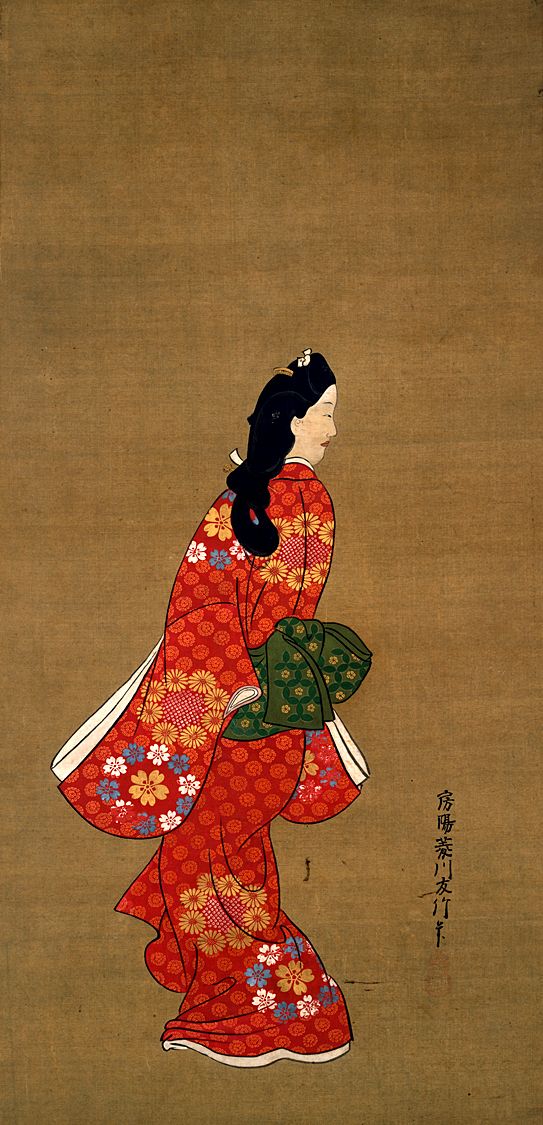
Beauty Looking Back (c.1672) Hishikawa Moronobu

Hokusai Katsushika (c.1843)
Two Beauties (c.1672) Hishikawa Moronobu

These works established Hishikawa as the premier Bijin guy of 1672-1694. He made 100-150 illustrated books consisting of Sumizuri-e (monochrome woodblock prints) and single sheets, most of which are unsigned. In a bid to prove my fine art and media background background aren't worthless, allow me to explain. Whilst no Hokusai in his bid to explode the linework in his drawings, he does create a hitherto unseen effect with the curvilinear effects his 1670's Japanese audience found rather saucy, and the Modern Style artists so admired in Britain for its curvy aesthetic. He also usually uses spatial arrangement with other characters to create hitherto unseen effects, perhaps akin to how in the 1960's experimental theater began to adopt Noh theatre backdrops for example by reducing the amount of visual background information, making the audience focus solely on the present visual information to allow the imagination to wander by alluding rather than an object declaring itself, rather like the Ma (negative space) found in a good Beardsley illustration.

The Bijin figures shown here in Hishikawas' work are all Wakashu (young-boys-of-the-way[of smecks]), which you can see in their hairstyle, because the forelock, a stand of hair left in front of the tonsure which dangles like a fringe is visible. Long-sleeved kosode with the open-inside-sleeve-seam worn by these young men were only worn by Wakashu and ladies and the hitoe found underneath were a sort of glimpse of ankle for the time and place if you will. Rather like how Saudi women use hidden layers of modest clothing to peacock. The linework and the way it wrapped around the body thus, was saucy becuase it reminded the intended audience of pervy old men (remember Japan still has a massive gender imbalance in the Diet so the gender struggle be real) the third-gender Bijin, emphasising more than before the nape, wrist and tightness of the Kosode garment around the body (think cinched to the gods but its a tightly wrapped ro kimono). This HITHERTO UNSEEN EFFECT of pushing the boundary of acceptability in Japanese soft core porn, allowed greater confidence in the softcoreporn world the Ludus pursuit of the Bijin or known rather nichely as an abuna-e.[5] 

The composition of the Kimono also would give additional information which as smug personas explain 'it has an additional story behind it that you just wouldnt understand(dont be a dick kids)'. These motifs are about as easy to decipher by modern Japanese viewers as a Turner painting is to a British viewer. One example in Beauty Looking Back is the arrangement of floral motifs which usually relate to Buddhist notions of beauty and order, and which represent harmony probably; we all have to do something for the first time somewhere. If you would like to learn with me, follow the blog throughout the Patterns series for more information on that.

Throughout the later years of his life, Hishikawa also created childrens books (1685) and in the traditional Japanese/Chinese branch of learning how to draw directly lifting from others; ie plagiarism he also used Kyoto subjects in his own spin on a topic when making prints which amalgamated a number of other styles from other illustrators perhaps as a device to draw in a wider audience forming the Hishikawa style (curvilinear lines, risque postures and a new feng shui to background matter). A common matter of this topic matter was the daily lives of women, such as women poets (100 Poems about 100 Poets, 1695), although for anyone who goes looking these are historical figures dressed mostly in Juni-hitoe. [1][2][3][4]

Reference List

[1] https://en.wikipedia.org/wiki/Hishikawa_Moronobu#Work

[2] https://www.metmuseum.org/art/collection/search/57664

[3] Youtube (2021), 'Life of a Wakashu, Japan’s Third Gender (Male-Male Romance in Edo Japan)', Linfamy, Available at https://www.youtube.com/watch?v=bzG4UOaGy7M

[4] https://desispeaks.com/wakashu/

[5] https://library.fvtc.edu/GenderEducation/LoveTypes

Social links:

https://www.etsy.com/uk/shop/KaguyasChest?ref=seller-platform-mcnav or https://www.instagram.com/kaguyaschest/ or https://www.youtube.com/channel/UC5APstTPbC9IExwar3ViTZw, or https://www.pinterest.co.uk/LuckyMangaka/hrh-kit-of-the-suke/

Saturday, March 13, 2021

麻の葉 | Asanoha | Hemp Leaves | Patterns #2

Asanoha is said to resemble the shape of the leaf of the hemp plant leaf in its geometric patterning and has been used to decorate Buddhist statues since the late Heian period (about 1100). 麻 being Hemp and 葉 leaf. The triangle on it own was said to work as a protective charm, and the grouped triangles in Asanoha therefore is said to keep away yokai. The pattern can represent healthy growth, vigor, resilience and prosperity, with the 6 triangles forming the pattern seen as particularly auspicious.[5] Asanoha is used today in Ranma (panels), textiles and graphic design.[1] Asanoha was popularised as a pattern by Kabuki actors from 1605 onwards, which made it a popular pattern to watch Kabuki shows in the Edo period such as Iwai Hanshirou V (1776-1847) and used both as a full and background motif.[4][6] 

Kanbara (Utagawa Kunisada)

Asanoha was used as a pattern since the Sengoku period as the hemp plant was commonly worn by lower classes as it was a cheap and durable plant to grow. It therefore made up the bulk of commonfolks kimono for the time until cotton was introduced in the early Edo period; it was the poor womans silk. Hemp is known as well as a common medicinal plant for alleviating pain, it is also known as a sturdy material which grows upright, as well as a durable plant, and can be used to make rope for instance. Because of its durability, hemp was associated with being healthy or living a long life and was often used on children's kimono in the hope they would grow up sturdy and strong. Today hemp and Asanoha are used for yukata.[2][3]

Reference List

[1] https://www.tanihata.co.jp/english/monyou/asanoha.htm 

[2] http://project-japan.jp/asanoha/#:~:text=It's%20a%20pattern%20that%20has,wish%20for%20children's%20healthy%20growth.

[3] https://www.nippon.com/en/japan-data/h00478/traditional-japanese-patterns.html

[4] https://www.lavenderhome.co.uk/pages/the-meaning-history-of-traditional-japanese-patterns

[5] https://polinacouture.com/en/the-meaning-of-patterns-on-japanese-fabrics/

[6] https://www.dokidokikimono.com/kimono/kimono-patterns-asanoha-%E9%BA%BB%E3%81%AE%E8%91%89/

Social links:

https://www.etsy.com/uk/shop/KaguyasChest?ref=seller-platform-mcnav or https://www.instagram.com/kaguyaschest/ or https://www.youtube.com/channel/UC5APstTPbC9IExwar3ViTZw, or https://www.pinterest.co.uk/LuckyMangaka/hrh-kit-of-the-suke/

Sunday, March 7, 2021

ルネ-ヴィヴィアン | Renee Vivien | 1907 | Kimono as transnational Culture Essay#1

Renee Vivien (1877 - 1909) , born Pauline Tarn, was an English lesbian poet. She wrote in French and perhaps English. She took up the style of the Symbolists and Parnassinism and was well known during the era of the Belle Epoque (the Beautiful Age) for producing Sapphic verse and living as an open quasi butch lesbian poet; her verse derived from the ancient poet Sapphos, also famed for her love of women.

To say Vivien lead a tumultuous life may be an understatement. Born to an American Heiress and a Scots father John Tarn, and the family lived in Paris for a short time until her father died in 1886. Vivien's mother desperately held onto John's family inheritance and gave Vivien hell as a child, frequently putting her under lock and key for perceived misbehaviour and trying to have her declared insane as to inherit the family fortune when it was bequeathed to her upon return to London in 1886.

Pauline became Renee in 1899 when she moved to Paris to escape her abusive mother, and in Paris she dedicated herself to poetry, writing exclusively in French, and running around Paris with wealthy lesbians dressed as Hamlet. She frequently pushed phallocentric narratives and kept to her own agenda in the patriarchal system she found herself living in. Whilst in Paris though she often attracted 'unwanted attentions' from male admirers and so would a body double stand in for her at her poetry performances. In Paris, her ground floor flat on 23, Avenue Foch (then Bois de Boulogne) opened onto a Japanese Garden, and was decorated with antiques from London and 'Eastern art' manufactures of shrines, statues and Buddhas which she smattered around the flat amidst fresh floral bouquets of lilies and offerings of Lady Apples with an ever coming and going stable of wealthy lesbian lovers.

Her first relationship was with Violet Shillito, then Natalie Barney in 1899 with Shilotto dying in 1900, and Barney splitting up as a result of Vivien's grief in 1901, with her first book published in the same year. She became involved in a relationship in 1902 with Baroness Helen van Zuylen, a branch of the Rothschilds family in France. Vivien, known for her aesthetical flair, was reliant on Zuylen who was married with children. Vivien considered herself married to Zuylen, but upon recieving a letter from the Turkish admirer, Kerime Turkhan Pasha, who was also married and so their relationship only developed through their letters. In 1907 however, Vivien was dumped by Zuylen and Vivien travelled to Japan in a rather dramatic relationship rebound to escape the gossip in the Lesbian circles of Paris. Kerime also stopped writing in 1908, turning to drugs, alcohol and sadomasochism of all things. Ever the eccentric, she continued living her lavish bohemian lesbian lifestyle until something we may recognise today as EDNOS caused her death in 1909.

Vivien was an aesthete, and this is evident from how she presented herself in society and how she lived her life. Her translations of Sappho from the Greek at Oxyrynchus, her globetrotting and her multinational heritage clearly played a role in how she came to own and understand other cultural artifacts and concepts, such as the Kimono, which I shall explore somewhat here with regards to viewing the Kimono through the Aesthetes lense.

The Aesthetical Movement, (approximately 1870-1900) in relation to Japanese design was the English answer to French design, developed into the Modern Style which later became Art Nouveau on the Continent. It's better known 'aesthetes' or purveyors of beauty included at the time figures such as Oscar Wilde and Mary Eliza Haweis (author of the Art of Beauty). Figures such as Wilde and Edward Carpenter championed the closeted lifestyle of Gay men, Wilde through his connections in the art world, under the guise of the 'Hellenic' or 'Japanese' worlds (see the Decay of Lying 1891) which touted historical literature as a sort of escapist revisionist Gay Arcadia, and Japan played this role from 1870 - 1933 for figures in the Bloomsbury scene such as Virginia Woolf (see Vogue review of Tale of Genji 1925). 

Decadence, the aesthetical era which Vivien was born into, prized Vapanese (Japanese as the Victorians saw it) art as purely aesthetical, and extension of the art for arts sake mantra popularised in France at the turn of the 19th century.

"'No, not Sappho' said Renée Vivien, who had come in with her light step , wearing an empress' s kimono and carrying a sheaf of roses in her arms , which she offered me by way of greeting. 

-The Muse of Violets (1904;1977)

In this passage, the Kimono is celebrated as a mark of wealth, compared to Sappho (high poetry) and Roses (expensive natural beauty denoting a Englishwoman perhaps) and Empresses, which to the decadent aesthete was a raucous display of finery and nothing more, for beautiful objects were said to have enough merit to exist on their own and as such were viewed as art objects (see Whistler's 1878 trial for more on the matter of substance.)

In context therefore, we see that in the transnational context, Kimono can be used to exemplify new ideals of beauty or aesthetical standards. The Kimono Vivien wears or said to be wearing was a popular staple among bohemians of the era and was used to denote that its wearer was part of the fashionable upper class, less so by the Edwardian era, but still if original a highly coveted item of great beauty and 'refined taste'. The Hellenic and Japanese worlds in a gay Vapanese notion, were regarded as in-code for the wealthy gay lifestyle in this time and place, and which later diverged as fodder into the new form of 'camp' with the inclusion of items such as fans used by performers today positively as cultural appreciation (think Mae West's Drag 1927; the Maltese Falcon 1931, Lindsay Kemp from 1959-2018 etc, also see Roger Bakers Drag, 1995).[1][2][3][4][5]

Next week I shall return to patterns, but the next essay will discuss cultural appropriation in an American context.

Bibliography

[1] https://en.wikipedia.org/wiki/Ren%C3%A9e_Vivien

[2] http://www.suzannestrohcreative.com/the-cruellest-month-for-renee-vivien/

[3] The Muse of the Violets : Poems, Renee Vivian, 1977, p.9

[4] Orientating Arthur Waley, 2003

[5] Drag: A History of Female Impersonation in the Performing Arts, Roger Baker, 1995, p79

See Also

https://en.wikipedia.org/wiki/Aestheticism

https://en.wikipedia.org/wiki/Modern_Style_(British_Art_Nouveau_style)

https://en.wikipedia.org/wiki/The_Decay_of_Lying

https://www.newyorker.com/culture/cultural-comment/the-radiant-prince-comes-to-fifth-avenue

https://en.wikipedia.org/wiki/Art_for_art%27s_sake

http://www.branchcollective.org/?ps_articles=nicholas-frankel-on-the-whistler-ruskin-trial-1878

https://en.wikipedia.org/wiki/Sapphic_stanza#:~:text=The%20Sapphic%20stanza%2C%20named%20after,a%20rhyme%20scheme%20of%20ABAB.

Social links:

https://www.etsy.com/uk/shop/KaguyasChest?ref=seller-platform-mcnav or https://www.instagram.com/kaguyaschest/ or https://www.youtube.com/channel/UC5APstTPbC9IExwar3ViTZw, or https://www.pinterest.co.uk/LuckyMangaka/hrh-kit-of-the-suke/

Sunday, February 28, 2021

芭蕉布 | Bashofu | Banana Cloth | Fabrics #1

Bashofu is a fabric made locally in Kyushu from wild Bananas which grow there due to the tropical climate of the islands, and is ideal for the heat as the fabric does not stick to the body when a wild sweatdrop appears. 

Imperial Ming Dynasty China Court Ladies

Historically the Ito-basho tree and fabric-weaving skills were introduced to Kyushu from Southern China, and were sent back to Ming dynasty China in bolts as gifts, having being traded with the Satsuma since at least the 17th century and for far longer as tribute to Ryukyuan kings from the 15th century. Historically, Bashofu was created all over Ryukyu and during the 19th century the Takahata loom was introduced which increased production rates, but which dropped after 1945 with the passing of many of the Ryukuyan weavers. Today the textile is woven in the Kijoka (喜如嘉) are of Ojimi Village (大宜味村; Ufujimi in the Ryukyuan language) in the Kunigami district of Okinawa Prefecture. In 1974 the tradition was recognised and is today deemed an Important Tangible Cultural Property, and its first living national treasure Tairo Toshiko (平良 敏子) in 2000 who turns 100 this year! (Congratulations Ms!) In local Ryukyuan folklore, it is said that Bashofu . Ryukuyans also hold that the cloth is a protective charm over it's wearer body and soul, and this is shown by the life expectancy of its residents who often live to over 100.[1][2]

The Bashofu Tree

Bashofu yarn is made using the bast fibres which jut from the trunk of the tree, of the musa balbisinia (Ito-basho) plant. The further out the fibre extract is from the trunk, the courser the result when made into Bashofu it becomes. Initially the cloth is made by dividing these course fabrics into layers and grades of courseness, boiled to soften and scutched to remove the excess tree sap created and left to dry. When the fibres dry, these splits are divided again for their thickness and knotted end-to-end to be spun and woven, requiring 40 trees worth of fibres to make a bolt of cloth.[3][4] The colouring of Bashofu is created primarily from the condition of its original fibres, so factors such as heat and how many grades the bast fibres came from the trunk determine the level of yellow to browning which the main colour of the cloth produces. Patterns are often applied to the fabric later on in brown or indigo application of stripes or checks and hatching patterns in graduating browns.[2][3]

The bigger problems faced today by Bashofu weavers is in the carrying on of the u-umi (hand woven) tradition of Bashofu weaving. Ms. Taira as head of the Preservation Society is working to combat this.[4]

Reference List

[1] https://www.selvedge.org/blogs/selvedge/bashofu

[2] https://en.wikipedia.org/wiki/%C5%8Cgimi

[3] https://en.wikipedia.org/wiki/Kij%C5%8Dka-bash%C5%8Dfu

[4] https://www.oki-islandguide.com/specialfeatures/pride-of-okinawa-basho-fu

Further Links

Bashofu production: http://www.bashofu.jp/

Social links:
https://www.etsy.com/uk/shop/KaguyasChest?ref=seller-platform-mcnav or https://www.instagram.com/kaguyaschest/ or https://www.youtube.com/channel/UC5APstTPbC9IExwar3ViTZw, or https://www.pinterest.co.uk/LuckyMangaka/hrh-kit-of-the-suke/

Monday, February 22, 2021

寛文大師 | The Kanbun Master | Active:1660-1673 | Bijin #1

The Development of the Human Figure in Japanese Art to that of the Bijin-ga

To define the term Bijin broadly, this means 'a beauty'. Beauty certainly in the Edo period favoured androgynous beauties, and was certainly not what the Western world defines today as beautiful, nor worked in the same frameworks or boundaries we apply to 'Beautiful people' today.[1]

Indeed the human body, unlike in the Western Canon and Japanese which survives, was seen as not necessarily the most favourable thing to be depicting in the early medieval period. Japanese art, during the Heian period certainly depicted figures, but these should be taken separately from the Bijin we know today, as they fall under their own branch of Heian aesthetics which mark the aesthetical and religious rank and tastes of the likes of Murasaki Shikibu & Lady Ise whom gallivanted around in Juni-hitoe, the Kosode's and Kimonos 12 layer ancestor. These styles and forms of art often depicted Beautiful women by the days aesthetical standards, but few examples survive and often show classic Buddhist or mythical figures in pursuit of the divine we see in Yamato-e.

The figure in Japanese art therefore is first seen in what we call today history and literature's Early Modern Period (1500 - 1700 for our purposes) in painting. Particularly, figures began cropping up in Japanese paintings with the start of Nanban Art (1543- 1629, derived from the Nanbanjin [Southern Barbarian; Foreigner] Trade) from 1550, particularly detailing the foreigners, warriors, guards and slaves of the wealthy, often Portuguese, traders who ran the trade. Today, 90 Nanban Byobu (南蛮屏風, Nanban Screens) survive today, a number in the style of the Kano and Tosa schools, mostly done portraying these foreign elements to Japan within Japanese genre scenes and materials for the most part. When these foreign elements (see Kirishitans) caused internal chaos, they were sent packing between 1597-1639, and totally shut off with the announcement of Sakoku (isolation policies) by the time mass scale print media became viable in Japan.[2]

Nanbanjin Byobu (c1600) Kano School

The History of Text in Woodblock Printing 

Empress Koken (718-770)

Woodblock printing, imported from China (created in 220 AD) was first used by Buddhist scholars to print the Hyakumanto Darani (in 764-770) when Empress Koken requested 1 million tiny wooden pagodas be made which contained teeny-weeny woodblock printed scrolls of Buddhist text to be distributed around Buddhist temples across Japan for having helped to suppress the Emi Rebellion (764) against her enemy, the Fujiwara no Nakamo (706-764) in an imperial power spat after her son the Emperor died. Following this, printing (texts) became the work of Buddhist priests until from the 10th century on when they printed sutras, mandalas and Buddhist iconography accompanying the text, as it was too labour intensive for production outside the temples, with some being printed in the 12th century onto court fans using woodblocks. Presses were introduced by the Nanbanjin trade and some from Korea by the 1590s in a limited number, mostly for printing Portuguese catechism texts, given the time-consuming nature of producing the 100,000 logographs for the Japanese texts than the 30 - 50 types in foreign Latin languages.[3]
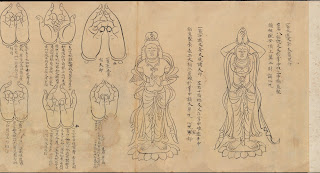
Sutras in the Scroll of Mudras (c.1000-1100)
Mandala of Monju Bosatsu (c.1200)

4 Deities of Koyasan Complex (c.1350-1400)

A Gay Old Time

By this time the beautiful figure in Japanese art as we know it began to take shape from the beginning of the Tokugawa reign in 1603. Text though was still more quickly produced on woodblocks and the first Japanese texts made in Saga by Hon-nami and Suminokura combined text and images in The Tales of Ise (1608). Later came illustrated folk tales (Tanrokuban; c1624) in 2 tone orange/green colours.[3]

Tales of Ise (1608)

With the new Sankin Kotai (alternate attendance) edicts of the Tokugawa, the Tozama daimyou (outer circle lords) in 1635 and by 1642 also the Fudai daimyou (inner circle lords) began moving into the cities for half of the year, bringing their entourages and servants with them, beginning the new phase of city life in Japan.[4] This brought a new wave of people to the cities, easily doubling the cities in size to larger than most of their European counterpart cities of the day. The fire of Meireki (1657) required Edo to be rebuilt as most structures were built in wood; akin to the damage of the fire of London (1666); and as Christopher Wren (1632-1732) did with London, this began a modernising project in Edo, creating a new wave of cottage industry printing businesses.[3] 

Shikomi-e (c.1603-1699) depicting two female dancers

Particularly involved were the theaters, Kabuki particularly. At first between 1603-1629, founded by the female shrine maiden Izumo no Okuni, Kabuki women actors (often Asobi-Onna) performed suggestive plays for the mixed class audiences in comic plays about everyday events, using highly differentiated form to today. These women engaged in kabukimono (歌舞伎者, to walk and dress 'bizarrely') between the teahouses and Yukaku (Yoshiwara was established in 1617) and often showed a nape or a wrist or two on and off stage in their illustrious kosode, now portrayed in the hand produced Shikomi-e (仕込絵, literally preparation picture, a better translation dancing or readying girl pictures) sold in the  Nakamura-za, Ichimura-za and Kawarazaki-za theaters by their middle class merchant patrons.[5] Outraged at the money and the fun, the stuffy old men banned the beautiful licentious artform in 1629 and created a new disaster worse than the last; Wakashu Kabuki (young male Kabuki). Yaro-kabuki or Onnagata (men playing women actors)  became a nightmare as the Oyama (male actors) only carried on the old wrist and nape traditions in the dramas and Kagemajaya (kagema or young male sex worker teahouse) of the day. Fights broke out over the affection of the actors, & the stuffy old men banned both young and old, and perhaps realising they were running out of choices for actors, lifted the ban on male actors in 1652.[6]
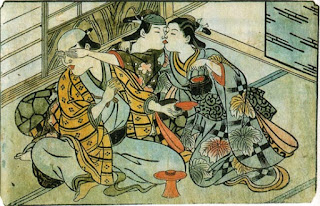
Client, Kagema & Asobi (1716-1735) Nishikawa Sukenobu

As I understand it, the Asobi were not dependent on men, but rather engaged in more of a 17th century style of compensated dating, particularly before the establishment of legal brothels, and after the ban on them performing in Kabuki, turned themselves over to the hedonistic world of Ukiyo, flitting between the wealthy merchants, and spending their earnings on Kagema, sake, actors and whatever tickled their fancy I suppose. They would have likely set trends, but this followed a general trend of valuing androgyny in mainstream Edo beauty standards, rather than the rigid Barbie and Ken image we may hold of the body today.

Thus began the city Kanazoshi culture (Kana books) in print media, simpler tales than the lofty Buddhist scriptures so far worthy of print and art. Tokyo Kanazoshi books contained heady tales of young beauties (usually men, a staple of Heian courtier & Buddhist monkly literature such as Zeami Motokiyo, 1363-1443 or Genji;Waley reference) engaged in hedonistic activities of Nanshoku and their beautiful, seductive, wakashu (young male samurai lover) napes being ravished by their samurai & merchant class superiors, on sale alongside the woodblock print illustrations of Kabuki dancers in streetcarts. All a bit too much for some stuffy old men in the Bakufu (tent goverment), they banned these explicit and raunchy displays of love found in the koshokuban (好色本; lewdness books) in 1661, only for them to prosper in the form of what became Shunga, popularised later in printed books like The Life of an Amorous Woman (1686) & The Great Mirror of Male Love (1687).[3][6][7][8]

Yonosuke with Telescope (1686) The Life of an Amorous Woman, Ihara Saikaku
A Kyoto theater, where a youthful actor is admired for his natural beauty (1687, Vol. 5) Ihara Saikaku

Bijin Ga

 Rules of Etiquette for Women (1660, Vol 1; Dress and Table Manners) Yamada Ichirobei 

Kimono Designs (1688) Yezoshiya Hachiyemon

With this Hinagata Bon (Kimono pattern books) came in 1666, with some motif books perhaps before began to popularise and cannonise the Bijin types, mostly found in the pleasure districts (particularly the gay ones) and a tad later the independent and fashionable Asobi-Onna (Play-women 遊女 or female prostitutes).[9][11] These sexual playgrounds of Ukiyo-e being created by the very same stuffy old men to hide all the grand fashions, excessive drinking, hanami watching, partyboat going with the Bijin and fun one presumes. These illustrated Bijin were woodblock dynamite among their patrons, the non-respected merchant classes. Thus Ukiyo-e (浮世絵, pictures of the floating world; floating deriving from Buddhist terminology connoting the worldly sorrow and grief of living outside of the state of nirvana) came to mean Erotic/Stylish/Gimme-a-piece-of-that.

 - [They] "living only for the moment, savouring the moon, the snow, the cherry blossoms, and the maple leaves, singing songs, drinking sake, and diverting oneself just in floating, unconcerned by the prospect of imminent poverty, buoyant and carefree, like a gourd carried along with the river current: this is what we call ukiyo." (Asai Ryoi; Tales of the Floating World)[10]

These Bijin and their lower class merchant lovers (money; their trade by association; was tainted in the eyes of priests) lived heady bisexual demimonde lifestyles of new money luxury and hedonism in their decadent floating world, today remaining in their black and white illustrations, which the wealthy merchants used to decorate their new homes in Edo.

Of lovers and Kosode

Into this assortium we find ourselves at home with The Kanbun Master (dates uncertain) which is regarded as the founder of Ukiyo-e today, although he/they remain a shadowy figure of the art world. Mentor or respected forefather to the artisan Hishikawa Moronobu (1618-1694), he is thought to be the first notable woodblock printer of these lower wordly images.  

Shunga Painting; Lovers Caught Surprised (c.1665-1669) Attrib. Kambun Master

50 attributed works of his survive and are a fantastic and delectable kosode feast for the eyes. He created a number of wordly images (shunga) among other literary works such as puppet plays (Joruri) and; in a display of his priorities; works critiquing courtesans (Yujo Hyobanki) on their looks and work practices shall we say. Working in both painting and woodblock printing, he would produce works perhaps en masse in 2 or 3 colours, or painting with a wider range the first single-sheet (unbound) woodblock printed images, primarily in shunga depiction of enraptured floating lovers, discovered in the throes of monochrome kabedon-but-its-the-floor action. He seems to had a flair for the early instagram photographer phase of 'colour pops' as well, adding a bit of red or yellow here and there to his Bijins. He was primarily motivated by the Edo monochrome Fuzokuga (風俗画, genre painting) of the time, which showed everyday life in Edo.[3][10][12][13]

Dance Genre Painting (1596-1615) Kano School
Prostitute with dog, perhaps a Nanbanjin dog (c1624-1639) Kanbun 'S' Style, A Prototype Bijin, based on the Hikone Byobu

Another train of thought is that these style of drawings where made from the contemporary motifs and characters of classical Japanese literature, mixed with genre painting formats and the poses struck by Asobi in the Kannei, perhaps Genna periods (around 1615-1644). A particularly frequent motif used in these styles, are the 'S' shape silhouette found in portraits of maiko, which became precursors to the Bijin-ga of Ukiyo-e. In turn these drew upon Classical Chinese and Japanese forms of beauty, so long black hair, chignon buns, exposed shoulder or nape, wrists and a flick of a fan. It is said the drapery effect of napes derived from the upper class courtesans, the Tayuu  who were out of reach of most townfolk who had to content themselves with watching their slow-gait walks along long streets like the Nanomachi road, was passed down to print culture in the 1670's from these paintings and prints. It should also be noted that this style was present before and during the rise of Kabuki. [14] 

Bibliography

[1] https://en.wikipedia.org/wiki/Bijin-ga

[2] https://en.wikipedia.org/wiki/Nanban_art

[3] https://en.wikipedia.org/wiki/Woodblock_printing_in_Japan

[4] https://en.wikipedia.org/wiki/Sankin-k%C5%8Dtai

[5] Ukiyo-e: An introduction to Japanese Woodblock Prints, Kobayashi Tadashi, 1997, pp.67-68, Kodansha International

[6] https://en.wikipedia.org/wiki/Kabuki

[7] https://en.wikipedia.org/wiki/Ihara_Saikaku

[8] https://en.wikipedia.org/wiki/Shunga

[9] Hinagata Bon: The Art Institute of Chicago Collection of Kimono Pattern Books, Betty Y. Siffert, 1992 p.86, Art Institute of Chicago Museum Studies

[10] https://en.wikipedia.org/wiki/Ukiyo-e

[11] Shadows of Transgression: Heian and Kamakura Constructions of Prostitution, Goodwin, J., 2000, pp.327-329, Monumenta Nipponica 

[12] https://en.wikipedia.org/wiki/Kanbun_Master

[13]  https://en.wikipedia.org/wiki/Japanese_painting#Azuchi%E2%80%93Momoyama_period_(1573%E2%80%931615)

[14] http://blog.tuad.ac.jp/prizeworks/?p=145

Social links:

https://www.etsy.com/uk/shop/KaguyasChest?ref=seller-platform-mcnav or https://www.instagram.com/kaguyaschest/ or https://www.youtube.com/channel/UC5APstTPbC9IExwar3ViTZw, or https://www.pinterest.co.uk/LuckyMangaka/hrh-kit-of-the-suke/

Sunday, February 14, 2021

鱗 | Uroko | Scales of the lizard | Patterns #1

The Uroko pattern is a repeating contrasted isosceles triangular motif which is said to represent the scales of reptiles or amphibious animals. These would be worn on the inside of a kimono or Obi, and are said to protect their wearer from attack and bad luck like a kind of talisman for warding off evil. The pattern is traditionally totally equal, but modern designs do take liberties with the dimensions of the triangles, and some designs include triangles inside triangles, or play around with the Ma (negative space) concept.
The uroko pattern has been around since the 13th century, used as the standard for Hojo Tokimasa (1138-1215). From the Muromachi period onwards (1336-1573) the pattern was used on Noh (Dojoji) and Kabuki costumes (Kyoganoko Musume Dojoji) to represent snakes and Kijo. 


Bibliography
[1] https://www.nippon.com/en/japan-data/h00478/traditional-japanese-patterns.html
[2] https://kirikomade.com/blogs/our-fabrics/japanese-patterns-2
[3] https://int.kateigaho.com/articles/tradition/patterns-15/#:~:text=The%20name%20of%20the%20pattern,to%20fish%20and%20snake%20scales.&text=From%20the%20Muromachi%20period%20(1336,ogres%20and%20incarnation%20of%20snakes.

Social links:
https://www.etsy.com/uk/shop/KaguyasChest?ref=seller-platform-mcnav or https://www.instagram.com/kaguyaschest/ or https://www.youtube.com/channel/UC5APstTPbC9IExwar3ViTZw, or https://www.pinterest.co.uk/LuckyMangaka/hrh-kit-of-the-suke/

Emperor Ai | Artyfarty

Emperor Ai of Han (personal name Liu Xin | 劉欣 | 25 BCE-1 CE), was an emperor of China's Han dynasty.  Deffo not BL (1651, PD) Chen Hongs...