Her Haughtynesses Decree

Sunday, September 3, 2023

王昭君 | Wang Zhaojun | 50 - 1 BCE | Bijin #21

Wang Zhaojun (active c50-1 BCE) was one of the four Meiren or great beauties of antiquity China. As a Meiren archetype, Zhaojun reflects beauties who are willing to give away a great deal, part of the transfer between antiquity ideals of acceptable beauty standards rooted in traditional ideals of inner and learned beauty (Dao/Tao beauty) towards contemporary Aesthetics standards of long black hair, cosmetics and alternating silhouettes popular by the Tang dynasty with court noblewomen and male poets. Zhaojun's tale begins at the court of Yuan of Han (48-33 BCE) and reflects the Han orientated male beauty standards of the time, which enabled female beauty to a point, but not allowing it to threaten existing male power structures whilst still serving Han male acceptability politics.

Wang Zhaojun with her Pipa (c.1600, PD) Kosumi Morihage

The tale of Wang Zhaojun

Zhaojun begins her tale as the child of a noble family living in Western China during the late Han Dynasty. Zhaojun was a great beauty, both inside and out being regarded as highly intelligent and aesthetically pleasing. As was customary, she was called upon by the Emperor to reside in his palace as a concubine representing her county in 36 BCE aged 14. At the court however, she spent her days in solitude, playing the Pipa & Gugin instruments, games of Go and practicing writing and painting. These marked her as an accomplished scholar as an adept practitioner of the Four Arts (四藝).

Zhaojun was confident enough in her looks that she did not bribe the court painter, resulting in her painting being subpar for her actual representative beauty. Due to this, she remained as a lady in-waiting at court. When a provincial Mongolian prince became ripe, Zhaojun was chosen as his tradable merchandise bride based on her supposed average, provincial beauty in 33 BCE. In this capacity Zhaojun volunteered, and in later being presented to court, the Emperor found out his error in allowing corrupt portrait painters to flourish, and eventually had to send Zhaojun to the Mongolian Kingdom.

Eventually Zhaojun produced 4 ankle-biters, 2 of whom were daughters; Yun Subu Juxi (须卜居次)  who became an important local political figure and Dangyu Juxi (当于居次). In 31 BCE with the death of the groom, Zhaojun requested a return to Western China, only for the Emperors progeny to determine Zhaojun must marry the succeeding prince of her new Kingdom, which in following her adopted homelands custom was to be her stepson. This produced 2 more daughters. These actions cemented Zhaojun as the pacifying, tolerant and wise Meiren of the Han dynasty whose selflessness enabled the pacification of the central Han courts.

Passive Otherworldly Beauty

A great many poems were written up until the early modern medieval period about Zhaojun. Most of them however present as a passive feminine token for male affection, being a mediator figure who gives over her agency and autonomy to fulfill the needs and requirements expected of her as a tradable commodity and womb factory. Zhaojun also often acts a meat shield used to protect Han ethnic groups from barbarian 'Hun' peoples Others even up until the early Medieval period in Europe, in China. This followed a patriarchal trope set by the central Han court as it sought to use women's bodies to draw its influence over neighbouring kingdoms and peoples through marriage pacts.[1] 

In the tradition of natural beauties prompted by the scholarly fascination with what it meant to be beautiful, Zhaojun was thus to be considered a Damei beauty figure, whose beauty therefore drew upon her intellectual beauties as earliers writers found in Xi Shi's tale:

Xi was said to be a true beauty, one of nature [...]. Zhuangzi and subsequent writers after him when contemplating Mei in this way rejected therefore fake/false beauty and accepted there is a spectrum of natural beauties. It was these natural beauties who represented the genuine which were to be revered as Damei ( Great Beauty ) which was held by the aesthetic and inner beauty of anyone, but which was not made but only produced naturally. This was a reflection of Zhuang's following of the Dao; [...] Zhuang also warned against the attainment and influence of beauty. Instead Zhuang encouraged us not to want for aesthetic or beautiful perfection, but to instead understand our own flaws and to understand that these give us their own unique beauty or advantages.[2]

Zhaojun represented this passive form of womanhood which was acceptable to men, as she embodied the Heavenly Nymph trope embodied in the work of Kaizhi. Zhaojun held a heavenly beauty which was both natural and yet otherworldly, a beauty which threatened other women's status due to the heightened place women depicted as Heavenly Nymphs held in the sexual marketplace, but which did not threaten male places as they were the perceived audience of these poems and thus the sole beneficiaries. Zhaojun was acceptably tame and selfless, serving her masters as a tradable commodity and protecting the Homogenous ethnic Han Chinese from the 'barbaric' Other by remaining an unattainable perfection which was yet still held to be solely Han originating, totally sidestepping the contributions Zhaojun played for the 'Hun' kingdoms she sometimes resided in.[1]

However there are variations in the agency given to Zhaojun dependent on the writer and the era, with the Tang era poets writing of her woeful journey to the land of the Huns as being so sorrowful that she began strumming her Pipa, which signified her own feelings of loss and homesickness.[3] However, most writers of Zhaojun wrote on her story during the early Ming period (1368-1644) which saw the tale change to focus on more xenophobic attitudes of its writers, turning Zhaojun into a passive intermediary away from the active and autonomous legend she acquired during the Tang.[1] 

By the way of the Lotus

Whilst not quite the exhilaration of Xi Shi, Zhaojun represented the archetypal expectations of beautiful women at the time, that their beauty must  reside purely in the realm of the intellect of noblewomen. By this time women were respected scholars, writers and moral exemplars but they played these roles through patriarchal lenses and worldviews. A far cry from the agency of the foregrounded Xi Shi, and the worldview which gave rise to the anti Wu Zetian crowd of Drunken Lotus Gongti Meiren ideals.[2] Even during Zhaojun's Tang renditions, she was depicted as a beautiful solitary figure with her Pipa by Han Gan (706-783 CE), which really only explored her beauty in the context of passivity and acceptance of her place and status in Han society.[3] Zhaojun was almost just this trope at the time of an almost 'fallen woman' type by marrying a non-ethnically Han person, and is more often remembered for her looks and the Emperor's reaction to them than what Zhaojun's motivations were to take on the role of marriage alliance volunteer.

Zhaojun therefore exemplified the bookend of the Heavenly Nymph trope exemplified in Kaizhi's time of women, in that whilst they could be valuable assets to the courts, kingdoms and people they served, their autonomy and agency was still held primarily in the hands of men and their roles where behind the bamboo curtain as it were. Their intellect came with the caveat of being practiced behind closed doors, ideally by wealthier castes and only for the benefit of upholding male dominated existing structures such as that of the Emperor's rule and the Han Chinese tributary system. Indeed until the upheaval of the 7th century of Matriarchal figureheads in China, these were the expected norms for women in this time, to be the properties of their fathers and husbands households and were expected to only act in accordance with their wishes as Confucian thinkers emphasised.[4]

Conclusion

In context therefore we see how the moral background of Zhaojun's tale shadows aesthetic beauty as a pre-existing side attraction of being a selfless person to self-serving men, which was then termed Damei beauty. Just as Xi proved herself, Zhaojun was to be admired for her otherworldly attitudes and decidedly metaphysical 'Han' standards to protect mostly Han-male interests and power structures. This moral tale reiterates the dao, self-sacrifice and the idea that aesthetic beauty was a pursuit to be held in vain, with real beauty coming from Zhaojun's acts of bravery in volunteering to move away from all she knew as a passive agent for male figurehead interests. 

Zhaojun was a moral tale for women of their place in Confucian society, a tool which whilst heeded in Japanese Heian society, was only pursued in the sense that complex emotions were considered to beautiful when subtly displayed.[4] Zhaojun in this way is the archetypal Heavenly Nymph Meiren, a conveniently passive pacifier and philosopher who happened to also be deeply beautiful and available, yet also elusive, pure and otherworldly construct of Han male beauty standards which would have been and still are held up to women as ideals, even thought their upholding solely benefits male interests and reiterates female subservience.

Bibliography

[1] Wang Zhaojun on the Border: Gender and Intercultural Conflicts in Premodern Chinese Drama, Daphne Pi-Wei Lei, 1996, Number 2, Volume 13, pp.229-237, Asian Theatre Journal

[2] See Bijin #17

[3] https://www.historyofroyalwomen.com/queen-wang-zhaojun/queen-wang-zhaojun-the-precious-jewel-that-the-emperor-deeply-regretted-losing/

[4] https://gradynewsource.uga.edu/being-a-woman-in-a-confucian-household/

Bijin Series Timeline

11th century BCE

- The Ruqun becomes a formal garment in China (1045 BCE); Ruqun Mei

8th century BCE

- Chinese clothing becomes highly hierarchical (770 BCE)

3rd century BCE

Xi Shi (flourished c201-900CE); The (Drunken) Lotus Bijin

2cnd century BCE

        - The Han Dynasty

1st century BCE

Wang Zhaojun (active 38 - 31 BCE) Intermediary Bijin

0000 Current Era

1st century

        - Han Tomb portraiture begins as an extension of Confucian Ancestor Worship; first Han aesthetic                                scholars dictate how East Asian composition and art ethics begin

                       - Isometric becomes the standard for East Asian Composition (c.100); Dahuting Tomb Murals

                       - Ban Zhao introduces Imperial Court to her Lessons for Women (c106);                                      Women play major roles in the powerplay of running of China consistently                                until 1000 CE, influencing Beauty standards

                       - Buddhism is introduced to China (150 CE)

                       - Qiyun Shengdong begins to make figures more plump and Bijin-like (c.150) but still pious

Diao Chan (192CE) [Coming Soon]

2cnd century

             - Yuefu folk ballads inspire desirable beauty standards of pining women [Coming Soon]

4th century

Gu Kaizhi (active 364-406); Metaphorical Beauty

        - Buddhism is introduced to Korea (c.372)

        - Chinese Artists begin to make aesthetic beauties in ethereal religious roles of heavenly Nymphs

                       - Luo River Nymph Tale Scroll (c.400)

          - Womens clothing emphasized the waist as the Guiyi (Swallow-Tail Flying Ribbons) style (c.400)

                       - Wise and Benevolent Women (c.400)

5th century

          - Chinese Art becomes decadent; Imperial Culture begins to see more expression in religious statues (c450)

                       - Longmen Grotto Boddhisattvas (471)

6th century

Xu Ling; (active 537-583); Terrace Meiren

7th century

            - Tang Dynasty Art (618-908)

           - Rouged Bijin (600-699 CE) https://commons.wikimedia.org/wiki/Category:Paintings_of_the_Tang_Dynasty

Yan Liben (active 642-673); Bodhisattva Bijin [Coming Soon] https://commons.wikimedia.org/wiki/File:%E0%B8%81%E0%B8%A7%E0%B8%99%E0%B8%AD%E0%B8%B4%E0%B8%A1.jpg Guan Yin  | https://archive.org/details/viewsfromjadeter00weid/page/22/mode/1up?view=theater

Wu Zetian (active 665-705); The Great Tang Art Patron [Coming Soon]

Asuka Bijin (c.699); The Wa Bijin

8th century

            - Princess Yongtai's Veneration Murals (701) [Coming Soon]

- Introduction of Chinese Tang Dynasty clothing (710)

- Sumizuri-e (710)

Yang Yuhuan Guifei (719-756); [Coming Soon] East Asian Supermodel Bijin https://core.ac.uk/download/pdf/275768522.pdf https://factsanddetails.com/china/cat2/4sub9/entry-5437.html#chapter-5

            - Astana Cemetery (c.700-750) [Coming Soon]

Zhang Xuan (active 720-755); [Coming Soon]

- What is now Classical Chinese Art forms

                    - An Lushun Rebellion (757) 

 Zhou Fang (active 766-805) ; Qiyun Bijin

- Emakimono Golden Age (799-1400)

9th century

                       - Buddhist Bijin [Coming Soon] https://commons.wikimedia.org/wiki/Category:Paintings_of_the_Tang_Dynasty#/media/File:Noble_Ladies_Worshiping_Buddha.jpg + https://en.wikipedia.org/wiki/Mogao_Caves#/media/File:Anonymous-Bodhisattva_Leading_the_Way.jpg

                    - Gongti Revival https://www.jstor.org/stable/495525?seq=2#metadata_info_tab_contents

10th century

                       -End of Tang Art (907)

13th century

                     - Heimin painters; 1200-1850; Town Beauty

15th century 

- Fuzokuga Painting schools; Kano (1450-1868) and Tosa (1330-1690) 

Tang Yin (active 1490-1524); Chinese Beauties [Coming Soon] https://www.comuseum.com/painting/masters/tang-yin/ 

16 century 

- Nanbanjin Art (1550-1630) 

- Wamono style begins under Chanoyu teachings (c1550-1580)

- Byobu Screens (1580-1670)

 - End of Sengoku Jidai brings Stabilisation policy (1590-1615)  

17th century  

- Land to Currency based Economy Shift (1601-1655)

- Early Kabuki Culture (1603-1673) ; Yakusha-e or Actor Prints

- Machi-Eshi Art ( 1610 - 1710) ; The Town Beauty

- Sumptuary legislation in reaction to the wealth of the merchant classes (1604-1685) 

- Regulation of export and imports of foreign trade in silk and cotton (1615-1685)  

Iwasa Matabei (active 1617-1650) ; Yamato-e Bijin  

The Hikone Screen (c.1624-1644) [Coming Soon]

- Sankin-Kotai (1635-1642) creates mass Urbanisation  

- Popular culture and print media production moves from Kyoto to Edo (1635-1650); Kiyohara Yukinobu (1650-1682) ; Manji Classical Beauty

- Shikomi-e (1650-1670) and Kakemono-e which promote Androgynous Beauties;

 Iwasa Katsushige (active 1650-1673) ; Kojin Bijin

- Mass Urbanisation instigates the rise of Chonin Cottage Industry Printing (1660-1690) ; rise of the Kabunakama Guilds and decline of the Samurai

- Kanazoshi Books (1660-1700); Koshokubon Genre (1659?-1661)

- Shunga (1660-1722); Abuna-e

Kanbun Master/School (active during 1661-1673) ; Maiko Bijin 

- Hinagata Bon (1666 - 1850) 

- Ukiyo Monogatari is published by Asai Ryoi (1666) 

Yoshida Hanbei (active 1664-1689) ; Toned-Down Bijin

- Asobi/Suijin Dress Manuals (1660-1700)

- Ukiyo-e Art (1670-1900)

Hishikawa Moronobu (active 1672-1694) ; Wakashu Bijin

- Early Bijin-ga begin to appear as Kakemono (c.1672)  

- Rise of the Komin-Chonin Relationship (1675-1725)

- The transit point from Kosode to modern Kimono (1680); Furisode, Wider Obi 

- The Genroku Osaka Bijin (1680 - 1700) ; Yuezen Hiinakata

Fu Derong (active c.1675-1722) ; [Coming Soon] https://archive.org/details/viewsfromjadeter00weid/page/111/mode/1up?view=theater

Sugimura Jihei (active 1681-1703) ; Technicolour Bijin 

- The Amorous Tales are published by Ihara Saikaku (1682-1687)

Hishikawa Morofusa (active 1684-1704) [Coming Soon]

- The Beginning of the Genroku Era (1688-1704)

- The rise of the Komin and Yuujo as mainstream popular culture (1688-1880) 

- The consolidation of the Bijinga genre as mainstream pop culture 

- The rise of the Torii school (1688-1799) 

- Tan-E (1688-1710)   

Miyazaki Yuzen (active 1688-1736) ; Genroku Komin and Wamono Bijin 

Torii Kiyonobu (active 1688 - 1729) : Commercial Bijin

Furuyama Moromasa (active 1695-1748)

18th century

Nishikawa Sukenobu (active 1700-1750) [Coming Soon]

Kaigetsudo Ando (active 1700-1736) ; Broadstroke Bijin

Okumura Masanobu (active 1701-1764)

Kaigetsudo Doshin (active 1704-1716) [Coming Soon]

Baioken Eishun (active 1710-1755) [Coming Soon]

Kaigetsudo Anchi (active 1714-1716) [Coming Soon]

Yamazaki Joryu (active 1716-1744) [Coming Soon] | https://www.jstor.org/stable/25790976?seq=5

1717 Kyoho Reforms

Miyagawa Choshun (active 1718-1753) [Coming Soon]

Miyagawa Issho (active 1718-1780) [Coming Soon]

Nishimura Shigenaga (active 1719-1756) [Coming Soon]

Matsuno Chikanobu (active 1720-1729) [Coming Soon]

- Beni-E (1720-1743)

Torii Kiyonobu II (active 1725-1760) [Coming Soon]

- Uki-E (1735-1760)

Kawamata Tsuneyuki (active 1736-1744) [Coming Soon]

Kitao Shigemasa (1739-1820)

Miyagawa Shunsui (active from 1740-1769) [Coming Soon]

Benizuri-E (1744-1760)

Ishikawa Toyonobu (active 1745-1785) [Coming Soon]

Tsukioka Settei (active 1753-1787) [Coming Soon]

Torii Kiyonaga (active 1756-1787) [Coming Soon]

Shunsho Katsukawa (active 1760-1793) [Coming Soon]

Utagawa Toyoharu (active 1763-1814) [Coming Soon]

Suzuki Harunobu (active 1764-1770) [Coming Soon]

- Nishiki-E (1765-1850)

Torii Kiyonaga (active 1765-1815) [Coming Soon]

Kitao Shigemasa (active 1765-1820) [Coming Soon]

Maruyama Okyo (active 1766-1795) [Coming Soon]

Kitagawa Utamaro (active 1770-1806) [Coming Soon]

Kubo Shunman (active 1774-1820) [Coming Soon]

Tsutaya Juzaburo (active 1774-1797) [Coming Soon]

Utagawa Kunimasa (active from 1780-1810) [Coming Soon]

Tanehiko Takitei (active 1783-1842) [Coming Soon]

Katsukawa Shuncho (active 1783-1795) [Coming Soon]

Choubunsai Eishi (active 1784-1829) [Coming Soon]

Eishosai Choki (active 1786-1808) [Coming Soon]

Rekisentei Eiri (active 1789-1801) [Coming Soon] [https://commons.wikimedia.org/wiki/Category:Ukiyo-e_paintings#/media/File:Rekisentei_Eiri_-_'800),_Beauty_in_a_White_Kimono',_c._1800.jpg]

Sakurai Seppo (active 1790-1824) [Coming Soon]

Chokosai Eisho (active 1792-1799) [Coming Soon]

Kunimaru Utagawa (active 1794-1829) [Coming Soon]

Utagawa Toyokuni II (active 1794 - 1835) [Coming Soon]

Ryūryūkyo Shinsai (active 1799-1823) [Coming Soon]

19th century

Teisai Hokuba (active 1800-1844) [Coming Soon]

Totoya Hokkei (active 1800-1850) [Coming Soon]

Utagawa Kunisada Toyokuni III (active 1800-1865) [Coming Soon]

Urakusai Nagahide (active from 1804) [Coming Soon]

Kitagawa Tsukimaro (active 1804 - 1836)

Kikukawa Eizan (active 1806-1867) [Coming Soon]

Keisai Eisen (active 1808-1848) [Coming Soon]

Utagawa Kuniyoshi (active 1810-1861) [Coming Soon]

Utagawa Hiroshige (active 1811-1858) [Coming Soon]

Yanagawa Shigenobu (active 1818-1832) [Coming Soon]

Katsushika Oi (active 1824-1866) [Coming Soon]

Hirai Renzan (active 1838ー?) [Coming Soon]

Utagawa Kunisada II (active 1844-1880) [Coming Soon]

Yamada Otokawa (active 1845) [Coming Soon] | 山田音羽子 https://www.jstor.org/stable/25790976?seq=10

Toyohara Kunichika (active 1847-1900) [Coming Soon]

Kano Hogai (active 1848-1888) [Coming Soon]

Tsukioka Yoshitoshi (active 1850-1892) [Coming Soon]

Noguchi Shohin (active c1860-1917) [Coming Soon]

Toyohara Chikanobu (active 1875-1912) [Coming Soon]

Uemura Shoen (active 1887-1949) [Coming Soon]

Kiyokata Kaburaki (active 1891-1972) [Coming Soon]

Goyo Hashiguchi (active 1899-1921) [Coming Soon]

20th century

Yumeji Takehisa (active 1905-1934) [Coming Soon]

Torii Kotondo (active 1915-1976) [Coming Soon]

Hisako Kajiwara (active 1918-1988) [Coming Soon] https://www.roningallery.com/artists/kajiwara-hisako | https://www.jstor.org/stable/25790976

Yamakawa Shūhō (active 1927-1944) [Coming Soon]


Social Links

One stop Link shop: https://linktr.ee/Kaguyaschest

https://www.etsy.com/uk/shop/KaguyasChest?ref=seller-platform-mcnav 

https://www.instagram.com/kaguyaschest/ 

https://www.youtube.com/channel/UC5APstTPbC9IExwar3ViTZw 

https://www.pinterest.co.uk/LuckyMangaka/hrh-kit-of-the-suke/

Friday, August 18, 2023

ひらがな | Hiragana | Text | Pattern series #20

Hiragana whilst a seemingly unlikely contender has been a motif used on kimono for centuries. Text on Kimono is used often to add poetical effect to an image, in imitation of the Heian period motif of Ashida-E. Most motifs which include this in 17th century Kimono are very large often draped across the shoulder expressively on what at the time was the new silhouette of furisode, whilst modern Kimono only use this motif in smaller fonts and styles a stylistic motif to marry images and texts.[1] For example, having a waka or haiku across the front of a masters craftsmen work are some I have seen used myself, but this is an exceedingly rare and unique motif in Kimono generally speaking. Different stylsitic writing styles are used to get across different aesthetics and meanings within the space they use, as will all graphic design processes.

Hinagata-Bon showing Hiragana on Kimono design (c.1667, PD) Japan  

Historically, Ashida-E (reed writing) were a sort of insider message to those who knew the reference which the text and image correlated with during the Peace Epoch. Distinctive and 'gaudy' Kimono became the rage by the 1670s among the middle classes of Edo and Osaka due to the side effects of Tokugawa Sumptuary Legislation which saw a rise in coinage, leading to urbanisation and local industry, whose more profitable industry leaders desired exciting new ways to show their wealth due to the sumptuary legislation of their day increasingly curtailing their spending and extravagances. They got around this by buying their Distinctive gaudy Kosode made by local Machi-Eshi (Town artists) like Yuezen Hiinakatta who imitated Kakemono scrolls by writing on Kimono, a now vital trend of Genroku KTC.[2][3] This trend continued until the 18th century, but fell out of favour with new money as it was regarded as tacky, becoming instead a smaller variation by 1800 and falling out of use by 1900. Some modern kimono may use it as an advertising motif or for poetical connotation, but this is rare.

Bibliography

[1] See Bijin series #15

[2] See Essay series #8

[3] See The Bijin has Arrived in Bijin #15

Apologies that this is up a day before it should be, but honestly, I am frazzled with stress at the moment between juggling my current schedule and switching over to a new one which has been frustrating to say the least as most of the stuff that is affecting my life is out of my hands. On the plus side, it means I have more control over my schedule in the future and that I will be reopening the shop at some point in the near future, somewhere between applying for my first real career role, volunteering, part time work. full time studying, learning Japanese and slowly going absolutely insane over the absolute hair pulling out exercise that is trying to get people in cushy offices to actually answer their GODDAMN EMAILS. Either way, I am getting rather burned out and need a day off before I have to start making more phone calls, emails and frustrated page scrolling to do these peoples jobs for them and apparently also everything else that involves which is *testing* my soul. Either way, heres to the future! Sorry about the rant, I just like to be organized and this has been the month from hell for me. Toodaloo~!

Socials:

One stop Link shop: https://linktr.ee/Kaguyaschest
https://www.etsy.com/uk/shop/KaguyasChest?ref=seller-platform-mcnav 
https://www.instagram.com/kaguyaschest/ 
https://www.youtube.com/channel/UC5APstTPbC9IExwar3ViTZw 
https://www.pinterest.co.uk/LuckyMangaka/hrh-kit-of-the-suke/ 

Sunday, August 6, 2023

羽二重 | Habutai | Plain weave silk | Fabric #20

Habutai ( feather-soft silk | 羽二重 ) is a basic plain weave silk. Habutai is commonly used to make the inner lining of some Kimono, most often summer Kimono. The thickness is measured in Mommes with 4 being sheer, 8 being lightweight, and 16 or more being rather heavy.[1][4] Also known by some as Pongee, this is the most common sort of silk you will see in Japanese silk types and is known for defining the silky feeling of Kimono. Habutai is made using unweighted raw silk yarn, leaving a handmade feel to the fabric.[3]

Vantines double page advertisement selling Habutai (1914, PD) archive.org
Yes the 1560 fashion comment made me laugh too

Historically, Habutai was woven in Japan on handlooms to be used in Kimono and was included as part of the Sumptuary laws banned fabrics for lower classes during the time of Tokugawa Ienari (1773-1841 | 徳川 家斉 ), an edict enforced by the likes of Mizuno Tadakuni ( 1794-1851 | 水野忠邦 ) onto Kabuki actors for example.[1][2][9] Habutai was originally woven on handlooms in smaller operations and workshops and was first exported from Japan in 1877 by Naohiro Koriki (active 1877-1887).[6][7] Habutai is a very taken for granted silk, serving as a functional, if luxurious place in the history of KTC, as the Meiji Emperor (1852-1912) for example gifted two rolls of Habutai on an 'imperial' tour around Yamanishi Prefecture to his accomadation hosts in 1880 as thanks.[5] The industrial scale at which products like Meisen were produced at by the 1890s when Habutai began to be widely exported to Europe and the US, beget an industrial enterprise by 1905 with output declining in production and export after 1920.[6][7] Exports increased again in 1937 and 1940 due to regulations and rationing in the Pacific War period for Japan, increasing after 1955.[8] Due to costs, today Habutai is mostly woven in other Asian economies as a blend of rayon and silk warp threads for things like scarves, parachutes and summer clothing.[1]

Bibliography

[1] https://en.wikipedia.org/wiki/Habutai

[2] https://www.arket.com/en_gbp/about/knowledge/habotai.html#:~:text=Knowledge%20Habotai%20(or%20habutai)%20means,in%20Japan%2C%20Korea%20and%20China.
[3] https://cameo.mfa.org/wiki/Habutai

[4] https://blog.patra.com/2017/06/28/the-different-types-of-silk/

[5] https://sake-shichiken.com/300_years_of_history

[6] The Rise and Fall of Industrialization and Changing Labor Intensity: The Case of Export-Oriented Silk Weaving District in Modern Japan, Tomoko Hashino, Keijiro Otsuka, 2015, pp.1-6 | Available online at https://www.econ.kobe-u.ac.jp/wp/wp-content/uploads/2023/06/1501.pdf 

[7] History of the Fukui Silk Textile Association of Japan, Buntaro Matsui, 1921, pp.7-21

[8] The Economic History of Japan 1600-1990; Economic history of Japan 1914-1955, Takafusa Nakamura, Akira Hayami, Kōnosuke Odaka, 1999, p.42, Volume 3

[9] The Economic Aspects of the History of the Civilization of Japan, Yosaburō Takekoshi, 1930, p.230, Volume 3

Socials:

One stop Link shop: https://linktr.ee/Kaguyaschest
https://www.etsy.com/uk/shop/KaguyasChest?ref=seller-platform-mcnav 
https://www.instagram.com/kaguyaschest/ 
https://www.youtube.com/channel/UC5APstTPbC9IExwar3ViTZw 
https://www.pinterest.co.uk/LuckyMangaka/hrh-kit-of-the-suke/ 

Sunday, July 23, 2023

主婦、ビジネスガール、OL | Housewife, Business Girl, Office Lady | 1930-1970 | Essay #20

In this essay I explore the concept of the arrival of the Business Girl, and the Shufu ( Censored | Housewife ) of the 1930-1970's period of the 20th century.[1] This intersects with how we see Wafuku represented, in a shifting dynamic that had not shifted so many barriers since the 1870s, and even until the 1990s with the intrusion of Euro/Americentric beauty standards being foisted upon the world during these centuries, in the wardrobes of the upwardly mobile single business women of from 1955-1965. These groups came into being in the 1950s with the advent of the eclipse of settler colonialism and patriarchal standards over women's lives internationally. KTC thus developed in response to these changing, testing and trying times (between 1930-1970).

Woman in Kimono with men in uniform (c1940, PD) SSJF01

Interwar period 1919-1940

The interwar years for the West saw the construction in Japan of new GEACPS beauty standards of homoegnous raven haired 'Wamono' beauties stood around, being a good wife, wise mother. Like Shanghai, places like Tokyo and Yokohama were very Western influenced, and highly cosmpolitan, diverse places to be in the 1920's. With their high numbers of foreign born population, cities like these enabled faster adoption of foreign trends, styles and fashions. In a bid to acclimatize to being a great power amongst the 'Civilized circle' of white powers as one of Commodore Perry's 19th century biographers related Japan, Japan heavily lent in to white proximity identity politicking during the early 20th century. Albeit with the aftermath of the rejection of the racial equality clause at the 1919 Versailles Treaty, and as the only POC signatory with a seat at the table, this increasingly isolated Japan from its White 'Counterparts' in the next 2 decades in the throes of Statesian Wilsonian foreign policy decisions.

Albeit GEACPS wanted MORE resources. So Asian countries were also not entirely co-prospering under this system either, even having the double intersectionality identity politics of being non-white and yet being GEACPSed by a nonwhite power. Mmhmm. Following this aftermath, these beauty standards grew heavily more jingoistic by the 1940s, with fashion being not an individual or societal lead activity, but rather a patriotic endeavour where Shufu would patch up old Hakama and use unconventional materials for the good of the Mother Country. These eventually lead to some rather strange propaganda styles on posters and various other wartime rationing fashions which lead more women into the workforce against the chagrin of some people, allowing more women to enter not just the labour force, but the middle classes and business arena than was seen as appropriate before during GEACPS time.

Kimono 1940-1945

I will let the images speak for themselves here, as it deserves at least 2 essays on its own to draw a conclusion about these images.


Jingo Dogwhistle Kimono (c.1940, PD) Japan


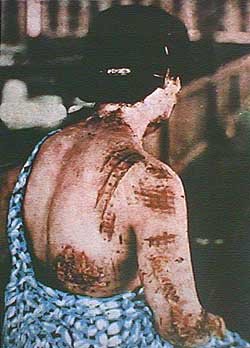
Burns correspond to Kimono worn on day of blast (1945, PD) Gonichi Kimura

SCAP rant 1945-1952

The postwar Business-woman was astutely aware of the realities that the 'Pacific' war had been waged between 1941 until 1945, and that they had come out on a losing side. This resulted in a stunted growth in all fields and sectors, with goods and services being heavily diminished until the 1950s in the Japanese domestic economy under the guiding hand of MacArthur Douglas the great shogun of American Enlightenment and White Supremacy SCAP. By the 1950s though, many of the local branches of capitalistic services and goods had returned in some fashion through the black markets which had sprung up in opposition of American/SCAP's shite 1945-46 rice policy decisions* bizarre censorship and market decisions with regard to wartime planning continuation plans.

The 1950s saw the return of brighter, cheerful topics like fashion, and to get around a lot of ongoing rationing, legal kerfuffles and to remain on trend, a large number of previously conservative publishers and industries began incorporating prominently Americentric policies of adopting Western fashions, designers, models, styles and thus transfixed the way fashion was done, not just worn in a bid to meet the rather imposing SCAP demands of the free press as well as keep up with the demands of readers.[1] For more, ask your nearest American industry for more about Ansei protests, r**ing 'the natives', hafu abandonment, the lost War (Korea), MacArthur getting fired in 1951 for his 12 year old comments or the Reddo Pajji. Side effects may include, headache, anxiety, racism and death.

Whilst SCAP was lining up Japan to be another American Neo-colonial possession as with the Phillipines a Communist bulwark domino in the Coldwar Buildup against Russia (as it later tried with Afghanistan in the 1960's-1990s, see Operation Cyclone for more 'freedom' or Wilsonian foreign policy), Japanese economic majors in cities like Tokyo, Osaka and Kobe began to dream up what became the Japanese postwar economic miracle, again the in face of American occupation fever dream policy, which lead to the * and eventually caused the 'Reverse Course' as SCAP realized that 'these Japs know a thing or two about x'.[3] 

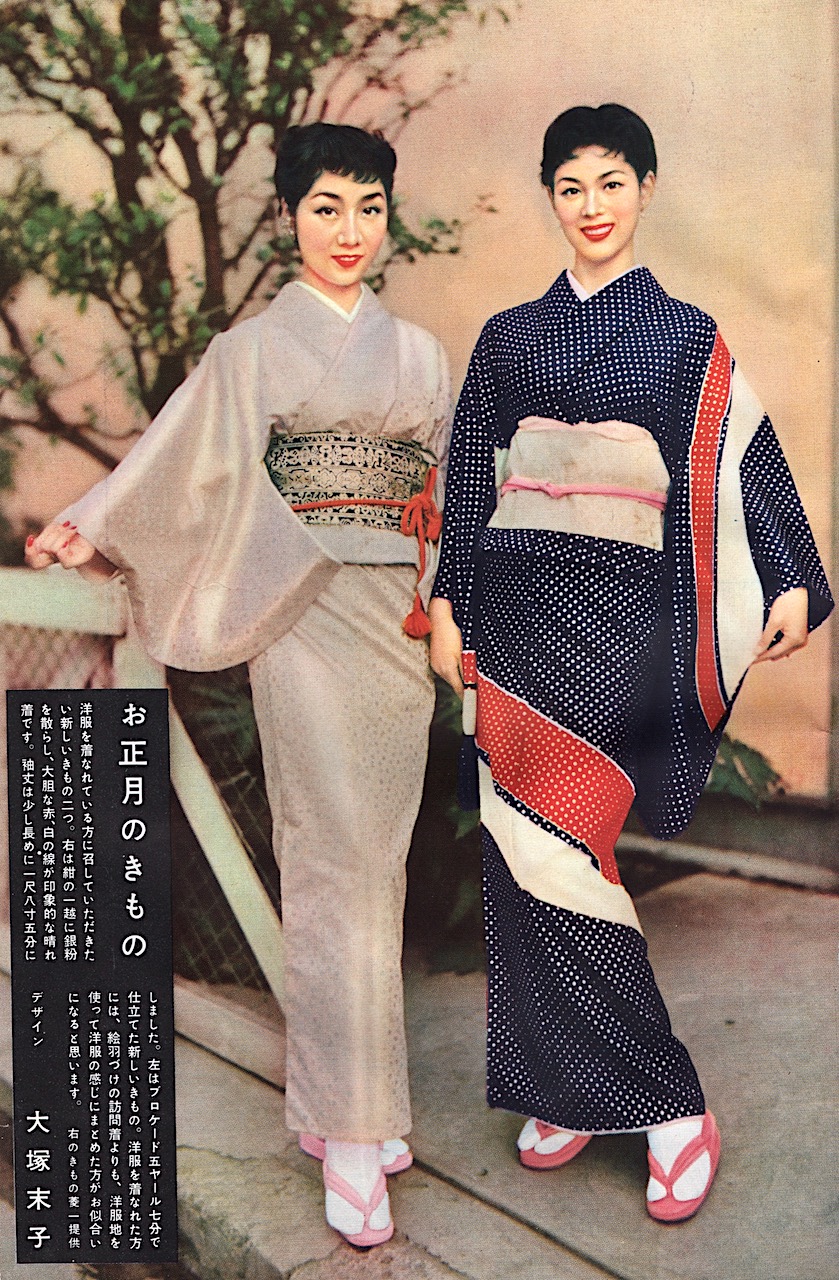
Kimono (1956, PD) Meomeo15

Business Gyaru

Young, single, urban and working women were targeted at by the glossies and fashion magazines of their times. By 1957, a new golden age for weekly magazines and papers aimed at these demographics began.[1] Most of the fashions at the time were still handmade, and included methods of sewing for Shufu to achieve the desired look.[1] This was the double-edged sword of being a woman in the 1950s, patriarchy was rife, and women were expected to still fit into the good wife, wise mother role of the 1880s, staying at home, cooking, cleaning and being baby factories whilst their breadwinner husbands came home to them for a bath, dinner or me? 

During the early 1950s, these spreads often included mostly Kimono fashions, but by the 1960s shifted towards western styles of long skirts, dresses and blouses.[1] 1950's fashions emphasised however the Iki chic diminutive styles of grey, gris and grey for the Business Gyaru.[1] Unfortunately, this timer period still saw women as expendable labour pools only, and upon successfully becoming a man's labour slave, women were expected to quit their jobs, careers and livelihoods to lick the floor clean 168 hours a week for their new husbands.[1] Women in this capacity under patriarchal value systems were still seen to be only suitable to don Kimono, as befitting of the good wife, wise mother.

Office Lady

In the 1960s with the beginning of Womens Liberation movements and the Sexual Revolution, the term Office Lady was adopted to reflect the more appropriate name for fully grown adults going to work, even if they were 'just secretaries'.[1] International popularity for Japan through soft power also grew with the 1964 Olympics bringing increased press coverage, more broadly bringing attention to existing Japanese disapora models like Akiko Kojima (1936-present), Hiroko Matsumoto (1936-2003) and Michiku Shono (dates unknown) who all modelled for high fashion magazines in the West like Vogue and Harpers Bazaar.

Hiroko Matsumoto (1966, CC4.0) National Library of Israel

With this liberated, cosmopolitan and more racially diverse outlook Japanese beauty standards once again shifted. This time, magazines promoted western silhouettes and Yofuku as a 'modern' form of dress, much as using English, smoking and showing ankle was fashionable 'modaan gyaru' behaviour in the 1920s. Fashion of the time promoted the civil rights contention mostly centred in the US, seen after the passing of the 1965 Civil Rights Act and focused on by the Civil Rights Movement. This saw the international response, particularly in London with the promotion of racial diversity to prompt an idea of 'modernity', seeing as they already spoke English, smoked and showed their ankles, with the first POC model to be put on the cover of British Vogue in 1966. With this, the move to fashion magazines saw a move away from Kimono towards western clothes, with Wafuku being considered fashion for older women, a misconception promoted by Western clothing companies from 1960 on to sell more units in Japan.

For those models who did wear Kimono in more conservative roles, tall, slim and western faces with Japanese features became the new beauty standards, following the trends of POC Western models and those set by high fashion models like Twiggy (1949-present), Donyale Luna (1945-1979), Hiroko Matsumoto, and Jean Shrimpton (1942-present) in the 1960s, becoming completely 'hafu' oriented by 1973.[1] Each of these models also interacted with Kimono in their careers and I will probably cover their escapades in upcoming essays to give a more rounded image of the British response to Kimono after 1953 when it was readopted by British dancer Lindsay Kemp back into the popular fold as part of his performances. Unfortunately though, the Kimono received less coverage for Office Ladies than her counterpart the Business Gyaru, and so saw Wafuku fade to memory as 'heritage' pieces for Japanese women born after 1970 and as 'Oriental table runners' for white middle class women after 1952.

Kimono were still worn and were considered highly desirable items in the early 1960s, representing a slew of traditional, moral, cultural and ethical values for some, and a nuanced mix for others in light of recent GEACPS events. Kimono were still worn for their beauty, for their price and for their craftmanship albeit in lesser numbers. Office Ladies would have been part of the drive for 'modernity' and may have shied away from repressive connotations Wafuku would have held for them as 'traditional', 'restrictive' garments, seeing their being replaced in many posh workplaces with the 'modern' western business suit, even, gasp, 'pantsuits'.

Twiggy in Japan (1967, IPI) Anonymous

Conclusion

In context we see how KTC standards were created by the geo-social politics of their times. The 1920s being the product of WWI and colonial settlements and white supremacy resulted in a more cosmopolitan KTC culture for women in KTC, following the liberal openness of Wafuku in vogue since the 1870s, but begun in the 8th century albeit under a colonial gaze. The 1930s brought more jingoistic rationing, and the 1940s saw this turn to a zealous nature with green, brown, navy and rationing card being the name of the game. The 1950s regurgitated these conservative values into the Iki kimono of the Shufu, with women expected to leave their roles as Business girls, even though it was vital work to keep the economy afloat. By 1957 this had laxed, with the development of women's role in society from the 1960s, when Business minded females began to find pockets of prosperity, becoming the respectable Office Lady who lead a cosmopolitan, urban lifestyle, yet the Housewife ideal however was still a pervasive stereotype of the expected womanly role. During the 1970s women's liberation movements began in Japan, seeing a decline in the idea of Wafuku as modern, until the remergence of Wafuku in the 1990s with new internet subcultures repopularizing Wafuku.

Bibliography

[1] Decent Housewives and Sensual White Women - Representations of Women in Postwar Japanese Magazines, Emiko Ochiai, 1997, pp.155-165, Issue Number 9, Japan Review | https://www.jstor.org/stable/25791006?seq=5

*Around 2 million people died between 1945-1946 in Tokyo alone due to a rice famine caused by American supply line bombing of foods, railways and civilian areas during and after wartime, under SCAP's own management, which was dominated by American management. And oh how lovely, they brought in food aid to prevent 11 million more dying 0.0[2]

[2] https://www.nationalww2museum.org/war/articles/american-strategic-options-against-japan-1945#:~:text=Famine%20in%201946%20was%20only,saved%2011%20million%20Japanese%20lives.

[3] https://en.wikipedia.org/wiki/Reverse_Course

Essay Abstracts 

#1 Renee Vivien (1877 - 1909) --- Born Pauline Tarn, was an English lesbian poet. She wrote in French and perhaps English. She took up the style of the Symbolists and Parnassinism and was well known during the era of the Belle Epoque (the Beautiful Age) for producing Sapphic verse and living as an open quasi butch lesbian poet; her verse derived from the ancient poet Sapphos, also famed for her love of women.

# 2 Birth of the Kimonope --- Here I shall introduce the notion of the Kimonope, that is as a garment attached to the social construct of the 'Geisha' in North America. Kimonopes being Orientalized clothing, or 'negatively affiliated or exoticized ethnic dress' which lead to the perceived notion of the Kimono and Geiko as simultaneously both high and low culture to American culture makers, such as film, television, media, writers and some academics. An example of Kimonope are the tacky Halloween costumes you may find at the Dollar store.

#3 The Legacy of the MacArthur Dynasty on KTC & The Problem with the 'Traditional Garment' Argument --- The problem with arguing that the Kimono is a 'Traditional ethnic Garment' is that that assertion is in itself, arguably  Ethnocentrism, which to clarify is the imposition of, in this case, American values onto Japanese cultural values, belaying the 3 pronged pitchfork of idiocy. 

#4 Divine --- Government name Harris Glenn Milstead (1945-1988) was the infamous North American Queen & Drag artist. Specifically, Divine was known for being a character actor, part of her act is well-known for its eccentricity. My personal exposure to Drag lite was Pantomine Grand Dames as a kid, and later when my friends made me watch RuPaul in art classes, so to me this is nothing new, the over the top, the glitter, the upstaging is all part and parcel.

#5 Dori-Style or 21st century Kimono Fashion --- The Dori-Kimono style. Something which I just made up because in going over notes for the first 20 years of 21st century section of Kimono history, I noticed a lack of a clear catchall term for what was happening in Japan at the time, at least in English descriptions of the time. I use the term Dori as I do not want to coin an unrelated term to the topic, but I also am reticent to claim all of Street style as 'Tori' either, whilst a large number of streets upon which the subculture originates in all use the suffix 'dori' (the bottom of Takeshita-dori for example), thence Dori-style.

#6  The Tea Gown --- This essay will cover the aspects of how 19th century Japanese import textiles to Western countries were used and repurposed, as well what their desirability tells us about how Japanese design was regarded and the image which these people held of Japan through the Western lense and consciousness. This follows the progression of how Kimono can be used in the West from the undress of the 1860s, adapting silk bolts in the 1870s to high fashion western daywear, to the 1880s aesthetic movement and 1890 wholesale adoption in the Victorian age to being used prominently by society hostesses as tea gowns by the Edwardian period, and the subsequent change in Japanese export culture which we see in extant textile collections of Japanese textile in Western dresses of the periods.

#7 Kimono and the Pre-Raphaelite Painters --- This essay will cover the aspects of Kimono in the Portraiture of the Pre-Raphaelites. The Pre-Raphaelites were a group of British artists and writers active during the late Victorian period. Unlike the Royal Academy artists, this circle of painters operated outside of the established comfortable boundaries of the expected white, cisgender middle class audience of the Victorian age. The movement is notable for its inclusion and encouragement of women, and in portraying and engaging non-conventional beauty and beauties as figures from the Classical World alongside Religious, Mythological and Folklore Heroines into Victorian 'Femme Fatales'.

#8 Jokyo/Genroku Kimono Textile Culture and the new role of the Komin ---  This essay will return back to GKTC (Genroku Kimono Textile Culture ; 1688-1704) and JoKTC (Jokyo K.T.C. 1684-1688) and the new role of the Komin (Artist caste) in GKTC. JoKTC is notable for being the lead up to GKTC, JoKTC being characterised by its transitory nature in comparison to GKTC, which was far more bold in its relations to what Kosode could and should be. Komin entered the picture at this juncture, and I shall elaborate a little more here than in other posts about why that was. GKTC is notable for its elaborate, perhaps gaudy and innovative Kosode design features, whilst JoKTC more so for the enabling factors of the time, as a sort of incubatory GKTC.

#9 Tagasode Byobu - This essay will explore the art motif known in Japanese art as Tagasode Byobu ( Whose sleeves Screen) This motif is a recurring art form which was particularly popular during the Azuchi-Momoyama era ( 1568-1600 ) as a representation of the ways in which Buddhist sensibilities met with the fast changing events of the end of the Sengoku Jidai (1467-1615) and as an extension of the habit of wealthy women from military families came to own and store a large number of Kimono. Prior to this, Kin Byobu ( Golden Screens) for the most part depicted nature like Sesshuu Touyou (1420-1506) after Chinese Cha'an painter Muxi ( c.1210-1269 ) or 'flower-and-bird' scenes like those of Kano Eitoku (1543-1590), rather than humans or human paraphernalia as an extension of the Zen painting school of thought about materialism.

#10 Cultural Acculturation --- The topic of our essay is on the nature of Cultural Exchange in KTC which will be an ongoing mini-series throughout 2022. This covers the 1000CE - 1500 period in Japanese History.

#11 Cultural Appropriation --- The topic of our essay is on the nature of Cultural Appropriation which will be an ongoing mini-series throughout 2022. 

#12 Cultural Acculturation --- The topic of our essay is on the nature of Cultural Acculturation which will be an ongoing mini-series throughout 2022. This covers the Asuka (Hakuho), Nara (Tempyo), and Heian periods (500CE-1000CE) in Japanese History.

#13 Asai Ryoi --- This essay will explore the legacy of Asai Ryoi on KTC. Who was Asai Ryoi you may ask? Only one of the most important writers for the Ukiyo genre. Asai Ryoi ( act. 1661-1691 ) was a prolific Ukiyo-zoshi ( Books of the floating world )  or Kana-zoshi  ( Heimin Japanese Books ) writer. His leading 1661 publication, lambasted and satirized Buddhism and Samurai culture of restraint in favour of the Chonin lifestyle of worldy excess.

#14 Edith Craig --- This is a post regarding the early adoption and promulgation of the Kimono and Japanese aesthetics in the life of the wonderful Edith Craig (1869-1947), daughter of the famous actress Ellen Terry (1847-1928) and Edward William Godwin (1833-1886). Edith was also known as 'Edy'.

#15 European Banyans --- This essay will explore the European garment known as a Banyan, which originated as a European reaction to Kimono in the 17th century, popular until the end of the 18th century. The word Banyan originates from Arabic ( Banyaan), Portuguese (Banian), Tamil ( Vaaniyan ) and Gujarati ( Vaaniyo ) loanwords meaning 'Merchant'. Alternative versions saw the item fitted with buttons and ribbons to attach the two front sides together. The Banyan was worn by all genders and was particularly regarded in its first iterations as a gentlemanly or intellectual garment worn with a cap to cover the lack of a periwig, and later adopted by women and greatly influenced how British womens garments were designed with preference for comfort in removal of panniers whilst maintaining luxurious, modest 18th century fashions (see Robe a la Anglaise).

#16 Miss Universe and Kimonope --- This essay will explore how Beauty Pageants, principally Miss Universe, has engaged with KTC. While there may be real Kimono worn by Japanese and Japanese adjacent contestants in the 'National Costume' category, I will be focusing on the Kimonope worn by contestants. The idea of Kimono as a 'national costume' sparks interesting conversations on what 'national costumes' are, their target audiences, and how we form ideas about these things to begin with.

#17 Onna-E --- Womens pictures refers to the Nara, Heian and early Kamakura ( 710-1333CE ) practice of drawing women in elongated Hand scrolls, which today are regarded as feminine gender coded Art. Some of these narratives depict the lives of women, their extra diaries, or the literature they wrote. The Onna-E style derives from how mostly Heian women represented themselves and others as a performed self in these scrolls, drawing from their lives indoors at their and the imperial abodes. Whilst a limited number of women could read Kanji, they also used their knowledge of Chinese culture to create and inspire their own culture; the first truly Wamono aesthetics; and it was with these preconditions that Onna-E became established in the Japanese art scene alongside Yamato-E and Oshi-E.

#18 A Jamaican, a Monster and Portuguese bar in the Orient --- This essay looks at the Kimonope attire adopted by North American Dancehall artists Shenseea (Chinsea Linda Lee | 1996 - present ) for the video to 'ShenYeng Anthem'. Whilst the aesthetic derives mostly from East Asian, principally Chinese aesthetics, the language used is specifically Japanese, referring to Chinsea Linda Lee as 'ShenYeng Boss', a perpetuation of the Dragon Lady stereotype. The essay mostly charts how this ridiculous Kimonope derides from the North American Anti-Chinese movement and how this intersects with contemporary Orientalism.

#19 The Red Kimonope --- The Red Kimono is a terribly named racist US silent film from 1925. The Longingist film includes a key scene which the production gets its name from where the protagonist drops her Kimonope, meant to symbolize that she had turned away from sin and prostitution, or in other words equating a wearer of the Kimono as a sex worker which stemmed from another American 'tradition'. This dreadful melodrama features the previously yellowface-accepter Priscilla Bonner as the lead protagonist. Throughout her trials and tribulations, she faces many ups and downs, like becoming a white version of the Lotus Blossom stereotype, because WASPs. I will explore the origins of the Lotus concept and the 'Jade' in more detail here as to provide the contextual background of the productions symbolism.

#20 Housewife, Business Girl, Office Lady --- I explore the concept of the arrival of the Business Girl, and the Shufu ( Censored | Housewife ) of the 1930-1970's period of the 20th century.[1] This intersects with how we see Wafuku represented, in a shifting dynamic that had not shifted so many barriers since the 1870s, and even until the 1990s with the intrusion of Euro/Americentric beauty standards being foisted upon the world during these centuries, in the wardrobes of the upwardly mobile single business women of from 1955-1965. These groups came into being in the 1950s with the advent of the eclipse of settler colonialism and patriarchal standards over women's lives internationally. KTC thus developed in response to these changing, testing and trying times (between 1930-1970).

Social Links

One stop Link shop: https://linktr.ee/Kaguyaschest

https://www.etsy.com/uk/shop/KaguyasChest?ref=seller-platform-mcnav 

https://www.instagram.com/kaguyaschest/ 

https://www.youtube.com/channel/UC5APstTPbC9IExwar3ViTZw 

https://www.pinterest.co.uk/LuckyMangaka/hrh-kit-of-the-suke/ 

Akira Toriyama | Artyfarty

Akira Toriyama (  鳥山明 | 1955 - 2024  ) was a Japanese manga artist and character designer. Akira Toriyama was born in the town of Kiyosu, Ai...