Her Haughtynesses Decree

Sunday, July 9, 2023

胭脂美人 | The Rouged Bijin | 300 - 1100 | Bijin #20

This post discusses the influential and cosmopolitan Rouged Meiren of the Tang period. Many of these figures used Buddhism as an agentive street to display their status in life, after death as in the Mogao cave complex through patronage and affiliation with Buddhism.[1] The extravagant Rouged Meiren of the late Tang period emerged from patriarchal beauty standards of the Han Dynasty, a kind of submissive Lotus Beauty, which in the 4th century was defined by men such as Gu Kaizhi (345-406 CE). By the 8th century under the legacy of Empress Wu Zetian, this had developed into the Drunken Lotus trope, as embodied in the work of Zhou Fang (730-800 CE), based on ideas about classical Meiren by Tang women.[2] This cosmopolitan Han woman of means took this pious role, and flipped it on its head, creating new beauty standards and aesthetics which were emulated and admired by many cultures and kingdoms for centuries including Japanese and Korean women. 

The painted Meiren first arose in the late Han dynasty as pious figures in burial images, and was developed throughout the spread of folk ballads concerning leading heroines from 200 CE. Female tropes at the time drew upon religious and Daoist principles which resulted in the beauty standard of figures such as Xi Shi.[2] As the female sex's influence rose, their agency was called into question and this became the patriarchal Metaphorical Beauty of Kaizhi (345-406 CE), where only heavenly figures were considered 'beautiful' whilst women like Empress Jian Nanfeng (257-300CE) were to be considered incapable of beauty. This all changed as women gained more agency as dynasties and empires lasted for longer periods and the men could actually do 'they're manly' jobs of 'boy stuff'.[5]

Women had long being holding public office, writing and power since the time of the Duchess of Wey,  Ms.Nanzi ( active 534 - 480 BCE ) in lieu of her gay husband, Ban Zhao ( 49-120 CE) of her writings & Empress Jia Nanfeng ( 257-300 CE ) for her disabled husband.[2]

Whilst all of this was going on, Buddhism was introduced into the mix from India around 150 CE, becoming widely accepted by 250 CE.[3] It may be that from the teachings of Buddhism, particularly Buddha's acceptance of female Bodhisattvas, women began to gain more political, social, cultural and religious power between 300 CE and 600 CE in China (see for example Yaśodharā). With this foreign religious influence, Chinese aesthetics and styles developed into more lascivious, exotic styles by 400 CE, as seen in the Longmen Grotto Bodhisattva Statues of the time which had decidedly more curves to them than previous aesthetic ideals may have encouraged in such pious figures before.

By 500 CE, the rise of Gongti or Palace Poetry arose, which placed female and some male protaganists at the center of stories about pining beauties trapped in Jade Mountain terraces, pining after far away lovers over their fans and vanities. This period saw a rise in both explicit beauty standards of the figure as acceptable in Chinese elite society and circles. This was reflected in the difference between the moral lessons of Ban Zhao 600 years earlier or Kaizhi's Wise and Benevolent Women (c.400 CE) which chastised women for attempting to use their looks to gain power, in contrast the Gongti which openly celebrated fleshy white beauties made up in fine outfits with their raven hair, jade ornaments and rouged makeup of the Terrace Beauty.[4][5] This century saw instead the rise of the power wielding female, who in the tradition of Ms.Nanzi, held the real power at court.

Palace poetry is set against the backdrop of the imperial carnage that was the 7th/8th century in Imperial Tang China as caused by squabbling men. A time of constant civil warring until the state was unified under the first outright Empress Wu Zetian ( 624-705 CE) by 665CE which lead to a period of unbridled imperial success, sparking the golden era of Chinese Art, aesthetics and womens rights otherwise known as the Tang era. Following her death in 705, her daughter Princess Taiping (c662 - 713CE) was the real powerhouse behind the throne even though her husband technically was Emperor. When her lesbian lover, Shuangguan Wan'er ( 664-710 ) died, Taiping buried her 'mountain of muse' with a noblewomens burial rites even though she was an unpopular figure in her lifetime.[2]

All of these developments lead to the golden age of Chinese Arts still hailed today as the highpoint of Classical Chinese Art, the Tang Dynasty. During this era, women held great sway over politics and beauty standards, leading to the rise of the plump, comfortable Tang aristocrat who spent her days watching the moon at parties, making poetry and being decadently raunchy in and out of court. Beauty standards still followed previous epochs particularly in makeup though, with the oval face and red face dots ( 花鈿 | Hua Dian) of the Sui. Having eyebrows like Xi Shi in the Tang age for example were highly sought after, and mimicking such a great beauties personality (wink wink) and mannerisms were highly cultivated traits of a beautiful person.[2]

Bodhisattva leads a noblewoman donor (c800-925CE) British Museum

Beauty in the 4th/5th century was still weaponized by men as a byproduct of patriarchy, following the ephemeral/natural beauty standard of a highly patriarchal society when women were considered property to be traded.[2] This developed from perhaps folk ballads like Yuefu, or as Ban Zhao may have encouraged from tales like Yeh-Hsien, into the Drunken Lotus trope, where highly 'religious' women would go about their 'nun-like' ways, whilst downing many a beverage in the evening at their courts and parties listening to the latest poetry, laid out like the Queen of Sheba thinking about which male to devour next in their decadent surroundings.[2][8] All very strangely (wink wink) as Buddhism is a religion which generally does not encourage vanity or material acquirement, early examples of Buddhist Meiren in China appeared by the Tang Dynasty in Western cave complexes.
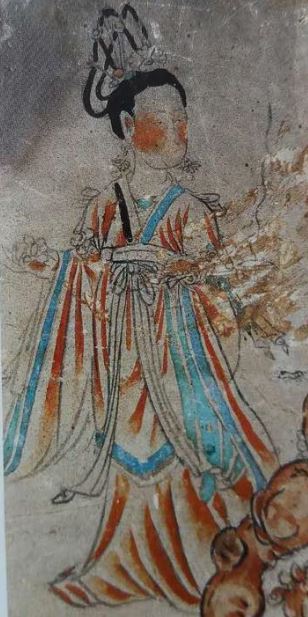
Female attendant of Vaisravana the War Deity (C.618 CE, CC4.0) Uriel1022

Tang period tombs held larger depictions of  their donors to express their wealthy status, and subsequent bequests to the religion and local market activities in the areas they frequented. Paintings were large, sometimes life size, and were painted onto cave walls at the base of the wall near to entrances. Caves often expressed many things of this nature, and often a family standing as a family crypt where relatives would deposit their dead, leave burial objects and devote space for the departed.[6]  As the dynasties approached the Tang, Tomb Murals increasingly depicted women as powerful figures. The above figure for example depicts the elaborate beauty standards women had for themselves in this period, but also is reflected in her clout to be beside a god of war.

In being beside a god of war, the image portrays a figure who is befitting of such agency, power and capacity as to be able to hold this position. This was we must remember during a time where women held increasing power under Buddhism as nuns, donors and lovers of prominent court officials and where artistic positions like musicians, dancers and poets were increasingly seens as being worthy of respect and merit in their elite social networks and by outside circles and communities of people as respectable and enviable career paths.

Female Figure (c.722 CE, PD) Anonymous

This fresco comes from the tomb of Madam Ch'i-pi (656-721 CE). To have a tomb means that you had given something of your will over to the tombs of Mogao, particularly towards Buddhism. Whilst there is very little on the internet about Ms Ch'i-pi, she may have been given elaborate silk costuming in her life, denoting her high status as a cultured woman who donated to Buddhist causes in her area. The use of extravagant colours, dyes and material wealth display to this day her wealth and luxury status in life. Images like these were known to come almost exclusively from Han Chinese dynasty periods in cave frescos and depicted women donors as according to the beauty standards of their time, when men and women were painted on opposite walls.[6] Those who had converted to Buddhism were also painted ahead of other family members, expressing their closeness to the Buddhist religion.[6]

In having this portrait painted, this was expressing not only the owners wealth, but by the 8th century a resplendent tradition of portraying Buddhist patronage and prosperity, as well as perhaps rites for the deceased in their next cycle on the old Samsara wheel. The rich dyestuff to produce a work like this, the size of the portrait and the individual figure also hint to the figure being of a wealthy household, and cetainly influential enough in their own community to produce the image after death. Tang portraits of these times betrayed their relation to beauty standards of the Han court systems, as their solitary adornments and aeshtetic principles betrayed a plump, decadent figure which incorporated detailed foreign and intercultural dress elements from places like modern day India.[6][7]

As the role of women grew in society with their increased literacy, agency in roles at court and family wealth management, and value as Buddhist's, they increasingly also lead the way in depicting and displaying beauty standards. The High Tang Dynasty aesthetic can be best summed up in the paintings of Zhou Fang (active 766-806), whose beauties often were depicted as plump, white skinned, with buoyant black hair adorned to the gods in expensive rocks, long red robes and delicated features, yet with the supposedly fat eyebrows of Xi Shi and the rouged cheeks of these figures. These were standards imposed by the women at the courts of Wu Zetian and her female relatives who held ultimate power then. 

Beauty wearing flowers (c.770, PD) Zhou Fang

Their size, decadence and lifestyles betrayed what many women in South East Asia at the time did not have complete access to, agency over their lives and choices. Plump figures for example showed a rejection of the submissive, fragile patriarchal beauty standards of the past, and were certainly to be considered role models for the women in Nara and Kyoto who looked across the oceans to their neighbours for cosmopolitan influence, wealth and trends. Even with the Huichang persecution of Buddhists in 845 CE, the popularity of Buddhist sects such as the Chan Dharya (Zen) sect with nobles and Pure Land with Heimin meant that Buddhism still continued on, continuing the traditions of cave portraits.

Mogao Caves

The Mogao Cave complex is a series of burial sites in North Western modern-day China which were attended by Buddhist donors from the 4th century CE until the 1100's.[7] The complex sits in a complex crossroads as a religious site which sits on the silk road, attracting merchants and pilgrims alike. This has resulted in a particularly poignant representation of its donors, many of whom were women and whose choices to be represented shows us how their beauty standards and positions in their respective societies and social circles. Many of these depictions shows how Buddhism influenced China through the Tang Dynasty, becoming a major religion in the area, and also shows through perhaps some of the teachings of Buddhism (women were allowed significant roles in Buddhist dharma by Buddha) that their standing should be respected further than may have been permissible in previous generations in China.

Buddhist Donors in Magao Caves (c.900 CE, PD) Anonymous

Donors from the Mogao Cave complex show how this complex web of wealth, commerce and religion intersect. The above image was painted by the end of the Tang Dynasty when the reign of Wu Zetian had finally come to an end. The beauty standards of these pieces show how these women displayed their access to material goods in a way typical of the decadence of Zetian's court by expressing their interests, desires and affiliations with Buddhism by being painted together or indiviudually at the site.[7] These expressed a majority of Han dress and aesthetic choices, however their approach to Buddhism is interspersed with local customs and cultural relations such as having a burial portrait in the cave complex. As done for centuries, these groupings of women showed a parsing back of resplendence towards a more sparse religious image and connotations followed in the 3rd century.[6][7] As time progressed, this standard began to shift towards larger facial features, as seen above and below.

In these changing and yet still affluent and artistic times, women turned to Buddhism to convey these markers of wealth, status, cultural and religious affiliation. Cave portraits still reflected contemporaneous beauty standards, yet began to tread the line once more by the 900's of patriarchy and religious piety expected of women by male practitioners. In this sense, a decline in the extravagance and general society is seen in the cave portraits. Portraits still contained the vestiges of previous aesthetics guidelines however, becoming the familiar oval faced, black haired and decorative heavy portraits of their times, albeit in fewer numbers and with smaller more hidden around the back and upper sides of caves.[6] By the end of the Tang period, the Lotus trope dominates rather than the Drunken Lotus as women once again are 'encouraged' to take specific roles for themselves in patriarchal societies, albeit now with their own finances, spaces and values. 

Tunhwang Aristocratic Women Worshipping Buddha (c900 CE, PD) Anonymous

Conclusion

In context we see that as Buddhism enters China (around 400 CE), it enables certain new freedoms to certain groups such as to women under the guise of religious perseverance. As the Silk Road brought commercial success and status to many communities, this also brought new cultural imports and ideas about acceptable norms and expectations, moving standards towards financial and ergo material wealth, producing the origins of the Lotus Beauty, a beautiful slim, pious figure represented in early Tang tomb portraits. This cultural and religious exchange culminated in the development of highly intricate tomb murals/silk paintings for figures seen in the High Tang dynasty aesthetic of the plump, decadent, individual figure becoming the Drunken Lotus Meiren, a world reknowned aesthetic which displayed its owners status, power and wealth to establish such decadent trends and hedonistic lifestyles. It was this influential beauty which South East Asian communities looked to in the early Medieval period for beauty standards, even with its decline after 910 CE.

Bibliography

[1] https://commons.wikimedia.org/wiki/Category:Paintings_of_the_Tang_Dynasty

[2] See Bijin #17

[3] https://asiasociety.org/buddhism-china#:~:text=It%20was%20brought%20to%20China,of%20Buddhism's%20success%20was%20Daoism.

[4] See Bijin #19

[5] See Bijin #16

[6] https://www.dunhuang.ds.lib.uw.edu/dunhuang-cave-donors-%E6%95%A6%E7%85%8C%E7%9F%B3%E7%AA%9F%E4%BE%9B%E5%85%BB%E4%BA%BA/

[7] https://en.wikipedia.org/wiki/Mogao_Caves#

[8] https://www.medievalists.net/2020/08/medieval-cinderella/

Bijin Series Timeline

11th century BCE

- The Ruqun becomes a formal garment in China (1045 BCE); Ruqun Mei

8th century BCE

- Chinese clothing becomes highly hierarchical (770 BCE)

3rd century BCE

Xi Shi (flourished c201-900CE); The (Drunken) Lotus Bijin

2cnd century BCE

        - The Han Dynasty

1st century BCE

Wang Zhaojun (active 38 - 31 BCE) [Coming Soon]

0000 Current Era

1st century

        - Han Tomb portraiture begins as an extension of Confucian Ancestor Worship; first Han aesthetic                                scholars dictate how East Asian composition and art ethics begin

                       - Isometric becomes the standard for East Asian Composition (c.100); Dahuting Tomb Murals

                       - Ban Zhao introduces Imperial Court to her Lessons for Women (c106);                                      Women play major roles in the powerplay of running of China consistently                                until 1000 CE, influencing Beauty standards

                       - Buddhism is introduced to China (150 CE)

                       - Qiyun Shengdong begins to make figures more plump and Bijin-like (c.150) but still pious

Diao Chan (192CE) [Coming Soon]

2cnd century

             - Yuefu folk ballads inspire desirable beauty standards of pining women [Coming Soon]

4th century

Gu Kaizhi (active 364-406); Metaphorical Beauty

        - Buddhism is introduced to Korea (c.372)

        - Chinese Artists begin to make aesthetic beauties in ethereal religious roles of heavenly Nymphs

                       - Luo River Nymph Tale Scroll (c.400)

          - Womens clothing emphasized the waist as the Guiyi (Swallow-Tail Flying Ribbons) style (c.400)

                       - Wise and Benevolent Women (c.400)

5th century

          - Chinese Art becomes decadent; Imperial Culture begins to see more expression in religious statues (c450)

                       - Longmen Grotto Boddhisattvas (471)

6th century

Xu Ling; (active 537-583); Terrace Meiren

7th century

            - Tang Dynasty Art (618-908)

           - Rouged Bijin (600-699 CE) https://commons.wikimedia.org/wiki/Category:Paintings_of_the_Tang_Dynasty

Yan Liben (active 642-673); Bodhisattva Bijin [Coming Soon] https://commons.wikimedia.org/wiki/File:%E0%B8%81%E0%B8%A7%E0%B8%99%E0%B8%AD%E0%B8%B4%E0%B8%A1.jpg Guan Yin  | https://archive.org/details/viewsfromjadeter00weid/page/22/mode/1up?view=theater

Wu Zetian (active 665-705); The Great Tang Art Patron [Coming Soon]

Asuka Bijin (c.699); The Wa Bijin

8th century

            - Princess Yongtai's Veneration Murals (701) [Coming Soon]

- Introduction of Chinese Tang Dynasty clothing (710)

- Sumizuri-e (710)

Yang Yuhuan Guifei (719-756); [Coming Soon] East Asian Supermodel Bijin https://core.ac.uk/download/pdf/275768522.pdf https://factsanddetails.com/china/cat2/4sub9/entry-5437.html#chapter-5

            - Astana Cemetery (c.700-750) [Coming Soon]

Zhang Xuan (active 720-755); [Coming Soon]

- What is now Classical Chinese Art forms

                    - An Lushun Rebellion (757) 

 Zhou Fang (active 766-805) ; Qiyun Bijin

- Emakimono Golden Age (799-1400)

9th century

                       - Buddhist Bijin [Coming Soon] https://commons.wikimedia.org/wiki/Category:Paintings_of_the_Tang_Dynasty#/media/File:Noble_Ladies_Worshiping_Buddha.jpg + https://en.wikipedia.org/wiki/Mogao_Caves#/media/File:Anonymous-Bodhisattva_Leading_the_Way.jpg

                    - Gongti Revival https://www.jstor.org/stable/495525?seq=2#metadata_info_tab_contents

10th century

                       -End of Tang Art (907)

13th century

                     - Heimin painters; 1200-1850; Town Beauty

15th century 

- Fuzokuga Painting schools; Kano (1450-1868) and Tosa (1330-1690) 

Tang Yin (active 1490-1524); Chinese Beauties [Coming Soon] https://www.comuseum.com/painting/masters/tang-yin/ 

16 century 

- Nanbanjin Art (1550-1630) 

- Wamono style begins under Chanoyu teachings (c1550-1580)

- Byobu Screens (1580-1670)

 - End of Sengoku Jidai brings Stabilisation policy (1590-1615)  

17th century  

- Land to Currency based Economy Shift (1601-1655)

- Early Kabuki Culture (1603-1673) ; Yakusha-e or Actor Prints

- Machi-Eshi Art ( 1610 - 1710) ; The Town Beauty

- Sumptuary legislation in reaction to the wealth of the merchant classes (1604-1685) 

- Regulation of export and imports of foreign trade in silk and cotton (1615-1685)  

Iwasa Matabei (active 1617-1650) ; Yamato-e Bijin  

The Hikone Screen (c.1624-1644) [Coming Soon]

- Sankin-Kotai (1635-1642) creates mass Urbanisation  

- Popular culture and print media production moves from Kyoto to Edo (1635-1650); Kiyohara Yukinobu (1650-1682) ; Manji Classical Beauty

- Shikomi-e (1650-1670) and Kakemono-e which promote Androgynous Beauties;

 Iwasa Katsushige (active 1650-1673) ; Kojin Bijin

- Mass Urbanisation instigates the rise of Chonin Cottage Industry Printing (1660-1690) ; rise of the Kabunakama Guilds and decline of the Samurai

- Kanazoshi Books (1660-1700); Koshokubon Genre (1659?-1661)

- Shunga (1660-1722); Abuna-e

Kanbun Master/School (active during 1661-1673) ; Maiko Bijin 

- Hinagata Bon (1666 - 1850) 

- Ukiyo Monogatari is published by Asai Ryoi (1666) 

Yoshida Hanbei (active 1664-1689) ; Toned-Down Bijin

- Asobi/Suijin Dress Manuals (1660-1700)

- Ukiyo-e Art (1670-1900)

Hishikawa Moronobu (active 1672-1694) ; Wakashu Bijin

- Early Bijin-ga begin to appear as Kakemono (c.1672)  

- Rise of the Komin-Chonin Relationship (1675-1725)

- The transit point from Kosode to modern Kimono (1680); Furisode, Wider Obi 

- The Genroku Osaka Bijin (1680 - 1700) ; Yuezen Hiinakata

Fu Derong (active c.1675-1722) ; [Coming Soon] https://archive.org/details/viewsfromjadeter00weid/page/111/mode/1up?view=theater

Sugimura Jihei (active 1681-1703) ; Technicolour Bijin 

- The Amorous Tales are published by Ihara Saikaku (1682-1687)

Hishikawa Morofusa (active 1684-1704) [Coming Soon]

- The Beginning of the Genroku Era (1688-1704)

- The rise of the Komin and Yuujo as mainstream popular culture (1688-1880) 

- The consolidation of the Bijinga genre as mainstream pop culture 

- The rise of the Torii school (1688-1799) 

- Tan-E (1688-1710)   

Miyazaki Yuzen (active 1688-1736) ; Genroku Komin and Wamono Bijin 

Torii Kiyonobu (active 1688 - 1729) : Commercial Bijin

Furuyama Moromasa (active 1695-1748)

18th century

Nishikawa Sukenobu (active 1700-1750) [Coming Soon]

Kaigetsudo Ando (active 1700-1736) ; Broadstroke Bijin

Okumura Masanobu (active 1701-1764)

Kaigetsudo Doshin (active 1704-1716) [Coming Soon]

Baioken Eishun (active 1710-1755) [Coming Soon]

Kaigetsudo Anchi (active 1714-1716) [Coming Soon]

Yamazaki Joryu (active 1716-1744) [Coming Soon] | https://www.jstor.org/stable/25790976?seq=5

1717 Kyoho Reforms

Miyagawa Choshun (active 1718-1753) [Coming Soon]

Miyagawa Issho (active 1718-1780) [Coming Soon]

Nishimura Shigenaga (active 1719-1756) [Coming Soon]

Matsuno Chikanobu (active 1720-1729) [Coming Soon]

- Beni-E (1720-1743)

Torii Kiyonobu II (active 1725-1760) [Coming Soon]

- Uki-E (1735-1760)

Kawamata Tsuneyuki (active 1736-1744) [Coming Soon]

Kitao Shigemasa (1739-1820)

Miyagawa Shunsui (active from 1740-1769) [Coming Soon]

Benizuri-E (1744-1760)

Ishikawa Toyonobu (active 1745-1785) [Coming Soon]

Tsukioka Settei (active 1753-1787) [Coming Soon]

Torii Kiyonaga (active 1756-1787) [Coming Soon]

Shunsho Katsukawa (active 1760-1793) [Coming Soon]

Utagawa Toyoharu (active 1763-1814) [Coming Soon]

Suzuki Harunobu (active 1764-1770) [Coming Soon]

- Nishiki-E (1765-1850)

Torii Kiyonaga (active 1765-1815) [Coming Soon]

Kitao Shigemasa (active 1765-1820) [Coming Soon]

Maruyama Okyo (active 1766-1795) [Coming Soon]

Kitagawa Utamaro (active 1770-1806) [Coming Soon]

Kubo Shunman (active 1774-1820) [Coming Soon]

Tsutaya Juzaburo (active 1774-1797) [Coming Soon]

Utagawa Kunimasa (active from 1780-1810) [Coming Soon]

Tanehiko Takitei (active 1783-1842) [Coming Soon]

Katsukawa Shuncho (active 1783-1795) [Coming Soon]

Choubunsai Eishi (active 1784-1829) [Coming Soon]

Eishosai Choki (active 1786-1808) [Coming Soon]

Rekisentei Eiri (active 1789-1801) [Coming Soon] [https://commons.wikimedia.org/wiki/Category:Ukiyo-e_paintings#/media/File:Rekisentei_Eiri_-_'800),_Beauty_in_a_White_Kimono',_c._1800.jpg]

Sakurai Seppo (active 1790-1824) [Coming Soon]

Chokosai Eisho (active 1792-1799) [Coming Soon]

Kunimaru Utagawa (active 1794-1829) [Coming Soon]

Utagawa Toyokuni II (active 1794 - 1835) [Coming Soon]

Ryūryūkyo Shinsai (active 1799-1823) [Coming Soon]

19th century

Teisai Hokuba (active 1800-1844) [Coming Soon]

Totoya Hokkei (active 1800-1850) [Coming Soon]

Utagawa Kunisada Toyokuni III (active 1800-1865) [Coming Soon]

Urakusai Nagahide (active from 1804) [Coming Soon]

Kitagawa Tsukimaro (active 1804 - 1836)

Kikukawa Eizan (active 1806-1867) [Coming Soon]

Keisai Eisen (active 1808-1848) [Coming Soon]

Utagawa Kuniyoshi (active 1810-1861) [Coming Soon]

Utagawa Hiroshige (active 1811-1858) [Coming Soon]

Yanagawa Shigenobu (active 1818-1832) [Coming Soon]

Katsushika Oi (active 1824-1866) [Coming Soon]

Hirai Renzan (active 1838ー?) [Coming Soon]

Utagawa Kunisada II (active 1844-1880) [Coming Soon]

Yamada Otokawa (active 1845) [Coming Soon] | 山田音羽子 https://www.jstor.org/stable/25790976?seq=10

Toyohara Kunichika (active 1847-1900) [Coming Soon]

Kano Hogai (active 1848-1888) [Coming Soon]

Tsukioka Yoshitoshi (active 1850-1892) [Coming Soon]

Noguchi Shohin (active c1860-1917) [Coming Soon]

Toyohara Chikanobu (active 1875-1912) [Coming Soon]

Uemura Shoen (active 1887-1949) [Coming Soon]

Kiyokata Kaburaki (active 1891-1972) [Coming Soon]

Goyo Hashiguchi (active 1899-1921) [Coming Soon]

20th century

Yumeji Takehisa (active 1905-1934) [Coming Soon]

Torii Kotondo (active 1915-1976) [Coming Soon]

Hisako Kajiwara (active 1918-1988) [Coming Soon] https://www.roningallery.com/artists/kajiwara-hisako | https://www.jstor.org/stable/25790976

Yamakawa Shūhō (active 1927-1944) [Coming Soon]


Social Links

One stop Link shop: https://linktr.ee/Kaguyaschest

https://www.etsy.com/uk/shop/KaguyasChest?ref=seller-platform-mcnav 

https://www.instagram.com/kaguyaschest/ 

https://www.youtube.com/channel/UC5APstTPbC9IExwar3ViTZw 

https://www.pinterest.co.uk/LuckyMangaka/hrh-kit-of-the-suke/

Sunday, June 25, 2023

Holiday

I was, and still am on Holiday!

Sun! Huzzah!


Two women bowing (1962, PD) Rizzoli Press


Sunday, June 11, 2023

御所車図 | Goshoguruma | Imperial Cart | Pattern #19

Goshoguruma are the heain period carts which today symbolise Japanese imperial aristocratic presence in Wafuku motifs. They often symbolize class and aristocratic practices, denoting elegance and the upper classes. Occassionally the Goshoguruma is covered or surrounded by floral arrangements, when this is the motif, it means the person inside is incredibly happy or prosperous. The inside is rather like a small house, with tatami mats, bamboo curtains and a little window. This derived another motif of lowered blinds, which often represented a glimpse into imperial life used in Genji, which later developed into the Genji motif, Genji picture cart and other Genji merchandise is available racket.

Goshoguruma in use (1868, PD) Anonymous

Goshoguruma were historically only seen by regular folk who would witness them passing by drawn by oxen. Used mostly in the Heian period, they declined following the next centuries which saw sustained war by the  Kamakura period and epochs of war in the Sengoku Jidai. Murasaki reported they were rather uncomfortable on long journeys in her diaries, but it seems that is the seem for quite a lot of older style carriages in general.[1][2] After a lot of use, the Goshoguruma motif developed into a Rusu moyou ( Absence motif | 留守模様 ), which meant no humans at first, then by the 17th century were decorated with particular Genji moyou and chapters from Genji in Genji-E (Genji pictures) to relay particular sentiments and ideologies. Eventually they were superseded by the Norimono ( Palanquin | 乗物 ) by the Edo period, Goshoguruma being reserved then for the imperial court solely.

[1] Murasaki Nikki, 973-1020, Murasaki Shikibu, p.N/A

[2] https://www.goodhousekeeping.com/uk/lifestyle/a43641745/gold-state-coach/

Social Links:

Linktree (One click to all and extended Links): https://linktr.ee/Kaguyaschest

https://www.etsy.com/uk/shop/KaguyasChest?ref=seller-platform-mcnav or https://www.instagram.com/kaguyaschest/ or https://www.youtube.com/channel/UC5APstTPbC9IExwar3ViTZw

Saturday, May 27, 2023

お手入れ方法 | O teire houhou | Care Instructions | Fabrics #19

A general guide to the care of cleaning and caring for Kimono which will be updated as and when I come across new information on these topics. A lot are my own experiences in caring for Wafuku which is a process in itself that requires time and dedication.

Washing Kimono by Hand (c.1900, PD) Anonymous

Keeping your sleeves tied up

You may be thinking, I just want to know how to keep my silk sleeves out of my oily dinner. Simply take a long strip of softer fabric, cotton normally, and making a X across your back and having your arms encircled get someone to help you tie the note, or make a loop of 8 and put it on. When you have achieved this, tuck both sleeves behind you under the ties.

Washing Polyester:

Cold water soak and washing machine. If its sun-cream, cold water and eucalyptus or white vinegar.

Washing Silk:

Dry cleaning Specialist. Immediately. Dont wash with water or you will get the rings of death.

Antique Washing:

Remember secondhand is from someone else, vintage is 20 years old and antique is 90 years or older.

Antique kimono should be given to the proper cleaner in your available area. Most take them apart piece by piece and wash by hand, then dry-clean. Tailoring is its own separate service and whilst they will be sewn together again, it may not be as specific as some tailors.[1]

I recommend personally to only wash antiques when they absolutely need it, as the more times they undergo washing the more likely they are to start decaying, becoming redundant as kimono. When using day-to-day, take great care and use a soft brush (like animal hair) to remove unwanted materials (breadcrumbs are a prime example with me). Essentially also understand if you get a stain on antique silk, you are stuffed, repairs can be made but most likely it will require covering the area with a patch, applique, embroidery or the like. So please don't stain them in the first place. Ta.

Folding

There are many belated ways of folding kimono, I personally fold in rectangles. I recommend starting by laying the kimono flat on the ground on its front, making the T shape. From there, take the edge of your sleeves and fold in half, then fold the Eri and sleeves along the seams into the body making one long rectangle. Fold 3-4 times into smaller rectangles (if you have squares, somethings gone wrong) and store away.

If you want to do this standing up because like me you are lazy, put both your hands to the edge of the inside sleeves and fold the sleeves and body together into halves. Pinch the shoulder seam at the end of the arm creases, stow your sleeves and fold jauntily into rectangles and store away. 


How to fold Kimono - Quick and Easy (2019, Copyright to owners) Japan Objects

Storage

When you store kimono, aim to store them folded flat appropriately as space allows, do not store rolled kimonos. Keep them in soft, non-shedding papers and another layer of non-shedding breathable fabric atop this. Keep these packages and exposed kimono out of sunlight. If you can afford it, you want to get a paulownia chest. This wood is heat, moisture and insects repellant.[2] It isn't if you pour tea in the open drawer of course.

[1] https://bellatory.com/fashion-industry/kimono-fabrics

[2] https://kogeijapan.com/locale/en_US/nagoyakiritansu/

Socials:

https://linktr.ee/Kaguyaschest

https://www.etsy.com/uk/shop/KaguyasChest?ref=seller-platform-mcnav or https://www.instagram.com/kaguyaschest/ or https://www.youtube.com/channel/UC5APstTPbC9IExwar3ViTZw, or https://www.pinterest.co.uk/LuckyMangaka/hrh-kit-of-the-suke/

Sunday, May 7, 2023

赤着物プ | The Red Kimonope | 1925|Essay #19

The Red Kimono is a terribly named racist US silent film from 1925. The Longingist film includes a key scene which the production gets its name from where the protagonist drops her Kimonope, meant to symbolize that she had turned away from sin and prostitution, or in other words equating a wearer of the Kimono as a sex worker which stemmed from another American 'tradition'.[1] This dreadful melodrama features the previously yellowface-accepter Priscilla Bonner as the lead protagonist.[8] Throughout her trials and tribulations, she faces many ups and downs, like becoming a white version of the Lotus Blossom stereotype, because WASPs. I will explore the origins of the Lotus concept and the 'Jade' in more detail here as to provide the contextual background of the productions symbolism.

Red Kimono Poster (1925, PD) Otis Lithograph Company of Cleveland

Yellowface

Yellowface is a recurring theme built on the minstrel show traditions of the 1830's onwards, which depicted mainly 'Ethiopian', 'Oriental' or Chinese and then eventually Japanese stereotypes (for yellowface, this is from 1853 onwards). Blackface was the blueprint for yellowface being a mockery of other cultures deemed 'inferior' to White traditions (American and perceived heritage European traditions), which first began in the US with performers impersonating 'black characters' like 'Jim Crow' in 1828 (Thomas Dartmouth Rice, 1808-1860) and 'Zip Coon' in 1829 (by George Washington Dixon, 1801-1861). These 'characters' built on earlier 'black types' of mockeries of black people commonly lumped together as 'Ethiopians', which in US theatre often placed black people in demeaning positions such as house slaves, butlers, maids, and the 'plantation black'.[1]

Zip Coon (1834, PD) R Toll | Jim Crow (1836, PD) NYPL
Yellowfaces predecessor

These 'types' were in turn taken from Oriental blackface performances by whites which portrayed Turkish and Muslim ('Moor' performances) of the 18th century which derided all brown people as invaders, which came from European traditions of the crusades and African-European colonisation. Blackface derided African-American culture of having any inherent value of its own throughout the 19th/20th century, and it was from this theatrical 'tradition' of discriminatory stereotypes that yellowface was born. Yellowface was born when its progenitor the french diplomat Evariste Regis Huc (1813-1860) greased himself into it in China (between 1839-1846) to develop his understanding of Mandarin, the language. On his journey around China, he was privy to traditional Chinese culture such as Chinese operas, which he described as the 'chants of savages'. He brought this ... attitude back with him to Paris in 1850, spreading his racist views of Chinese performance art and people, peppering his account with other writers accounts of thievery and non-Christian ways.[2][3]

This account seems to highly flavoured perceptions of Chinese people, as many early stereotypical accounts of Chinese people depict them as thieves, laundry business-owners and exotic. Before the 1850s, these depictions solely relied on commercial goods (porcelain) popular through the Chinoiserie fad, but these kitsch Scottish-Chinese Suona-Bagpipe operas soon gave way to Huc's vision.[2] Heightened Sinophobia against Chinese migrant labourers who sought to work through the California Gold Rush, a  time which saw the California Mining Tax (1850-1852) which targeted Chinese miners by enforcing a head-tax.

The Yellowface Jim Crow

In 1854, the first American 'minstrel pioneer, Charley Backus (1831-1883) performed in yellowface as 'John Chinaman' in his San Francisco Minstrel Troupe.[2] John Chinaman ran a laundry, stole gold from his white neighbors, spoke in Chinese-English pidgin, wore a 'shabee' (Hispanic pun) Shan-Ku uniform full of holes and sported a Queue hairstyle. His dinner consisted of dogmeat, rat, cat and mice and was wholly unassimilable and therefore un-American. He later found a home in the 'folksongs' of minstrel performer John A Stone (active 1854-1864), and between Stone and Backus, the John Chinaman stereotype spread internationally, primarily finding its home in New York theatre.[2][4] Whilst a niche in minstrelsy, Sinophobia was deep-rooted in this 'tradition', as in Josh, John (Get Out, John):

Your tail is severed clean off John; 

Your pig tail is clean cut off; [...]

You have lost your nankin shirt of blue, [...]


You have come, as it were alone;

And you lead an unhappy kind of life,

Coming without a cheerful wife,

A cheerful wife of your own, John;

An almond-eyed wife of your own.


You've left your national god, John, 

You've left your god and your land

You've left the dress of the land of flowers

And in leaving these, haven't taken ours;

And you've friends upon neither hand, John, 

You have friends upon neither hand.[5]

Whilst 'almond-eyed' Chinese women were nowhere remotely as populous as their male counterparts, some Chinese women did find their way to America.[2][5] Before 1850, these few women reflected popular stereotypes found in Euro-American operas which were based on Chinese artefacts, mostly for women the pottery beauties depicted mostly in gardens on the sides of pottery. Afong Moy (c.1815-c.1850) was brought to the US for this very reason, displaying her 'exotic' bound feet to sell pottery for the Carnes brothers from the 1830s-1840's.[2][7] After 1850, yellowface songs referred to Chinese women in passing as 'Jades', or prostitutes because many Chinese-American women were sex trafficked into North America to get there, often into California and the West, with much of their time seemingly spent in laundries in competition with Irish laundry business owners if we believe the minstrels shows. Stereotypical yellowface Jade marriages often broke down, usually with the sudden death of the Chinese husband in these 'plays', or the white husband leaving mysteriously.[2] Other insults included 'monkey', 'dusky, 'drumstick eaters', 'mongol', 'Asiatic', 'Coolie', 'Baboon', 'leper' and opium related stereotypes.[2]

Irish Yellowface

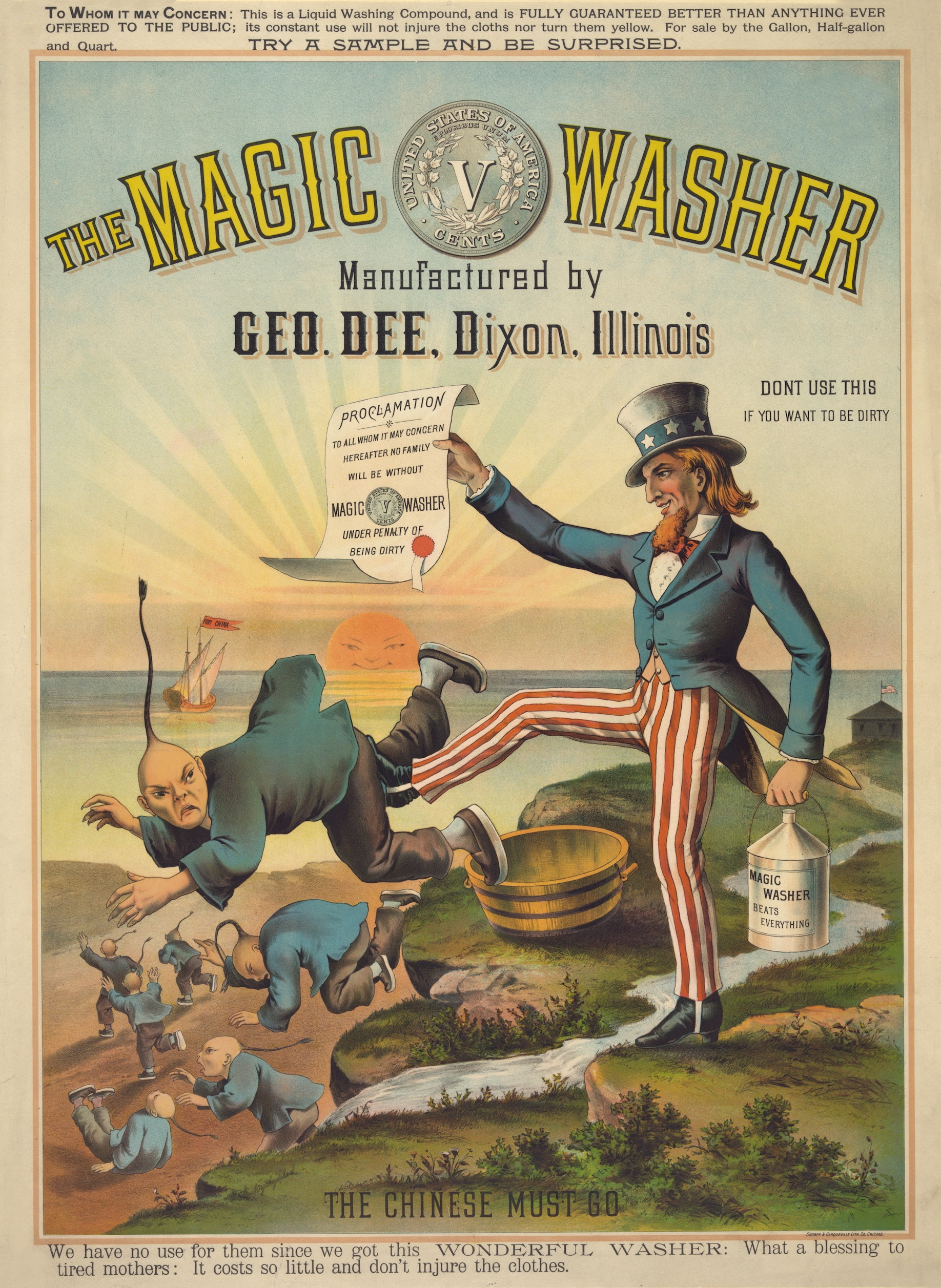
By the 1860s, not one to miss out, the Irish, German and Italian immigrants began cashing in on the John Chinaman act such as the classic 1860s minstrel character 'Ching Chong'. Ching Chong was a warning to Asian men not to attempt to marry whites, who like Ching Chong's debauched lover, would run away, as the Chinese did from California on the Transcontinental Railroad in 1869, much as the Great Migration from the South did. By 1870 though, Sinophobia became overwhelming amongst Statesian WASPs, as Chinese people tried to survive living in a genocidal hellhole. This migratory tension was seen in American vaudeville yellowface 'Chinese' acts, which portrayed 'Heathen Chinese' stereotypes, saw the rise of the Gong to signal 'Asian-ness' and set the proverbial Sinophobia dry grass pile alight, seeing the Chinese Exclusion Act (1882) come to pass, the first American legislation to ban POC from entering North America.[2]

Chinese Must Go Advert (1886, PD) George Dee Magic Washing Machine Company

Yellow Peril

After the Exclusion Act and drawing up of laws like the Racial Covenant Clauses later on, Chinese-Americans began to form China Towns, which had Chinese Theatres. These were established by the 1890s, a time when Statesian imperialism, Jingoism and Sinophobia flourished with the acquistion of the Philippines, Hawaii, Guam and many other territorial acquisitions and protected territiories.[2] This saw a rise in hatred of all Asians, and saw a diversification to the hatred of all Asians, in an equal opportunity discrimination age were Indians, Chinese, Japanese, Filipino etc were now all 'Asiatics' who needed Americans guiding hand towards the light of civilisation, especially Tagalog. The Japanese however were particularly 'barbaric savages' and feared through what became known as the Yellow Peril, because of their victories in 1895 in the Sino-Japanese war. Yellow Peril belied a mysterious Oriental plot to overthrow white supremacy in the US and Europe, with MiSCEgEnAtIoN (or a 'pollution of the caucasian race').[2] These numbers grow and dipped by the 20th century, as more Gentlemans Agreements (1907) and 'Immigration Acts' (1917, 1924) were passed, limiting specifically East Asian emigrants to the US. This lead to the American concentration camps of WWII, redlining, etc and gasp, Sessue Hayakawa (1886-1973) who was an early cinema international heartthrob.[6] 

The realities of the 1890s colonisation of Eastern Asia (c.1899, PD) Stewart
A Chinese political map, the bear is Russia, the dog is Britain, the frog France and the Eagle the US
Japan sits poking Korea I think

Export Kimono

Kimono came into this messy picture by the 1870s globally. Whilst European families were accustomed to 'Nightgownes' since the early 17th century, these only reached Statesian shores as Export Gowns with the growth of Japan Inc. in the late 19th century, and were increasingly bought by those wild enough to travel to Japan who bought many Kimono back with them as bric-a-brac souvenirs. Worn at first by the Rothschilds in the 1870s and 1880's, later the Vanderbilts in following the fashions of the French stage actresses. Kimono after Loti's seminal Madame Chrysantheme (1887) represented a prostitutes attire born from the classic Lotus Blossom trope, and were often longinguistically associated with 'Geisha' from the operatic classic of Puccinis opera after Long's 1898 original, and the news of diva actresses like Sarah Bernhardt who would be found swaraying around backstage and through the Hollywood gossip columns. These Longingly became staples of middle class Boudoir attire by the early 20th century in imitation of the 'European fashions' becoming fashionable lingerie attire for white Americans, and shameful unmodern attire for Japanese-Americans.

Madame Butterfly (1907, PD) University of Washington, Francis MacLennan, Elza Szamosy

Appropriation for America

Yellowface is not specifically seen in the Red Kimono as far as I can tell; I don't deal in this everyday; however it was certainly a widely accepted idea that the Japanese and Chinese were to be considered an 'other' type of people than 'Americans'. Performers like William 'Chung Ling Soo' Robinson (1861-1918) normalised these expectations on the stage to make fun of their East Asian counterparts (see the talented Ching Ling Foo | 1854-1922 ) by stealing their identities, cultural items, jobs and even performances to do so.[7] Picking up another cultural item and associating it with 'sin', the Red Kimono as produced by women (Dorothy Davenport | 1895-1977), as was common in the early days of American cinema clearly sat well with all involved at the time with the production. The protagonist of the film is played by Priscilla Bonner (1899-1996), who symbolized white American women who had 'fallen into prostitution'. Wealthier white women would in turn lift them from their circumstances, a popular trope of late Victorian/Early Edwardian period literature and film in a bid to 'alleviate the suffering of the' poors. 

Bonner had previously been cast and agreed to work in Shadows, a another silent yellowface production, three years before (in 1922) Red Kimono was shot, which was a continuation of white fears born from the subjugation of the 'yellow races' of Eastern Asia by the United States beginning in 1898 when the USA bought the Phillipines from Spain. 'American interests' in the area had allowed the colonisation of Korea, subjugation of China and colonisation of certain Pacific Islands between 1880-1920, which gave whites a false sense of superiority over the 'Mongol' species as American pseudo-race-science and Eugenics then claimed Asian peoples were descended from something other what white people were descended from. 

Lon Chaney in Yellowface on set (1922, PD) Orange County Archives

WASPs were also, as against African-Americans, terrified that Asian peoples would do the same thing to themselves as the WASPS had done to POC groups, leading to cultural appropriation of objects like the Kimono as a self-serving way to show racial superiority of whites over the 'Asiatics'. This culminated in the Kimonope, a clothing version of yellowface, to make white women feel safer in their place at the top of the racial hierarchy they and white men had created for themselves. These roles using yellowface against East Asian women were mostly established by the 1890s, when the Yellow Peril and Chinese Exclusion Act brought the issues into mainstream Statesian society. It was this and the hit classical opera Madame Butterfly (published 1898, in theatres by 1904) which established the Lotus Blossom stereotype, predating the need for the 1934 Dragon Lady stereotype.[7]

The Red Kimona

The Red Kimono in fact refers to the scarlet woman (sex worker/prostitute) trope, and appears in the film after the film's 'protagonist' sees her mirror image shift into a Red 'Kimono', indicating a change in future status. The protagonist indeed becomes a 'histrionic' Jane as netizens put it, who serves her pimp after this.[8] The protagonist upon finding her cheating husband and being brushed off; her taste is that good apparently; shoots him in the shop where he is buying the next 'wife's' ring from protagonists stolen money and promptly gets a straight to jail card with plenty of histrionics.[8]

During the trial of her shooting her pimp, the Kimono is dropped on the floor indicating that she is leaving her 'prostitution' days behind her. In this way, the Kimono in this film is depicted as an Orientalist-adjacent object (see Said 2003), which perpetuates pre-existing stereotypes that people who wear this particular garment are the archetypical 'geisha', 'prostitutes' or 'scarlet women'. The Kimono in the American canon though is most often a Kimonope in disguise as legitimate Wafuku, in this case being a form of boudoir lingerie, transformed as such by the fact that a white woman has worn this garment which the audience or 'Us' is meant to understand as a non-racialist body. Worn on any other POC woman, particularly in Silent Hollywood, this would more likely make her a 'Jade', sex worker or 'Geisha' stereotype. 

Conclusion

In context therefore we see how from the 1830s-1920s, East Asian women were created into the exotic other, in order to push racist white supremacist narratives of 'racial and civil superiority'. Beginning with Afong Moy, East Asian culture was denigrated as worthy of only being an exotic good to be sold by white men. This progressed into the first American theatre tradition, minstrelsy, which on the basis of blakface created by the 1850s internationally known yellowface impressions. This progressed to the 1890s into the Yellow Peril, Lotus Blossom stereotype and the denigration of Chinese/Japanese/Korean-Americans. The Kimono originally an artistic export item worn by the wealthy, eventually with the appearance of the Madame Butterfly opera was adopted into the American theatrical Kimonope and combined with the anti-Asian milieu to create acceptable cultural paradigms in which productions like The Red Kimono were born. Therefore, the Kimonope in American cinema, certainly of the early 20th century is a racist construction of Japanese women as the 'Asiatic' other.

Bibliography

[1] https://en.wikipedia.org/wiki/Blackface

[2] Yellowface: Creating the Chinese in American Popular Music and Performance, Krystyn R. Moon, 2005, pp.6-74

[3] Travels in Tartary, Thibet and China, Evariste Regis Huc, 1854[1928], pp.xxx-xxxi | Available at https://archive.org/details/b3135953x_0001

[4] Empire of Culture: US Entertainers and the Making of the Pacific Circuit; 1850-1890, Matthew Wittman, 2010, pp.62-69

[5] Put's Original California Songster, John A Stone, 1868, p.62 | Available at https://archive.org/details/putsoriginalcali00ston/page/n63/mode/1up

[6] See Essay #4

[7] See Essay #18

[8] https://www.imdb.com/title/tt0016276/reviews?ref_=tt_urv

The production in full: https://www.youtube.com/watch?v=_2dBX2S3_LU

Essay Abstracts 

#1 Renee Vivien (1877 - 1909) --- Born Pauline Tarn, was an English lesbian poet. She wrote in French and perhaps English. She took up the style of the Symbolists and Parnassinism and was well known during the era of the Belle Epoque (the Beautiful Age) for producing Sapphic verse and living as an open quasi butch lesbian poet; her verse derived from the ancient poet Sapphos, also famed for her love of women.

# 2 Birth of the Kimonope --- Here I shall introduce the notion of the Kimonope, that is as a garment attached to the social construct of the 'Geisha' in North America. Kimonopes being Orientalized clothing, or 'negatively affiliated or exoticized ethnic dress' which lead to the perceived notion of the Kimono and Geiko as simultaneously both high and low culture to American culture makers, such as film, television, media, writers and some academics. An example of Kimonope are the tacky Halloween costumes you may find at the Dollar store.

#3 The Legacy of the MacArthur Dynasty on KTC & The Problem with the 'Traditional Garment' Argument --- The problem with arguing that the Kimono is a 'Traditional ethnic Garment' is that that assertion is in itself, arguably  Ethnocentrism, which to clarify is the imposition of, in this case, American values onto Japanese cultural values, belaying the 3 pronged pitchfork of idiocy. 

#4 Divine --- Government name Harris Glenn Milstead (1945-1988) was the infamous North American Queen & Drag artist. Specifically, Divine was known for being a character actor, part of her act is well-known for its eccentricity. My personal exposure to Drag lite was Pantomine Grand Dames as a kid, and later when my friends made me watch RuPaul in art classes, so to me this is nothing new, the over the top, the glitter, the upstaging is all part and parcel.

#5 Dori-Style or 21st century Kimono Fashion --- The Dori-Kimono style. Something which I just made up because in going over notes for the first 20 years of 21st century section of Kimono history, I noticed a lack of a clear catchall term for what was happening in Japan at the time, at least in English descriptions of the time. I use the term Dori as I do not want to coin an unrelated term to the topic, but I also am reticent to claim all of Street style as 'Tori' either, whilst a large number of streets upon which the subculture originates in all use the suffix 'dori' (the bottom of Takeshita-dori for example), thence Dori-style.

#6  The Tea Gown --- This essay will cover the aspects of how 19th century Japanese import textiles to Western countries were used and repurposed, as well what their desirability tells us about how Japanese design was regarded and the image which these people held of Japan through the Western lense and consciousness. This follows the progression of how Kimono can be used in the West from the undress of the 1860s, adapting silk bolts in the 1870s to high fashion western daywear, to the 1880s aesthetic movement and 1890 wholesale adoption in the Victorian age to being used prominently by society hostesses as tea gowns by the Edwardian period, and the subsequent change in Japanese export culture which we see in extant textile collections of Japanese textile in Western dresses of the periods.

#7 Kimono and the Pre-Raphaelite Painters --- This essay will cover the aspects of Kimono in the Portraiture of the Pre-Raphaelites. The Pre-Raphaelites were a group of British artists and writers active during the late Victorian period. Unlike the Royal Academy artists, this circle of painters operated outside of the established comfortable boundaries of the expected white, cisgender middle class audience of the Victorian age. The movement is notable for its inclusion and encouragement of women, and in portraying and engaging non-conventional beauty and beauties as figures from the Classical World alongside Religious, Mythological and Folklore Heroines into Victorian 'Femme Fatales'.

#8 Jokyo/Genroku Kimono Textile Culture and the new role of the Komin ---  This essay will return back to GKTC (Genroku Kimono Textile Culture ; 1688-1704) and JoKTC (Jokyo K.T.C. 1684-1688) and the new role of the Komin (Artist caste) in GKTC. JoKTC is notable for being the lead up to GKTC, JoKTC being characterised by its transitory nature in comparison to GKTC, which was far more bold in its relations to what Kosode could and should be. Komin entered the picture at this juncture, and I shall elaborate a little more here than in other posts about why that was. GKTC is notable for its elaborate, perhaps gaudy and innovative Kosode design features, whilst JoKTC more so for the enabling factors of the time, as a sort of incubatory GKTC.

#9 Tagasode Byobu - This essay will explore the art motif known in Japanese art as Tagasode Byobu ( Whose sleeves Screen) This motif is a recurring art form which was particularly popular during the Azuchi-Momoyama era ( 1568-1600 ) as a representation of the ways in which Buddhist sensibilities met with the fast changing events of the end of the Sengoku Jidai (1467-1615) and as an extension of the habit of wealthy women from military families came to own and store a large number of Kimono. Prior to this, Kin Byobu ( Golden Screens) for the most part depicted nature like Sesshuu Touyou (1420-1506) after Chinese Cha'an painter Muxi ( c.1210-1269 ) or 'flower-and-bird' scenes like those of Kano Eitoku (1543-1590), rather than humans or human paraphernalia as an extension of the Zen painting school of thought about materialism.

#10 Cultural Acculturation --- The topic of our essay is on the nature of Cultural Exchange in KTC which will be an ongoing mini-series throughout 2022. This covers the 1000CE - 1500 period in Japanese History.

#11 Cultural Appropriation --- The topic of our essay is on the nature of Cultural Appropriation which will be an ongoing mini-series throughout 2022. 

#12 Cultural Acculturation --- The topic of our essay is on the nature of Cultural Acculturation which will be an ongoing mini-series throughout 2022. This covers the Asuka (Hakuho), Nara (Tempyo), and Heian periods (500CE-1000CE) in Japanese History.

#13 Asai Ryoi --- This essay will explore the legacy of Asai Ryoi on KTC. Who was Asai Ryoi you may ask? Only one of the most important writers for the Ukiyo genre. Asai Ryoi ( act. 1661-1691 ) was a prolific Ukiyo-zoshi ( Books of the floating world )  or Kana-zoshi  ( Heimin Japanese Books ) writer. His leading 1661 publication, lambasted and satirized Buddhism and Samurai culture of restraint in favour of the Chonin lifestyle of worldy excess.

#14 Edith Craig --- This is a post regarding the early adoption and promulgation of the Kimono and Japanese aesthetics in the life of the wonderful Edith Craig (1869-1947), daughter of the famous actress Ellen Terry (1847-1928) and Edward William Godwin (1833-1886). Edith was also known as 'Edy'.

#15 European Banyans --- This essay will explore the European garment known as a Banyan, which originated as a European reaction to Kimono in the 17th century, popular until the end of the 18th century. The word Banyan originates from Arabic ( Banyaan), Portuguese (Banian), Tamil ( Vaaniyan ) and Gujarati ( Vaaniyo ) loanwords meaning 'Merchant'. Alternative versions saw the item fitted with buttons and ribbons to attach the two front sides together. The Banyan was worn by all genders and was particularly regarded in its first iterations as a gentlemanly or intellectual garment worn with a cap to cover the lack of a periwig, and later adopted by women and greatly influenced how British womens garments were designed with preference for comfort in removal of panniers whilst maintaining luxurious, modest 18th century fashions (see Robe a la Anglaise).

#16 Miss Universe and Kimonope --- This essay will explore how Beauty Pageants, principally Miss Universe, has engaged with KTC. While there may be real Kimono worn by Japanese and Japanese adjacent contestants in the 'National Costume' category, I will be focusing on the Kimonope worn by contestants. The idea of Kimono as a 'national costume' sparks interesting conversations on what 'national costumes' are, their target audiences, and how we form ideas about these things to begin with.

#17 Onna-E --- Womens pictures refers to the Nara, Heian and early Kamakura ( 710-1333CE ) practice of drawing women in elongated Hand scrolls, which today are regarded as feminine gender coded Art. Some of these narratives depict the lives of women, their extra diaries, or the literature they wrote. The Onna-E style derives from how mostly Heian women represented themselves and others as a performed self in these scrolls, drawing from their lives indoors at their and the imperial abodes. Whilst a limited number of women could read Kanji, they also used their knowledge of Chinese culture to create and inspire their own culture; the first truly Wamono aesthetics; and it was with these preconditions that Onna-E became established in the Japanese art scene alongside Yamato-E and Oshi-E.

#18 A Jamaican, a Monster and Portuguese bar in the Orient --- This essay looks at the Kimonope attire adopted by North American Dancehall artists Shenseea (Chinsea Linda Lee | 1996 - present ) for the video to 'ShenYeng Anthem'. Whilst the aesthetic derives mostly from East Asian, principally Chinese aesthetics, the language used is specifically Japanese, referring to Chinsea Linda Lee as 'ShenYeng Boss', a perpetuation of the Dragon Lady stereotype. The essay mostly charts how this ridiculous Kimonope derides from the North American Anti-Chinese movement and how this intersects with contemporary Orientalism.

#19 The Red Kimonope --- The Red Kimono is a terribly named racist US silent film from 1925. The Longingist film includes a key scene which the production gets its name from where the protagonist drops her Kimonope, meant to symbolize that she had turned away from sin and prostitution, or in other words equating a wearer of the Kimono as a sex worker which stemmed from another American 'tradition'. This dreadful melodrama features the previously yellowface-accepter Priscilla Bonner as the lead protagonist. Throughout her trials and tribulations, she faces many ups and downs, like becoming a white version of the Lotus Blossom stereotype, because WASPs. I will explore the origins of the Lotus concept and the 'Jade' in more detail here as to provide the contextual background of the productions symbolism.

Social Links

One stop Link shop: https://linktr.ee/Kaguyaschest

https://www.etsy.com/uk/shop/KaguyasChest?ref=seller-platform-mcnav 

https://www.instagram.com/kaguyaschest/ 

https://www.youtube.com/channel/UC5APstTPbC9IExwar3ViTZw 

https://www.pinterest.co.uk/LuckyMangaka/hrh-kit-of-the-suke/ 

Akira Toriyama | Artyfarty

Akira Toriyama (  鳥山明 | 1955 - 2024  ) was a Japanese manga artist and character designer. Akira Toriyama was born in the town of Kiyosu, Ai...